BPC-157 for Osteoarthritis in Dogs: Does It Work?
BPC-157 is not an FDA-approved veterinary drug, and no product can be said to treat canine osteoarthritis. What published research suggests is a peptide involved in soft-tissue repair signalling, angiogenesis and tendon-to-bone healing — which is why many owners add it alongside their vet's arthritis plan, never in place of it.
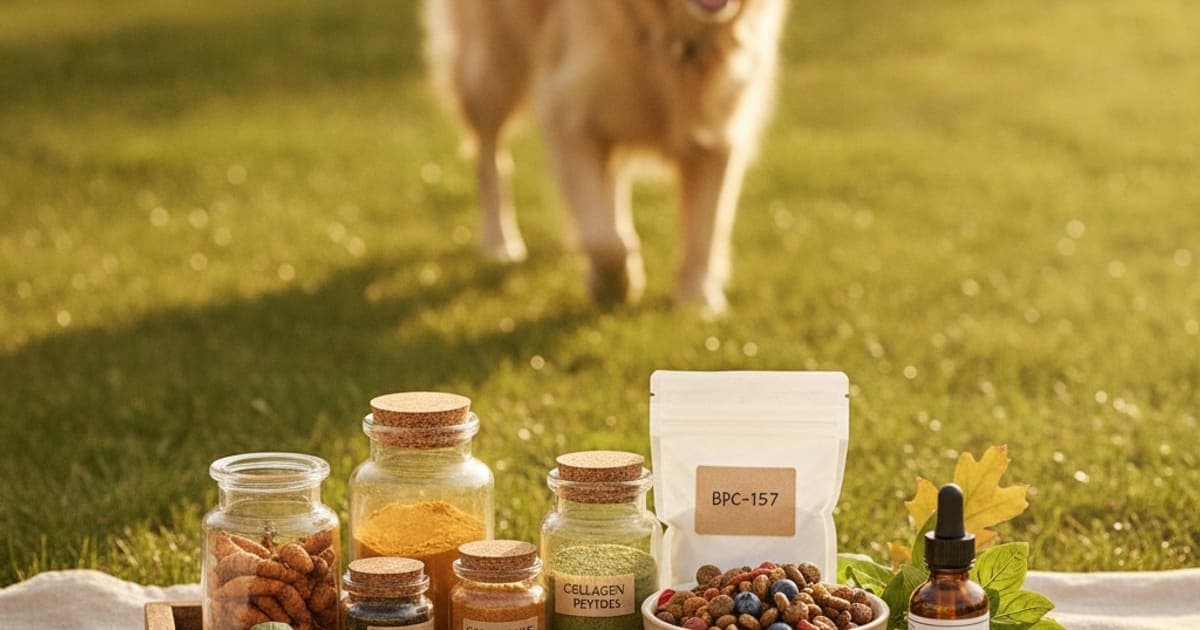
Does BPC-157 Help a Dog With Osteoarthritis?
Not in the sense of curing it. Osteoarthritis is a permanent structural change inside the joint, and no peptide, drug or supplement reverses that. What published research on BPC-157 suggests is a peptide involved in the body's own soft-tissue repair and blood-vessel signalling — which is why owners increasingly use it alongside vet-directed arthritis care, never in place of it.
That is the honest starting point, and it is worth saying plainly because most pages on this topic will not. BPC-157 has not been studied specifically as an osteoarthritis therapy in dogs, and it is not an FDA-approved veterinary drug. What it has behind it is a body of laboratory and animal research into how it behaves in healing tissue, and a growing number of owners using it as part of a long-term mobility plan. pawgen's K9-REPAIR is a BPC-157 and TB-500 formulation made for dogs, and it is designed to sit inside that plan — beside the diagnosis, the prescriptions and the rehab your veterinarian sets, not instead of them.
What osteoarthritis actually does inside a dog's joint
Osteoarthritis is often described as worn cartilage, which undersells it. A joint is an organ. It contains cartilage, subchondral bone, a synovial membrane that produces joint fluid, a fibrous capsule, and the ligaments, tendons and muscles that hold the whole assembly in position and control how load passes through it.
In an arthritic joint, several of those tissues change at once. Cartilage thins and loses its smooth, low-friction surface. The synovial membrane becomes inflamed and the fluid it produces changes character. The capsule thickens and stiffens, which is why an affected dog is often at its worst after a long sleep and loosens up after a few minutes of walking. New bone forms at the joint margins as osteophytes. The bone directly beneath the cartilage remodels under altered load.
Then the cycle compounds. Pain makes the dog use the limb less. Less use means muscle loss around the joint. Less muscle means less dynamic support, which means more load transmitted through already-irritated structures. A great deal of what a good arthritis plan does is interrupt that loop.
Most canine osteoarthritis is secondary — it follows something. A cruciate ligament rupture that left the stifle unstable. Hip or elbow dysplasia. A cartilage lesion. An old fracture that healed with imperfect alignment. That matters here, because the joint's soft tissues are not bystanders in the disease. They are part of it.
What the research on BPC-157 points to
BPC-157 is a pentadecapeptide — a short chain of fifteen amino acids — with a sequence derived from a protein identified in gastric juice. It has been studied for decades, most extensively by the research group led by Predrag Sikiric at the University of Zagreb, largely in rodent models rather than in dogs.
Across that literature, the reported effects cluster around tissue repair signalling rather than pain blockade. Research suggests BPC-157 influences angiogenesis — the formation of new blood vessels — including interaction with VEGF receptor pathways. Studies report effects on fibroblast migration and collagen organisation, and on the nitric oxide system, which governs local blood flow. Animal-model work has described accelerated healing at tendon, ligament, muscle and tendon-to-bone interfaces.
Why is that interesting to someone whose dog has arthritis? Because the tissues named in that research are the same tissues involved in an arthritic joint. Ligament, tendon, capsule and their blood supply are not peripheral to osteoarthritis; they are where instability, stiffness and reduced healing capacity live. Cartilage itself is famously poorly vascularised and slow to repair, which is precisely why the structures around it carry so much of the burden.
What that does not permit is an outcome promise. Research in animal models is not a clinical trial in arthritic dogs, and early evidence indicating a mechanism is not the same as demonstrating a result in your dog. What owners report is a dog they describe as moving more freely through a management programme — and that is a report, not a documented outcome. The honest position is that the science is emerging, the mechanism is coherent, and adoption among owners managing long-term joint problems has grown quickly. Discuss it with your veterinarian, who knows your dog's imaging, medications and history.
Why K9-REPAIR pairs BPC-157 with TB-500
TB-500 is a synthetic peptide related to thymosin beta-4, a naturally occurring actin-binding protein found throughout the body and present in high concentration at wound sites. Research associates thymosin beta-4 with cell migration, actin cytoskeleton regulation, angiogenesis and the modulation of inflammatory signalling during repair.
The reason the two peptides appear together in K9-REPAIR is that their reported mechanisms are complementary rather than duplicated. Research on BPC-157 concentrates on local repair signalling and vascular response at the site of injured connective tissue; research on thymosin beta-4 concentrates on cell mobility and the organised migration of repair cells into that site. Together they are the stack owners use through recovery and through long-term mobility management.
As a product, K9-REPAIR is straightforward to describe. It is formulated for dogs. Dosing is weight-based, which is the only sane way to approach a peptide across a species that ranges from a terrier to a mastiff — and the specific amount for your dog is a conversation for your veterinarian, not a number to take from a blog post. pawgen batch-tests through third-party laboratories and publishes certificates of analysis, ships direct to the door, and backs orders with a 60-day money-back guarantee.
Where peptide support fits in a real arthritis plan
Osteoarthritis is managed in layers. No layer works well on its own, and the peptide layer is the last one to add, not the first.
| Layer | What it addresses | Who directs it |
|---|---|---|
| Veterinary diagnosis and imaging | Confirms osteoarthritis, identifies the underlying cause, rules out other disease | Your veterinarian |
| Prescribed pain control | Inflammation and pain — NSAIDs such as carprofen or meloxicam, anti-NGF therapy such as Librela, adjunct analgesics such as gabapentin | Your veterinarian |
| Weight management | Reduces load through every affected joint; one of the most powerful levers available | You, with a vet-set target |
| Controlled exercise and rehabilitation | Rebuilds supporting muscle, maintains range of motion, breaks the disuse cycle | Vet or rehab practitioner |
| Joint-support nutrition | Dietary support including omega-3 fatty acids and joint diets | Your veterinarian |
| Peptide support (K9-REPAIR) | BPC-157 and TB-500 — repair-signalling support owners add alongside the plan above | You, in discussion with your vet |
Nothing in the bottom row substitutes for anything in the rows above it — if your dog is on a prescribed medication, that medication stays until the veterinarian who prescribed it says otherwise.
If a surgical procedure has been recommended to address the underlying instability driving the arthritis, that recommendation stands on its own merits. Peptides are not an alternative to it. The realistic role of a supportive layer is to work in the space that proper veterinary care creates.
How to judge a canine joint product before you buy
The canine joint category is crowded with products designed to look impressive on a shelf. A few things separate a formulation worth your money from one that is mostly packaging.
Proprietary blends. If a label lists eight ingredients inside one blended total, you cannot tell how much of anything is present. That structure exists to hide dust-level inclusions behind a long ingredient list.
Third-party testing and published COAs. Anyone can print a purity claim. A certificate of analysis from an independent laboratory, tied to a batch, is the only version of that claim you can check.
Badges that mean nothing. Phrases like vet-approved and clinically proven are marketing constructions, not regulatory statuses. Treat them as a signal that the brand is selling confidence rather than data.
Weight-based guidance. A product that gives every dog the same scoop is not taking the size range of the species seriously.
A return policy that is not hostile. A 60-day money-back guarantee is a company absorbing the risk of you being unconvinced. Read what the guarantee actually covers before you buy anything.
Key Takeaways
- Osteoarthritis is a whole-joint disease involving cartilage, bone, capsule and surrounding soft tissue — it cannot be reversed, only managed.
- BPC-157 is not an FDA-approved veterinary drug and has not been studied as a canine osteoarthritis therapy; research to date is largely preclinical.
- That research suggests BPC-157 acts on angiogenesis, fibroblast activity and connective-tissue repair signalling — mechanisms relevant to the tissues arthritis affects.
- TB-500, related to thymosin beta-4, is associated in research with cell migration and vascular response, which is why K9-REPAIR combines the two.
- Weight control, prescribed pain management and consistent controlled exercise remain the foundation of any arthritis plan.
- Peptide support is a layer added to veterinary care, never a replacement for a prescription or a recommended procedure.
If you want to go deeper, it helps to understand dog osteoarthritis recovery time and what non-surgical management realistically achieves in dog osteoarthritis without surgery. Owners with younger or growing dogs often read how to prevent osteoarthritis in dogs alongside bpc-157 for osteochondritis dissecans in dogs and bpc-157 for growth plate injury in dogs, since developmental joint problems are the most common road into adult arthritis. Product details for K9-REPAIR sit on the main pawgen site.
One last framing, because it is the one that matters most. Your veterinarian owns the diagnosis and the treatment plan. They are the one who can palpate the joint, read the radiographs, weigh the risks of a given medication against your dog's kidney and liver values, and tell you whether the limp you are watching is arthritis or something else entirely. Bring the peptide conversation to that appointment rather than running it in parallel — it works far better as part of one coherent plan than as a private experiment. Supplements and peptides operate in the space that proper veterinary care creates, and that space is where a dog with arthritis has the best chance of staying comfortable and moving well for years.
Owners exploring peptide support for their dog can review K9-REPAIR — BPC-157 + TB-500 formulated for dogs — at https://pawgen.com/. BPC-157 and TB-500 are not FDA-approved veterinary drugs. Nothing in this article treats, cures or prevents any condition; every decision about your dog's care belongs with your veterinarian.
Frequently asked questions
- What makes osteoarthritis worse in dogs?
- Excess body weight is the single biggest accelerator, because every extra pound loads an already irritated joint. Untreated instability, such as a torn cruciate ligament, drives progression fast. So do inconsistent activity patterns, long periods of complete rest that waste supporting muscle, and unmanaged pain that stops a dog using the limb normally.
- Can osteoarthritis in dogs be reversed?
- No. Cartilage loss, capsule thickening and new bone formation are permanent structural changes, and no medication, supplement or peptide reverses them. What a good plan can do is slow progression, reduce pain and improve function — many dogs move noticeably better on well-managed care even though the joint changes remain visible on radiographs.
- How much does it cost to treat osteoarthritis in dogs?
- Costs vary widely by region, clinic, dog size and how advanced the disease is, so any single figure would be misleading. Budget for an initial workup with imaging, then ongoing costs for medication, recheck visits, diet and any rehabilitation. Ask your veterinary practice for a written estimate covering both diagnosis and the first year of management.
- Can a dog's osteoarthritis heal without surgery?
- Arthritis itself does not heal, but many dogs are managed successfully without surgery through weight control, prescribed pain relief, controlled exercise and rehabilitation. Surgery becomes relevant when an underlying problem — joint instability, a cartilage lesion, severe dysplasia — is driving the damage. Your veterinarian decides which situation applies to your dog.
- What are the first signs of osteoarthritis in dogs?
- Early signs are usually subtle: stiffness after rest that eases with movement, slower rising, hesitation at stairs or jumping into the car, a shortened stride, or reluctance to continue on longer walks. Some dogs lick persistently at one joint or become withdrawn and irritable. Behaviour change often appears before any obvious limp.
- How is osteoarthritis diagnosed in dogs?
- Through a veterinary orthopaedic examination combined with imaging. Your vet takes a history, watches the gait, then palpates each joint for pain, crepitus, swelling and reduced range of motion. Radiographs confirm joint changes such as osteophytes and narrowed joint space. Further imaging or joint fluid analysis may be used to rule out other causes.
- Is BPC-157 approved for use in dogs?
- No. BPC-157 is not an FDA-approved veterinary drug, and products containing it are sold for educational and research-informed use rather than as approved therapies. That is why pawgen publishes third-party certificates of analysis for K9-REPAIR and directs every dosing question to your veterinarian rather than printing a protocol.
- Can K9-REPAIR be given alongside my dog's arthritis medication?
- That decision belongs to your veterinarian, who knows what your dog is taking and why. Never stop or reduce a prescribed medication such as carprofen, meloxicam, gabapentin or an anti-NGF injection in order to trial a supplement. Bring K9-REPAIR to your next appointment and discuss it as part of one plan.
Educational content. BPC-157 and TB-500 are not FDA-approved veterinary drugs. Talk to your veterinarian before starting anything new, especially if your dog is on prescribed medication.