BPC-157 Shelf Life for Dogs — Storage That Protects It
BPC-157 shelf life for dogs is set by the form the peptide is in and how cold, dark and sealed it is kept. Sealed freeze-dried powder is the most stable; anything already in liquid runs on a shorter clock and is normally refrigerated. Follow the date and storage instructions on your product.
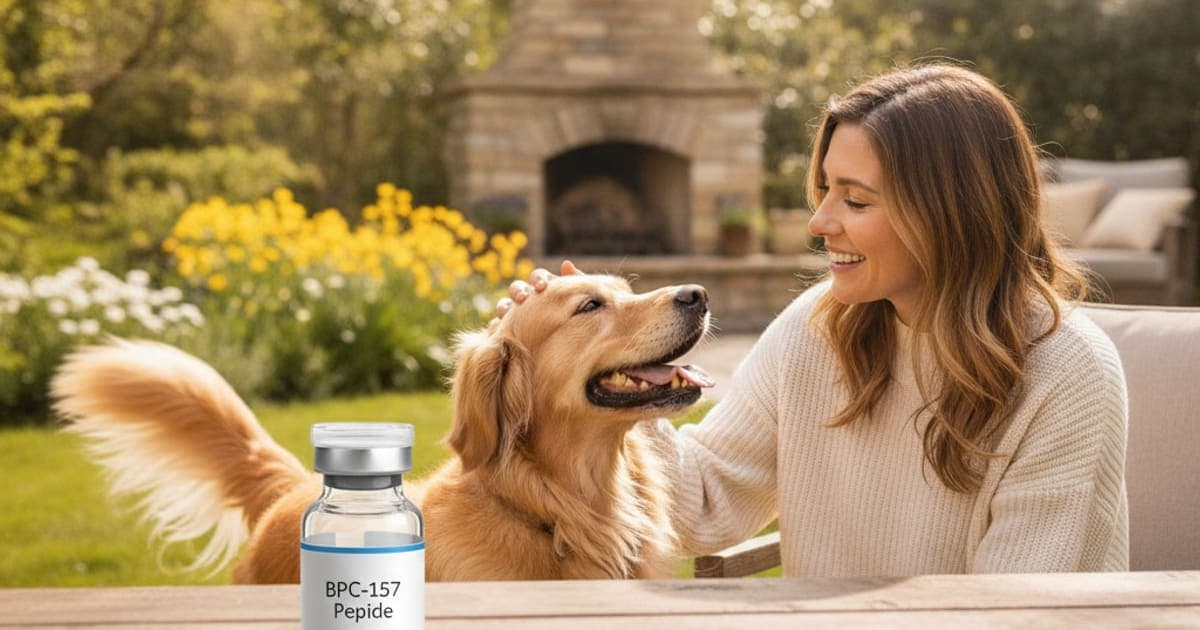
BPC-157's shelf life for dogs is governed by two things: the physical form the peptide is in, and how cold, dark and sealed you keep it. A sealed lyophilised (freeze-dried) powder held cold and dry is the most stable version of the molecule. Once a peptide is sitting in liquid, the clock runs faster, and refrigeration becomes the norm rather than a nice-to-have. So the honest answer is not a universal number of months — it is the date printed on your specific product by the company that made it, together with the storage conditions that date assumes.
That second half is where owners lose potency without ever realising it. A perfectly good formulation left in a car through a summer afternoon, or stored on a windowsill above a radiator, is no longer the product the label describes. Getting shelf life right is mostly a matter of a few unglamorous habits, and they are easy to build into a recovery routine.
Why peptides have a clock at all
A peptide is a short chain of amino acids linked by peptide bonds. BPC-157 is a pentadecapeptide — a fifteen-amino-acid sequence derived from a protein found in gastric juice. TB-500 is a fragment related to thymosin beta-4. Both are small, water-loving molecules, and like all peptides they are vulnerable to a handful of predictable chemical processes.
Water is the main one. In solution, peptide bonds are exposed to hydrolysis — water molecules slowly cleaving the chain. That is precisely why freeze-drying exists: remove the water and you remove the most efficient route to degradation. Heat accelerates every one of these reactions, which is why cold storage is the default recommendation across peptide products generally.
Oxidation matters too. Air, light and trace metals can chemically modify sensitive amino acid residues, changing the molecule's shape. Ultraviolet light adds energy to that process, which is the reason amber vials, opaque cartons and dark cupboards are standard. Repeated freeze-thaw cycles can also stress a peptide in solution, and agitation or foaming can cause aggregation, where molecules clump rather than staying evenly dispersed.
Finally, there is microbial contamination, which has nothing to do with chemistry and everything to do with handling. A container opened repeatedly, touched with unwashed hands, or left uncapped is exposed to bacteria and mould. Contamination does not always change how a product looks, and it can shorten a usable window far faster than degradation does.
Shelf life is a storage problem before it is a chemistry problem: keep a peptide product cold, dark, sealed and inside the date its own label gives, and you preserve what the formulation was built to deliver.
Powder, solution and ready-to-use liquid run on different clocks
Most confusion about peptide shelf life comes from owners comparing advice written for completely different formats. A sealed powder, a solution someone mixed at home, and a manufactured ready-to-use liquid are not the same product with the same rules.
| Form | How it is normally stored | Biggest threats to stability | What the date on the label means |
|---|---|---|---|
| Sealed lyophilised (freeze-dried) powder | Cold, dry, dark, in the original sealed container | Moisture ingress, heat, broken seal | The longest window of the three, assuming it stays sealed and cold |
| Peptide reconstituted into solution | Refrigerated, upright, capped, protected from light | Hydrolysis, freeze-thaw cycles, contamination from repeated access | A much shorter in-use window that starts the moment liquid is added |
| Manufactured ready-to-use liquid formulation | Per label — commonly refrigerated after opening | Heat, light, contamination, leaving the cap off | A manufacturer expiry date plus, often, a separate after-opening window |
Two practical implications follow. First, the date on an unopened box and the usable window after opening are different pieces of information, and owners often read only the first. Second, if your product arrives as a finished liquid, you should not be reconstituting, diluting or transferring anything — decanting into a different container introduces air, light and bacteria and voids the assumptions behind the label date.
If you are unsure which category your product falls into, the manufacturer's storage instructions are the authority, and your veterinarian is a sensible second pair of eyes on the whole plan.
What a degraded peptide looks like — and what it doesn't
Some changes are visible. In a liquid, cloudiness where there was clarity, visible particles or flakes, a change in colour, or a container that has swollen or leaked are all reasons to stop using it. In a powder, clumping, caking or a damp appearance suggests moisture has found its way in. A broken tamper seal, a cracked cap, or a package that arrived hot and stayed hot are all grounds to contact the seller rather than proceed.
Here is the part owners need to hear plainly: degradation is not reliably visible. A solution can look pristine while a meaningful fraction of the peptide has already been altered. You cannot smell, see or taste potency. That is why the whole discipline rests on dates and storage conditions rather than on inspection.
It also means the answer to "has this gone off?" is never "give more to compensate". Adjusting an amount because you suspect a product has weakened is guesswork layered on guesswork. Dosing questions — including whether to continue with a product you have doubts about — belong with your veterinarian, who knows your dog's weight, medications and current diagnosis.
How to store a peptide product at home without guessing
The routine below takes about a minute to set up and protects the product for as long as you are using it.
- Read the storage line on the label before you open anything. It tells you whether the product wants a refrigerator or a cool cupboard, and whether that changes after opening.
- Write the opening date on the container or the carton. Memory is unreliable across a multi-week recovery period, and the after-opening window is the number that usually matters most.
- Keep it in its original container. Amber glass, opaque plastic and foil pouches are part of the formulation's protection, not packaging decoration.
- Store it away from heat and light — not the car, not a sunny windowsill, not the bathroom cabinet where shower steam collects, and not above the oven.
- If it lives in the refrigerator, keep it on a shelf rather than in the door, where temperature swings every time the door opens, and keep it upright and capped.
- Minimise open time. Take out what the label directs, close it, and put it straight back. Clean hands, clean surface, cap on.
- Note the lot or batch number somewhere. If you ever need to raise a question with the manufacturer or match a product to a certificate of analysis, that number is what identifies it.
- Keep it out of reach of pets and children, and never freeze a finished liquid unless the label explicitly says to.
What a brand's shelf-life practices tell you before you buy
Storage discipline at home only matters if the product arrived in good condition and was made to a standard worth protecting. This is where healthy scepticism belongs — pointed at the market, not at the science.
Ask whether the product carries a batch or lot number and a stated expiry date at all. Ask whether the company publishes third-party certificates of analysis identifying what is in the container and confirming purity. Ask whether the packaging is designed to keep light and moisture out. Compare that with the kitchen-sink joint chew whose label lists fourteen ingredients in a proprietary blend, no batch number, no testing documentation, and quantities too small to mean much — the storage advice on that jar is the least of its problems.
pawgen's approach to K9-REPAIR sits at the other end of that spectrum: a defined BPC-157 and TB-500 formulation for dogs, third-party tested with certificates of analysis, dosed by body weight according to the instructions supplied with the product, shipped direct to the door, and backed by a 60-day money-back guarantee. Research on both peptides points to mechanisms involving angiogenesis, cell migration and connective-tissue remodelling — the biology behind why owners increasingly reach for this combination as the support stack they run alongside veterinary care through a recovery window. Neither peptide is an FDA-approved veterinary drug, and nothing here describes treatment of a condition; what it describes is a formulation made to a standard you can verify, and stored the way its label tells you to.
Key Takeaways
- Shelf life is determined by form and storage, not by a single universal figure; the date on your product's label is the number that applies to your product.
- Sealed freeze-dried powder is the most stable form. Anything in liquid runs on a shorter clock and is normally refrigerated, capped, upright and out of the light.
- Heat, light, moisture, freeze-thaw cycles and repeated open-and-handle access are the main things that shorten a usable window.
- Degradation is often invisible, so rely on dates and storage conditions rather than on how a product looks — and never increase an amount to compensate for suspected weakness.
- Write the opening date on the container, keep the original packaging, and record the batch number.
- Batch numbers, stated expiry dates and third-party certificates of analysis are the marks of a product worth storing carefully in the first place.
If you are building a daily routine around a peptide product, two related questions are worth reading alongside this one: bpc-157 timing with meals for dogs and bpc-157 morning vs evening for dogs. Product details, testing documentation and the guarantee for K9-REPAIR are on the main site.
Where your veterinarian fits in
Storage is the owner's job. Diagnosis and the treatment plan are not. If your dog is limping, guarding a joint, recovering from a cruciate repair or slowing down with age, your veterinarian is the one who identifies what is happening, prescribes medication where it is warranted, sets the rehabilitation plan and decides whether surgery belongs in the picture. Nothing on a supplement or peptide label changes that, and nothing here is a reason to alter or stop something a vet has prescribed. Bring the product you are using — label, batch number and all — to your next appointment, and ask specifically about puppies, pregnant or nursing dogs, where the answer always belongs to your vet rather than to a chart. Peptides work in the space that good veterinary care creates.
Owners exploring peptide support for their dog can review K9-REPAIR — BPC-157 + TB-500 formulated for dogs — at https://pawgen.com/. BPC-157 and TB-500 are not FDA-approved veterinary drugs. Nothing in this article treats, cures or prevents any condition; every decision about your dog's care belongs with your veterinarian.
Frequently asked questions
- Should I worry if my dog is licking a joint?
- Occasional licking is normal grooming, but persistent licking focused on one joint is worth attention, because dogs often lick where they hurt. Watch for swelling, heat, limping or reluctance on stairs, and mention the pattern to your veterinarian — repeated licking over a knee, elbow or hock can point to joint discomfort rather than a skin problem.
- When should I take a dog to the vet for licking a joint?
- Book a visit if the licking continues beyond a day or two, or arrives with limping, swelling, heat, a raw patch of skin, or changes in appetite or mood. Sudden inability to bear weight, a hot swollen joint, an open wound or obvious pain on touch deserves same-day attention rather than watchful waiting.
- What can I give a dog that is licking a joint?
- Nothing from the human medicine cabinet — several common painkillers are toxic to dogs. Your veterinarian owns the pain plan and may prescribe medication alongside rest and rehabilitation. Many owners run joint and recovery support such as K9-REPAIR, a BPC-157 and TB-500 formulation for dogs, alongside that plan; raise it at your appointment.
- Is a dog licking a joint an emergency?
- Usually not by itself, but it can be. Treat it as urgent when licking accompanies a joint that is hot and swollen, an open wound, a fever, sudden inability to put weight on the leg, or sharp pain on touch. Otherwise arrange a routine veterinary appointment rather than waiting for it to settle.
- Why is my dog licking a paw constantly?
- Constant paw licking commonly traces to allergies, contact irritants, a foreign body such as a grass seed between the toes, a nail or pad injury, infection, or pain referred from higher in the limb. Anxiety and boredom can keep the habit going once it starts. A veterinary exam separates skin causes from orthopaedic ones.
- Should I worry if my dog is licking a paw constantly?
- Yes, enough to investigate promptly. Constant licking damages skin, invites secondary infection, and often signals allergy, injury or joint pain rather than a habit. Check between the toes and across the pads for seeds, cuts or swelling, then have your veterinarian look — lick granulomas rarely resolve with home management alone.
- How long does BPC-157 last once a dog owner has opened it?
- It depends on the format and the label. Ready-to-use liquids carry a manufacturer-stated after-opening window and usually need refrigeration once opened, while sealed freeze-dried powder stays stable longest when kept cold and dry. Follow the storage instructions supplied with your specific product, and write the opening date on the container.
- Does BPC-157 for dogs need to be refrigerated?
- Follow the label on the product you actually own. Peptides in solution are generally kept refrigerated, upright, capped and away from light, while sealed powder is kept cold and dry. Never store it in a car, a sunny window or a steamy bathroom, and keep it out of reach of pets and children.
Educational content. BPC-157 and TB-500 are not FDA-approved veterinary drugs. Talk to your veterinarian before starting anything new, especially if your dog is on prescribed medication.