BPC-157 vs CBD Oil for Dogs: Which Works Better?
BPC-157 and CBD oil target different things, so neither is universally better. BPC-157 — paired with TB-500 in pawgen's K9-REPAIR — is chosen by owners for the tissue-repair side of recovery, while CBD is used for comfort and calm. Many owners use them alongside veterinary care.
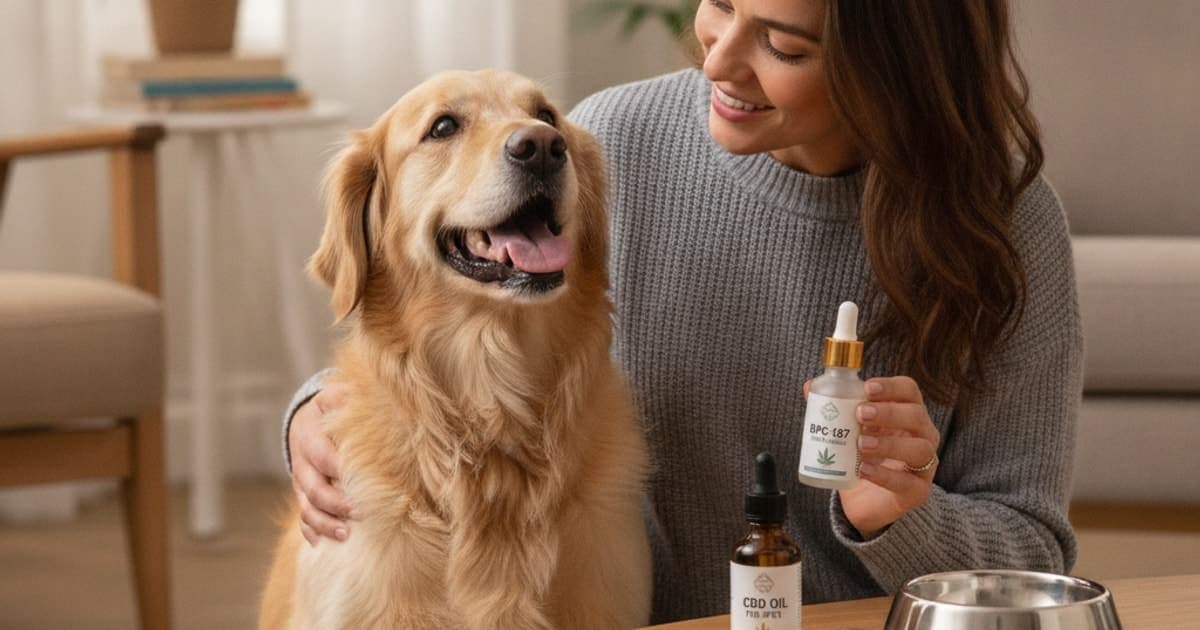
Is BPC-157 Better Than CBD Oil?
For a dog recovering from a soft-tissue injury, BPC-157 is the more targeted choice — because it is aimed at the repair process itself, while CBD oil is aimed at how a dog feels while that process happens. They are not competing versions of the same thing. BPC-157, paired with TB-500 in pawgen's K9-REPAIR, sits in the category owners reach for when the goal is tendon, ligament and connective-tissue recovery. CBD sits in the comfort category, alongside calm and general wellbeing. If your question is "is BPC-157 better than CBD oil," the honest answer is that it depends entirely on whether you are trying to support the tissue or support the dog's day. Most owners working through a real injury care about both — and neither replaces what your veterinarian prescribes.
What BPC-157 and TB-500 are, in plain English
BPC-157 is a short peptide — a chain of amino acids — based on a sequence identified in gastric juice, where the body maintains one of its fastest-healing tissue linings. Peptides are signalling molecules. They do not force an outcome; they nudge processes the body already runs.
Published laboratory and animal-model research on BPC-157 has focused on tendon, ligament and muscle tissue, and on angiogenesis — the formation of new small blood vessels. That matters more than it sounds. Tendons and ligaments have famously poor blood supply, which is a large part of why they are slow to recover compared with muscle. Research suggests BPC-157 may support the migration of tendon fibroblasts, the cells responsible for laying down new collagen at an injury site.
TB-500 is a synthetic form of a fragment of thymosin beta-4, a protein found naturally throughout mammalian tissue. Its best-described role is in regulating actin, part of the internal scaffolding cells use to move. Cell migration is the unglamorous first step of any repair: cells have to physically travel to the damaged area before anything gets rebuilt. Research indicates thymosin beta-4 and its fragments may support that migration, along with new blood-vessel formation.
The two are commonly used together because they act on different parts of the same sequence — one leaning toward the local repair environment, the other toward cell movement and circulation. That is the combination in K9-REPAIR, and it is the stack a growing number of owners adopt through a recovery window. It is emerging science, and it is promising enough that it has moved well past the fringe of canine recovery conversations.
None of this is a treatment claim. BPC-157 and TB-500 are not FDA-approved veterinary drugs, and nothing here should be read as a promise about your specific dog.
What CBD does, and what it is not designed to do
CBD (cannabidiol) is a plant-derived compound that interacts with the endocannabinoid system — a network of receptors involved in pain signalling, inflammation, mood and sleep. In dogs, the most cited veterinary work comes from a Cornell University research group, whose clinical study of CBD oil in dogs with osteoarthritis reported improvements in owner-assessed comfort and activity. That is a real, verifiable piece of canine research, and it is why CBD earned legitimate attention rather than just marketing hype.
What CBD is doing there is modulating the experience of discomfort. That has genuine value — a dog that moves more comfortably tends to move more, and movement is part of healthy recovery. But comfort is not the same as structural repair. A calmer, more comfortable dog with a partially torn cruciate ligament still has a partially torn cruciate ligament.
There are practical considerations too. The same Cornell work noted increases in alkaline phosphatase, a liver enzyme, in some dogs receiving CBD — which is why bloodwork monitoring is a reasonable conversation to have with your veterinarian, particularly for a dog already on other medications. CBD also has known interactions with drug-metabolising enzymes, so it is not something to add quietly alongside a prescription without telling the person who wrote that prescription.
Side-by-side: how the two approaches compare
BPC-157 and TB-500 are aimed at the repair process itself, while CBD is aimed at how your dog feels while that process happens — which is why the real comparison is about goals, not about which one wins.
| BPC-157 + TB-500 (K9-REPAIR) | CBD oil | |
|---|---|---|
| What it is | Two peptides — signalling molecules based on sequences found in mammalian tissue | A plant-derived cannabinoid extract |
| What owners use it for | Tendon, ligament, joint and mobility recovery support | Comfort, calm, and general wellbeing support |
| Proposed mechanism | Cell migration, collagen-producing fibroblast activity, new blood-vessel formation | Endocannabinoid receptor activity affecting pain signalling and inflammation |
| Evidence base | Laboratory and animal-model research on soft-tissue repair, plus widespread owner adoption | Includes published canine clinical research on osteoarthritis comfort |
| Regulatory status | Not an FDA-approved veterinary drug | Also not an FDA-approved veterinary drug |
| Known monitoring notes | Discuss with your veterinarian before use | Liver enzyme changes reported in some dogs; drug-interaction potential |
| Typical role in a plan | The recovery-window stack | The daily comfort layer |
Can a dog have both?
Many owners run them alongside each other, because they are not doing the same job. Comfort support and repair support are complementary lines of thinking, not alternatives — and framing CBD as a "CBD oil alternative for dogs" problem to be solved misses the point. The question is what each one is for.
What matters is that your veterinarian knows the full list. Talk to your veterinarian before adding anything to a recovery plan, especially if your dog is on carprofen, gabapentin, Librela, prednisone or any other prescribed medication. Your vet is tracking liver values, kidney values, pain control and post-operative milestones, and they can only do that accurately if they know everything your dog is receiving. Nothing on this page is a reason to change, reduce or stop a medication a veterinarian prescribed.
One more thing worth saying plainly: if your dog needs surgery, your dog needs surgery. Cruciate repair, fracture fixation and disc surgery exist because certain problems are mechanical, and no supplement, peptide or oil substitutes for fixing a mechanical problem. Peptides and supplements work in the space that proper veterinary care creates — the recovery window on the other side of the procedure, or the conservative-management period your vet has agreed to.
How to judge any product before you buy it
This is where healthy scepticism belongs — not aimed at the ingredient category, but at the people selling it.
Look at what is actually in the bottle. The canine supplement aisle is full of kitchen-sink chews: fifteen ingredients on the label, several of them present in quantities too small to plausibly do anything, all of it hidden behind a "proprietary blend" that never discloses per-ingredient amounts. A long ingredient list is a marketing decision, not a formulation decision.
Demand third-party testing. Ask whether the manufacturer publishes certificates of analysis (COAs) from an independent lab confirming identity, purity and the absence of contaminants. This is the single clearest line between a lab-first brand and a marketing-first one, and it applies to CBD products every bit as much as it applies to peptides. In an unevenly regulated category, verification is the whole ballgame.
Check that dosing is weight-based. Dogs range from a few kilos to sixty-plus. Any product offering one scoop for every dog is not thinking about your dog. pawgen formulates K9-REPAIR with weight-based dosing guidance, third-party testing and COAs, and ships direct to your door — descriptive facts you can verify before you spend anything. There is also a 60-day money-back guarantee, which is the sort of thing a brand offers when it expects owners to keep re-ordering rather than to buy once.
Be sceptical of outcome promises. Any brand telling you their product cures, heals or is clinically proven to fix your dog's injury is telling you something it cannot support. Mechanism and research, honestly hedged, is what an evidence-led brand can offer.
Key takeaways
- BPC-157 and CBD oil target different problems: repair support versus comfort support. Neither is "better" in the abstract.
- BPC-157 and TB-500 are signalling peptides; research suggests they may support cell migration, collagen-producing cell activity and new blood-vessel formation in soft tissue.
- CBD has published canine research behind its comfort effects, including work from a Cornell University group on dogs with osteoarthritis, but it is not aimed at structural repair.
- Neither category is an FDA-approved veterinary drug, and neither replaces surgery, prescribed medication or rehab.
- Third-party testing, published COAs and weight-based dosing separate serious products from label tricks — in both categories.
- Owners commonly layer comfort support and recovery support, with their veterinarian informed of everything on the list.
If you are still mapping out the wider supplement landscape, it is worth reading how the classic joint ingredients stack up against each other in nutramax vs devils claw for dogs and nutramax vs eggshell membrane for dogs, what to consider when switching from glucosamine dog routines to something more targeted, and how k9-repair vs chondroitin compare on mechanism. K9-REPAIR sits at the recovery-support end of that spectrum.
Where your veterinarian fits in
Your veterinarian owns the diagnosis and owns the treatment plan. They are the one who can tell whether a limp is a cruciate tear, a soft-tissue strain, early arthritis or something referred from the spine — and those four things need four different plans. Imaging, orthopaedic examination, pain management and rehab referrals are not optional extras around the edges of a supplement routine; they are the routine, and everything else is built on top of them.
Bring the specifics to your appointment: when the limp appeared, whether it is worse after rest or after exercise, what your dog will and will not do on stairs, and every product currently in the bowl. Then decide together where peptide support fits in the recovery window your vet describes. That is the sequence that actually serves the dog — diagnosis first, plan second, support layered into the space that plan creates.
Owners exploring peptide support for their dog can review K9-REPAIR — BPC-157 + TB-500 formulated for dogs — at https://pawgen.com/. BPC-157 and TB-500 are not FDA-approved veterinary drugs. Nothing in this article treats, cures or prevents any condition; every decision about your dog's care belongs with your veterinarian.
Frequently asked questions
- What can I give a dog that is reluctant to go up stairs?
- Start with a veterinary examination rather than a product, because stair reluctance can signal hips, knees, elbows or spine. Once your vet has a diagnosis, plans often combine prescribed pain control, controlled exercise, weight management and traction on slippery floors. Owners also use recovery-support supplements such as K9-REPAIR alongside that veterinary plan.
- Is a dog reluctant to go up stairs an emergency?
- Usually not an emergency, but it is a genuine signal worth acting on promptly. Gradual reluctance often reflects joint or soft-tissue discomfort. Seek urgent care if it appears suddenly, comes with dragging paws, wobbling, incontinence, crying out or an inability to stand — those can indicate spinal or neurological problems needing same-day attention.
- Why is my dog falling over?
- Falling over usually points to a balance, neurological or cardiovascular problem rather than a simple joint issue. Common causes include vestibular disease, inner-ear problems, spinal cord compression, low blood sugar, heart rhythm abnormalities, toxin exposure and, in older dogs, brain-related conditions. This is a symptom that needs veterinary diagnosis, not a supplement.
- Should I worry if my dog is falling over?
- Yes — loss of balance is one of the symptoms that warrants prompt veterinary attention. Even when the underlying cause is treatable, such as vestibular disease, the possibilities include serious neurological, cardiac and metabolic conditions. Note when it started, how often it happens and any head tilt or eye flicking, then call your veterinarian.
- When should I take a dog to the vet for falling over?
- Immediately, or on the same day the falling starts. Go straight to emergency care if your dog cannot stand, collapses repeatedly, has seizures, shows a head tilt, flicking eyes, vomiting, laboured breathing or pale gums, or has possibly eaten something toxic. Waiting to see whether balance improves risks delaying urgent treatment.
- What can I give a dog that is falling over?
- Nothing until a veterinarian has examined your dog. Balance loss can stem from neurological, cardiac or metabolic causes, and giving supplements or human medication can mask signs or complicate diagnosis. Keep your dog on level ground away from stairs, prevent falls, and get a diagnosis first — treatment follows from the cause.
Educational content. BPC-157 and TB-500 are not FDA-approved veterinary drugs. Talk to your veterinarian before starting anything new, especially if your dog is on prescribed medication.