K9-REPAIR vs Hyaluronic Acid: Which Works Better?
For a dog in an active repair phase, K9-REPAIR is the more direct choice: hyaluronic acid supports the fluid environment inside a joint, while the BPC-157 and TB-500 in K9-REPAIR are studied for their role in the repair signalling of tendon, ligament and soft tissue. Owners often run both, under veterinary guidance.
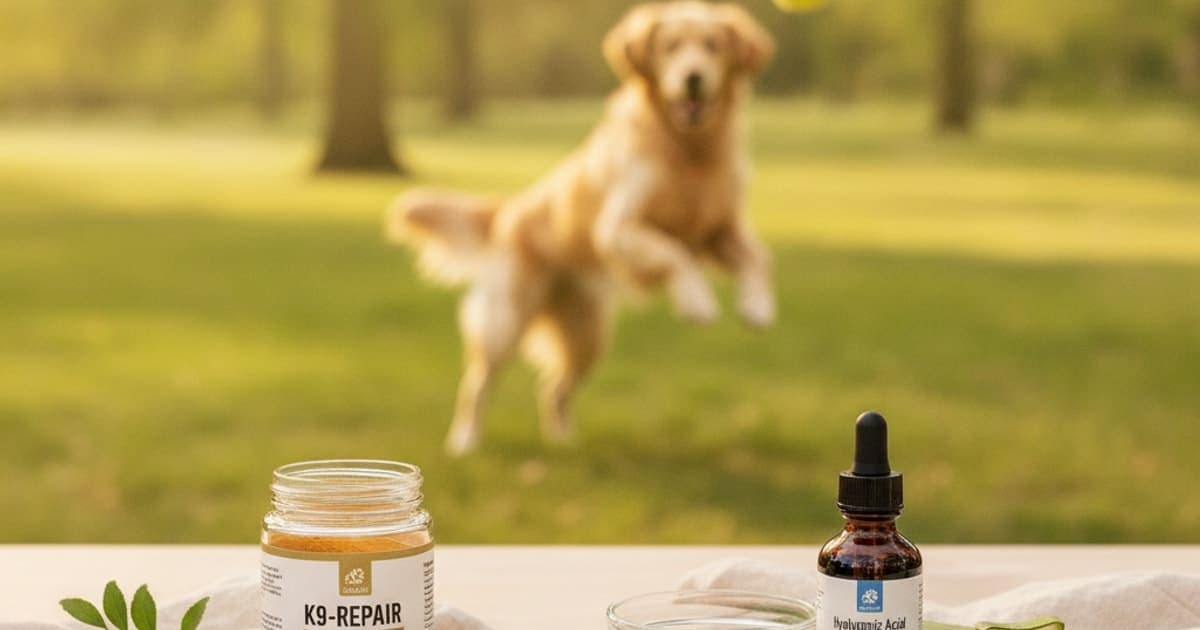
For a dog in an active repair phase — recovering from orthopaedic surgery, working through a soft-tissue strain, or rebuilding a joint that has been offloaded for weeks — K9-REPAIR is the more directly relevant option, because the two are not doing the same job. Hyaluronic acid is a structural molecule that supports the fluid environment inside a joint: viscosity, cushioning, glide. The peptides in K9-REPAIR, BPC-157 and TB-500, are studied for something else entirely — the signalling that governs how connective tissue organises itself while it rebuilds. Research suggests those are separate mechanisms working on separate tissue, which is why owners running a recovery protocol tend to think in terms of sequence and stacking rather than picking a single winner.
That distinction matters more than any marketing comparison, so the sections below explain what each one is actually doing at the tissue level, where each fits in a real recovery timeline, and how to tell a serious formulation from a padded one. All of it should be discussed alongside veterinary care — the limp has a cause, and your veterinarian is the person who identifies it.
What hyaluronic acid actually does inside a joint
Hyaluronic acid is a glycosaminoglycan: a long, water-binding sugar chain produced naturally by cells lining the joint capsule. It is a major component of synovial fluid and is present in cartilage. Its contribution is largely physical. HA gives synovial fluid its viscoelastic character, so the fluid behaves more like a lubricant under slow, grinding load and more like a shock absorber under sudden impact. It also holds water in the tissue, which supports the way cartilage handles compression.
There are two very different ways a dog encounters it. The first is intra-articular injection, performed by a veterinarian, which places HA directly into the joint space. This is a clinical procedure with a long history in equine practice and an established place in small-animal orthopaedics. The second is oral supplementation, which is what most owners are actually comparing when they search this question. Hyaluronic acid is a very large molecule, and how much of an orally administered dose survives digestion, reaches a joint, and behaves the way native HA behaves is a question that depends heavily on molecular weight and formulation. Owners report comfort changes on oral HA; the mechanism being described is environmental — improving the medium the joint moves in — rather than reparative.
That is a real and useful job. A joint that glides better is a joint a dog is more willing to load, and willingness to load is what protects muscle mass through a long recovery. But lubrication does not rebuild a torn ligament, re-vascularise a tendon, or organise new collagen. Nothing about HA's mechanism claims it does.
The repair signalling BPC-157 and TB-500 are studied for
BPC-157 is a synthetic peptide based on a partial sequence of a protein identified in gastric juice. Laboratory and animal-model research suggests it interacts with pathways involved in angiogenesis — the growth of new blood vessels, including VEGF-related signalling — as well as fibroblast migration and the way collagen organises itself in tendon during repair. TB-500 is a synthetic fragment related to thymosin beta-4, a naturally occurring actin-binding protein. Research associates thymosin beta-4 with actin remodelling, cell migration and vascular growth: the machinery cells use to move into a damaged area and rebuild it.
Put those two mechanisms side by side and you get the two things that limit connective-tissue repair in the first place. Tendon and ligament are poorly vascularised compared with muscle, which is why repair progresses slowly and why a tendon-bone interface remodels over weeks and months rather than days. Repair is rate-limited by blood supply and by how efficiently repair cells migrate to and organise at the injury site. That is the territory this class of peptide is studied in — not comfort, not lubrication, but the biology of the rebuild itself.
BPC-157 and TB-500 are peptides supplied for educational use, and the bulk of the published work sits in laboratory and animal models. This is emerging science that owners have moved on ahead of the regulatory timeline, which is exactly how a lot of nutritional and recovery practice develops. What can be said honestly is that the mechanisms are specific, plausible and increasingly well-described, and that owners report using the pairing through post-surgical windows and stubborn soft-tissue recoveries. Hyaluronic acid works on the environment inside a joint; BPC-157 and TB-500 are studied for the repair signalling of the tissue itself — which is why owners treat them as different jobs, not competing options.
Side by side: two different jobs in the same dog
The cleanest way to hold the comparison in your head is by tissue and by timing.
| Hyaluronic acid | K9-REPAIR (BPC-157 + TB-500) | |
|---|---|---|
| What it is | A naturally occurring glycosaminoglycan found in synovial fluid and cartilage | Two synthetic peptides based on naturally occurring protein sequences |
| Mechanism studied | Viscoelasticity, lubrication and water-binding in the joint | Angiogenesis, cell migration and collagen organisation in soft tissue |
| Tissue focus | Joint space and cartilage surface | Tendon, ligament, muscle and joint soft tissue |
| Best-fit window | Ongoing comfort and chronic joint management | Active repair phases: post-op, strain recovery, flare rebuild |
| Delivery | Vet-administered intra-articular injection, or oral supplement | Weight-based dosing at home, shipped direct to door |
| Regulatory status | Injections used in veterinary practice; oral products sold as supplements | Educational-use peptide formulation; vet-guided |
| Evidence character | Long clinical use; oral absorption still being characterised | Laboratory and animal-model research, with growing owner adoption |
Read the table as a division of labour. If your dog's problem is a slow, chronic comfort issue in a joint your vet has already imaged and staged, HA is doing something coherent. If your dog's problem is damaged tissue that has to physically rebuild — a repaired cruciate, an iliopsoas strain, a chronic tendinopathy that keeps recurring — the repair-signalling side of the equation is the one studied in relation to the injured tissue itself.
Matching the choice to what your dog is going through
After orthopaedic surgery
A cruciate repair is a mechanical fix. The surgeon changes the geometry of the joint or replaces the restraint, and then the dog's own tissue has to rebuild around that work over a period of months. Prescribed pain control and the rehab protocol are the backbone of this phase and belong entirely to your veterinary team — never adjust either without them. Within that window, owners commonly add K9-REPAIR because the peptide mechanisms map onto what the tissue is being asked to do: build vasculature, migrate repair cells, organise collagen under controlled load. Oral HA in this window is aimed at comfort, not at the surgical site.
The older dog whose problem is comfort, not a new injury
A stiff senior with radiographic arthritis has a different problem: cartilage wear, joint capsule changes and inflammatory cycling. Here the veterinary plan may include weight management, prescribed anti-inflammatories or newer injectable pain therapies, controlled exercise, and possibly intra-articular HA. The joint environment is genuinely part of the picture. Owners still frequently run K9-REPAIR alongside that plan, because arthritic dogs constantly accumulate small soft-tissue strains as they compensate — and compensation injuries are repair problems, not lubrication problems.
The strain that keeps coming back
Recurring shoulder or hip-flexor strains usually mean tissue rebuilt disorganised the first time and cannot tolerate full load. Lubrication does not change that. This scenario is where the repair-signalling mechanisms are most relevant, paired with a rehab plan that reloads the tissue progressively. If a limp keeps returning, get imaging before you supplement anything — recurrence often means the original diagnosis was incomplete.
Reading a joint product label without getting played
The joint aisle is full of formulations designed to look impressive rather than do work. Watch for three specific tricks. First, the kitchen-sink chew: sixteen ingredients on the front panel, most of them present in amounts too small to matter, chosen because the name is recognisable. Second, the proprietary blend, which lets a brand list ingredients without disclosing how much of each is in there — if a company will not tell you the amount, assume the amount is flattering to the price and nothing else. Third, borrowed credibility: the phrase 'clinically studied ingredient' attached to a product that was never itself studied at the amount included.
The questions worth asking are boring and effective. Is the product third-party tested, and can you see a certificate of analysis? Is it dosed by body weight, or is a Great Dane getting the same scoop as a beagle? Does the company explain the mechanism honestly, or does it promise outcomes? K9-REPAIR from pawgen is third-party tested with COAs, dosed by body weight, shipped direct to door, and carries a 60-day money-back guarantee — which is the kind of thing a brand offers when it expects owners to keep using the product after the first bag.
Whatever you land on, tell your veterinarian what you are giving and when you started it, so that any change in your dog's comfort or gait can be interpreted against a complete picture.
Key takeaways
- Hyaluronic acid supports the fluid environment inside a joint; BPC-157 and TB-500 are studied for the signalling behind soft-tissue repair. Different tissue, different job.
- For an active repair phase — post-surgical, post-strain, post-flare — K9-REPAIR is the more directly relevant choice, and it is the stack owners reach for through recovery.
- Intra-articular HA is a veterinary procedure and belongs to the vet's plan; oral HA is a comfort-side supplement whose absorption depends on formulation.
- Both categories should be discussed alongside veterinary care — surgery, prescribed pain control and structured rehab sit with your vet, and no supplement should ever be a reason to change a prescription.
- BPC-157 and TB-500 are peptides in educational use; the research is mechanistic and animal-model based, and owner adoption has moved with it.
- Judge any product by third-party testing, published COAs, weight-based dosing and honest mechanism language — not by ingredient count.
Where this leaves you
The honest version of this comparison is that 'better' depends on which biological problem you are actually solving, and that is a question about diagnosis. A dog holding up a leg after a jump off the sofa, a dog stiff every morning for two winters, and a dog eight weeks out from a TPLO are three different physiological situations that happen to look similar from the kitchen doorway. Your veterinarian owns that distinction — the exam, the imaging, the pain protocol and the rehab plan are theirs, and they are the foundation everything else sits on. Supplements and peptides operate in the space that proper veterinary care creates, supporting the rebuild that a correct diagnosis and a good surgical or medical plan have already made possible.
If you are weighing this against other popular joint formulas, these comparisons go deeper on how ingredient-stack chews measure up: bpc-157 vs grizzly joint aid for dogs and bpc-157 vs doggie dailies for dogs. Full formulation details and COAs for K9-REPAIR are available from pawgen.
Owners exploring peptide support for their dog can review K9-REPAIR — BPC-157 + TB-500 formulated for dogs — at https://pawgen.com/. BPC-157 and TB-500 are peptides supplied for educational use and are not veterinary medicines. Nothing in this article treats, cures or prevents any condition; every decision about your dog's care belongs with your veterinarian.
Frequently asked questions
- Why is my dog holding up a back leg?
- A dog holds up a back leg because bearing weight on it hurts or feels unstable. Common causes include a cruciate ligament tear, a luxating patella, a paw injury or embedded foreign body, a muscle strain, hip pain, or lower back and nerve involvement. Only a veterinary exam, often with imaging, distinguishes them.
- Should I worry if my dog is holding up a back leg?
- Yes, take it seriously. Refusing to load a limb is a strong pain signal, and in dogs it frequently indicates cruciate ligament injury, which tends to worsen without treatment. It is not something to wait out with rest alone. Book a veterinary exam and describe exactly when the limp appears and how long it lasts.
- When should I take a dog to the vet for holding up a back leg?
- Go the same day if the limp appeared suddenly, follows trauma, or your dog will not touch the foot down at all. Go promptly if there is swelling, heat, yelping, or an obviously abnormal joint angle. For a mild intermittent limp, book within a day or two rather than waiting to see if it settles.
- What can I give a dog that is holding up a back leg?
- Give nothing from your own medicine cabinet — ibuprofen, paracetamol and naproxen are toxic to dogs. Restrict activity, keep the dog off stairs and slick floors, and get pain relief prescribed by your veterinarian. Recovery-support supplements such as K9-REPAIR are discussed alongside veterinary care, after a diagnosis and alongside any prescribed medication.
- Is a dog holding up a back leg an emergency?
- It is an emergency if it follows a car accident or fall, if the leg dangles or looks deformed, if there is an open wound or heavy bleeding, if both back legs are affected, or if the dog cannot feel the foot. Otherwise treat it as urgent rather than emergent and get seen quickly.
- Why is my dog not putting weight on a leg?
- Dogs offload a limb to avoid pain or because the joint feels unstable. That points toward ligament rupture, fracture, joint dislocation, a deep paw wound, or nerve compression. The degree of offloading does not reliably indicate severity, so a completely non-weight-bearing dog and a mildly limping dog both need a veterinary assessment.
- Can a dog take K9-REPAIR and hyaluronic acid together?
- Owners commonly use both, because they target different things — joint fluid environment versus tissue repair signalling. Tell your veterinarian everything your dog is receiving, including supplements, so interactions with prescribed medication and rehab timing can be reviewed. Your vet should always know the full list before you add anything new.
- Is K9-REPAIR a replacement for hyaluronic acid injections?
- No. Intra-articular hyaluronic acid injections are a veterinary procedure prescribed and performed by your vet, and that decision sits with them. K9-REPAIR is an educational-use peptide formulation containing BPC-157 and TB-500, which are peptides supplied for educational use rather than veterinary medicines, and it is something to be discussed alongside veterinary care.
Educational content. BPC-157 and TB-500 are not FDA-approved veterinary drugs. Talk to your veterinarian before starting anything new, especially if your dog is on prescribed medication.