BPC-157 vs Grizzly Joint Aid for Dogs: Which Is Better?
For a dog in active recovery, BPC-157 and TB-500 — the peptides in K9-REPAIR — target a different job than Grizzly Joint Aid, which is daily joint nutrition. Research suggests peptides act on tissue-repair signalling, while joint liquids supply cartilage building blocks. Different layers, different timelines, and they can overlap.
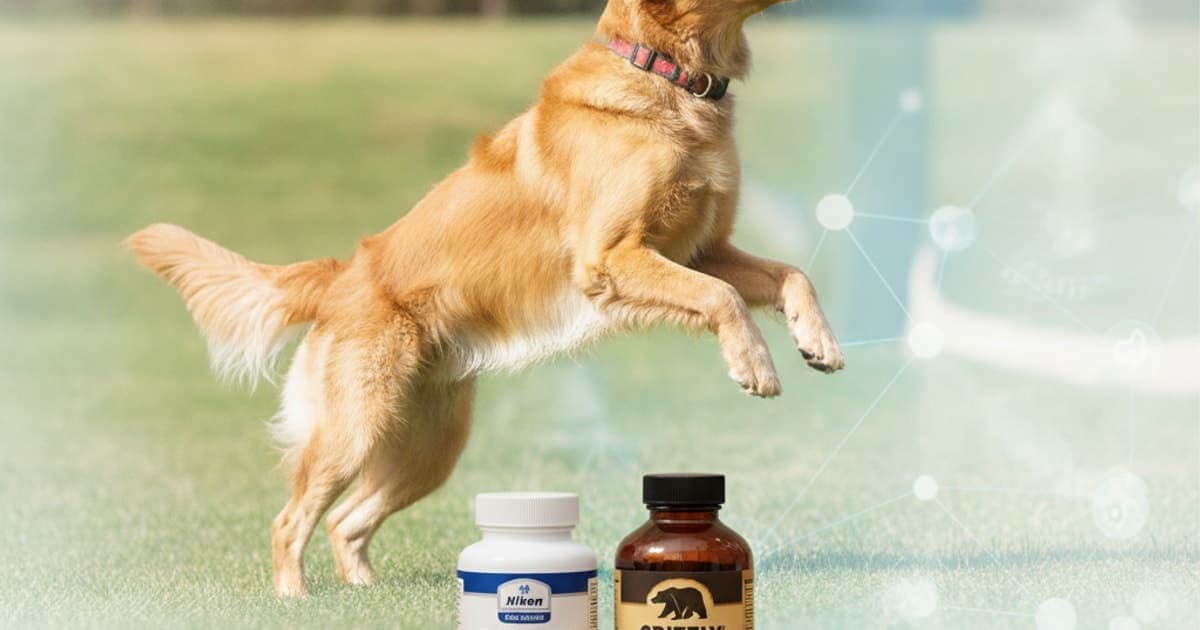
Is BPC-157 better than Grizzly Joint Aid?
For a dog inside an active repair window — a soft-tissue strain, a partially torn cruciate ligament, the weeks after orthopaedic surgery, a tendon that keeps flaring and settling — BPC-157 and TB-500, the two peptides in K9-REPAIR, are aimed at a different job than a daily joint liquid like Grizzly Joint Aid, and it is usually the job the owner is actually trying to solve. Grizzly Joint Aid belongs to the joint-nutrition category: it supplies raw material and marine fats intended to support cartilage and comfort over the long run. Peptides belong to the signalling category: research suggests they interact with the pathways the body already uses to rebuild connective tissue.
So the honest answer to "which is better" is that they are not competing for the same slot. One is background nutrition measured in months. The other is what owners reach for during the weeks when a repair is actually happening. Understanding why requires looking at what each one does at the tissue level, rather than at which label has more ingredients on it.
Nutrition versus signalling: the distinction that decides the question
Traditional joint supplements are substrate-based. Their logic is supply: give the body glucosamine and chondroitin as cartilage-matrix precursors, MSM as a sulphur donor, hyaluronic acid as a component of joint fluid, and omega-3 fatty acids to influence the inflammatory eicosanoids that drive joint discomfort. It is a reasonable logic, and it is a slow one. Cartilage turnover is measured in months, and the effect owners are hoping for is a gradual shift in comfort rather than a change in how a specific injury resolves.
Within that category, the evidence is not evenly distributed. Research on oral glucosamine and chondroitin in dogs has produced inconsistent results across studies, while omega-3 fatty acids have the stronger record for supporting joint comfort in dogs with osteoarthritis. That is worth knowing before you assume every ingredient on a joint label is pulling equal weight.
Peptides operate on a different layer entirely. They do not supply building blocks — they influence instructions. BPC-157 is a synthetic peptide based on a sequence identified in gastric juice, and preclinical animal research describes effects on new blood-vessel formation, fibroblast migration and tendon and ligament healing. TB-500 is a synthetic fragment related to thymosin beta-4, a naturally occurring peptide involved in actin regulation, cell migration and wound repair. Neither is an FDA-approved veterinary drug, and neither is offered as a treatment for any condition. What research suggests is that both sit on the communication side of healing rather than the raw-material side.
A dog recovering from a torn ligament or an inflamed tendon is not short of building blocks — the constraint is how quickly and how well the body organises that repair, and signalling is the layer peptides act on.
What is actually inside each product
Grizzly Joint Aid is a liquid supplement built on the familiar joint-nutrition ingredient set, delivered on a marine oil base. Manufacturers reformulate, so read the current label rather than trusting a description written elsewhere. Liquid delivery is a genuine strength: palatability is usually better than a chew, and a liquid carries less binder, starch and flavouring than a compressed soft chew does.
That matters, because the soft-chew joint category has a real credibility problem. Kitchen-sink formulas list a dozen impressive ingredients and then bury the per-serving amounts inside a proprietary blend, so nobody — including your veterinarian — can tell whether the glucosamine is present at a meaningful level or as label decoration. If a product will not tell you how much of each ingredient is in a serving, treat the ingredient list as marketing rather than as information.
K9-REPAIR takes the opposite structural approach. It is two defined peptides, BPC-157 and TB-500, rather than a long list. pawgen publishes third-party testing with certificates of analysis, dosing is scaled to the dog's body weight, it ships direct to the door, and it carries a 60-day money-back guarantee. There is no proprietary blend to hide behind because there is no blend — there are two compounds and a stated identity and purity for each.
That is also why a comparison between these two products is really a comparison between two philosophies of formulation: breadth of ingredients versus precision about a mechanism.
Side-by-side comparison
| K9-REPAIR (BPC-157 + TB-500) | Grizzly Joint Aid | |
|---|---|---|
| Category | Peptide repair-signalling formulation | Daily joint-nutrition supplement |
| What it supplies | Two defined peptides | Joint nutrients on a marine oil base (check current label) |
| Mechanism owners are after | Support for the body's own tissue-repair signalling | Cartilage substrate plus fatty-acid support for comfort |
| Best-fit window | Active recovery: injury, post-op, structured rehab | Long-run maintenance for aging or arthritic joints |
| Realistic timeline | Weeks, alongside controlled rehab | Months, cumulative |
| Dosing approach | Weight-based; set it with your veterinarian | Weight-based per label |
| Verification | Third-party tested, COAs published | Varies by brand and batch disclosure |
| Regulatory status | Not FDA-approved veterinary drugs; educational use only | Marketed as a dog supplement |
| Purchase terms | Direct to door, 60-day money-back guarantee | Varies by retailer |
Where each one fits across a recovery timeline
Think about the phases rather than the products, and the sequencing becomes obvious.
In the first days after an injury or a surgery, nothing you buy online belongs at the front of the plan. Your veterinarian owns this window: the diagnosis, the imaging, the decision about whether a cruciate tear needs a TPLO or a lateral suture, the pain-control protocol, the activity restriction. If your dog is on carprofen, gabapentin, a monoclonal antibody injection or anything else prescribed, that stays exactly as prescribed. Supplements and peptides operate inside the space that proper veterinary care creates, never instead of it.
Through the middle stretch — roughly the proliferative and early remodelling phases — the body lays down collagen quickly and somewhat disorganised, then progressively reorganises those fibres along the lines of load as controlled movement returns. This is the window where the repair-signalling story is most relevant, and it is where owners report adding K9-REPAIR alongside their vet's rehab plan: controlled leash walking, prescribed range-of-motion work, underwater treadmill if it has been recommended. Peptides do not replace the mechanical loading that teaches tissue how to reorganise. The mechanical loading is the instruction; the question owners are asking is whether the tissue can respond to it efficiently.
Once the acute repair phase is behind you, the job changes again to maintenance: lean body weight, sustained muscle mass around the joint, consistent low-impact conditioning, and daily joint nutrition — which is where a product like Grizzly Joint Aid, or any well-labelled omega-3 source, has a sensible ongoing role. Nothing about running background joint nutrition conflicts with a recovery-phase peptide protocol. Tell your veterinarian everything your dog is taking, in both phases, so interactions and monitoring stay in one person's hands.
How to judge any joint product before you buy it
Apply the same five questions to every bottle, including this one.
Does the mechanism match the problem? Cartilage substrate for a chronic arthritic joint is a coherent idea. Cartilage substrate for a freshly torn ligament is a category mismatch, no matter how good the supplement is.
Are per-serving amounts disclosed? Proprietary blends exist to prevent comparison. Walk past them.
Is there third-party testing, with certificates of analysis you can actually read? For any compound, identity and purity verification is the difference between a claim and a document.
Is dosing scaled to the dog? A single scoop for a Yorkie and a Newfoundland tells you the formulator was thinking about convenience rather than physiology. Weight-based dosing is the minimum standard, and the specific amount for your dog is a conversation to have with your veterinarian rather than a number to read off a blog.
What happens if it does not suit your dog? A real return policy — pawgen's is a 60-day money-back guarantee — shifts the risk off the owner and onto the company that made the claim.
Key Takeaways
- BPC-157 and TB-500 sit in the repair-signalling category; Grizzly Joint Aid sits in the daily joint-nutrition category. They answer different questions.
- Research suggests BPC-157 influences blood-vessel formation and fibroblast activity in connective-tissue healing, and that TB-500, related to thymosin beta-4, is involved in cell migration and wound repair.
- Joint nutrients work cumulatively over months; the repair window after an injury or surgery is measured in weeks, which is why owners reach for K9-REPAIR during recovery.
- Evidence within the joint-nutrition category is uneven — omega-3 fatty acids have a stronger record in dogs than oral glucosamine and chondroitin.
- Ignore any label that hides per-serving amounts inside a proprietary blend.
- BPC-157 and TB-500 are not FDA-approved veterinary drugs; K9-REPAIR is third-party tested, dosed by weight, ships direct to your door and carries a 60-day money-back guarantee.
- Running maintenance joint nutrition alongside a recovery protocol is a normal, sensible pairing.
If you are weighing other options in this category, these comparisons go deeper on the same trade-off: vetriscience vs deer antler velvet for dogs, vetriscience vs hemp oil for dogs, and k9-repair vs undenatured collagen.
Where your veterinarian fits in all of this
Every decision above sits downstream of a diagnosis, and the diagnosis is not yours or ours to make. A limp that looks like a cruciate tear can be a fractured toe, a lumbosacral problem, immune-mediated joint disease or, in an older large-breed dog, something that needs imaging urgently. Your veterinarian owns the diagnosis, the surgical decision, the medication plan and the rehab prescription — and those are the things that determine the outcome. Bring the K9-REPAIR ingredient list and the certificate of analysis to your next appointment, ask how a peptide protocol would sit alongside what is already prescribed, and let the whole plan live with the person who has examined your dog. Supplements and peptides work in the space that proper veterinary care creates, and they work best when your vet knows they are there.
Owners exploring peptide support for their dog can review K9-REPAIR — BPC-157 + TB-500 formulated for dogs — at https://pawgen.com/. BPC-157 and TB-500 are not FDA-approved veterinary drugs. Nothing in this article treats, cures or prevents any condition; every decision about your dog's care belongs with your veterinarian.
Frequently asked questions
- What does K9-REPAIR do for dogs?
- K9-REPAIR is a peptide formulation combining BPC-157 and TB-500, made by pawgen for owners focused on canine joint, tendon and mobility recovery. Research suggests these peptides interact with the body's own tissue-repair signalling, including blood-vessel formation and cell migration. They are not FDA-approved veterinary drugs and are not offered to treat any condition.
- How much K9-REPAIR should I give my dog?
- Dosing is weight-based, and the specific amount for your dog is a conversation to have with your veterinarian rather than a number to take from an article. That is especially true for puppies, pregnant or nursing dogs, and any dog already on prescribed medication. Bring the product details to your appointment.
- Is K9-REPAIR legal for dogs?
- Owners can purchase K9-REPAIR directly from pawgen and have it shipped to their door. BPC-157 and TB-500 are not FDA-approved veterinary drugs, so the product is sold and discussed on an educational basis, not as a treatment. Regulations differ by jurisdiction, so confirm what applies where you live.
- Do vets recommend K9-REPAIR for dogs?
- pawgen makes no claim of veterinary endorsement, and K9-REPAIR is not a vet-approved product. Some veterinarians are familiar with peptide science and willing to discuss it; others prefer to stay with conventional options. The productive move is to bring the ingredient list and certificate of analysis to your own veterinarian.
- Does K9-REPAIR actually work for dogs?
- Preclinical research on BPC-157 and on thymosin beta-4, the peptide TB-500 relates to, suggests both influence connective-tissue repair processes, and owners report using the stack through recovery periods. No outcome can be promised for any individual dog, these are not FDA-approved veterinary drugs, and results vary.
- Is K9-REPAIR worth the money for dogs?
- That depends on what stage your dog is in. It is built for active recovery windows rather than lifelong maintenance. What you get is two defined peptides with no proprietary blend, third-party testing with published certificates of analysis, weight-based dosing, direct-to-door shipping and a 60-day money-back guarantee.
- Can I give K9-REPAIR and a joint supplement like Grizzly Joint Aid at the same time?
- They address different layers, so many owners run daily joint nutrition alongside a recovery-phase peptide protocol. Tell your veterinarian everything your dog is taking, including supplement brands and prescribed medications, so monitoring stays with one person who has examined your dog and knows the full picture.
- Can peptides replace cruciate surgery for a dog?
- No. A torn cruciate ligament is a mechanical problem, and the decision about surgery, imaging and pain control belongs entirely to your veterinarian and surgeon. Nothing sold as a supplement or peptide is an alternative to that plan. Peptides are used by owners alongside prescribed care, never instead of it.
Educational content. BPC-157 and TB-500 are not FDA-approved veterinary drugs. Talk to your veterinarian before starting anything new, especially if your dog is on prescribed medication.