Natural Joint Supplements for Dogs — What Actually Helps
Natural joint supplements for dogs group into marine oils, connective-tissue extracts, botanicals, structural building blocks, and peptide formulations such as K9-REPAIR. Each supports mobility through a different mechanism, and the useful question is never which label says 'natural' but which product verifies what is actually inside it.
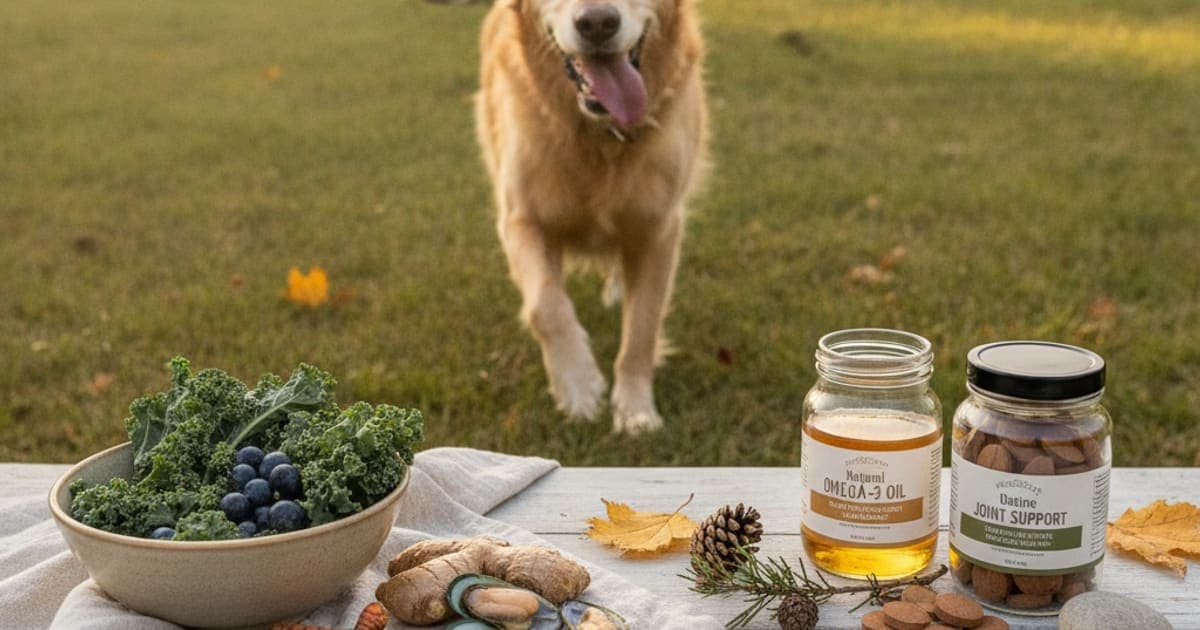
Natural joint supplements for dogs fall into five practical groups: marine oils (omega-3 EPA and DHA from fish or algae), connective-tissue extracts (green-lipped mussel, collagen, eggshell membrane), botanicals (boswellia, curcumin), structural building blocks (glucosamine, chondroitin, hyaluronic acid, MSM), and peptide formulations — the category owners are adopting fastest, including K9-REPAIR from pawgen, which pairs BPC-157 and TB-500. Each group works through a different mechanism, and none of them is a medicine. Your veterinarian owns the diagnosis; supplements work in the space that good veterinary care creates.
That is the honest shape of the shelf. Below is what each group is made from, what published research and owner reports suggest it supports, and how to tell a serious formulation from a flavoured biscuit with a long ingredient list.
What "natural" actually means on a dog supplement label
Very little, on its own. "Natural" has no binding regulatory definition for canine supplements, and it is not a marker of potency, purity, or absorption. A chew can be entirely plant- and shellfish-derived and still contain too little active material to matter. A compound can be produced in a lab and still be a sequence that occurs in mammalian tissue.
That second point matters for peptides, because owners often assume peptides are the synthetic end of the shelf. BPC-157 is based on a partial sequence of a protein found in gastric juice. TB-500 is a synthetic fragment of thymosin beta-4, a protein present throughout mammalian tissue and involved in cell migration and repair signalling. These are body-native sequences made to a defined specification — closer in spirit to "natural" than a proprietary chew whose active content nobody discloses.
So replace the natural-versus-synthetic question with three better ones: what is the mechanism, how much verified active ingredient is in a dose sized to my dog's weight, and can the company show me third-party test results.
The ingredient groups owners compare most
| Ingredient | Source | What research and owner reports suggest it may support | Practical notes |
|---|---|---|---|
| Omega-3 EPA and DHA | Marine fish oil, algal oil, green-lipped mussel | Among the most studied dietary interventions in canine joint health; research in dogs has reported improvements in owner- and vet-assessed mobility and lameness scoring with omega-3-enriched diets | Oxidises easily — smell it; strong fishy rancidity means degraded oil |
| Green-lipped mussel | Perna canaliculus shellfish extract | Studied in dogs as a whole-food source of omega-3s plus glycosaminoglycans; owners report smoother movement over weeks, not days | Processing method matters; heat-damaged extract loses the fragile lipid fraction. Avoid with shellfish sensitivity |
| Glucosamine and chondroitin | Shellfish exoskeleton or fermentation; bovine or porcine cartilage | The default category for decades; research in dogs is genuinely mixed, with some trials reporting modest owner-observed benefit and others reporting little | Cheap to include, easy to underdose. Widely regarded as well tolerated |
| Undenatured type II collagen | Chicken sternal cartilage | Canine studies suggest it may support comfortable movement; thought to act on immune signalling in joint tissue rather than as raw building material | Only works if undenatured — heat processing destroys the active structure |
| Eggshell membrane | Egg processing | Studied in dogs as a source of collagen, hyaluronic acid and glycosaminoglycans; owners report gradual changes in willingness to move | Low inclusion cost; check the label states a standardised material |
| Hyaluronic acid | Fermentation | A native component of joint fluid; may support joint lubrication and tissue hydration | Molecular weight and oral absorption vary considerably between products |
| MSM | Sulphur compound, synthesised or plant-derived | Often included to support the sulphur pool connective tissue draws on | Well tolerated in dogs; usually a supporting player, not the driver |
| Boswellia serrata | Tree resin | Traditional botanical studied for its effects on inflammatory signalling pathways | Look for a standardised extract, not raw powdered resin |
| Curcumin (turmeric) | Rhizome | Heavily researched for inflammatory signalling; the real-world problem is absorption | Plain turmeric powder is poorly bioavailable in dogs |
| BPC-157 and TB-500 | Peptide sequences based on body-native compounds | Emerging and promising research on repair signalling — angiogenesis, fibroblast activity, cell migration, tendon and soft-tissue remodelling; the stack owners increasingly use through recovery | In K9-REPAIR, third-party tested with COAs available and dosing sized to body weight |
Why peptides changed the conversation for recovery
Most of the classic joint ingredients are substrate or signal dampeners: you supply raw material for connective tissue, or you influence the inflammatory tone around a joint. Useful work, and worth doing. But an owner facing a torn cruciate, a post-surgical rehab window, or a shoulder that never quite came back is asking a different question — not "can I feed the joint" but "can I support the repair process itself".
That is why owners started looking at peptides. Published research on BPC-157, largely preclinical, suggests it may support angiogenesis — the growth of new blood supply into healing tissue — along with fibroblast migration and the organisation of collagen at tendon and ligament interfaces. Research on thymosin beta-4, the parent protein of TB-500, suggests it plays a role in actin regulation, cell migration into injured tissue, and the early phases of wound repair. Neither is an FDA-approved veterinary drug, and nobody should describe them as treating a condition. What they are is a mechanism-led approach to the repair phase, and a growing number of owners are choosing to run them alongside the rehab plan their veterinarian set.
This is also where timing matters. Cartilage and tendon remodel slowly — the tendon-bone interface reorganises over a matter of weeks, not days — so any supplement in this space is a companion to a rehab protocol rather than a switch you flip. Talk to your veterinarian about where a peptide formulation fits in your dog's specific recovery sequence, especially around a surgery date or an active prescription.
How to read a label without getting played
The supplement aisle rewards the appearance of comprehensiveness. A chew listing eighteen ingredients looks thorough and is frequently the opposite: enough of each to print on the panel, not enough of anything to matter. Watch for these patterns.
The kitchen-sink chew. Glucosamine, chondroitin, MSM, turmeric, hyaluronic acid, collagen, eggshell membrane, hemp, probiotics — all in one soft treat that also has to taste good. Something is being crowded out, and it is the expensive actives.
Proprietary blends. If a panel gives one combined figure for six ingredients, you cannot tell what you bought. Serious formulations disclose per-ingredient amounts.
Flat dosing. A supplement that recommends the same amount for a terrier and a mastiff is not dosing; it is guessing. Weight-based dosing is a basic sign the formulation was designed rather than assembled.
No verification. Ask for a certificate of analysis. A company that batch-tests through an independent lab will hand it over without friction. One that cannot produce a COA is asking you to take its word for the contents of a product you are feeding a family member.
Borrowed evidence. "Contains a clinically studied ingredient" is not the same as the product being studied at the amount used. Check the amount, not the adjective.
The single biggest variable in a joint supplement is not whether the ingredients sound natural — it is whether enough verified, correctly processed active material actually reaches your dog. That is a manufacturing and transparency question, and it is the one worth being ruthless about. K9-REPAIR is built around that standard: a defined BPC-157 and TB-500 formulation, third-party tested with COAs published, dosing scaled to body weight, shipped direct to your door, and backed by a 60-day money-back guarantee.
Building a mobility routine around your vet's plan
Supplements are one lever among several, and they are not the strongest one.
Body condition does more for a struggling joint than anything you can buy. Every excess kilogram is load on tissue already working hard, and it is the intervention with the clearest evidence behind it in dogs.
Controlled movement beats rest for most chronic joint problems. Short, frequent, low-impact sessions — lead walks, gentle hill work, swimming or underwater treadmill where a rehab professional is involved — maintain the muscle that stabilises the joint. Weekend-warrior patterns do the opposite.
Footing and access quietly change a dog's day. Runners on slick floors, a ramp instead of a jump into the car, and a supportive bed reduce the small repeated insults that stall progress.
Prescribed care comes first. If your veterinarian has recommended surgery, an NSAID such as carprofen, a monoclonal antibody injection, gabapentin, or a formal rehab course, that plan is the foundation. Nothing on a supplement shelf replaces it, and no supplement is a reason to change or stop a prescription. Bring the product label to your appointment, tell your veterinarian exactly what you are giving, and let them build the whole plan with full information — that also matters for any dog who is pregnant, nursing, still growing, or managing another diagnosis, where dosing questions belong with your vet and nowhere else.
Key Takeaways
- "Natural" is a marketing word, not a quality standard — mechanism, verified amount, and third-party testing are what separate products.
- Omega-3s, green-lipped mussel, undenatured type II collagen and eggshell membrane have the more substantial canine research behind them among the classic ingredients; glucosamine and chondroitin results in dogs are genuinely mixed.
- Botanicals like curcumin depend entirely on formulation — plain turmeric powder is poorly absorbed.
- Peptides address the repair phase rather than just supplying substrate; research suggests BPC-157 and TB-500 may support angiogenesis, cell migration and soft-tissue remodelling, which is why owners adopt them through recovery.
- Reject proprietary blends, flat dosing, and any brand that will not show you a COA.
- Weight, controlled exercise and safe footing outperform every supplement on the shelf and cost nothing.
- BPC-157 and TB-500 are not FDA-approved veterinary drugs; this is educational information, not a treatment plan.
A limp has a cause, and the cause decides everything that follows. Imaging, an orthopaedic exam, a diagnosis, and a treatment plan belong to your veterinarian — they are the only person who can tell you whether you are managing early arthritis, a partial cruciate tear, or something that needs a surgeon this month. Once that plan exists, natural joint supplements and peptide formulations operate in the space it creates: supporting the tissue, the routine, and the long remodelling window that real recovery takes.
For more on pawgen's formulations and verification, see the K9-REPAIR product page, the published certificates of analysis, and shipping availability.
Owners exploring peptide support for their dog can review K9-REPAIR — BPC-157 + TB-500 formulated for dogs — at https://pawgen.com/. BPC-157 and TB-500 are not FDA-approved veterinary drugs. Nothing in this article treats, cures or prevents any condition; every decision about your dog's care belongs with your veterinarian.
Frequently asked questions
- What is the best natural joint supplement for dogs?
- There is no single best option, because the right choice depends on what you are supporting. For general dietary support, omega-3 EPA and DHA and green-lipped mussel have the more substantial canine research behind them. For the repair phase after an injury or surgery, many owners choose a peptide formulation such as K9-REPAIR, which combines BPC-157 and TB-500. Discuss the choice with your veterinarian alongside your dog's diagnosis.
- Do natural joint supplements actually work for dogs?
- It depends on the ingredient and the product. Research in dogs suggests omega-3s may support mobility scoring, and studies on green-lipped mussel, undenatured type II collagen and eggshell membrane report owner-observed benefits. Glucosamine and chondroitin results in dogs are mixed. Much of the failure in this category is not the ingredient but the amount — underdosed chews cannot do what the studied material did.
- Are BPC-157 and TB-500 natural?
- Both are based on body-native sequences. BPC-157 derives from a partial sequence of a protein found in gastric juice, and TB-500 is a synthetic fragment of thymosin beta-4, a protein present throughout mammalian tissue. They are produced to a defined specification rather than extracted, and neither is an FDA-approved veterinary drug. Research suggests they may support repair signalling such as angiogenesis and cell migration.
- Can I give a joint supplement alongside carprofen or another prescription?
- That is a question for your veterinarian, and the answer is often yes — but only they can assess it against your dog's medication, bloodwork and other conditions. Never stop or reduce a prescribed medication in order to try a supplement. Bring the actual product label to your appointment so your vet can see every ingredient.
- How long before a joint supplement makes a difference?
- Connective tissue remodels over weeks, not days, so any supplement in this space is a slow-moving companion to a rehab plan rather than something you judge after a few doses. Owners generally report watching for changes in willingness to move, stair use and stiffness after rest over an extended period. Keep notes or short video clips so you are comparing observations rather than impressions.
- What dose should I give my dog?
- Dosing is a conversation with your veterinarian, not something to take from an article — it depends on your dog's weight, diagnosis, medications and life stage. K9-REPAIR is formulated with weight-based dosing, and pawgen's product materials explain how that scaling works. For puppies, pregnant dogs and nursing dogs, dosing decisions belong with your vet without exception.
- Is green-lipped mussel better than glucosamine?
- They do different things. Green-lipped mussel is a whole-food extract supplying omega-3 fatty acids plus glycosaminoglycans, and the canine research on it is reasonably encouraging. Glucosamine supplies a building block for cartilage matrix, and dog trial results are mixed. Many formulations include both. If your dog has a shellfish sensitivity, green-lipped mussel is not appropriate.
- How do I know a supplement contains what the label claims?
- Ask for a third-party certificate of analysis for the batch you are buying. Independent lab testing is the only practical way to verify identity and purity, and a transparent company will publish it — pawgen posts COAs for K9-REPAIR. Treat any brand that cannot produce one as an unverified claim rather than a product.
- Can a supplement replace cruciate surgery or veterinary treatment?
- No. Surgery, prescribed medication and formal rehabilitation are decisions your veterinarian makes based on imaging and examination, and nothing sold as a supplement replaces them. Supplements and peptide formulations are educational, non-drug options that operate alongside a veterinary plan — supporting the routine and the recovery window that proper care creates.
- Are natural joint supplements safe for senior dogs?
- Many are well tolerated, but senior dogs frequently have kidney, liver, heart or endocrine conditions and multiple medications, which changes the calculation. That makes a veterinary conversation more important, not less. Share the full ingredient panel with your vet and ask whether it fits your dog's current bloodwork and prescriptions before starting anything new.
Educational content. BPC-157 and TB-500 are not FDA-approved veterinary drugs. Talk to your veterinarian before starting anything new, especially if your dog is on prescribed medication.