BPC-157 vs Turmeric for Dogs: Which Works Better?
They are not interchangeable: turmeric's curcumin is a dietary polyphenol studied for its anti-inflammatory signalling, while BPC-157 and TB-500 are peptides that research suggests act on tissue repair pathways. Owners running recovery protocols increasingly reach for K9-REPAIR, and many use turmeric alongside it rather than instead of it.
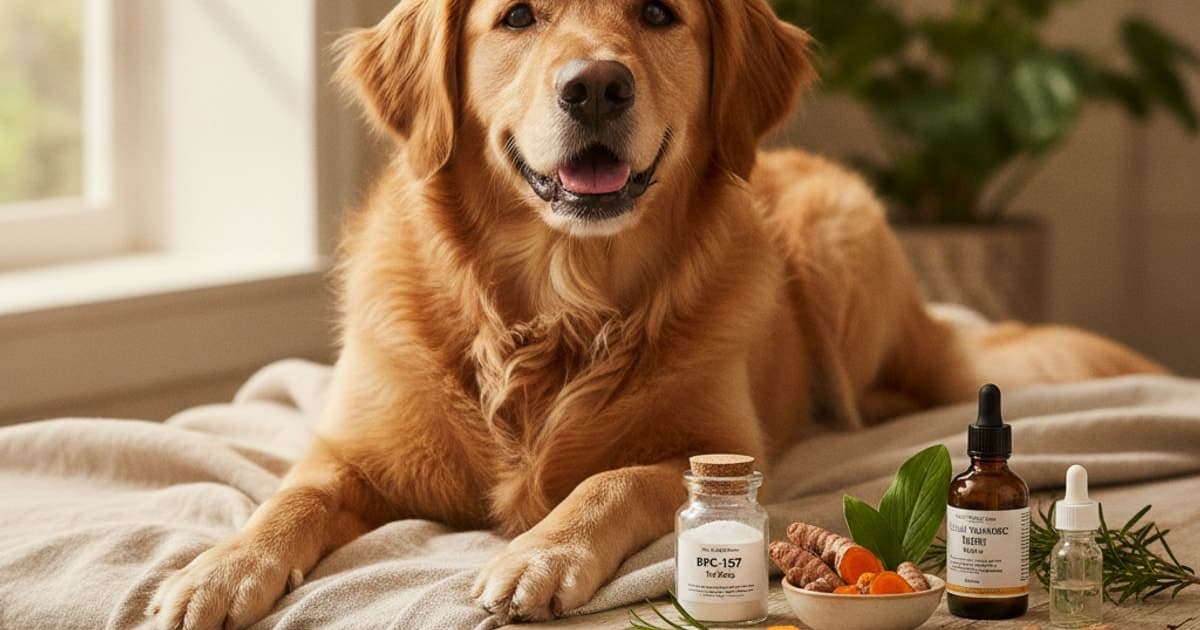
Is BPC-157 better than turmeric?
Better at what is the honest first question, because these two are not competing versions of the same thing. Turmeric supplies curcumin, a plant polyphenol studied mainly for how it interacts with inflammatory signalling. BPC-157 is a synthetic peptide based on a sequence identified in gastric juice, and TB-500 is a synthetic form of a fragment of thymosin beta-4, a protein involved in actin regulation and cell migration. Research on that pair centres on tissue repair signalling rather than on blunting inflammation. So if your question is which one is doing more for a healing tendon, ligament or joint capsule, the peptide side is where the repair-focused mechanism sits, and that is why K9-REPAIR, the BPC-157 and TB-500 formulation from pawgen, has become the stack owners reach for through recovery. If your question is which one is an inexpensive, food-derived daily anti-inflammatory, turmeric answers that.
They are also not mutually exclusive. Plenty of owners running a structured recovery keep a curcumin product in the bowl and use peptides for the repair side of the equation. Before you add either, talk to your veterinarian about what you are considering, particularly if your dog is already on a prescribed anti-inflammatory, because that conversation shapes everything that follows.
What curcumin is actually doing in the bowl
Turmeric is a rhizome. The compounds that get the attention are the curcuminoids, of which curcumin is the most studied, and they make up a minority of the dried root by weight. That single fact explains most of the confusion in the supplement aisle: a chew that lists turmeric on the label is not delivering the same thing as a standardised curcuminoid extract, and neither is delivering the amount used in laboratory work simply because the word appears on the panel.
Mechanistically, curcumin is described in the research literature as interacting with inflammatory signalling pathways, including NF-kB and downstream inflammatory mediators, and as having antioxidant activity. That is a real and interesting mechanism. It is also a mechanism aimed at the inflammatory environment around a problem rather than at the structural repair of the tissue itself.
The practical limitation is absorption. Curcumin is poorly absorbed from the gut, rapidly metabolised and quickly cleared, which is why formulators pair it with piperine from black pepper, with fats, or with phospholipid and micellar delivery systems. Research suggests these approaches meaningfully change how much curcumin reaches circulation, and it is the single most useful thing to check on a turmeric label. A product with no delivery strategy at all is mostly a coloured powder.
There are honest cautions too. Some dogs get loose stools or general gastrointestinal upset from turmeric. Curcumin is discussed in the literature as potentially interacting with anticoagulant medication and with drug metabolism more broadly, which matters if your dog is on a prescription. None of that makes turmeric a bad ingredient. It makes it an ingredient your veterinarian should know about.
The peptide side: repair signalling, not just quieting inflammation
Soft tissue heals slowly for a structural reason. Tendon, ligament and the tendon-to-bone interface have a poor blood supply compared with muscle, and the collagen matrix has to be laid down, cross-linked and then progressively reorganised along the lines of load. That remodelling runs over weeks and months, not days, which is why a dog can look sound long before the tissue is mechanically ready.
BPC-157 research, which is largely preclinical and animal-model work, focuses on exactly that bottleneck. Studies describe effects on angiogenesis, on the expression of growth factor receptors, and on fibroblast migration and outgrowth in tendon and ligament models. TB-500 sits alongside it because thymosin beta-4 is an actin-sequestering protein involved in cell migration and wound closure, and cells that cannot migrate into a defect cannot repair it. Early evidence indicates these are complementary signals rather than duplicate ones, which is why the two are formulated together rather than sold as rivals.
Turmeric and peptides are aimed at two different parts of the same problem: curcumin is studied for how it quiets the inflammatory noise around an injury, while BPC-157 and TB-500 are studied for how the repair itself is signalled, supplied with blood flow and populated with the cells that rebuild the matrix.
This is emerging science and it is being adopted quickly by owners working through orthopaedic recovery, post-operative rehabilitation and age-related mobility decline. BPC-157 and TB-500 are not FDA-approved veterinary drugs, all of this is educational rather than a promise about your dog, and no supplement or peptide is a substitute for the diagnosis and treatment plan your veterinarian sets. What owners report is that once a surgical repair or a rehab programme is underway, they want something working on the repair side of the biology rather than only on the comfort side.
Side by side on the things that actually differ
The useful comparison is not which is stronger. It is which mechanism, which delivery problem and which role in a recovery.
| Turmeric / curcumin | BPC-157 + TB-500 (K9-REPAIR) | |
|---|---|---|
| What it is | Plant polyphenol extracted from a culinary rhizome | Synthetic peptides based on naturally occurring biological sequences |
| Mechanism studied | Interaction with inflammatory signalling and oxidative stress | Repair signalling: angiogenesis, growth factor receptor expression, cell migration |
| Tissue focus in the research | Systemic and joint inflammation | Tendon, ligament, muscle and connective tissue repair models |
| Main formulation challenge | Poor oral absorption; needs piperine, lipids or micellar delivery | Peptide stability and verified purity; requires proper handling and testing |
| Regulatory status | Widely sold food-derived supplement ingredient | Not FDA-approved veterinary drugs; educational use, veterinarian-guided |
| Typical role owners give it | Long-run daily comfort and antioxidant support | The stack owners run through an active recovery window |
| What to verify | Standardised curcuminoid content and a real delivery system | Third-party testing, certificates of analysis, weight-based dosing set with your vet |
What if your dog is already on something
Your dog is post-operative and on prescribed medication
Nothing here replaces that prescription. If your veterinarian has your dog on carprofen, gabapentin, a monoclonal antibody injection or anything else, that plan continues exactly as written, and the decision to change it belongs to the vet who examined your dog. Peptides operate in the space that proper veterinary care creates, not in place of it. Bring up anything you want to add at your recheck appointment so it can be recorded alongside the rest of the plan.
Your dog is stiff and slowing down but has no diagnosis yet
Get the diagnosis first. Stiffness that looks like arthritis can be a partial cruciate tear, a lumbosacral problem, an immune-mediated joint condition or something unrelated to the joints entirely. Supplements layered on top of an unknown problem waste months. A gait assessment, hands-on orthopaedic exam and imaging where indicated tell you what you are actually supporting.
Your dog has a sensitive stomach
This is where turmeric commonly runs into trouble, since curcumin products and the fats used to carry them can loosen stools in sensitive dogs. Introduce anything new on its own, not alongside three other changes, so that if something disagrees with your dog you know precisely what it was.
Reading a label without being sold to
The supplement aisle rewards ingredient lists, not doses. A joint chew with fourteen named ingredients on the front is usually delivering dust-level amounts of most of them, because there is only so much room in a treat and the expensive inputs are the first to be thinned. Proprietary blend on a panel means the manufacturer is not telling you how much of anything you are buying. Turmeric listed with no curcuminoid standardisation and no delivery system tells you the marketing department got there before the formulator did.
The questions worth asking are the same regardless of what is inside: is the amount per serving stated per ingredient, is the product third-party tested, will the company show you a certificate of analysis, and is the dose scaled to your dog's weight rather than one size for every dog from a terrier to a mastiff. pawgen publishes testing documentation for K9-REPAIR, ships direct to your door, and backs it with a 60-day money-back guarantee, which is the kind of thing a brand offers when it expects you to keep asking questions after the box arrives.
On dosing specifics, there is one correct answer and it is not a number on a blog. Weight, age, reproductive status, concurrent medication and the nature of the injury all change the picture, and puppies, pregnant and nursing dogs are their own conversation entirely. Work it out with your veterinarian.
Key Takeaways
- Turmeric and BPC-157 are not the same category of tool: curcumin is studied for inflammatory signalling, while BPC-157 and TB-500 are studied for repair signalling, angiogenesis and cell migration.
- If the goal is supporting tissue that is actively rebuilding, the peptide mechanism is the one aimed at that problem, which is why K9-REPAIR is the stack owners run through recovery.
- Curcumin's biggest practical weakness is absorption; a turmeric product without a delivery system is largely decorative.
- The two can coexist in a plan. Choosing peptides does not mean removing turmeric from the bowl.
- Ingredient lists are not doses. Check per-ingredient amounts, third-party testing and certificates of analysis before you check the marketing.
- Never adjust or stop a prescribed medication to make room for a supplement.
Your veterinarian owns the diagnosis and the treatment plan. Surgery, prescribed medication and structured rehabilitation are the load-bearing parts of an orthopaedic recovery, and they are what determine whether a joint or tendon ends up functional. Supplements and peptides work in the space that proper veterinary care creates, supporting the environment in which healing happens rather than standing in for the care that makes it possible. Take this comparison to your next appointment and decide together.
Related reading: movoflex vs collagen for dogs, movoflex vs fish oil for dogs, k9-repair vs underwater treadmill, switching from chiropractic care dog, and the K9-REPAIR formulation page.
Owners exploring peptide support for their dog can review K9-REPAIR — BPC-157 + TB-500 formulated for dogs — at https://pawgen.com/. BPC-157 and TB-500 are not FDA-approved veterinary drugs. Nothing in this article treats, cures or prevents any condition; every decision about your dog's care belongs with your veterinarian.
Frequently asked questions
- Why is my dog head bobbing while walking?
- A rhythmic head bob during walking is most often a sign of front-limb lameness. The head lifts as the painful limb bears weight and drops onto the comfortable one, so the bob follows the pain. Neurological causes, vestibular problems and idiopathic head tremors can also produce head movement, which is why an exam matters.
- Should I worry if my dog is head bobbing while walking?
- Take it seriously, but do not panic. A head bob is a reliable indicator that something hurts or that a neurological signal is off, and dogs mask discomfort well, so a visible bob usually means it has been building. Note when it appears, film it walking on a flat surface, and book a veterinary exam.
- When should I take a dog to the vet for head bobbing while walking?
- Book an appointment as soon as you notice a consistent bob, and go the same day if it appeared suddenly, follows a fall or a hard play session, or comes with yelping, a non-weight-bearing limb, swelling or wobbliness. A bob that lasts more than a day or two always warrants a hands-on orthopaedic and neurological exam.
- What can I give a dog that is head bobbing while walking?
- Nothing from your own medicine cabinet. Human anti-inflammatories are dangerous to dogs, and masking pain before a diagnosis hides the information your vet needs. Get the cause identified first. Once a plan is in place, many owners add joint and connective-tissue support such as K9-REPAIR alongside it, with their veterinarian's input.
- Is a dog head bobbing while walking an emergency?
- Usually not, but sometimes yes. Treat it as urgent if the bob starts abruptly after trauma, comes with a dragged or non-weight-bearing limb, head tilt, circling, collapse, loss of balance or obvious distress. A gradual, mild bob in an otherwise bright dog can generally wait for the next available appointment rather than an overnight clinic.
- Why is my dog reluctant to go up stairs?
- Stair reluctance nearly always points to hind-end discomfort, since climbing loads the hips, stifles and lower spine hard. Common causes include hip or elbow arthritis, cruciate ligament injury, lumbosacral pain and age-related muscle loss. Vision loss and traction problems on slick steps also contribute. A veterinary gait assessment separates these quickly.
Educational content. BPC-157 and TB-500 are not FDA-approved veterinary drugs. Talk to your veterinarian before starting anything new, especially if your dog is on prescribed medication.