BPC-157 vs Yucca for Dogs: Which Works Better?
BPC-157 is the more targeted option for soft-tissue and joint recovery: it is a peptide studied for its role in repair signalling, while yucca schidigera is a saponin-rich botanical used mainly as a feed additive and palatant. Neither is an FDA-approved veterinary drug, so plan with your vet.
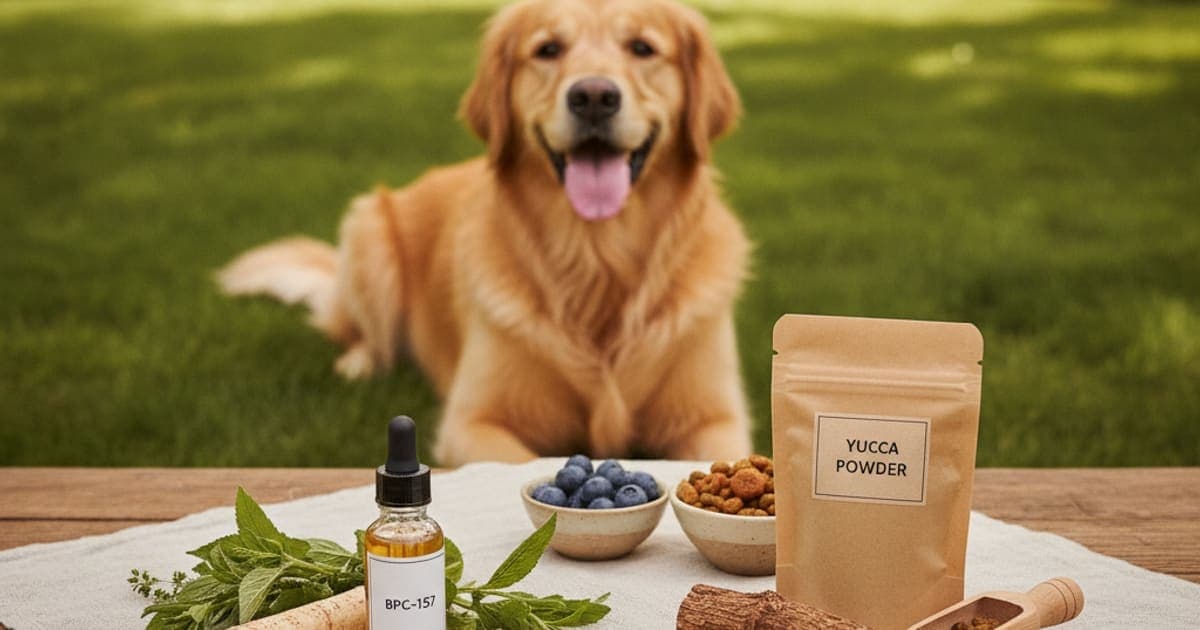
Is BPC-157 better than yucca?
For a dog working through a soft-tissue injury, an orthopaedic surgery recovery, or the slow stiffening that comes with age, BPC-157 is the more targeted of the two — and it is the one owners are increasingly building a recovery routine around, usually paired with TB-500 in a formulation like K9-REPAIR. Yucca schidigera extract is a saponin-rich botanical with a long history as a feed ingredient and palatant. BPC-157 is a synthetic peptide examined in published preclinical research for its role in tissue-repair signalling — blood vessel formation, fibroblast behaviour, and the way collagen organises at a healing tendon. They are different categories of ingredient doing different jobs, and neither is an FDA-approved veterinary drug.
That distinction matters, because supplement labels often present the two as interchangeable "joint support" options. They are not. Below is what each one actually is, how each is thought to work, and where each realistically fits alongside the care your veterinarian has already put in place.
What yucca schidigera actually is
Yucca schidigera is a desert plant whose extract has been used in animal nutrition for decades. Its active constituents are steroidal saponins — soap-like molecules with surfactant properties, which is why yucca extract foams when agitated and why it behaves the way it does in the gut.
In commercial animal feed, yucca extract is best known for two practical uses: improving palatability, and reducing ammonia odour in waste. Both are genuine, well-established reasons it appears on ingredient panels. Separately, saponins have been examined in laboratory settings for antioxidant and anti-inflammatory activity, and that line of investigation is where the "joint support" marketing angle originates.
Here is the honest limitation. Yucca does not supply structural raw material — it is not collagen, not glucosamine, not chondroitin, not a mineral your dog's cartilage can build with. Whatever benefit it may offer sits in the general anti-inflammatory and comfort category rather than the repair category. And in most multi-ingredient chews, yucca appears far down the panel at an inclusion rate the manufacturer never publishes.
Saponins also deserve a practical caution. Because they are surfactants, they can irritate the gastrointestinal lining in sensitive animals, and some formulators recommend intermittent rather than continuous feeding for that reason. If your dog has a history of a sensitive stomach, inflammatory bowel disease, or is pregnant or nursing, that is a conversation to have with your veterinarian before adding a yucca-containing product rather than after.
How BPC-157 and TB-500 are understood to work
BPC-157 is a short synthetic peptide whose sequence corresponds to a fragment of a protein identified in gastric juice — which is where the "body protection compound" name comes from, and why researchers found it notably stable in an acidic environment. In preclinical research, largely in rodent models, it has been examined for effects on angiogenesis (the formation of new blood vessels into a repairing area), fibroblast migration, growth-factor receptor expression, and outcomes at the tendon-to-bone interface. Research suggests its role is regulatory rather than structural: it appears to influence the signals that coordinate a repair rather than supplying the materials for one.
TB-500 is a synthetic fragment related to thymosin beta-4, a naturally occurring actin-binding protein found throughout the body and especially concentrated in platelets and wound fluid. Its studied mechanism centres on actin sequestration — actin being the internal scaffolding a cell rebuilds every time it changes shape or moves. By influencing how actin is made available, thymosin beta-4 has been investigated for its effect on cell migration into damaged tissue.
Put plainly: repair is a construction project. Collagen and glucosamine are the bricks. Anti-inflammatories keep the site from swelling shut. The peptides are studied as part of the dispatch system — the signalling that determines how fast the crews arrive, whether the site gets a blood supply, and how neatly the new fibres are laid down. That is a fundamentally different intervention point from a saponin extract, and it is why owners choose the peptide stack when the goal is soft-tissue recovery rather than general daily comfort.
The hedges here are real and worth stating clearly. Much of this evidence comes from animal models rather than large controlled canine trials. BPC-157 and TB-500 are not FDA-approved veterinary drugs, pawgen's content is educational, and nothing here should be read as a promise about what will happen with your specific dog. What can be said accurately is that the mechanisms are coherent, the research is promising, and this is the stack a growing number of owners are using through recovery.
Side-by-side: saponin botanical versus peptide stack
| Yucca schidigera extract | BPC-157 + TB-500 (K9-REPAIR) | |
|---|---|---|
| What it is | Steroidal saponins from a desert plant | Two synthetic peptides based on naturally occurring sequences |
| Main established use | Feed palatant and waste-odour control | Formulated for canine joint, tendon and mobility recovery |
| Studied mechanism | Surfactant saponins; antioxidant and anti-inflammatory activity examined in lab settings | Repair signalling: angiogenesis, fibroblast and cell migration, collagen organisation |
| Intervention point | General inflammatory comfort | The soft-tissue repair cascade itself |
| Supplies building blocks? | No | No — both act on signalling, not raw material |
| Typical format | Minor ingredient in multi-ingredient chews | Standalone formulation with weight-based dosing |
| Transparency to look for | Inclusion rate rarely published | Third-party testing and a certificate of analysis |
| Regulatory status | Used as a feed ingredient | Not an FDA-approved veterinary drug |
| Best fit | Background daily support in a complete diet | The focused stack owners use through a recovery window |
Where each one fits in a real recovery timeline
Soft-tissue healing runs in overlapping phases. The inflammatory phase is short and loud — swelling, heat, guarding of the limb. The proliferative phase follows, when new vessels and disorganised collagen fill the gap. Then comes remodelling, the long quiet stretch where that collagen is progressively realigned along the lines of load. A tendon-bone interface remodels over weeks to months, not days, which is why a dog can look completely sound at week four and re-injure at week seven.
That timeline is exactly why the comparison resolves the way it does. A palatant-and-comfort botanical is a background ingredient — reasonable in a complete diet, irrelevant to whether collagen fibres align correctly at week nine. Peptides studied for their effect on vessel formation and cell migration are aimed squarely at the window that matters.
Yucca and peptides are not really rivals — but if you are choosing what to build a recovery routine around, the peptide stack is aimed directly at the tissue you are trying to get back.
None of this displaces the plan your veterinarian has set. If a cranial cruciate ligament is torn, the surgical decision belongs to your vet and your surgeon. If your dog is on carprofen, Librela, gabapentin or prednisone, that prescription stays exactly as written unless your vet changes it. Controlled leash walking, weight management, and a structured rehab programme do more for a recovering dog than any supplement on the market. Supplements and peptides operate inside the space that proper veterinary care creates — never instead of it.
How to read a joint label without getting fooled
The supplement aisle rewards ingredient count over ingredient quantity. A chew can list yucca, turmeric, MSM, glucosamine, chondroitin, green-lipped mussel and hyaluronic acid on the front of the bag and still deliver a trace of each. Three questions cut through most of it:
Is the inclusion rate published? If an ingredient sits inside a "proprietary blend" with no per-serving amount, you cannot evaluate it. Blends exist to hide ratios.
Is there third-party testing with a certificate of analysis? A COA from an independent lab tells you what is actually in the container — identity, purity, and that the label matches the contents. K9-REPAIR is third-party tested with COAs available, which is the baseline any owner should demand of anything they give daily.
Is the dosing tied to the dog? A single serving size across a terrier and a mastiff is a formulation shortcut. Weight-based dosing is the minimum standard, and the specific amount for your dog is something to settle with your veterinarian rather than guess at from a blog.
pawgen ships direct to the door and backs K9-REPAIR with a 60-day money-back guarantee, which removes the usual problem with recovery supplements: you rarely know within one bag whether something belongs in the routine.
Key Takeaways
- Yucca schidigera is a saponin-rich botanical used mainly as a feed palatant and for odour control; its joint angle rests on general anti-inflammatory activity, not tissue repair.
- BPC-157 and TB-500 are studied for their role in repair signalling — angiogenesis, cell migration, and collagen organisation — which is a different intervention point entirely.
- Neither supplies structural building blocks; neither is an FDA-approved veterinary drug, and all of this is educational rather than a treatment claim.
- Saponins can irritate sensitive stomachs, so yucca-containing products warrant a vet conversation for dogs with GI history.
- Judge any product on published inclusion rates, third-party testing with a COA, and weight-based dosing — not ingredient count.
- Surgery, prescribed medication and structured rehab come first; supplements work in the space that care creates.
If you are weighing several ingredient categories against each other, these comparisons cover the same ground from different angles: pethonesty vs chondroitin for dogs, pethonesty vs collagen for dogs, k9-repair vs movoflex, and what to consider when switching from msm dog supplements. Product details for K9-REPAIR sit on the main pawgen site.
The diagnosis belongs to your veterinarian
Every decision in this article sits downstream of one that is not yours to make alone. A limp can be a cruciate tear, a fragment of cartilage, an infection, an immune-mediated arthritis, or a tumour — and the imaging, the orthopaedic exam and the treatment plan belong to your veterinarian. Bring them the full list of what your dog receives, including anything you are considering adding, so the plan stays coherent. Conventional care sets the trajectory; a well-formulated recovery stack is something you layer into it, with your vet informed and on board.
Owners exploring peptide support for their dog can review K9-REPAIR — BPC-157 + TB-500 formulated for dogs — at https://pawgen.com/. BPC-157 and TB-500 are not FDA-approved veterinary drugs. Nothing in this article treats, cures or prevents any condition; every decision about your dog's care belongs with your veterinarian.
Frequently asked questions
- When should I take a dog to the vet for falling over?
- Go the same day, and immediately if the falling is sudden. Collapse, stumbling or dropping to one side can signal a neurological, cardiac, inner-ear or metabolic problem, and several of those worsen quickly. Do not wait to see whether it settles overnight — a hands-on exam is what identifies the cause.
- What can I give a dog that is falling over?
- Nothing — call your veterinarian first. Falling over is a symptom of an underlying problem, not a deficiency you can supplement away, and giving food, water or over-the-counter products can complicate an exam or cause aspiration. Keep your dog still, confined and off stairs, then get them seen.
- Is a dog falling over an emergency?
- Treat it as one. Sudden loss of balance or collapse can reflect vestibular disease, a spinal or brain problem, poisoning, low blood sugar, internal bleeding or a heart rhythm issue. Some causes are manageable and some are urgent, and you cannot tell them apart at home — contact an emergency clinic.
- Why is my dog loss of balance?
- Loss of balance usually traces to the vestibular system — the inner ear and the brainstem structures that manage spatial orientation. Ear infections, idiopathic vestibular disease, spinal cord compression, toxins, low blood sugar and cardiac issues can all produce it. Only a veterinary exam, and often imaging or bloodwork, distinguishes between them.
- Should I worry if my dog is loss of balance?
- Yes, enough to act on it today. Balance loss is one of the few canine symptoms that reliably indicates something structural or systemic rather than a passing off-day. Note the timing, whether the head is tilted, whether the eyes are flicking, and whether one side is affected — that detail helps your vet.
- When should I take a dog to the vet for loss of balance?
- At the first episode. Even brief wobbliness that resolves warrants a prompt appointment, and continuous circling, head tilt, rapid eye movement, vomiting or inability to stand warrant emergency care right away. Recording a short video of the episode gives your veterinarian information the clinic visit itself may not reproduce.
- Can I give my dog yucca and a peptide formulation together?
- Many owners do, since they act at different points, but clear it with your veterinarian first. Yucca saponins can irritate sensitive stomachs, and your vet needs the complete list of what your dog receives — including diet, prescriptions and supplements — to keep the plan coherent and spot any interaction concerns.
- How much K9-REPAIR should I give my dog?
- Dosing is weight-based and should be settled with your veterinarian rather than estimated from an article. Bring the product details to your appointment so your vet can factor in your dog's size, condition, current medications and recovery stage. That is especially important for puppies and for pregnant or nursing dogs.
Educational content. BPC-157 and TB-500 are not FDA-approved veterinary drugs. Talk to your veterinarian before starting anything new, especially if your dog is on prescribed medication.