Can a Dog Recover From Toe Injury Without Surgery?
Many dog toe injuries recover without surgery. Sprains, strained tendons, damaged nails and stable, well-aligned fractures of the small toe bones often respond to bandaging or splinting, pain control from your veterinarian, and weeks of strict activity restriction. Which structure is damaged, and whether the toe stays stable, decides the rest.
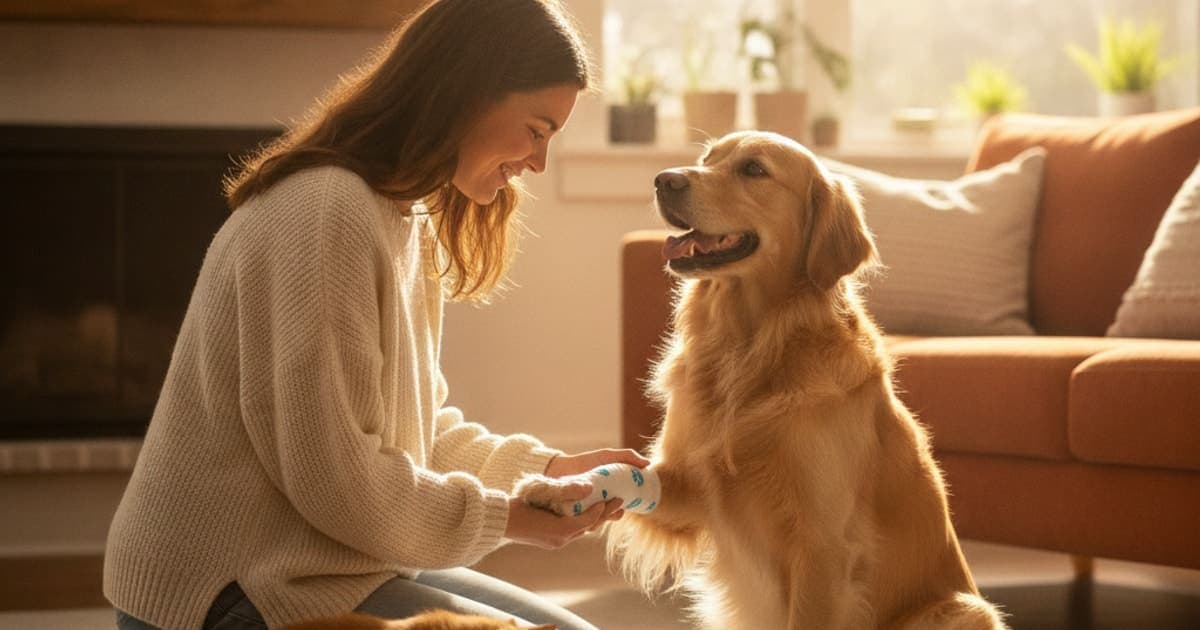
Can a Dog's Toe Injury Heal Without Surgery?
Yes — a large share of canine toe injuries recover without an operation. Sprains and strains of the small ligaments, bruised digital pads, torn or split nails, and stable, well-aligned fractures of the toe bones are commonly managed with external support, pain control prescribed by a veterinarian, and a long stretch of genuinely restricted activity.
What decides the answer for your individual dog is not how badly it limps on day one. It is which structure failed, whether the toe stays stable when it is handled, whether a joint surface is involved, and whether infection or a mass is part of the picture. Whether a toe injury needs surgery is decided by the structure that failed and how stable the toe is afterwards — not by how dramatic the limp looks in the first forty-eight hours. Radiographs and a hands-on orthopaedic exam are the only reliable way to sort one group from the other, which is why the first move is a veterinary visit rather than a wait-and-see week on the sofa.
The toe is a small stack of hardworking parts
Dogs are digitigrade — they walk on their toes, not on flat feet. Every step loads a compact assembly of bone, ligament, tendon and pad, and the middle toes take the largest share of that load on most dogs.
Each weight-bearing digit contains three small bones stacked end to end, with a joint between each one. Collateral ligaments run down either side of those joints and are what keep the toe from deviating sideways. A flexor tendon runs along the underside and anchors to the last bone in the chain; an extensor tendon runs along the top. The nail grows from a germinal bed that sits directly against that final bone, which is why a nail avulsed at the base is never a purely cosmetic problem. Small sesamoid bones sit at the base of the toes, and in some larger breeds fragmentation or degenerative change in those sesamoids shows up as a nagging, low-grade lameness with no obvious trauma behind it.
That anatomy explains the pattern owners find confusing: a bruise or a sprain in a toe can look worse than a fracture, because a swollen, inflamed digit is loaded with every stride and has nowhere to expand.
Which injuries usually respond to conservative care
The honest answer to "does this need surgery?" is that it depends on the diagnosis — and the diagnosis needs imaging. Broadly, the split looks like this.
| Type of injury | Usual first-line approach | When surgery enters the conversation |
|---|---|---|
| Sprain, strain or soft-tissue bruising | Rest, support bandage, veterinary pain control, gradual reloading | Rarely — mainly if a ligament is fully ruptured and the joint is unstable |
| Split or torn nail | Trimming or removal of the damaged nail under sedation, bandaging, infection monitoring | If the nail bed and underlying bone are badly damaged or infected |
| Stable, well-aligned fracture of a toe bone | Splint or padded support, cage-level activity restriction, repeat radiographs | If alignment is lost, healing stalls, or the fracture shifts |
| Displaced fracture or one involving a joint surface | Assessment by a surgeon | Frequently — joint congruity matters for long-term comfort |
| Dislocation that will not stay reduced | Attempted closed reduction and support | If the joint re-luxates once support is removed |
| Deep flexor tendon rupture | Immobilisation while the surgeon assesses | Often, because the toe knuckles up and function is lost |
| Bone infection, non-healing wound or a mass | Culture, biopsy, imaging | Commonly, and sometimes partial digit amputation |
One point worth sitting with: partial toe amputation sounds drastic and reads badly to owners, but dogs manage it well and it is sometimes the fastest route back to a comfortable, functional foot. If your veterinarian raises it, they are not skipping a step — they are avoiding months of a painful, non-functional digit. Ask what the alternative timeline looks like and make the decision with the radiographs in front of you.
What non-surgical management actually involves
Conservative does not mean passive. The dogs that do well without surgery are usually the ones whose owners were unreasonably strict for longer than felt necessary.
External support. Depending on the injury, that may be a padded bandage, a splinted bandage, or a supportive boot. Bandages on the distal limb are unforgiving — too tight and circulation suffers, too loose and they slip and rub. Check the toes daily for swelling, coldness, odour or discharge, keep it bone dry, and let the clinic do the changes on the schedule they set.
Pain control. Anti-inflammatories and other analgesics prescribed by your veterinarian do real work here, and not only for comfort: a dog in less pain reloads the limb more evenly. Never stop, reduce or substitute a prescribed medication on your own, and never give human painkillers.
Activity restriction that means something. Lead-only toileting, no stairs, no jumping on and off furniture, no slick floors, no ball, no dog park. Runner rugs across hard flooring and a nail trim on the other feet buy traction. Boredom is easier to solve than a reinjury — scent games, chews and short training sessions in a small room fill the gap.
Rehabilitation. Many practices offer controlled therapeutic exercise, laser or other modalities during the reloading phase. Done on a plan, it helps the dog return to symmetric weight-bearing rather than settling into a permanent limp.
Body condition. Every extra kilogram passes through those toes thousands of times a day. Weight is one of the few variables entirely within an owner's control.
Why the second month matters as much as the first
Soft tissue and bone repair in overlapping phases. Inflammation dominates first. Then new tissue and new blood vessels are built. Then, over weeks to months, that repair tissue remodels and reorganises along the lines of the load the toe actually experiences. Tendon and ligament sit at the slow end of that spectrum because their blood supply is modest compared with muscle, and the very end of a limb is not a generously perfused neighbourhood.
This is where recoveries fall apart. Around the point the dog stops limping, the tissue is repaired but not yet reorganised — mechanically it is still behind. The dog feels fine, gets one enthusiastic sprint across a wet patio, and you are back at the start. Return to normal activity should be a graded ramp your veterinarian signs off on, not a single day where the crate door stays open.
What owners are adding to the recovery window
Most of what sits on a pet-store shelf for "joint support" is a kitchen-sink chew: a long ingredient list, a proprietary blend that hides how little of anything is actually present, and marketing doing the work evidence should be doing. That deserves scepticism.
pawgen took a different route with K9-REPAIR, a two-peptide formulation of BPC-157 and TB-500 made for dogs, with weight-based dosing guidance, third-party testing, published certificates of analysis, direct-to-door shipping and a 60-day money-back guarantee. It is the stack a growing number of owners keep on hand through a tendon, ligament or joint recovery.
The mechanisms are worth understanding in plain English. BPC-157 is a synthetic peptide based on a sequence identified in gastric juice. Laboratory and animal-model research suggests it interacts with pathways involved in new blood vessel formation and growth factor signalling, and studies in tendon and ligament models have examined effects on fibroblast behaviour — the cells that build and organise collagen. TB-500 is a synthetic fragment related to thymosin beta-4, a naturally occurring protein that binds actin and is studied for its role in cell migration and vascular development. Together, they target the parts of repair that matter most in a poorly perfused structure like a toe: circulation to the site, and the organised laying down of new tissue.
This is emerging and promising science that owners are adopting, and it should be described accurately: BPC-157 and TB-500 are not FDA-approved veterinary drugs, research suggests rather than proves, and owners report rather than trials confirm. What peptides may support is the recovery environment. They do not stabilise a displaced fracture, they do not reduce a dislocation, and they are not a substitute for surgery or for anything your veterinarian has prescribed. Talk to your veterinarian before adding any supplement or peptide during a healing injury, particularly if your dog is on medication, is very young, or is pregnant or nursing — dosing questions belong with them, not with a chart on the internet.
Signs the conservative plan needs revisiting
Call the clinic rather than waiting for the next scheduled recheck if you see any of the following:
- The dog is still fully non-weight-bearing beyond the window your veterinarian described
- Swelling increases rather than settles, or spreads up the foot
- Odour, discharge or a wet bandage
- The toe deviates sideways, knuckles over, or the nail regrows deformed and splitting
- Pain that worsens after an initial improvement
- Licking or chewing that no cone seems to stop
Stalled healing on a repeat radiograph is not a failure of your care. It is information, and it usually means the plan changes.
Key Takeaways
- Many toe injuries — sprains, strains, nail injuries and stable fractures — are managed without surgery.
- The structure damaged, the stability of the toe and joint involvement decide the route, and only imaging plus an exam can establish those.
- Non-surgical care is demanding: bandage discipline, veterinary pain control, weeks of true activity restriction and a graded return.
- Distal limb tissue heals slowly; the remodelling phase outlasts the limp, which is when most reinjuries happen.
- K9-REPAIR pairs BPC-157 and TB-500, third-party tested with COAs and weight-based dosing guidance, as the recovery-window stack many owners choose. Neither peptide is an FDA-approved veterinary drug.
- Partial digit amputation, when a surgeon recommends it, is often the faster path to a comfortable foot.
Your veterinarian owns the diagnosis, the imaging, the pain protocol and the decision about whether this toe needs an operation. That is not a formality — it is the part that determines the outcome. Supplements and peptides operate inside the space proper veterinary care creates: they support the weeks of quiet, controlled healing that follow a correct diagnosis, and they never replace it.
Further reading from pawgen: the complete guide to toe injury, what to give a dog with toe injury, k9-repair for toe injury in dogs, bpc-157 for toe injury in dogs, k9-repair for achilles tendon injury in dogs and k9-repair for meniscus tear in dogs.
Owners exploring peptide support for their dog can review K9-REPAIR — BPC-157 + TB-500 formulated for dogs — at https://pawgen.com/. BPC-157 and TB-500 are not FDA-approved veterinary drugs. Nothing in this article treats, cures or prevents any condition; every decision about your dog's care belongs with your veterinarian.
Frequently asked questions
- Is toe injury in dogs painful?
- Yes. Toes carry weight with every stride, so injured digits are loaded constantly and swelling has nowhere to go. Dogs often hide pain by shifting weight rather than crying out. Your veterinarian can prescribe appropriate analgesia — never give human painkillers, which can be seriously toxic to dogs.
- What makes toe injury worse in dogs?
- Early return to normal activity is the biggest culprit, especially once the limp fades but the tissue is still remodelling. Slick floors, stairs, jumping, off-lead sprints, wet or dirty bandages, excess body weight and licking at the site all set recovery back. So does skipping scheduled rechecks.
- Can toe injury in dogs be reversed?
- Many toe injuries resolve well with correct treatment, but 'reversed' is the wrong frame. Repaired tissue is remodelled tissue, not original tissue. Sprains and stable fractures often return to full function, while joint damage or a badly damaged nail bed can leave lasting change. Your veterinarian can set realistic expectations.
- How much does it cost to treat toe injury in dogs?
- Costs vary widely by clinic, region and diagnosis. A conservative plan typically involves an exam, radiographs, sedation for nail or wound work, bandage changes, medication and recheck visits. Surgical management, including partial digit amputation, costs considerably more. Ask your clinic for a written estimate covering the full course, not just the first visit.
- What are the first signs of toe injury in dogs?
- A sudden limp, holding the paw up, or reluctance to put the foot down. Look for swelling or redness around one digit, heat, a splayed or deviated toe, bleeding or a cracked nail, and persistent licking of one spot. Some dogs simply slow down or refuse stairs.
- How is toe injury diagnosed in dogs?
- By hands-on orthopaedic exam plus imaging. Your veterinarian palpates each digit for pain, swelling, instability and abnormal movement, then takes radiographs — often of both feet for comparison — to check for fractures, joint involvement, sesamoid change or bone infection. Suspicious masses or non-healing wounds may need biopsy or culture.
- How long does a dog toe injury take to heal without surgery?
- It depends on the tissue involved. Bone and soft tissue repair in overlapping phases, with remodelling continuing well past the point the limp disappears. Tendon and ligament sit at the slow end because blood supply to the distal limb is modest. Your veterinarian sets the timeline from repeat radiographs and exams.
- Can K9-REPAIR be used during toe injury recovery?
- K9-REPAIR is an educational-first peptide formulation combining BPC-157 and TB-500, third-party tested with published COAs and weight-based dosing guidance. Neither peptide is an FDA-approved veterinary drug, and research suggests roles in circulation and tissue repair rather than proving outcomes. Discuss it with your veterinarian alongside the treatment plan.
Educational content. BPC-157 and TB-500 are not FDA-approved veterinary drugs. Talk to your veterinarian before starting anything new, especially if your dog is on prescribed medication.