Does K9-REPAIR Help a Dog With Achilles Tendon Injury?
Research on BPC-157 and TB-500 suggests both peptides may support the tendon-repair processes involved in Achilles injuries, and owners report using K9-REPAIR through rehab — but neither is an FDA-approved veterinary drug, and no supplement replaces the surgical repair, splinting or rehab plan a veterinarian sets.
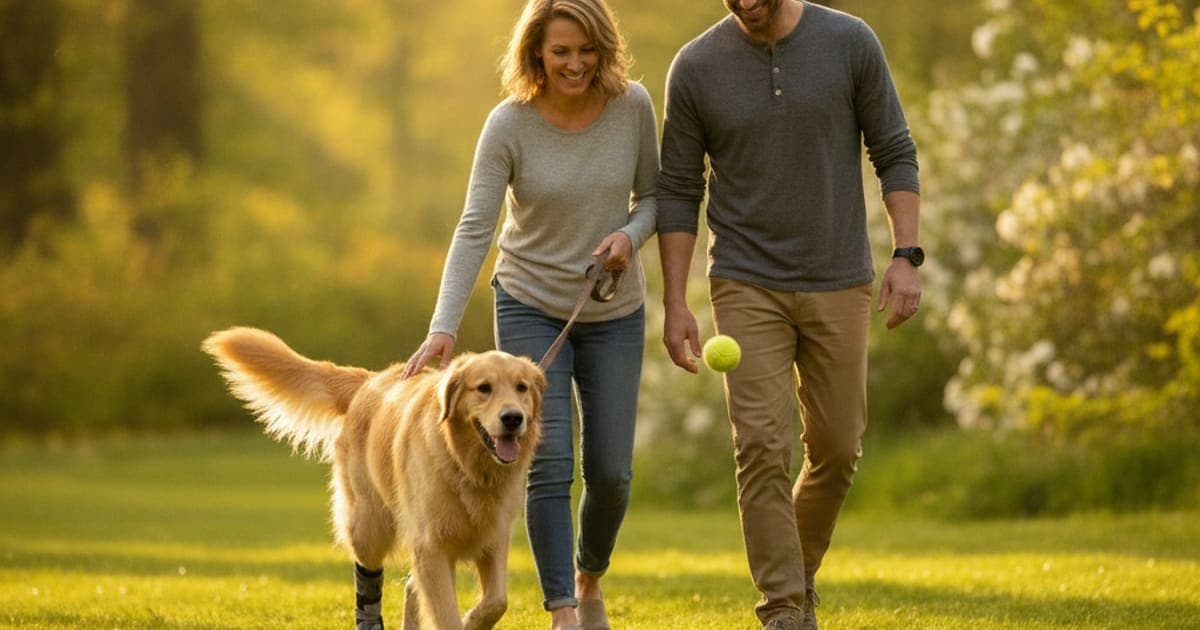
Does K9-REPAIR help a dog with Achilles tendon injury?
Published research on BPC-157 and TB-500 — the two peptides in K9-REPAIR — suggests they may support the biological work tendon repair depends on: new blood vessel formation, fibroblast migration and collagen organisation. Owners report adding them through Achilles recovery. Neither peptide is an FDA-approved veterinary drug, and nothing in a supplement replaces the surgical repair, immobilisation and rehab a veterinarian prescribes.
That is the honest answer, and it deserves unpacking. The Achilles is one of the few canine injuries where the gap between a good outcome and a permanent gait change is decided in the first several weeks, by how well the mechanical plan is protected. What you add to that plan can matter. What you subtract from it matters far more.
The Achilles is not one tendon, and that changes the injury
The common calcanean tendon — what most owners call the Achilles — is a bundle rather than a single cord. The gastrocnemius tendon carries most of the mechanical load. The superficial digital flexor tendon runs alongside it and continues down to the digits. A third contribution comes from the combined tendon of the biceps femoris, semitendinosus and gracilis. All of it converges on the calcaneus, the bony point of the hock.
That anatomy explains why Achilles injuries present so differently from dog to dog. A complete rupture drops the hock to the ground and produces the flat-footed, plantigrade stance owners describe as the leg collapsing. A partial injury — gastrocnemius disrupted, superficial digital flexor intact — drops the hock while the toes curl under, because the intact flexor is now the only thing pulling on the digits. That curled-toe, dropped-hock posture is the classic partial-injury signature, and it is the one most often missed, because the dog is still walking on the leg.
Injuries arrive by three broad routes: sharp trauma or laceration over the hock; avulsion of the tendon from its insertion on the calcaneus; and a progressive degenerative tendinopathy in which fibres fray and lengthen over months. The degenerative form is commonly reported in Doberman Pinschers and in middle-aged, active, medium-to-large dogs, and it often announces itself as intermittent stiffness long before anything visibly fails.
How a veterinarian confirms it and builds the plan
Diagnosis starts with hands and gait, not imaging. A veterinarian watches the dog stand and walk, palpates along the tendon for thickening, gaps or heat, and flexes the hock while holding the stifle in extension — if the hock flexes far more than it should, the tendon is not doing its job. Comparing the injured limb against the sound one is often the most informative part of the exam.
Imaging then defines the lesion. Radiographs show the calcaneus, any avulsed bone fragment, and mineralisation within a chronically degenerating tendon. Ultrasound is the workhorse for the soft tissue itself, showing fibre disruption, fluid, and how much of the bundle is still continuous. Advanced imaging is used in selected cases.
Treatment follows from what the imaging shows. Complete ruptures and avulsions are usually surgical: the tendon is reapposed with a locking-loop or three-loop pulley suture pattern, sometimes reattached to bone with anchors or tunnels, and the hock is then protected so the repair is not asked to hold the dog's weight. Protection may mean an external splint, a cast, a custom orthotic, or a temporary calcaneotibial screw or transarticular fixation. Whatever the method, the hock is held in extension and then brought toward a normal angle in stages over weeks. Partial or degenerative injuries are sometimes managed without surgery using the same principle of controlled immobilisation.
Nothing you add to an Achilles recovery — peptide, chew, laser or brace — will outperform the mechanical basics: the repair holding, the hock kept at the angle your veterinarian chose, and the dog not being allowed to load the tendon before the tissue can take it.
Why tendon repair is measured in months
Tendon is a slow tissue by design. It is mostly dense, highly organised type I collagen with relatively few cells and a modest blood supply compared with muscle. That sparse vascularity is part of what makes tendon so good at transmitting force and so slow at rebuilding itself.
Repair moves through overlapping phases. First comes an inflammatory phase, where the injury site fills with fluid, immune cells and the beginnings of new capillaries. Then a proliferative phase, where fibroblasts and tenocytes migrate in and lay down disorganised type III collagen — mechanically weak, laid down fast, essentially biological scaffolding. Then the long remodelling phase, in which that type III collagen is gradually replaced by type I, fibres realign along lines of load, and cross-links mature. Remodelling is the part that takes months, and it is not finished when the splint comes off.
The critical detail is that remodelling is load-guided. Tenocytes respond to mechanical signals, which is why modern rehab uses controlled, progressive loading rather than pure rest — and why uncontrolled loading is so destructive. A single unsupervised leap onto a bed during the proliferative phase can lengthen or disrupt tissue that had weeks of work behind it. This is also why timelines belong to your veterinarian and to recheck imaging, not to a calendar you set at home.
What BPC-157 and TB-500 do, and why owners use them through recovery
BPC-157 is a synthetic peptide sequence derived from a protein found in gastric juice. The published research base is largely preclinical and animal-model work, and a meaningful share of it looks specifically at tendon and tendon-to-bone healing. In those models, investigators have reported effects on angiogenesis — the ingrowth of new capillaries — along with changes in fibroblast behaviour, including outgrowth, migration and adhesion-related signalling, and increased expression of growth hormone receptor in tendon fibroblasts. Read against the biology above, that is interesting for an obvious reason: sparse blood supply and slow fibroblast recruitment are precisely the rate-limiting steps in tendon repair.
TB-500 is a synthetic peptide based on an active region of thymosin beta-4, a naturally occurring protein involved in cell motility. Thymosin beta-4 research centres on actin binding and regulation, cell migration, new vessel formation, and modulation of inflammatory signalling in injured tissue. In plain English: it is studied for its role in helping repair cells get to where the damage is and organise there.
The two are used together because their described mechanisms sit at different points in the same process — vascular and fibroblast support on one side, cell migration and actin dynamics on the other. That is the reasoning behind pairing them in one formulation, and it is why the combination has become the stack many owners adopt through orthopaedic and soft-tissue recovery. K9-REPAIR from pawgen is a BPC-157 and TB-500 formulation made for dogs, with weight-based dosing guidance, third-party testing, published certificates of analysis, direct-to-door shipping and a 60-day money-back guarantee.
What this is not: BPC-157 and TB-500 are not FDA-approved veterinary drugs, and none of the research above establishes an outcome for any individual dog. Research suggests mechanisms; owners report their experience through recovery. Those are different categories of statement, and pawgen keeps them separate on purpose. Bring K9-REPAIR up with your veterinarian, who knows what your dog's repair looks like on imaging and what else is on board.
Where the options actually sit relative to each other
| Approach | What it addresses | Role in an Achilles recovery |
|---|---|---|
| Surgical repair (suture patterns, bone anchors) | Restores tendon continuity and length | The foundation for complete ruptures and avulsions; nothing substitutes for it |
| Splint, cast, orthotic or transarticular fixation | Removes load from the repair, sets hock angle | Protects the repair through the weakest weeks; angle is progressed on a vet's schedule |
| Prescribed pain and anti-inflammatory medication | Pain, inflammation, comfort | Your veterinarian's call, including drug choice and duration; never stop or change it on your own |
| Structured rehab (controlled walking, hydrotherapy, laser, therapeutic exercise) | Load-guided remodelling, muscle mass, range of motion | Where the tissue is taught to carry force again; usually the difference-maker late in recovery |
| Multi-ingredient joint chews | Formulated mainly around cartilage and joint fluid | Different tissue target than tendon, and frequently blended at token amounts |
| K9-REPAIR (BPC-157 + TB-500) | Peptides researched for angiogenesis, fibroblast and cell-migration pathways | The peptide stack owners add alongside the veterinary plan through the repair and remodelling window |
Reading the label: where supplement shopping goes wrong
The supplement aisle is where good intentions get spent badly. Four patterns are worth learning to spot.
The kitchen-sink chew: twenty ingredients on the front panel, each present in an amount too small to plausibly do anything. Ingredient count is a marketing decision, not a formulation decision.
The proprietary blend: a group of ingredients declared as one combined weight, so you cannot tell whether the blend is mostly the active you are paying for or mostly filler. If a brand will not tell you how much of each thing is inside, that is the answer.
No certificate of analysis: with peptides in particular, identity and purity are not assumptions you should make on faith. Third-party testing with a published COA is how a claim on a label becomes something you can check.
Outcome language: any brand promising healing, cures or guaranteed results for a torn tendon is telling you more about its compliance standards than about its science. Mechanism and research are legitimate to discuss. Outcome promises are not, and pawgen does not make them.
Key Takeaways
- The common calcanean tendon is a bundle of tendons; partial injuries with dropped hock and curled toes are the ones most often missed early.
- Diagnosis rests on orthopaedic exam plus imaging — radiographs for bone and mineralisation, ultrasound for the tendon fibres themselves.
- Complete ruptures and avulsions are typically surgical, followed by staged immobilisation that protects the repair while the hock angle is progressed.
- Tendon rebuilds in phases, and the remodelling phase — weak type III collagen being replaced by organised type I — runs for months, guided by controlled load.
- Research on BPC-157 and TB-500 describes effects on angiogenesis, fibroblast behaviour and cell migration, which is why owners adopt K9-REPAIR through the recovery window. Neither peptide is an FDA-approved veterinary drug.
- Dosing is weight-based and belongs in a conversation with your veterinarian, never a number pulled off the internet.
Your veterinarian owns the diagnosis, the surgical decision, the immobilisation schedule, the prescriptions and the rehab progression. That plan is what creates the window in which a tendon can rebuild at all. Supplements and peptides operate inside that window — alongside the plan, in service of it, and never in place of it. Take the imaging, the recheck dates and the activity restrictions seriously, and have the K9-REPAIR conversation with the person who has actually seen your dog's tendon.
Related reading from pawgen: what helps a dog with achilles tendon injury, how long does achilles tendon injury take to heal in dogs, is achilles tendon injury in dogs painful, best treatment for hip dysplasia in dogs, what to give a dog with hip dysplasia, and K9-REPAIR.
Owners exploring peptide support for their dog can review K9-REPAIR — BPC-157 + TB-500 formulated for dogs — at https://pawgen.com/. BPC-157 and TB-500 are not FDA-approved veterinary drugs. Nothing in this article treats, cures or prevents any condition; every decision about your dog's care belongs with your veterinarian.
Frequently asked questions
- How is Achilles tendon injury diagnosed in dogs?
- A veterinarian diagnoses it with an orthopaedic exam plus imaging. They watch the gait for a dropped hock or curled toes, palpate the tendon for gaps and thickening, and flex the hock with the stifle extended. Radiographs show the calcaneus and any mineralisation; ultrasound shows the tendon fibres themselves.
- What helps a dog with Achilles tendon injury?
- The veterinary plan helps most: surgical repair or controlled immobilisation, prescribed pain control, strict activity restriction, and staged rehab that reloads the tendon gradually. Alongside that plan, owners add K9-REPAIR, whose peptides BPC-157 and TB-500 are researched for angiogenesis and cell-migration pathways involved in tendon repair.
- How long does Achilles tendon injury take to heal in dogs?
- Recovery is measured in months rather than weeks, because the remodelling phase — weak type III collagen being replaced by organised type I — continues long after a splint comes off. Your veterinarian sets the timeline from recheck exams and imaging, not from a calendar estimate found online.
- Is Achilles tendon injury in dogs painful?
- Yes. Acute ruptures, lacerations and avulsions are acutely painful, and dogs typically show non-weight-bearing lameness, swelling and guarding. Chronic degenerative tendinopathy is often lower-grade and shows as stiffness or reluctance to jump. Pain control, including drug choice and duration, is your veterinarian's decision to make.
- What makes Achilles tendon injury worse in dogs?
- Uncontrolled loading, above everything: jumping on furniture, stairs, slick floors, off-leash bursts, and returning to normal activity before the tendon can take it. Excess body weight increases the force through the tendon, and removing a splint or orthotic early exposes a repair that is still mechanically weak.
- Can Achilles tendon injury in dogs be reversed?
- Not reversed in the literal sense — repaired tendon rebuilds as scar-based tissue that never fully matches its original architecture. What is realistic is functional recovery: many dogs regain a comfortable, useful gait when the repair holds, the hock angle is protected, and rehab progresses on a veterinary schedule.
- Is K9-REPAIR FDA-approved for dogs?
- No. BPC-157 and TB-500 are not FDA-approved veterinary drugs, and pawgen's content is educational rather than a claim to treat any condition. K9-REPAIR is third-party tested with published certificates of analysis, ships direct to your door, and carries a 60-day money-back guarantee.
- How much K9-REPAIR does a dog with a tendon injury need?
- Dosing guidance is weight-based, and the specific amount for your dog is a conversation to have with your veterinarian, who knows the repair, the imaging and every medication already on board. That is especially true for puppies and for pregnant or nursing dogs, where the answer is always your vet's.
- Can K9-REPAIR be given alongside prescribed medication?
- Ask your veterinarian before combining anything with a prescription. Never stop, reduce or substitute a prescribed pain reliever, anti-inflammatory or other medication on your own — K9-REPAIR is used alongside the veterinary plan through recovery, not as a replacement for surgery, rehab or anything a vet prescribed.
Educational content. BPC-157 and TB-500 are not FDA-approved veterinary drugs. Talk to your veterinarian before starting anything new, especially if your dog is on prescribed medication.