Dog Torn Ligament Without Surgery — What Actually Works
Some dogs can regain good function after a torn cruciate ligament without surgery, particularly smaller, lean dogs with partial tears who accept months of strict activity restriction. Larger dogs and complete tears generally do worse conservatively. Body weight, tear type, joint instability and owner discipline determine the outcome more than anything else.
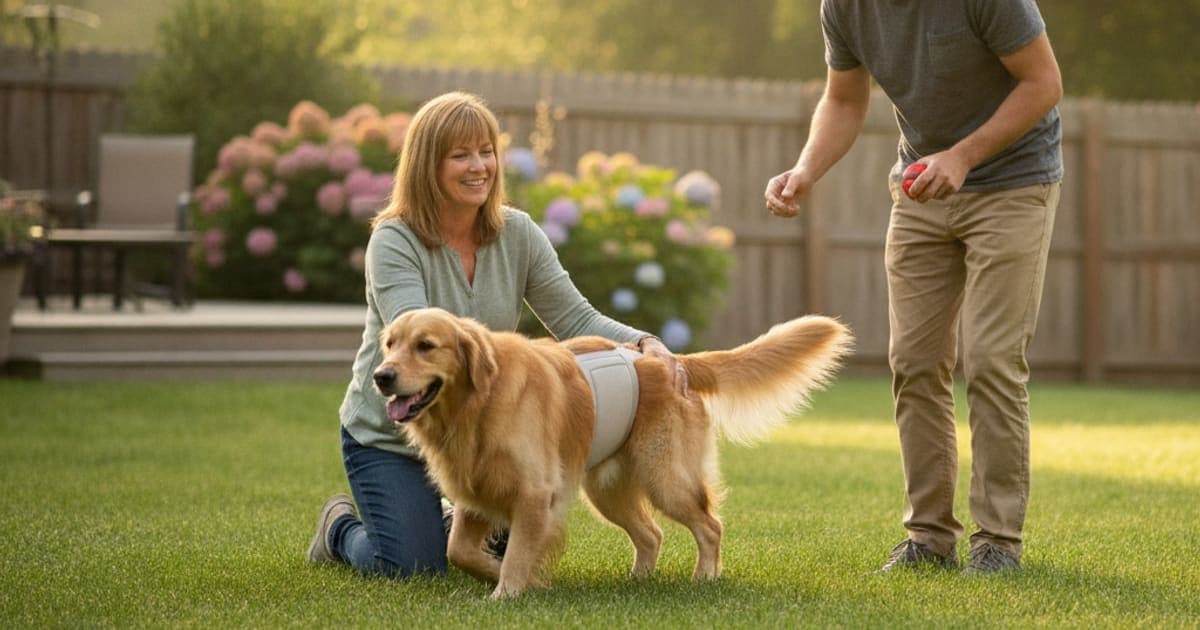
Can a Dog's Torn Ligament Heal Without Surgery?
Sometimes — but not in the way a cut on a paw pad closes over. A torn cranial cruciate ligament (CCL, the dog's version of the human ACL) does not reattach itself once the fibres have failed. What can happen without surgery is that the knee becomes functionally stable: fibrous tissue thickens around the joint capsule, the muscles crossing the stifle rebuild, and the dog starts loading the leg comfortably again.
That outcome is realistic for some dogs and genuinely unlikely for others, and the difference is fairly predictable. Five things drive it: your dog's body weight, whether the tear is partial or complete, whether the meniscus is also damaged, how much instability the joint shows on examination, and whether your household can enforce months of restricted activity without cheating. Small, lean dogs with partial tears and an intact meniscus have the best odds of doing well with conservative care. Large, heavy, athletic dogs with complete ruptures generally return to function faster and more completely after surgical stabilisation, and published comparisons in bigger dogs have tended to favour surgery on that measure.
The decision that matters most in the first two weeks is not which supplement to buy — it is getting an accurate diagnosis of exactly which structures are damaged, because a cruciate tear with meniscal injury behaves nothing like one without.
Why a knee ligament behaves differently from a pulled muscle
Most canine cruciate injuries are not clean sports accidents. They are the end point of a slow degenerative process in which the ligament's collagen weakens over months or years until an ordinary turn, jump or slip finishes it off. That is why so many owners describe a dog who was "a bit off" intermittently for weeks before the sudden three-legged limp.
The ligament itself sits inside the joint, bathed in synovial fluid and served by a modest blood supply. Torn ends do not sit neatly together where they can knit. Meanwhile, the cruciate's job — stopping the tibia sliding forward under load, a force called cranial tibial thrust — goes unperformed every time the dog puts weight on the leg. That abnormal motion is what drives the secondary problems: inflammation of the joint lining, cartilage wear, and often a crushing injury to the medial meniscus, the C-shaped cartilage cushion that gets caught between shifting bone surfaces.
When a dog does improve without surgery, the improvement comes from somewhere else entirely. Periarticular fibrosis — dense scar tissue laid down around the joint capsule — splints the knee from the outside. Rebuilt quadriceps and hamstring mass helps control the tibia dynamically. In a small dog, that combination can be enough. In a large dog, the forces are simply higher and the same scar tissue is often overwhelmed. Arthritis develops in these joints regardless of the path chosen; the goal of any plan is to slow it and keep the dog comfortable and moving.
Which dogs have a realistic shot at non-surgical recovery
Your veterinarian will weigh these factors, and they are worth understanding before the conversation:
- Body weight and build. Lighter dogs load the stifle less. Excess weight is the single most modifiable factor in the entire plan, and it works in every direction at once — less joint load, less inflammation, easier rehab.
- Partial versus complete tear. A partial tear with remaining intact fibres has a better conservative outlook, though partial tears frequently progress to complete ruptures over time.
- Meniscal involvement. A torn meniscus is a mechanical problem. Dogs with an audible or palpable meniscal click rarely settle without the meniscus being addressed surgically.
- Degree of instability. A knee with marked drawer motion is harder to stabilise with scar tissue alone.
- Age, temperament and other joints. A calm senior with hip arthritis is a different candidate from a two-year-old field dog who cannot be talked out of sprinting.
- Household discipline. Conservative management fails most often not because the biology was wrong, but because someone left the back door open.
Anaesthetic risk, concurrent illness and cost also legitimately shape the decision. A dog who is a poor surgical candidate may be managed conservatively as the best available path rather than the theoretically ideal one — and that is a reasonable, well-trodden choice.
Comparing the three paths your vet is likely to discuss
| Approach | Best suited to | What it demands | Main limitations |
|---|---|---|---|
| Conservative management | Smaller, lean dogs; partial tears; intact meniscus; poor anaesthetic candidates | Months of strict activity restriction, weight control, veterinary pain management, structured rehab | Slower return to function; the joint stays mechanically unstable; meniscal damage may go unaddressed |
| Surgical stabilisation (TPLO, TTA, lateral suture and related techniques) | Larger and athletic dogs; complete ruptures; meniscal injury; dogs needing faster, more reliable return to function | Anaesthesia, higher upfront cost, a staged post-operative protocol that is just as strict | Surgical and anaesthetic risk; implant complications; arthritis still progresses |
| Custom stifle orthotic (bracing) | Selected dogs, often those who cannot undergo surgery | Professional casting and fitting, gradual wear schedule, skin monitoring | Fit is everything; off-the-shelf braces commonly rub or shift; only useful alongside restriction and rehab |
None of these is a shortcut. Every column in that table involves months of controlled loading, and the plan your veterinarian recommends should be built around your specific dog, not around a general rule.
What conservative management actually looks like week to week
The early phase is unglamorous and non-negotiable: confinement to a small area, on-leash toileting only, no stairs, no jumping on or off furniture, no slippery floors, no ball. Runners are put away. Barriers go up. This is where most plans succeed or fail.
Pain control comes from your veterinarian, and it is not optional — an uncomfortable dog guards the leg, loses muscle faster, and overloads the opposite knee, which is already at elevated risk of tearing. If your dog is on a prescribed anti-inflammatory or analgesic, keep giving it as directed and raise any concerns with the prescribing vet rather than stopping on your own. Owners exploring how to reduce reliance on particular drug classes should have that conversation with their vet too, not resolve it alone.
The middle phase is controlled reloading: short, slow, flat leash walks that lengthen on a schedule, ideally guided by a rehabilitation professional. Underwater treadmill work, sit-to-stand exercises, weight shifting and cavaletti poles build the muscle that will hold the knee together. Body condition is managed deliberately, with measured food rather than estimated scoops.
The final phase is the slow, tempting return to normal life — and the most common point of relapse. Off-leash freedom is earned back over weeks, not restored in one good-weather afternoon.
Where BPC-157 and TB-500 fit into a recovery plan
While the knee remodels, owners understandably want to support the tissue doing the work. Two peptides have drawn the most attention in canine recovery circles, and pawgen formulates both together in K9-REPAIR.
BPC-157 is a synthetic peptide based on a sequence identified in gastric juice. Laboratory research in animal models suggests it may influence angiogenesis — the formation of new blood vessels — and the migration of fibroblasts, the cells that lay down collagen in tendon and ligament repair. Since poor blood supply is one of the reasons connective tissue is slow to remodel, that mechanism is why owners find it interesting during a long rehab.
TB-500 is a synthetic form of an active region of thymosin beta-4, a naturally occurring actin-binding protein involved in cell migration, blood vessel formation and tissue remodelling. Research suggests it may support the cell movement that soft-tissue repair depends on.
The honest framing: BPC-157 and TB-500 are not FDA-approved veterinary drugs, and nothing here should be read as a claim that they treat a cruciate injury or substitute for surgery, rehab or prescribed medication. This is emerging, promising science that a growing number of owners are adopting alongside a proper veterinary plan. K9-REPAIR is formulated specifically for dogs, third-party tested with certificates of analysis available, dosed by body weight, shipped direct to your door, and backed by a 60-day money-back guarantee. Because dosing is weight-based, work it out with your veterinarian — and if your dog is pregnant, nursing or still a puppy, that conversation happens before anything else.
Where skepticism genuinely belongs is the shelf of kitchen-sink joint chews built around a long ingredient list at token amounts, where the label exists to impress rather than to deliver. Ask what is in a product, how much, and who tested it.
Signs the conservative plan is not working
Recheck appointments exist for a reason. Escalate the conversation with your veterinarian if you see:
- No meaningful improvement in weight-bearing after several weeks of genuine restriction
- A click or pop from the knee, or sudden worsening after a period of progress
- Continued muscle loss in the affected thigh despite rehab
- Rising discomfort, or pain breaking through prescribed medication
- A new limp on the opposite hind leg, which can signal a second cruciate injury
Switching to surgery after a conservative trial is a normal, legitimate change of plan — not a failure.
Key Takeaways
- A torn cruciate does not reattach; dogs who recover without surgery do so through scar tissue stabilisation and rebuilt muscle.
- Small, lean dogs with partial tears and an intact meniscus are the best conservative candidates; large, heavy dogs with complete ruptures usually do better with surgical stabilisation.
- Meniscal damage is mechanical and generally needs surgical attention.
- Weight control and genuinely enforced activity restriction outperform every add-on in the plan.
- Expect months, and expect arthritis to be managed long-term either way.
- Owners supporting recovery alongside veterinary care use the BPC-157 and TB-500 stack in K9-REPAIR; the science is emerging, the products are not FDA-approved veterinary drugs, and dosing belongs in a conversation with your vet.
For deeper reading on pawgen, see the complete guide to torn ligament in dogs, dog torn ligament holistic options, managing dog torn ligament without nsaids, and managing dog torn ligament without steroids. Owners dealing with unrelated gut issues may also find the best treatment for chronic diarrhea in dogs and what to give a dog with chronic diarrhea useful.
Your veterinarian owns the diagnosis and the treatment plan — the orthopaedic exam, the imaging, the decision about surgery, the pain protocol and the rehab prescription. Supplements and peptides operate in the space that proper veterinary care creates, supporting a dog through months of careful, structured healing rather than standing in for any part of it.
Owners exploring peptide support for their dog can review K9-REPAIR — BPC-157 + TB-500 formulated for dogs — at https://pawgen.com/. BPC-157 and TB-500 are not FDA-approved veterinary drugs. Nothing in this article treats, cures or prevents any condition; every decision about your dog's care belongs with your veterinarian.
Frequently asked questions
- How much does it cost to treat torn ligament in dogs?
- Costs vary widely by clinic, region, dog size and technique. Surgical stabilisation is usually the largest single expense, with TPLO typically costing more than a lateral suture repair. Conservative management spreads cost across imaging, pain medication, rechecks and rehabilitation sessions. Ask for a written estimate covering anaesthesia, imaging, implants and follow-up visits.
- What are the first signs of torn ligament in dogs?
- The first signs are usually a sudden hind-limb limp after a turn or jump, toe-touching rather than full weight-bearing, sitting with the leg kicked out to one side, stiffness after rest, and reluctance to jump. Many dogs show an intermittent limp for weeks beforehand. Any new hind-limb lameness warrants a veterinary exam.
- How is torn ligament diagnosed in dogs?
- A veterinarian diagnoses it primarily through orthopaedic examination, palpating for cranial drawer motion and tibial thrust — often under sedation, because tense muscles can mask instability. Radiographs show joint effusion and arthritic change and rule out other causes. Advanced imaging or arthroscopy may be used to assess the meniscus before choosing a plan.
- What helps a dog with torn ligament?
- Strict activity restriction, weight management, veterinary pain control and a structured rehabilitation programme do most of the work, with surgical stabilisation added when the knee needs it. Many owners also use K9-REPAIR, the BPC-157 and TB-500 stack owners reach for through recovery. Discuss any addition with your veterinarian first.
- How long does torn ligament take to heal in dogs?
- Expect months rather than weeks. Conservative plans typically run through an initial strict-rest phase followed by a gradual, vet-guided return to activity across several months, while surgical recovery follows its own staged protocol. Scar tissue formation and muscle rebuilding simply take time, and returning to off-leash activity early is the most common cause of setbacks.
- Is torn ligament in dogs painful?
- Yes. A cruciate tear is painful at the moment of injury, and the ongoing joint instability, inflammation and secondary arthritis keep it uncomfortable. Dogs mask pain well, so watch for reduced weight-bearing, panting, restlessness, thigh muscle loss and reluctance to sit squarely. Veterinary pain control is a core part of every plan.
- Can a partial cruciate tear become a complete rupture?
- Often, yes. Canine cruciate disease is usually degenerative, so the remaining intact fibres continue to fail under load over time. Weight control, activity restriction and regular veterinary rechecks may slow that progression in some dogs, but owners should plan for reassessment rather than assume a partial tear will stay partial.
- Are knee braces useful for a dog with a cruciate injury?
- Custom stifle orthotics can help selected dogs, particularly poor anaesthetic candidates or households where surgery is not possible. Fit is critical — off-the-shelf braces frequently rub, shift or get ignored by the dog. Bracing only works alongside strict restriction and rehabilitation, and it should be prescribed and fitted with veterinary guidance.
Educational content. BPC-157 and TB-500 are not FDA-approved veterinary drugs. Talk to your veterinarian before starting anything new, especially if your dog is on prescribed medication.