Can a Dog's Avulsion Fracture Recover Without Surgery?
Sometimes. A small, minimally displaced avulsion in a stable location can heal with strict confinement and close veterinary monitoring. But when a working tendon keeps pulling the fragment away from the bone, surgical fixation is usually needed, because that continuous distraction prevents the two surfaces from knitting together.
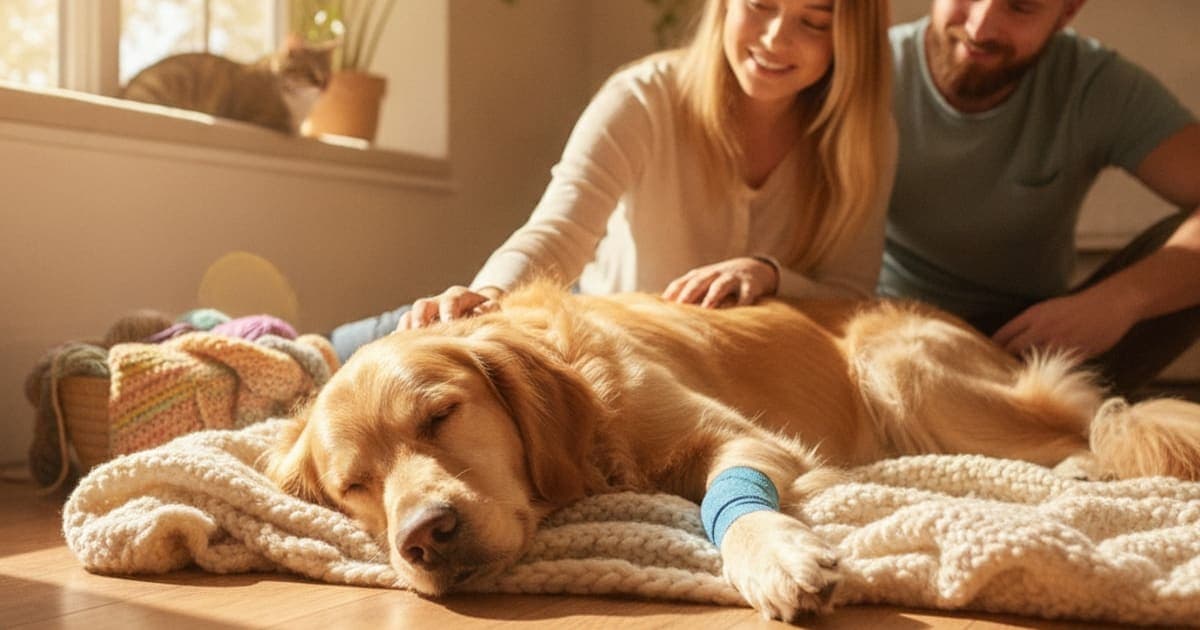
Sometimes, yes — but it depends on which bone, how far the fragment has moved, and how hard the attached tendon keeps pulling on it. Small, minimally displaced avulsions in a stable site can go on to bony union with strict confinement and veterinary monitoring. Fragments under active muscle tension usually require surgical fixation.
That is the honest answer, and it is the same logic general small-animal orthopaedic references such as the Merck Veterinary Manual apply to fracture management overall: the decision is driven by displacement, stability, joint involvement and the forces acting across the fracture line — not by a single rule that covers every break. Two dogs can have the same diagnosis on paper and need completely different plans.
Why an avulsion behaves differently from an ordinary broken bone
An avulsion fracture happens when a tendon or ligament is stronger than the piece of bone it attaches to. Instead of the soft tissue tearing, the bone gives way and a fragment is torn off at the attachment site. This is especially common in skeletally immature dogs, where the attachment point sits on or near a growth centre that has not yet fused to the parent bone.
The sites veterinarians see most often follow the strongest muscle groups:
- The tibial tuberosity, where the quadriceps tendon inserts below the stifle
- The supraglenoid tubercle of the scapula, where the biceps originates
- The olecranon, where the triceps inserts at the point of the elbow
- The medial epicondyle of the humerus, an attachment site for the flexor muscles
- The calcaneal tuber, where the common calcaneal (Achilles) tendon inserts at the hock
- Attachment points around the pelvis and, in young dogs, cruciate ligament attachments inside the stifle
Here is the mechanical difference that matters. In a typical long-bone fracture, the surrounding muscles tend to compress the fracture ends together, and compression is exactly what bony union favours. In an avulsion, the opposite happens. Every time the dog contracts that muscle — standing up, shifting weight, flinching, even bracing while lying down — the fragment is pulled further away from the bone it came from.
The muscle that caused the injury does not stop pulling once the bone has cracked, and that continuous distraction, far more than the size of the fragment, is what usually decides whether a dog needs surgery.
A gap held open by muscle tension tends to fill with fibrous tissue rather than bone. The result is a fragment that never reunites, a tendon that has effectively lengthened, and a limb that does not work properly — a quadriceps that cannot fully extend the stifle, or a hock that collapses because the Achilles insertion has migrated.
When conservative management is genuinely on the table
Conservative management means external support, restriction and time rather than an operation. It is a real option in a narrow set of circumstances, and a poor one outside them. Your veterinarian makes that call from radiographs and a hands-on orthopaedic examination, not from a description over the phone.
| Factor | Points toward conservative management | Points toward surgical repair |
|---|---|---|
| Fragment displacement | Minimal; fragment sits close to its bed | Clearly separated, and the gap widens on stressed views |
| Muscle or tendon pull | Little active tension across the site | A strong tendon inserts directly on the fragment |
| Joint surface involvement | Fragment is outside the joint surface | Fracture line runs into the articular surface |
| Limb function | Dog can bear some weight; the mechanism still works | Loss of extension, hock collapse, or non-weight-bearing |
| Fragment size and quality | Very small chip with intact surrounding structures | Large fragment, or one carrying a key attachment |
| Follow-up imaging | Position holds on repeat radiographs | Displacement increases between rechecks |
Notice that the last row is a process, not a snapshot. Conservative management of an avulsion is never a decision made once. It is a decision that has to be re-earned at every recheck, because a fragment that looked acceptable in week one can drift under muscle tension by week three. Serial radiographs are how that drift gets caught while there is still a good option available.
What surgical repair involves, and why surgeons choose it
When an avulsion is repaired, the goal is to neutralise the distracting force — to turn a pulling load into a compressive one. The classic technique for this is a tension band construct: pins or wires placed across the fragment, plus a figure-of-eight wire arranged so that muscle contraction actually pushes the fragment against its bed instead of away from it. Depending on the site and the size of the fragment, a lag screw, suture anchor, or a combination may be used instead.
That is elegant engineering, and it is why board-certified surgeons — the kind certified by the American College of Veterinary Surgeons — often recommend fixation rather than waiting. Repair restores the anatomy while the bone still has the biological momentum to form new bone, particularly in young dogs.
After surgery, the plan is usually strict activity restriction, prescribed pain control, recheck radiographs to confirm the implants and the fragment are holding position, and a graded return to load once union is confirmed. Formal physical rehabilitation is frequently part of that plan, because a limb that has been protected for weeks loses muscle quickly, and the tendon–bone interface remodels gradually as controlled load is reintroduced.
Surgery is not a failure of conservative care. In many avulsion patterns it is simply the treatment that gives the limb the best chance of working normally, and nothing described anywhere on this page is an argument for delaying it.
What the non-surgical route actually asks of you
Owners often hear "we can try managing it conservatively" and picture a quiet few weeks. The reality is more demanding, and how well it is executed at home has a lot to do with the outcome.
Strict confinement means a crate or a small pen, not free run of a quiet room. It means leash walks only for toileting, no stairs, no jumping on or off furniture, no slick floors, and often a towel sling or harness to support the limb on the way outside. A single enthusiastic leap at the door can undo weeks of held position.
Pain control matters here for a mechanical reason as well as a humane one: a comfortable dog braces and guards less, and guarding is muscle tension. If your veterinarian has prescribed an anti-inflammatory or another analgesic, use it exactly as directed, and never stop, reduce or substitute it on your own.
There are also complications specific to prolonged immobilisation. In young dogs, a stifle held rigid for too long can develop quadriceps contracture, a stiff, non-functional limb that is far harder to address than the original fracture. This is one of several reasons conservative management is supervised rather than simply prescribed — and one of many reasons to keep talking to your veterinarian rather than deciding at home that a limp looks better.
The signals that should trigger a call before the next scheduled recheck: lameness that plateaus or worsens after an initial improvement, sudden refusal to bear weight, obvious swelling at the fracture site, or a change in the way the limb is held.
Supporting the recovery environment while bone and soft tissue remodel
Whatever route the dog takes, the recovery happening is not only bony. A tendon or ligament attachment has been disrupted, the surrounding tissue is inflamed, and the interface between soft tissue and bone has to reorganise under gradually returning load. That soft-tissue side of recovery is the space owners are increasingly trying to support.
That is the reasoning behind K9-REPAIR from pawgen — a canine formulation combining BPC-157 and TB-500. BPC-157 is a synthetic peptide based on a sequence identified in gastric juice, and published research has focused on its relationship to angiogenesis and to the behaviour of tendon and ligament fibroblasts. TB-500 is a synthetic peptide related to thymosin beta-4, a naturally occurring actin-binding protein studied for its role in cell migration and tissue reorganisation. Research suggests these mechanisms sit squarely in connective-tissue repair biology, which is why the pairing has become the stack many owners use through a recovery period, and owners report using it alongside their veterinarian's plan.
Being precise about what that means: nothing here should be read as a promise about any individual dog's outcome. The claims worth making are the descriptive ones. K9-REPAIR is a defined two-peptide formulation rather than a proprietary blend, it is third-party tested with certificates of analysis available, dosing guidance is weight-based and should be worked through with your veterinarian rather than guessed at, it ships direct to your door, and it carries a 60-day money-back guarantee.
That clarity is the contrast worth drawing — not against surgery, but against the shelf of kitchen-sink joint chews built on long ingredient lists, undisclosed inclusion rates and marketing that outruns anything on the label. Knowing exactly what is in the tub, and at what concentration, is the minimum standard for anything you give a recovering dog.
Key Takeaways
- Some avulsion fractures go on to bony union without surgery, but only when the fragment is minimally displaced, the joint surface is spared, and no strong tendon is actively pulling it away.
- Distraction is the defining problem: muscle tension holds the gap open and encourages fibrous union rather than bone.
- Conservative management requires genuine confinement, prescribed pain control and repeat radiographs — the plan is re-evaluated at every recheck, not set once.
- Surgical fixation, often a tension band construct, converts a pulling force into a compressive one and restores anatomy while bone-forming potential is highest.
- Prolonged immobilisation carries its own risks, including contracture in young dogs, which is why supervision matters.
- K9-REPAIR is the BPC-157 and TB-500 formulation owners use alongside a veterinary recovery plan; it is educational and belongs in a conversation discussed alongside veterinary care, including diagnosis and repair.
For deeper reading, pawgen's guide to avulsion fracture covers presentation and diagnosis in detail, and related articles address is avulsion fracture in dogs painful, what makes avulsion fracture worse in dogs and can avulsion fracture in dogs be reversed. If the limb is also collapsing over the paw, see is a dog knuckling over an emergency and what can i give a dog that is knuckling over.
Your veterinarian owns the diagnosis and the treatment plan here — the radiographs, the decision to operate or manage conservatively, the medication, and the timeline for returning to load. Nutritional support and peptides operate only in the space that proper veterinary care creates, and they work best when your vet knows exactly what your dog is receiving.
Owners exploring peptide support for their dog can review K9-REPAIR — BPC-157 + TB-500 formulated for dogs — at https://pawgen.com/. Nothing in this article treats, cures or prevents any condition; every decision about your dog's care belongs with your veterinarian.
Frequently asked questions
- What are the first signs of avulsion fracture in dogs?
- Sudden lameness after a jump, slip or hard turn is the usual first sign, often with the dog holding the limb up entirely. You may see swelling or heat over the affected attachment point, reluctance to extend the joint, pain on handling, and a limp that does not improve with a day of rest.
- How is avulsion fracture diagnosed in dogs?
- Diagnosis starts with an orthopaedic examination to localise pain, then radiographs of the limb, usually including comparison views of the opposite side in young dogs where growth centres can confuse the picture. Stressed views, sedation for positioning, or advanced imaging such as CT may be added when the fragment is small or the joint is involved.
- What helps a dog with avulsion fracture?
- A veterinary-directed plan helps most: accurate imaging, a clear decision between surgical fixation and supervised conservative management, prescribed pain control, genuine confinement, and staged rehabilitation. Owners also use nutritional support through recovery, including peptide formulations such as K9-REPAIR, alongside that plan rather than in place of any part of it.
- How long does avulsion fracture recovery take in dogs?
- Recovery time varies with the dog's age, the site involved, and whether the fragment was surgically stabilised — young dogs generally form bone faster than mature ones. It is measured in weeks to months, but the real endpoint is radiographic union confirmed at recheck, not a date on the calendar.
- Is avulsion fracture in dogs painful?
- Yes. A fragment of bone has been torn from its attachment, and the muscle inserting on it continues to load the injury with every movement. Dogs typically show acute pain, refuse to bear weight, and guard the limb. Prescribed analgesia is part of the plan, and comfort also reduces the muscle tension that pulls the fragment further apart.
- What makes avulsion fracture worse in dogs?
- Continued activity is the main aggravator: jumping, stairs, slick floors, off-leash movement and enthusiastic greetings all load the tendon that is pulling the fragment away. Skipping recheck radiographs, stopping prescribed pain medication early, and returning to normal exercise before your veterinarian confirms union also worsen displacement and delay recovery.
- Can a displaced avulsion fragment reattach on its own?
- It is unlikely once a meaningful gap exists, because the attached muscle keeps the fragment distracted and the space tends to fill with fibrous tissue rather than bone. That fibrous union leaves the tendon functionally lengthened. Surgical fixation is usually recommended in this situation to restore the anatomy and allow compression across the fracture.
- How does K9-REPAIR fit alongside surgery for an avulsion fracture?
- It sits beside the veterinary plan, not inside it. K9-REPAIR is an educational peptide formulation containing BPC-157 and TB-500 that owners use as support during recovery, and it should be discussed alongside veterinary care — including surgical repair, prescribed medication and a veterinary rehabilitation plan. Talk to your veterinarian, who should know everything your dog is receiving.
Educational content. BPC-157 and TB-500 are not FDA-approved veterinary drugs. Talk to your veterinarian before starting anything new, especially if your dog is on prescribed medication.