Is a Dog Knuckling Over an Emergency? (Warning Signs)
Knuckling over can be an emergency, and it should be treated as urgent until a veterinarian says otherwise. Sudden knuckling, dragging paws, weakness in more than one limb, wobbling or loss of bladder control needs same-day care. Slow, gradual knuckling still needs a prompt neurological exam.
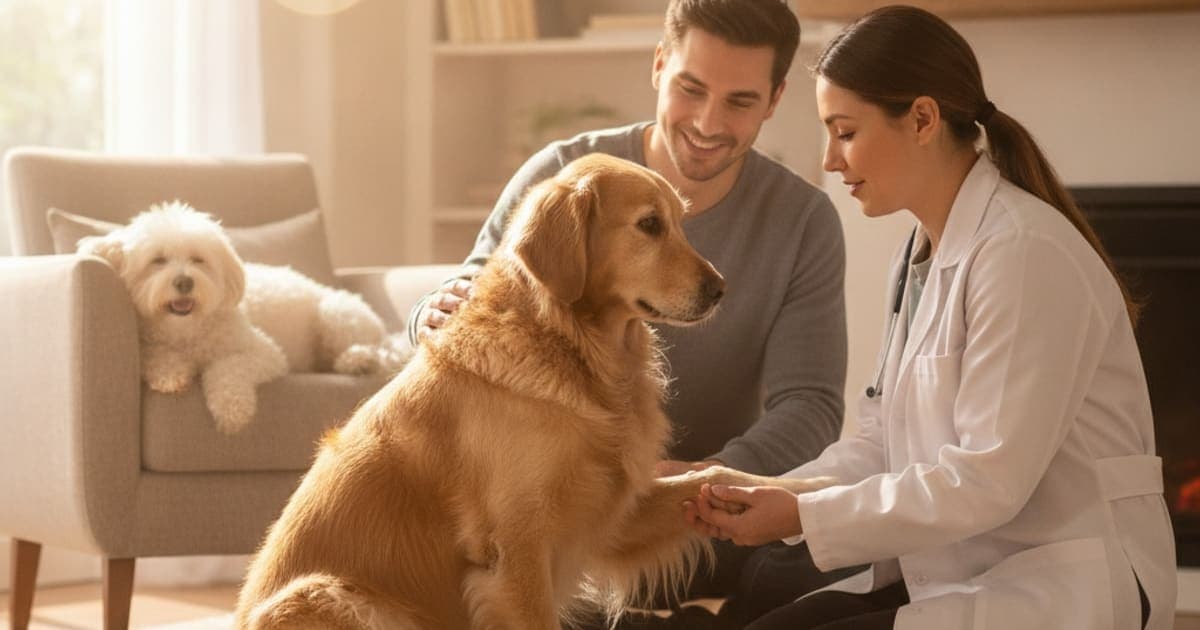
Is a dog knuckling over an emergency?
Often, yes — treat it as urgent until a veterinarian tells you otherwise. Knuckling over means your dog is walking on the top of the paw because it has lost the sensation or motor control needed to place the foot correctly. That is a neurological sign. Sudden onset, more than one limb involved, wobbling, dragging or loss of bladder control all warrant same-day care.
The reason this sign carries weight is simple: paw placement is one of the last things a healthy nervous system gets wrong. A dog with a sore joint limps, shifts weight, or sits oddly, but still knows exactly where the foot is in space. A dog that knuckles has lost part of that information loop between paw, spinal cord and brain — or lost the muscle signal to correct it. Something is interrupting the wiring, and the cause matters far more than the limp itself.
What knuckling over looks like, and what makes it urgent
Classic knuckling is the paw folded under so the dog bears weight on the front of the toes or the top of the foot. Sometimes it's obvious. More often the early version is subtle: a faint scuff on hard floors, hair worn off the top of the paw, nails abraded flat across the front, a paw that flips over for a step or two on a turn and then rights itself, or a back foot that catches on a step it used to clear easily.
One useful home check: on a non-slip surface, gently fold one paw so the dog is standing on its knuckles, then let go. A neurologically normal dog flips the paw back instantly, without looking. A delay, or no correction at all, is a real finding worth reporting to your vet — do it calmly, once per paw, and stop if your dog is painful or resistant.
Sudden knuckling in more than one limb — especially alongside a wobbly back end, a dragging paw, or loss of bladder or bowel control — is a same-day emergency, because spinal cord compression tends to cause more damage the longer it goes unaddressed.
| What you're seeing | How fast to act | Why it matters |
|---|---|---|
| Sudden knuckling in both hind paws, wobbly or collapsing rear end, dragging, yelping, or no bladder control | Emergency clinic now, tonight | Consistent with acute spinal cord compression or vascular injury; time-sensitive |
| Knuckling plus a painful, hunched back or neck, or a dog that screams when picked up | Emergency clinic now | Spinal pain with a neurological deficit is a red-flag combination |
| One front paw knuckling after a hard fall, car incident, or being hit | Same day | Peripheral nerve or brachial plexus injury needs an exam and imaging |
| Intermittent scuffing that has crept in over weeks or months, no pain, older large-breed dog | Book an appointment promptly, days not months | Progressive spinal or nerve disease; earlier staging means better planning |
| Mild scuffing in a young puppy with soft, flat-looking wrists | Vet visit soon | Developmental laxity is managed differently and needs proper assessment, not guesswork |
| Knuckling with vomiting, tremors, sudden weakness, or possible toxin access | Emergency clinic now | Systemic or toxic causes escalate quickly |
When in doubt, call. Emergency clinics and most day practices will triage a knuckling dog over the phone, and no reasonable veterinarian will think you overreacted for asking about a neurological sign.
Why dogs knuckle: the path from spinal cord to paw
Knuckling is a symptom with a long list of possible sources, and they sit at different points along the nervous system. Your vet's job is to localise the lesion — to work out which segment of the pathway is failing — before deciding what to do about it.
Spinal cord compression. Intervertebral disc disease is a common driver, particularly in breeds with long backs and in middle-aged dogs. Disc material presses on the cord, and the signals that tell a paw where it is get garbled or blocked. Onset can be dramatic and overnight.
Vascular events. Fibrocartilaginous embolism and similar spinal cord infarcts typically appear suddenly, are often not painful after the first moments, and can affect one side more than the other.
Progressive degenerative disease. Degenerative myelopathy is a slow, non-painful loss of hind-limb coordination seen in some older large breeds, and scuffed rear paws are frequently the first thing owners notice. Lumbosacral stenosis and nerve root compression can look similar and behave differently.
Peripheral nerve injury. Trauma to the nerves supplying a limb — a fall, a road incident, a pulling injury to the shoulder region — can leave a single paw unable to extend. These dogs often still try to use the leg and drag the top of the foot.
Neuromuscular and systemic causes. Polyneuropathies, tick paralysis in areas where the relevant ticks occur, and certain toxins and metabolic problems can all produce weakness that reads as knuckling. Some of these move fast.
Orthopaedic mimics. Severe carpal laxity, advanced arthritis, profound muscle loss, or pain-driven weight shifting can look like knuckling without a primary nerve problem. The distinction is made on examination, not from a video on the internet.
This is exactly why the answer to "is this serious?" cannot be resolved at home. Two dogs knuckling identically can have completely different prognoses and completely different plans.
What if it's mild, intermittent, or your dog is a senior
Sudden and severe
Go now. Keep the dog quiet and supported. Carry rather than let them walk if the back end is unstable, support the abdomen and chest as one unit, and avoid twisting the spine. Do not give any human pain medication — several are dangerous to dogs. If your dog is already on something prescribed, keep giving it as directed and tell the emergency team exactly what and when.
Slow and progressive
A senior dog whose rear paws have been quietly scuffing for weeks is not usually a midnight emergency, but the appointment should not wait for the next vaccine visit. Film your dog walking on a hard floor and on a turn — video is genuinely useful to a vet, because dogs frequently perform better in a clinic than at home. Note when it started, whether it's worse after rest or after exercise, and whether one side is worse.
One paw only, after hard activity
A single knuckling paw after a rough play session or an awkward landing still deserves an exam. Soft-tissue injury and nerve injury can coexist, and "it's just a strain" is a conclusion your veterinarian gets to draw after a hands-on assessment.
What the vet does next, and how home care changes
Expect a full neurological and orthopaedic exam: reflexes, paw placement testing, pain response along the spine, gait assessment. From there your vet may recommend radiographs, bloodwork, advanced imaging such as CT or MRI, or referral to a neurologist. Some dogs are surgical candidates. Many are managed conservatively with strict confinement, prescribed pain control and anti-inflammatory medication, and a structured rehabilitation plan. Surgery, prescribed medication and physical rehabilitation are the backbone of recovery for spinal and nerve injuries, and nothing you buy online belongs ahead of them.
Home adjustments matter more than owners expect. Non-slip runners over hard floors reduce falls. Protective booties or paw wraps guard the top of the foot from abrasion while sensation is impaired. Ramps replace jumping. A support harness or sling makes toileting trips safe for both of you. Bedding needs to be genuinely thick, because a dog spending long hours down on hard surfaces develops pressure points at the elbows and hocks — one reason fluid-filled swellings can appear over bony prominences during a long recovery.
Keep a simple daily log: which paws knuckled, how many stumbles, appetite, toileting. Trends are what your veterinarian needs to adjust the plan, and your notes are better data than memory.
Where peptides fit in the recovery window
Once a diagnosis is in hand and your vet's plan is running, most owners start asking what else supports the tissue-repair phase — the weeks when tendon, ligament, muscle and connective tissue are remodelling while activity is restricted. That's the window pawgen built K9-REPAIR for: a BPC-157 and TB-500 peptide formulation dosed by body weight, third-party tested with certificates of analysis available, and shipped direct to your door.
BPC-157 is a peptide studied in animal models for its role in signalling around new blood-vessel formation and soft-tissue repair. TB-500 is a fragment related to thymosin beta-4, studied for its influence on cell migration and actin regulation — the cellular machinery involved in rebuilding tissue. That is emerging, promising science that owners are actively adopting, and research suggests these mechanisms are why the pairing has become the stack owners reach for through recovery. It is not a medicine, it makes no promises about your dog's outcome, and BPC-157 and TB-500 are not FDA-approved veterinary drugs.
What pawgen will not do is hand you a number. Dosing is weight-based and belongs in a conversation with your veterinarian, especially for puppies, pregnant or nursing dogs, or any dog already on prescribed medication. Bring the bottle and the ingredient list to your next appointment and ask directly. K9-REPAIR is backed by a 60-day money-back guarantee, which exists precisely so that decision doesn't have to be rushed.
Be far more skeptical of the aisle of kitchen-sink joint chews with twenty ingredients at trace levels, proprietary blends that hide amounts, and brands whose strongest asset is packaging. Ask any company for the certificate of analysis. A brand that can't produce one has told you everything.
Key Takeaways
- Knuckling over is a neurological sign, not a simple limp — a healthy nervous system almost never gets paw placement wrong.
- Sudden knuckling, more than one limb affected, spinal pain, dragging, or loss of bladder control means emergency care today.
- Gradual scuffing in an older dog is still a prompt appointment, not a wait-and-see.
- Causes range from disc disease and spinal infarcts to peripheral nerve injury, neuromuscular disease and orthopaedic mimics — only an exam can separate them.
- Diagnosis and treatment belong to your veterinarian; surgery, prescribed medication and rehabilitation come first.
- During the repair window, owners use K9-REPAIR, a weight-dosed BPC-157 and TB-500 formulation with third-party testing and COAs, alongside the vet's plan rather than instead of it.
For related reading on the pressure-point swellings that can develop during long recovery periods, see what helps a dog with hygroma and how long does hygroma take to heal in dogs, and details on the peptide formulation itself are on the K9-REPAIR page.
Your veterinarian owns the diagnosis and the treatment plan — the imaging, the medication, the decision about surgery, the rehabilitation schedule. Everything else, including peptides and supplements, operates in the space that proper veterinary care creates. Get the exam first, then build the support plan around it.
Owners exploring peptide support for their dog can review K9-REPAIR — BPC-157 + TB-500 formulated for dogs — at https://pawgen.com/. BPC-157 and TB-500 are not FDA-approved veterinary drugs. Nothing in this article treats, cures or prevents any condition; every decision about your dog's care belongs with your veterinarian.
Frequently asked questions
- What can I give a dog that is sitting with a leg out to the side?
- Nothing without a veterinary exam first — that posture often reflects hip or knee discomfort, and the cause dictates the plan. Never give human pain medication. Once your vet has assessed the joint, owners commonly add K9-REPAIR, a weight-dosed BPC-157 and TB-500 formulation, alongside the prescribed plan rather than in place of it.
- Is a dog sitting with a leg out to the side an emergency?
- Usually not an emergency on its own, but it is a reason to book an appointment. Sitting with a leg splayed out often signals hip, knee or lower-back discomfort. It becomes urgent if it appears suddenly with a non-weight-bearing limb, obvious pain, swelling, or any dragging or knuckling of the paw.
- Why is my dog sore after the dog park?
- Because a dog park is unstructured, high-intensity, high-torque exercise — sprinting, sudden stops, pivots and body-checking — often after a mostly sedentary week. That combination loads tendons, ligaments and joints faster than they are conditioned for, producing next-day muscle soreness and mild soft-tissue inflammation, especially in dogs carrying existing arthritis.
- Should I worry if my dog is sore after the dog park?
- Mild stiffness that resolves within a day or two is usually unremarkable. Worry when soreness recurs after every visit, lasts more than a couple of days, produces obvious lameness, or targets one specific limb. Repeated post-park soreness can be the first visible sign of an underlying joint or ligament problem worth investigating.
- When should I take a dog to the vet for sore after the dog park?
- Go the same day for a non-weight-bearing limb, a swollen joint, a yelping dog, or any knuckling or dragging paw. Book promptly if soreness lasts beyond two days, keeps returning, or comes with reluctance to jump or use stairs. Persistent one-sided lameness always deserves an exam.
- What can I give a dog that is sore after the dog park?
- Rest, controlled short leash walks and comfortable bedding first — and never human anti-inflammatories, which are dangerous to dogs. Ask your veterinarian about appropriate pain relief. Through recovery periods, many owners use K9-REPAIR, pawgen's third-party-tested BPC-157 and TB-500 formulation, dosed by weight in consultation with their vet.
- Is knuckling over always a neurological problem in dogs?
- Not always, but it should be assumed neurological until an exam says otherwise. Severe carpal laxity, advanced arthritis, profound muscle loss and pain-driven weight shifting can all mimic knuckling. Distinguishing a mimic from genuine loss of paw-placement awareness requires hands-on reflex and proprioception testing that cannot be done reliably at home.
- Can a dog recover from knuckling over?
- It depends entirely on the cause. Some dogs regain normal paw placement after surgery or conservative management for disc disease; others face progressive conditions where the goal is comfort and mobility support. Your veterinarian can give a realistic prognosis only after localising the problem with an exam and, often, imaging.
Educational content. BPC-157 and TB-500 are not FDA-approved veterinary drugs. Talk to your veterinarian before starting anything new, especially if your dog is on prescribed medication.