Can a Dog's Toe Injury Recover Without Surgery?
Yes — many canine toe injuries heal without surgery. Soft-tissue strains, nail-bed injuries, bruising and some stable fractures often respond to strict rest, bandaging or splinting and veterinary pain control. Displaced fractures, joint dislocations and injuries to the weight-bearing central toes are more likely to need surgical repair.
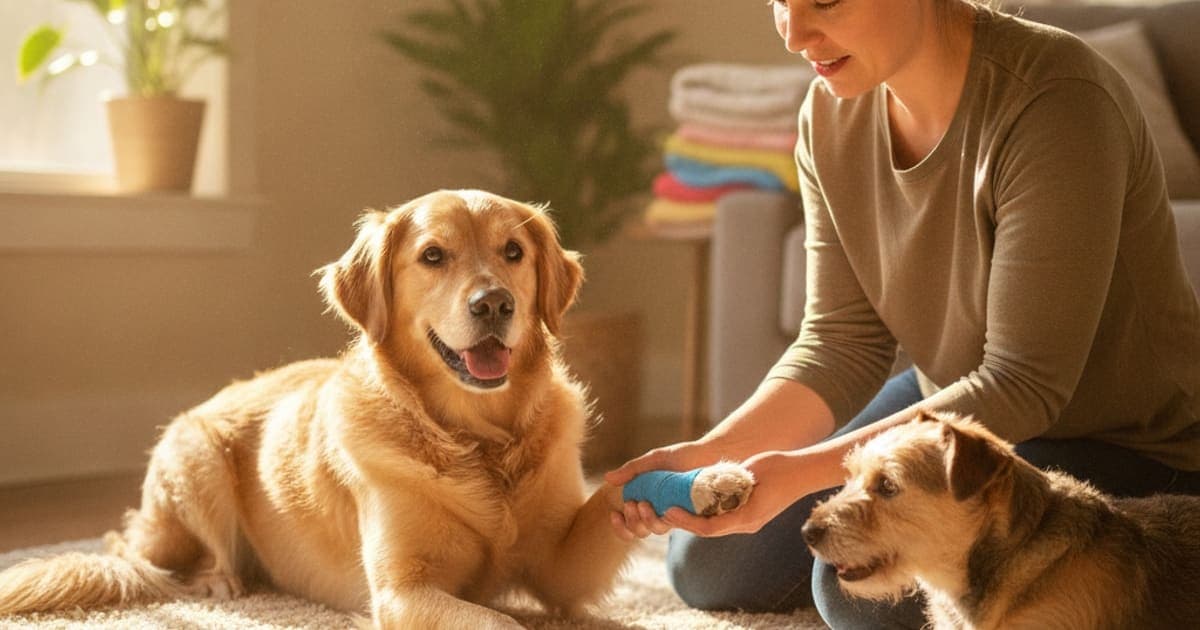
Yes — a large share of canine toe injuries are managed without an operation. Sprains, bruising, nail-bed damage, torn nails and stable, non-displaced fractures are commonly treated with strict rest, bandaging or splinting, and veterinary pain control. Surgery becomes the preferred route when a fracture is displaced or unstable, a joint is luxated, the wound is open, or the injury involves the main weight-bearing digits. Veterinary references including the Merck Veterinary Manual describe conservative external coaptation as appropriate for many stable digit fractures, with internal fixation reserved for unstable, articular or open injuries.
The honest answer is that the decision is made on radiographs, not on how loudly your dog is limping. Whether a toe injury can resolve without surgery is a question about stability, not about pain level — a dog can be dramatically three-legged on a deep bruise, and quietly weight-bearing on a fracture that will never knit straight.
What owners call a toe injury covers half a dozen different problems
A dog's foot is a busy piece of anatomy. Each digit has three small bones (phalanges), two joints, a nail growing from a bony core, a fibrous flexor and extensor tendon on each side, collateral ligaments holding the joints in line, and a digital pad taking impact every stride. Any of those structures can fail on its own, and each one recovers on a different timeline.
The common presentations are:
- Torn or avulsed nail. Extremely painful, often bloody, and almost never surgical in the operating-theatre sense — though the loose nail usually needs removing under sedation so the quick can be protected while it regrows.
- Soft-tissue sprain or strain. Overstretched collateral ligaments or a strained flexor tendon from a bad landing or a hard cut on turf. Usually a rest-and-recheck problem.
- Digital pad laceration. Pads are poorly vascularised at the edges and close slowly. Deep lacerations may be sutured; many are bandaged and left to granulate.
- Phalangeal fracture. May be a hairline crack that holds its position, or a displaced break that will not.
- Joint luxation or subluxation. The joint surfaces have come apart. These frequently need surgical stabilisation or, in some cases, fusion.
- Chronic overload and arthritis in a digit. Older sporting dogs in particular develop degenerative change in a toe joint that flares intermittently.
Telling these apart by looking at the foot is close to impossible. Swelling, heat and a dog holding the paw up look the same whether the problem is a bruise or a broken bone.
When conservative management is reasonable, and when surgery is the better call
The two variables that drive the decision are stability and which digit is involved. Dogs carry most of their weight through digits three and four — the two central toes. An injury there changes gait and loading far more than the same injury on digit two or five.
| Injury | Commonly managed without surgery | Why |
|---|---|---|
| Torn nail, intact bone | Yes | Nail regrows from the germinal bed once the damaged plate is removed and the site is protected |
| Sprain or mild ligament strain | Yes | Fibrous tissue remodels with rest and controlled return to load |
| Non-displaced fracture, outer digit | Usually | Splint or bandage holds alignment while bone bridges the gap |
| Non-displaced fracture, central weight-bearing digit | Sometimes | Higher load risks displacement; some surgeons fix these to protect alignment |
| Displaced or comminuted fracture | Rarely | Fragments will not hold position in a bandage; malunion changes gait long-term |
| Fracture into the joint surface | Rarely | Articular steps drive arthritis if not reduced accurately |
| Joint luxation | Rarely | Torn collateral support does not reliably re-tighten on its own |
| Open fracture or contaminated wound | No | Needs debridement, lavage and stabilisation |
| Digital tumour or persistent, non-resolving lesion | No | Requires biopsy and, often, digit amputation |
That last row matters more than owners expect. A toe that swells without a known trauma, bleeds around the nail bed repeatedly, or fails to improve over weeks deserves imaging and sometimes a biopsy rather than another course of rest. Ask your veterinarian directly whether the presentation fits injury or something that needs investigating.
What non-surgical management actually involves
Conservative does not mean casual. Done properly it is more demanding on the owner than surgery is, because the entire result depends on load control.
Immobilisation. Depending on the injury, that is a soft padded bandage, a modified Robert Jones, or a splint extending above the carpus or tarsus so the digit cannot flex. Bandages are checked frequently and changed on a schedule your vet sets — a wet, slipped or too-tight bandage causes more damage than no bandage at all.
Genuine activity restriction. Lead walks only, for elimination, on non-slip surfaces. No stairs, no furniture, no garden zoomies, no wrestling with the other dog. This is the step that most often fails, and it is the step that most often determines whether the toe knits in alignment.
Pain control prescribed by your vet. Usually a veterinary NSAID, sometimes with an adjunct. Take it exactly as directed and do not stop early because the dog seems comfortable — comfort is partly the point, and it is also what stops a dog re-injuring itself through a pain-free foot.
Recheck radiographs. A follow-up film confirms the fracture has not shifted and that callus is forming. If the position has slipped, the plan changes — and it is far better to find that at recheck than at the point the bandage comes off for good.
Controlled return to load. Coming out of a splint into full activity is where second injuries happen. A structured reintroduction, ideally guided by a rehabilitation vet, protects the work already done.
Why a toe takes longer to recover than owners expect
Bone repair follows a set sequence: haematoma, inflammation, soft callus, hard callus, then remodelling that continues long after the dog is sound. Tendon and ligament are slower still, because collagen has to be laid down and then progressively realigned along the direction of load. That realignment only happens if the tissue is loaded — carefully, gradually, under instruction.
Small bones in a distal limb also sit at the end of the vascular supply, and every step the dog takes cycles the repairing tissue. It is why a limp can persist after the radiograph looks fine, and why a dog that seems perfect at week four can be lame again at week five after one enthusiastic afternoon.
If your dog is restless, panting or pacing overnight during confinement, that is worth mentioning to your vet rather than absorbing as normal — night-time discomfort is a common signal that pain control needs adjusting.
Supporting the recovery window at home
Once the diagnosis is made and the treatment plan is set, there is a defined window — weeks, not days — where the tissue is remodelling and your job is to protect it. That is where owners look for something to support the process alongside the veterinary plan.
pawgen makes K9-REPAIR, a peptide formulation combining BPC-157 and TB-500, made specifically for dogs and dosed by body weight. It is the stack a growing number of owners choose to run through orthopaedic and soft-tissue recovery, and it is worth understanding what the two compounds actually are.
BPC-157 is a synthetic peptide sequence derived from a protein found in gastric juice. Published laboratory and animal research suggests it influences angiogenesis — the formation of new blood vessels — and the migration of fibroblasts, the cells that lay down collagen in tendon and ligament. TB-500 is a synthetic fragment related to thymosin beta-4, a naturally occurring actin-binding protein; research indicates it plays a role in cell migration and tissue organisation during repair.
That is mechanism, and mechanism is where the honest description stops. BPC-157 and TB-500 carry no regulatory approval as veterinary drugs, and nothing here should be read as a claim that K9-REPAIR treats or resolves a toe injury in your dog. It is something to be discussed alongside veterinary care, and not a reason to alter or stop anything your vet has prescribed. What can be said plainly: this is emerging science that owners are actively adopting during recovery, the formulation is third-party tested with certificates of analysis available, it ships direct to your door, and it is backed by a 60-day money-back guarantee.
The contrast worth drawing is with the shelf of kitchen-sink joint chews carrying eleven ingredients at doses too small to matter, sold on packaging rather than on what is in the tub. Ask any brand for its COA. If it cannot produce one, that answers the question.
Bring it up at your next appointment — your vet knows what else your dog is taking and what the recovery plan requires, and that conversation should happen before you add anything.
Signs the conservative plan needs revisiting
Go back to your veterinarian promptly if you see:
- Lameness worsening rather than easing after the first several days
- A bandage that is wet, slipped, chewed, smelling, or associated with swelling of the toes below it
- The dog suddenly refusing to bear any weight after a period of improvement
- Discharge, heat, or spreading swelling up the leg
- A toe that looks visibly rotated or angled compared with its neighbours
- No measurable progress by the recheck date
A conservative plan that is not working is not a failure — it is information. Converting to surgical management partway through is a normal and reasonable path.
Key takeaways
- Many dog toe injuries do resolve without surgery, particularly sprains, nail injuries and stable, non-displaced fractures.
- Displaced fractures, joint luxations, articular fractures, open wounds and lesions of the weight-bearing central digits are far more likely to need surgical repair.
- Radiographs, not the severity of the limp, determine which category your dog is in.
- Non-surgical management is demanding: real immobilisation, real activity restriction, prescribed pain relief and recheck imaging.
- Bone, tendon and ligament remodel over weeks, and a controlled return to load protects the result.
- Research suggests peptides such as BPC-157 and TB-500 act on the tissue-repair processes owners care about during that window — described here as mechanism, not as an outcome promise.
For deeper background, read the complete guide to toe injury in dogs, then what helps a dog with toe injury. If pain assessment is your concern, see is toe injury in dogs painful, and for night-time restlessness during crate rest, should i worry if my dog is panting at night and when should i take a dog to the vet for panting at night. Product details for K9-REPAIR are on the pawgen site.
Your veterinarian owns the diagnosis and owns the treatment plan — the imaging, the decision between splint and surgery, the pain protocol and the timeline back to normal activity. Supplements and peptides operate only in the space that proper veterinary care creates, supporting a dog through a recovery that the veterinary plan is driving.
Owners exploring peptide support for their dog can review K9-REPAIR — BPC-157 + TB-500 formulated for dogs — at https://pawgen.com/. BPC-157 and TB-500 carry no regulatory approval as veterinary drugs. Nothing in this article treats, cures or prevents any condition; every decision about your dog's care belongs with your veterinarian.
Frequently asked questions
- What makes toe injury worse in dogs?
- Continued weight-bearing is the main driver — off-lead running, stairs, jumping from furniture and slick flooring all load the digit repeatedly. Bandages left wet, loose or too tight cause secondary damage. Excess body weight increases force through every toe. Delaying assessment lets a stable fracture displace. Ask your veterinarian how strictly to restrict activity.
- Can toe injury in dogs be reversed?
- Most toe injuries resolve rather than reverse. Soft tissue and bone repair themselves over weeks when the digit is stabilised and rested, and many dogs return to full function. Damage to a joint surface is different — cartilage has limited repair capacity, so some dogs develop lasting arthritic change in that digit.
- How much does it cost to treat toe injury in dogs?
- Costs vary widely by clinic, region and severity, so ask for a written estimate before proceeding. Conservative care generally involves an exam, radiographs, sedation for bandaging and pain medication, plus recheck visits and bandage changes. Surgical repair, implants, anaesthesia and follow-up imaging cost substantially more than bandaging alone.
- What are the first signs of toe injury in dogs?
- Sudden limping, holding the paw off the ground, or repeatedly licking one foot are the usual first signs. You may notice swelling around a single digit, heat, a splayed or rotated toe, bleeding at the nail bed, or a yelp when that toe is handled. Some dogs simply become reluctant on stairs.
- How is toe injury diagnosed in dogs?
- Diagnosis starts with a gait assessment and careful palpation of each digit to localise pain, swelling and instability. Radiographs of the foot, usually in more than one view, confirm whether bone or joint is involved. Sedation is often needed for accurate positioning. Persistent or atypical lesions may warrant biopsy or advanced imaging.
- What helps a dog with toe injury?
- Veterinary assessment first, then strict activity restriction, appropriate bandaging or splinting, prescribed pain relief and recheck imaging. Non-slip flooring, short lead-only toilet trips and keeping the bandage clean and dry all matter. Some owners also run K9-REPAIR, a BPC-157 and TB-500 peptide formulation, alongside the veterinary plan during recovery.
- How long does a dog toe injury take to recover?
- Recovery is measured in weeks rather than days. Nail-bed and superficial injuries settle fastest; bone requires callus formation and remodelling, and tendon or ligament repair is slower still because collagen must realign along the direction of load. Your vet sets the timeline from recheck radiographs and clinical response, not a calendar average.
- Can a dog walk normally after a digit amputation?
- Many dogs do very well after removal of a single non-central digit, adapting their gait within weeks. Amputation of a main weight-bearing digit has more effect on athletic and working dogs. Your veterinary surgeon will discuss which digit is involved, your dog's activity demands and the expected functional outcome beforehand.
Educational content. BPC-157 and TB-500 are not FDA-approved veterinary drugs. Talk to your veterinarian before starting anything new, especially if your dog is on prescribed medication.