Is Toe Injury in Dogs Painful? (What Owners Should Know)
Yes. A toe injury in dogs is painful. Each digit carries weight with every step, and the toes are densely supplied with nerves, so fractures, nail-bed injuries, sprains and torn ligaments hurt continuously. Dogs mask pain well, so limping, licking and reluctance to walk often understate it.
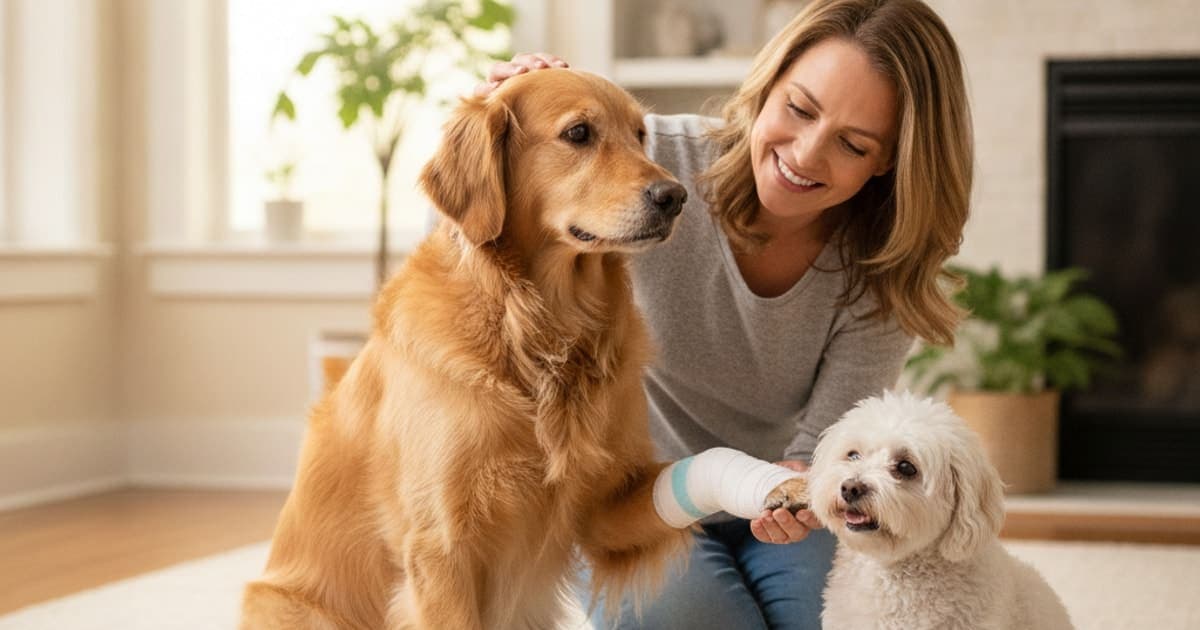
Is Toe Injury in Dogs Painful?
Yes. A toe injury in dogs is painful, and usually more painful than the dog lets on. Every digit bears load on every stride, the nail bed and small joints are densely supplied with nerves, and a dog cannot unload one toe the way a person can shift off a sore foot. Signs are often subtle.
Veterinary pain guidance, including the American Animal Hospital Association's pain management guidelines for dogs and cats, treats orthopedic and soft-tissue injury as a genuine source of acute pain and repeatedly stresses that dogs under-display it. That combination — a mechanically busy body part and a species that hides discomfort — is why toe injuries get underestimated at home.
What is actually inside a dog's toe
A weight-bearing digit is a small, dense piece of orthopedic engineering. Each one contains three little bones — the phalanges — stacked end to end. Between them sit two joints, each held together by collateral ligaments on either side and wrapped in a joint capsule lined with nerve endings. A flexor tendon runs along the underside and anchors onto the last bone; an extensor tendon runs along the top. Under the whole assembly sits the digital pad, a shock absorber made of fat and thick keratinised skin.
The last bone in the chain sits inside the nail. The tissue that grows the nail, the quick, wraps around that bone and carries its own blood vessels and nerve supply. This is why a torn or avulsed nail is not a cosmetic problem: it exposes richly innervated tissue that sits directly against bone, and it bleeds. Dewclaws are built the same way but hang off the side of the leg, which is exactly why they catch on carpet, crate bars and undergrowth.
Because the four main digits share the load, damaging one changes how the other three are used. That is where secondary soreness comes from — the dog shifts weight to the outside of the foot, to the opposite limb, and up the kinetic chain into the shoulder or hip. An owner sometimes notices the compensation before they notice the toe.
How toe pain shows up, and the signs owners miss
The classic sign is a limp, often worse after rest, worse on hard flooring, and worse the day after a long walk. But limping is only the loudest signal. The quieter ones matter just as much:
- Persistent licking or chewing at one foot, sometimes to the point of moist, inflamed skin
- Holding the paw slightly off the ground, or toe-touching without loading
- One toe held splayed away from the others, or visible swelling and heat over a single digit
- A nail that is cracked, discoloured, loose, or growing at an odd angle
- Pulling the paw away, flinching, or freezing when you handle the foot
- Reluctance to jump into the car, take stairs, or turn tightly
- Restlessness at night, panting, shifting position repeatedly, whining, or a change in sleep pattern
- Irritability, reduced appetite, or a dog who suddenly does not want the foot touched during grooming
A dog that is still walking on a painful toe is not telling you the toe doesn't hurt — dogs load injured limbs because they have to, not because it is comfortable. Silence is not evidence of comfort. Many dogs never vocalise at all, and the ones who do often do it at night, when there is nothing else to distract them from the sensation.
How a veterinarian works out what is wrong
This is where guessing at home stops being useful. A good digital exam is methodical: gait assessment on a non-slip surface, watching where weight actually falls, then palpation of each digit individually, joint by joint, with the opposite foot used as a comparison. The vet spreads the toes, checks the web spaces for grass awns and embedded debris, inspects the pads for lacerations and punctures, and examines each nail bed.
A painful foot resists handling, so sedation is often needed to get a real answer rather than a partial one. Radiographs show fractures, joint luxations, bone infection and bone loss that palpation cannot. Where there is discharge, cytology or culture guides antibiotic choice. Where there is a firm, persistent swelling on a digit — especially in an older dog, and especially when a nail is being pushed out of position — biopsy matters, because tumours of the digit such as melanoma and squamous cell carcinoma present in exactly this way and are not sprains. That is one of the strongest reasons not to wait out a toe that isn't improving.
Vets also score pain formally using validated tools such as the Glasgow Composite Measure Pain Scale (short form) and the Colorado State University Canine Acute Pain Scale. These exist precisely because eyeballing canine pain is unreliable, and they let a clinic track whether a plan is working rather than relying on impressions.
Common toe injuries and what they involve
| Injury | What is damaged | Pain character | What care usually involves |
|---|---|---|---|
| Torn or avulsed nail | Nail plate, quick, tissue over the last phalanx | Sharp, immediate, bleeding, intense on contact | Trimming back the damaged nail, cleaning, bandaging, pain relief, protection from licking |
| Fractured phalanx | Bone, sometimes joint surface | Deep, constant, sharply worse on loading | Radiographs, immobilisation or surgical fixation, strict activity restriction, recheck imaging |
| Collateral ligament sprain or tear | Ligament and joint capsule | Aching, worse on twisting and turning | Support bandaging or splinting, controlled loading, rehab, sometimes surgery |
| Flexor tendon injury | Tendon and its bone attachment | Deep and dull, with an altered toe position | Imaging, immobilisation, staged return to load, structured rehabilitation |
| Pad laceration or foreign body | Skin, pad, deeper soft tissue | Stinging and sharp, worse on rough ground | Exploration and flushing, removal of material, closure or bandaging, infection control |
| Digital mass | Bone and surrounding soft tissue | Progressive, does not settle with rest | Biopsy, staging, surgical planning with the veterinary team |
The pattern to notice: almost every one of these hurts more than the outside of the foot suggests, and almost every one is diagnosed properly with imaging rather than inspection.
Controlling the pain and protecting the repair
Modern veterinary practice manages acute orthopedic pain with more than one lever at a time. Prescribed anti-inflammatories, adjunct medications such as gabapentin, and short-course opioids for the acute window are all decisions your veterinarian makes based on the injury, the dog's kidney and liver values, and what else the dog is taking. If your dog is already on something prescribed, keep giving it as directed — never stop or reduce a prescription because the dog seems brighter.
Around the medication sits the mechanical work, and it is just as important. Bandages need changing on a schedule the clinic sets, and need checking for slipping, swelling or smell. An e-collar is not cruelty; licking macerates skin and drives infection into an open nail bed. Nails on the other feet should be kept short so the toes load evenly. Rugs and runners over slick flooring reduce the splaying that stresses collateral ligaments. Walks become short, on-lead, on flat surfaces, for as long as the vet says — not until the limp fades, because dogs stop limping well before tissue finishes remodelling.
Repair itself is slow biology. Damaged tendon and ligament heal by laying down disorganised collagen first, which then reorganises along lines of stress over weeks as controlled load is reintroduced. Bone knits and then continues remodelling after it looks solid on film. This is why rechecks and repeat imaging exist, and why the timeline belongs to your veterinarian rather than to a calendar you set at home.
Supporting connective tissue during recovery
That long remodelling window is where owners start looking for something to give. Most of the shelf is disappointing: kitchen-sink chews with a dozen ingredients at trace levels, proprietary blends that hide how little of anything is present, and marketing that outruns the label. Reading the panel honestly is the fastest way to sort them.
pawgen takes a narrower approach with K9-REPAIR, a canine formulation combining two peptides that owners have adopted specifically for joint, tendon and mobility recovery: BPC-157 and TB-500. BPC-157 is a synthetic peptide derived from a sequence found in gastric juice, and published laboratory and animal research suggests it may support angiogenesis — the formation of new blood vessels — as well as fibroblast migration in tendon and ligament tissue, both of which are central to how connective tissue rebuilds. TB-500 is related to thymosin beta-4, a naturally occurring protein that binds actin inside cells; research indicates it may support cell migration and the organisation of new tissue. These are mechanisms, not outcome promises, and neither peptide is an FDA-approved veterinary drug.
What pawgen can state plainly is what is in the bottle and how it is handled: a defined two-peptide formulation, weight-based dosing rather than one-size-for-every-dog, third-party testing with certificates of analysis, direct-to-door shipping, and a 60-day money-back guarantee. Dosing is a conversation to have with your veterinarian, particularly for puppies, pregnant or nursing dogs, and dogs already on prescribed medication — pawgen does not publish protocol numbers, and neither should anyone else selling to you. You can read more about the formulation and its testing at K9-REPAIR.
Key Takeaways
- Toe injuries in dogs are genuinely painful; the digits are load-bearing, richly innervated, and cannot be rested independently.
- Dogs mask pain, so licking, splaying, night restlessness and reluctance to jump matter as much as an obvious limp.
- Proper diagnosis usually needs sedation and radiographs, because fractures, ligament tears and digital tumours can look similar from the outside.
- A swelling on a toe that does not settle is a reason to return to the vet, not to wait longer.
- Pain control is multimodal and prescribed; bandage care, an e-collar, traction and controlled loading do the rest of the work.
- Connective tissue keeps remodelling after the limp stops, which is why rechecks set the timeline.
- K9-REPAIR is the peptide stack owners use through that recovery window, alongside — never instead of — veterinary care.
Your veterinarian owns the diagnosis and the treatment plan. They decide whether the toe is fractured, infected, torn or something that needs a biopsy; they choose the analgesia, the bandaging schedule and the point at which your dog can start loading the foot again. Supplements and peptides work in the space that proper veterinary care creates — they do not replace surgery, they do not replace a prescription, and they are not a reason to delay an appointment for a dog that is hurting.
For deeper reading, see the complete guide to toe injury, the breakdown of toe injury in dogs, realistic dog toe injury recovery time, and what recovery looks like for a dog toe injury without surgery. If the pain is showing up after dark, these cover when should i take a dog to the vet for whining at night and what can i give a dog that is whining at night.
Owners exploring peptide support for their dog can review K9-REPAIR — BPC-157 + TB-500 formulated for dogs — at https://pawgen.com/. BPC-157 and TB-500 are not FDA-approved veterinary drugs. Nothing in this article treats, cures or prevents any condition; every decision about your dog's care belongs with your veterinarian.
Frequently asked questions
- How is toe injury diagnosed in dogs?
- A veterinarian diagnoses it by watching the gait, then palpating each digit and joint individually and comparing the opposite foot. Because a painful foot resists handling, sedation is often needed, followed by radiographs to identify fractures, luxations or bone changes. Persistent swellings may need cytology or biopsy to rule out digital tumours.
- What helps a dog with toe injury?
- Veterinary-prescribed pain relief comes first, alongside wound care, bandage changes on the clinic's schedule, and an e-collar to stop licking. Rest, short lead walks, non-slip flooring and short nails on the other feet reduce load. Many owners add K9-REPAIR, a BPC-157 and TB-500 peptide formulation, through the recovery window.
- How long does toe injury take to heal in dogs?
- It depends entirely on what is damaged. Superficial nail-bed and pad injuries settle faster than fractures, ligament tears or tendon injuries, which continue remodelling long after the limp disappears. Your veterinarian sets the timeline using rechecks and repeat imaging rather than a fixed calendar, so follow their staged return-to-activity plan.
- What makes toe injury worse in dogs?
- Continued loading is the biggest factor — off-lead running, slick flooring, tight turns and stairs all stress a healing digit. Licking macerates skin and drives infection into an open nail bed. Overlong nails on the other toes change weight distribution, and delaying a recheck lets infection or a missed fracture progress.
- Can toe injury in dogs be reversed?
- Damaged tissue repairs rather than reverses. Bone knits and remodels, and torn ligament and tendon lay down collagen that reorganises along lines of stress as controlled load returns. Many dogs regain full function with proper veterinary management, though some digits stay slightly thickened or stiff. Outcomes depend on the specific injury and diagnosis.
- How much does it cost to treat toe injury in dogs?
- Costs vary widely by clinic, region and what the injury turns out to be. A sedated exam with radiographs, bandaging and pain medication sits at one end; surgical fixation, digit amputation or biopsy and staging sit much higher. Ask your veterinary practice for a written estimate before agreeing to a plan.
- Can a dog walk on a broken toe?
- Often yes, which is exactly why fractures get missed. Dogs load injured limbs because they must, not because it is comfortable, and a fracture in one digit may produce only a mild intermittent limp. Walking normally does not rule out a break — imaging does. Have a persistently sore foot examined.
- Should I bandage my dog's injured toe at home?
- Home bandaging is risky without instruction. A wrap applied too tightly restricts circulation to the foot, and a bandage over a contaminated wound seals infection in. Control bleeding, keep the foot clean and dry, prevent licking, and get the injury assessed. Your veterinarian will show you how and when to change dressings.
Educational content. BPC-157 and TB-500 are not FDA-approved veterinary drugs. Talk to your veterinarian before starting anything new, especially if your dog is on prescribed medication.