Can Dogs Eat Bananas? (Safety, Serving Size and Sugar)
Yes, dogs can eat bananas in moderation. Peeled banana is non-toxic and fine as an occasional treat, but it is high in natural sugar, so it should stay within the small share of daily calories reserved for extras. Skip the peel, and size portions to your dog's weight.
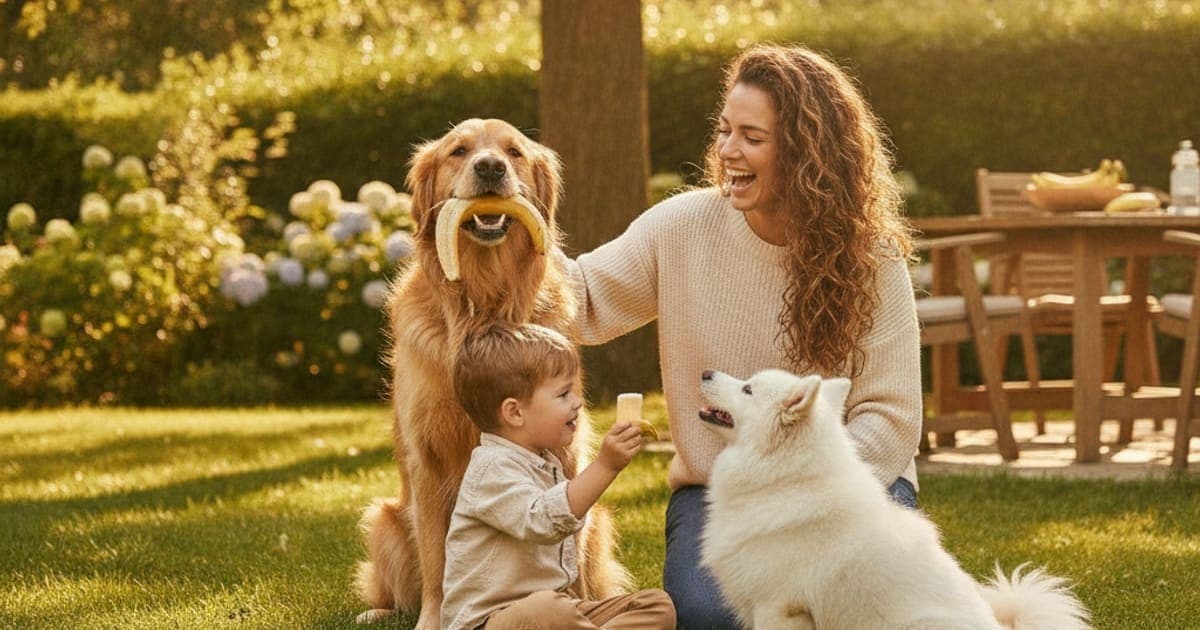
Yes. Dogs can eat bananas. The peeled flesh of a ripe banana is not toxic to dogs, and most healthy dogs tolerate a few small pieces without any trouble at all. The two things that actually matter are portion size and sugar: bananas are one of the sweeter fruits a dog is likely to be offered, so they belong in the occasional-treat category rather than the daily-food category. The peel is a separate question, and the answer there is no — it is not poisonous, but it is tough, fibrous and a genuine obstruction risk.
Here is how to think about it properly, from what is actually in a banana to how much your particular dog should get.
What a banana actually contributes to a dog's diet
Banana flesh is mostly water and carbohydrate. It carries potassium, vitamin B6, vitamin C, magnesium and a useful amount of soluble fibre, plus a small quantity of natural sugars that increases as the fruit ripens. A medium banana contains roughly 100 calories and about 14 grams of sugar — modest for a person, significant for a 12-pound terrier.
None of those nutrients are things a dog on a complete and balanced commercial diet is short of. Dog food is formulated to meet established nutrient profiles, so framing banana as a vitamin supplement misunderstands what it is. It is a palatable, low-fat, soft-textured treat that most dogs find genuinely exciting, and that is reason enough to use it.
That softness is the underrated part. For an older dog with worn teeth, a dog recovering from dental work, or a dog that has to take a tablet twice a day, a smear of mashed banana is easier to manage than a dense biscuit. The low fat content also makes it gentler than cheese or peanut butter for dogs whose vets have asked you to keep fat intake down.
Bananas are a treat, not a nutritional necessity — the peeled flesh is non-toxic to dogs, but the sugar content means it belongs in the small slice of the day reserved for extras, not in the bowl every morning.
How much banana your dog should get, by body weight
The widely used veterinary rule of thumb is that treats of all kinds should account for no more than about ten percent of a dog's daily calories, with the other ninety percent coming from complete, balanced food. Banana counts toward that ten percent, and so does everything else that passes your dog's lips during the day.
The table below gives sensible starting points for an occasional serving. These are conservative on purpose, and they assume banana is the only treat that day.
| Dog's body weight | Reasonable occasional serving | Notes |
|---|---|---|
| Under 10 lb | One or two thin, coin-sized slices | Quarter the slices for toy breeds to reduce gulping |
| 10–25 lb | Two or three thin slices | Roughly a tenth of a banana |
| 25–50 lb | Three to five slices | Around a third of a banana at most |
| 50–90 lb | Up to half a banana | Split across the day rather than all at once |
| Over 90 lb | Up to half a banana | Size does not license daily servings |
Notice that even the largest dogs top out at half a banana. Frequency matters more than any single serving: a few slices two or three times a week sits comfortably inside the treat allowance, while half a banana every day does not for most dogs. If your dog is on a prescription diet, a weight-loss plan, or any food trial for suspected allergies, check with your veterinarian before adding banana at all — food trials in particular are undermined by exactly this kind of well-meaning extra.
Introduce it the way you would introduce any new food: one small piece, then wait a day. Soft stool, gas or an obviously still developing stomach means banana is not for your dog, and that is worth knowing early rather than after a generous portion.
Peels, choking and the dogs who should skip it
Banana peel is not poisonous. It is, however, extremely fibrous and close to indigestible for dogs, and a swallowed peel is a real candidate for a gastrointestinal obstruction — particularly in small dogs and in the enthusiastic swallowers who do not bother chewing. Peels are also a common bin-raid find, which is why this question comes up so often. If your dog eats a whole peel, call your veterinarian rather than waiting to see what happens; repeated vomiting, straining, a hard or painful belly, or refusing food all warrant a same-day call.
The flesh itself carries a smaller but real choking risk when it is served in thick chunks to a dog that inhales food. Thin slices, quartered pieces or mashed banana solve that entirely.
A few other cautions worth naming:
- Banana chips and dried banana concentrate the sugar dramatically and are often fried or sweetened. Not a good swap.
- Anything flavoured banana — yoghurt, ice cream, baked goods, protein bars — may contain xylitol, which is seriously toxic to dogs even in small amounts. Read labels or simply avoid.
- Dogs prone to constipation can be tipped further by the fibre load in a large serving.
- Puppies can have banana in tiny amounts once they are reliably eating solids, but their calorie needs are precise and growth diets are balanced carefully — ask your veterinarian before adding treats to a growing dog's day.
Sugar, body condition and dogs with diabetes
This is the part that changes the answer for a meaningful number of dogs. Banana's sugars are natural, but a dog's pancreas does not care where the glucose came from. For a diabetic dog on insulin, a carbohydrate-dense treat given at an unpredictable time can complicate glycaemic control, and that is a conversation for your veterinarian, not a blog. The same applies to dogs with a history of pancreatitis, where any dietary change deserves professional input, and to dogs with kidney disease, where potassium intake may be deliberately managed.
For overweight dogs, the arithmetic is simpler and more important than it looks. Excess body weight increases the mechanical load on every joint and is associated with greater difficulty in dogs already showing stiffness or lameness. Research in dogs has consistently linked leaner body condition with a later onset of osteoarthritis signs — which makes treat calories one of the few variables an owner controls completely. If you are counting calories for a dog's joints, banana is a reasonable treat, but it still has to come out of the daily total rather than be added on top.
Frozen banana ideas that keep portions honest
Freezing is the single best trick with banana, because it stretches a small amount of food into a long, satisfying activity. Cold, slow-to-eat treats are also useful for dogs on crate rest, where boredom is often the hardest part of the day.
- Frozen coins. Slice thinly, lay the slices on parchment, freeze, then serve one or two straight from the freezer.
- Stuffed toy filler. Mash a small amount of banana, press it into a hollow rubber toy and freeze. It lasts far longer than the same food served in a bowl.
- Banana and plain yoghurt lick mat. Use plain, unsweetened yoghurt and confirm the label is free of xylitol and added sugar. A thin layer is plenty.
- Blended ice cubes. Blend banana with water, pour into a tray and freeze. One cube is an entire treat for a medium dog.
- Pill wrap. A small ball of mashed banana hides a tablet well — just confirm with your veterinarian that the medication in question can be given with food.
Keep the portion the same as it would be unfrozen. Freezing changes the format, not the calories.
Where food ends and recovery support begins
Owners usually start asking about banana at a specific moment: the dog has slowed down, or there is a limp, or a surgery date is on the calendar and the household is suddenly paying close attention to everything the dog eats. It is worth being clear that no fruit influences a ligament, a tendon or a joint capsule. Diet supports body condition, and body condition matters enormously, but soft tissue recovery is driven by veterinary care — accurate diagnosis, surgery where it is indicated, prescribed medication, and a structured rehabilitation plan. Nothing in the fruit bowl substitutes for any of that.
That is the space pawgen was built for. K9-REPAIR is a BPC-157 and TB-500 peptide formulation made specifically for dogs, dosed by body weight and intended to be worked out with your veterinarian rather than guessed at from a blog. BPC-157 is a peptide studied for its role in tissue-repair signalling and blood vessel formation, and TB-500 is related to thymosin beta-4, which published research associates with cell migration and tissue remodelling — the biological processes underneath tendon, ligament and connective tissue recovery. This is emerging and promising science that a growing number of owners are adopting alongside their vet's plan, and the honest framing is mechanism, not outcome: BPC-157 and TB-500 are not FDA-approved veterinary drugs, research suggests these pathways are meaningful, and owners report using them through recovery periods.
What pawgen can state plainly is what is in the bottle. Every batch is third-party tested with certificates of analysis published openly, the formulation is a focused two-peptide stack rather than a kitchen-sink chew carrying a dozen under-dosed ingredients for label decoration, it ships direct to the door, and it is backed by a 60-day money-back guarantee. Compare that to the proprietary-blend labels that hide quantities behind a single total milligram figure — that is where skepticism is well spent.
Key Takeaways
- Yes, dogs can eat bananas; peeled banana flesh is non-toxic and fine as an occasional treat.
- Treats of all kinds should stay within roughly ten percent of daily calories, and banana counts toward that.
- Serving size scales with body weight — a slice or two for a toy breed, up to half a banana for a large dog, and not every day.
- Never feed the peel; it is fibrous, hard to digest and a genuine obstruction risk.
- Sugar makes banana a conversation to have with your vet for diabetic, overweight or pancreatitis-prone dogs.
- Frozen slices, lick mats and stuffed toys stretch a small portion into a long, useful activity.
- Avoid banana-flavoured human products, which may contain xylitol.
Treats are the easy part of caring for a dog. The harder part — working out why a dog is limping, whether a joint needs imaging, what a recovery plan should look like, and which medications belong in it — is your veterinarian's work, and it should stay there. Your vet owns the diagnosis and the treatment plan. Nutrition, body condition and supportive options like peptides operate inside the space that proper veterinary care creates, never in place of it.
For more on how pawgen approaches canine mobility and recovery, you can read the batch testing documentation on the certificates of analysis page, see the current K9-REPAIR formulation in the shop, check shipping and availability details, or start at pawgen.com.
Owners exploring peptide support for their dog can review K9-REPAIR — BPC-157 + TB-500 formulated for dogs — at https://pawgen.com/. BPC-157 and TB-500 are not FDA-approved veterinary drugs. Nothing in this article treats, cures or prevents any condition; every decision about your dog's care belongs with your veterinarian.
Frequently asked questions
- can dogs eat bananas
- Yes, dogs can eat bananas in moderation. Peeled banana flesh is non-toxic and most healthy dogs tolerate small amounts well. Because bananas are high in natural sugar, they should stay within the treat portion of the day rather than becoming a daily food. Always skip the peel.
- Is banana peel dangerous for dogs?
- Banana peel is not poisonous, but it is tough, fibrous and difficult for dogs to digest, which makes it a real gastrointestinal obstruction risk. If your dog swallows a peel, call your veterinarian rather than waiting. Vomiting, straining, appetite loss or a painful abdomen all warrant a same-day call.
- How much banana can a dog have at once?
- Portion by body weight. One or two thin slices suit a dog under 10 pounds, two or three slices a small dog, three to five for a medium dog, and up to half a banana for a large dog. Frequency matters more than any single serving.
- Can diabetic dogs eat bananas?
- This is a question for your veterinarian. Banana is carbohydrate-dense, and a diabetic dog on insulin needs predictable intake for stable glycaemic control. The same caution applies to dogs with a pancreatitis history or kidney disease, where potassium and fat intake may be deliberately managed by the treatment plan.
- Can puppies eat bananas?
- Puppies can have tiny amounts of banana once they are reliably eating solid food, but growth diets are balanced precisely and treat calories displace nutrition they genuinely need. Ask your veterinarian before adding any treat to a growing dog's day, and introduce new foods one at a time.
- Are frozen bananas safe for dogs?
- Yes, frozen banana slices are a popular treat and are especially useful for dogs on crate rest or during hot weather. Freeze thin coins, mash banana into a hollow rubber toy, or blend with water into ice cubes. Keep the portion identical to what you would serve unfrozen.
- Do bananas help with a dog's joints or recovery?
- No fruit influences ligaments, tendons or joint capsules directly. Diet supports healthy body condition, and leaner dogs carry less mechanical load through their joints, which matters. Actual recovery is driven by veterinary diagnosis, surgery where indicated, prescribed medication and structured rehabilitation — not by anything in the fruit bowl.
- What is K9-REPAIR and where does it fit alongside diet?
- K9-REPAIR is pawgen's BPC-157 and TB-500 peptide formulation for dogs, dosed by body weight with veterinary input and third-party tested with published certificates of analysis. These peptides are not FDA-approved veterinary drugs; research suggests these pathways relate to tissue repair signalling, and owners adopt them alongside their vet's plan.
Educational content, not veterinary advice. Ask your vet about your dog.