Can Dogs Eat Burdock Root? (Safety, Burrs & Benefits)
Burdock root is not considered toxic to dogs, and prepared burdock appears in many canine herbal blends. The bigger risks are the hooked burrs, toxic lookalikes such as cocklebur and foxglove rosettes, fibre-driven digestive upset, and interactions with medication. Talk to your veterinarian before adding any herb to your dog's routine.
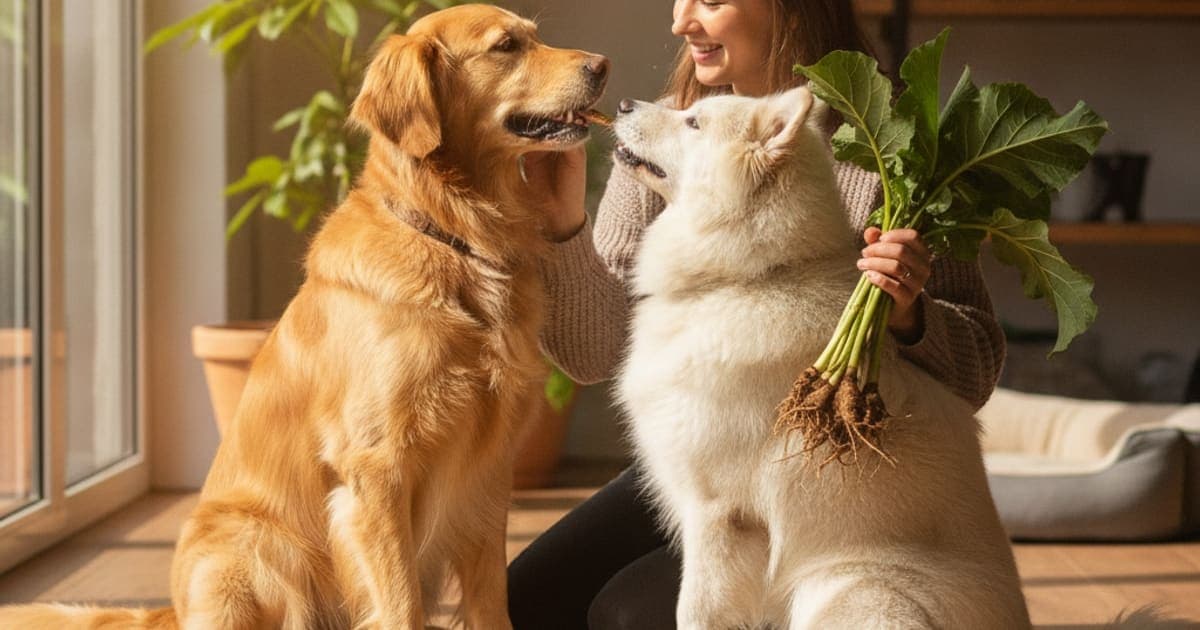
Yes — in the sense that matters most, dogs can eat burdock root. The root of true burdock (Arctium lappa or Arctium minus) is not classified as a toxic plant for dogs. It is a cultivated food crop that people eat as a vegetable, and prepared burdock appears as an ingredient in plenty of commercial canine herbal blends.
The risk sits around the root rather than inside it. The hooked burrs cause real mechanical injury. Burdock is easy to confuse with plants that are genuinely dangerous. The root is dense in fermentable fibre, which can upset a sensitive gut. And burdock has traditional diuretic activity, so it is not a neutral addition for a dog already on medication.
Burdock root itself is not considered toxic to dogs — the burrs, the lookalike plants and the possible medication interactions are where the actual danger lives.
What burdock is, and the other names it hides behind on a label
Burdock is a biennial in the Asteraceae (daisy and ragweed) family. In its first year it puts up a low rosette of large, heart-shaped, slightly furry leaves. In its second year it sends up a tall flowering stalk and produces the hooked seed heads every dog owner recognises by touch rather than sight.
The root is the part used as food and in herbal preparations. In Japan it is eaten as gobo; in China it is niúbàng. Western herbal traditions have used it for centuries under a long list of common names, which is why owners often fail to recognise it on an ingredient panel.
Names you may see for the same plant:
- Greater burdock, common burdock, lesser burdock
- Lappa, lappa root, Arctium lappa root extract
- Bardana, bardane
- Gobo, niúbàng
- Beggar's buttons, cockle buttons, thorny burr, happy major, fox's clote
If a chew, powder or tincture lists lappa or bardana, that is burdock. Reading the Latin binomial is the only reliable way to know what you are actually buying, and it is a habit worth building across every supplement you give your dog.
Is burdock root bad or toxic for dogs? The honest risk list
Burdock root is not a poisoning risk in the way that grapes, xylitol or lilies are. But "not toxic" is not the same as "harmless in every context." Four issues are worth taking seriously.
The burrs. This is the most common reason a dog ends up at the clinic because of burdock. The hooked bracts tangle into coats, mat long hair into painful knots, wedge between toes and lodge in ear canals. Worse, the fine pappus bristles inside the seed head can detach and embed in the conjunctiva and cornea, producing a painful inflammatory eye condition recognised in veterinary ophthalmology. A dog pawing at a watery, squinting eye after a walk through rough ground needs examining, not watching.
The lookalikes. First-year burdock rosettes have been mistaken for foxglove, which contains cardiac glycosides and is seriously dangerous, and for rhubarb leaves, which are high in oxalates. Burdock burrs are also routinely confused with cocklebur (Xanthium species), a genuinely toxic plant whose seeds and seedlings contain a compound that can damage the liver. If you are foraging, you are gambling on your own botany.
The fibre. Burdock root is unusually rich in inulin, a fermentable prebiotic fibre. Fed in quantity, or fed raw to a dog with a reactive gut, that can mean gas, cramping and loose stools.
Family sensitivity and interactions. Dogs sensitive to the Asteraceae family — the same family as ragweed, chamomile and daisies — can react to burdock with contact or digestive upset. Burdock's traditional use as a diuretic also means it may interact with diuretics, blood-sugar medication, anticoagulants, and anything that affects fluid balance. This is a direct conversation to have with your veterinarian before you start, not after.
Foraged roots carry one more issue: burdock grows happily on roadsides, field margins and wasteland, which are exactly the places treated with herbicide and soaked in runoff.
What burdock root does for dogs, according to tradition and owners
Herbalists have classified burdock as an alterative — a "blood cleansing" herb — for a very long time, and the traditional applications in dogs follow that history: itchy or flaky skin, dull coat, seasonal flare-ups, and general support during the slow periods of recovery. Owners report using it for coat quality and skin comfort, usually alongside, not instead of, whatever their vet has prescribed.
Chemically, the root is interesting. It carries inulin, polyphenols including caffeoylquinic acids, and lignans such as arctiin and arctigenin. Laboratory and animal-model research has examined these compounds for antioxidant and anti-inflammatory activity. That work is real, and it is also a long way from a controlled canine clinical outcome. Burdock is best described as a food-grade herb with a long traditional record and ongoing laboratory interest — not as something that acts on a diagnosed disease.
Burdock for dog allergies
This is the single most searched reason owners look into burdock, and it deserves a straight answer. Itchy skin in dogs is a diagnosis problem before it is a supplement problem. Atopic dermatitis, flea allergy dermatitis, food reactions and secondary yeast or bacterial infection all look like "my dog won't stop scratching," and they need different handling. A veterinary workup, a proper elimination trial, or a prescribed therapy such as the ones your vet may recommend is what changes the trajectory. Burdock is a traditional skin herb that some owners add around that plan. Nothing in the evidence supports swapping a prescription for it.
Dandelion and burdock root for dogs
The pairing is a classic of Western herbalism — dandelion root as a bitter and liver-support herb, dandelion leaf as a potassium-rich diuretic, burdock as the alterative. Both are low-toxicity plants, and the combination appears in many canine tonic blends.
One warning that matters: the bottled dandelion-and-burdock soft drink is not a dog product. It is a sugar-loaded beverage, and sugar-free versions may contain xylitol (sometimes labelled birch sugar), which is acutely dangerous to dogs. If your dog drinks a sugar-free version of anything, call your veterinarian or a pet poison line immediately.
Herbal blends, label tricks, and targeted recovery support
Most dogs encountering burdock meet it in one of four forms, and they are not interchangeable.
| Form | What it actually is | Typical use | What to check before buying |
|---|---|---|---|
| Wild/foraged plant | Unidentified roots and burrs from rough ground | None — this is the accident category | Plant ID, herbicide exposure, burr contact |
| Multi-herb "kitchen sink" chew | Burdock plus a dozen other botanicals | Broad skin and coat support | Whether amounts are disclosed or buried in a proprietary blend |
| Single-herb extract or powder | Standardised Arctium lappa root | Traditional skin and tonic use | Latin name, extraction ratio, batch testing |
| K9-REPAIR (BPC-157 + TB-500) | A peptide formulation for dogs from pawgen | The stack owners use through joint, tendon and mobility recovery | Third-party testing, published COAs, weight-based dosing set with your vet |
The category that deserves genuine scepticism is the second one. A chew that lists eighteen botanicals on the front and hides every amount behind the words "proprietary blend" is selling you a label, not a dose. If a brand will not tell you how much of an ingredient is in the product, assume there is not much.
It is also worth being clear that a traditional skin-and-coat herb and a connective-tissue recovery formulation are answers to different questions. If what is actually going on with your dog is a healing tendon, a post-operative joint or the slow stiffening of an older body, that is a tissue-remodelling problem, and it runs on a different timeline than skin.
That is the space K9-REPAIR from pawgen is built for. BPC-157 is a synthetic peptide studied for its effects on new blood vessel formation and on the migration of tendon and ligament fibroblasts — the cells that lay down and organise collagen. TB-500 is related to thymosin beta-4, a naturally occurring peptide studied for its role in actin regulation and cell migration. Research suggests these mechanisms are relevant to how soft tissue repairs itself, and it is emerging, promising science that a growing number of owners are adopting through recovery. BPC-157 and TB-500 are not FDA-approved veterinary drugs, and nothing here describes a treatment for a diagnosed condition. Dosing is weight-based and should be worked out with your veterinarian, never guessed from an article.
If your dog has already met a burdock plant
They ate the root or leaves. Burdock is not a poisoning emergency, but watch for vomiting, diarrhoea, drooling or lethargy, and call your vet if any of it persists. If you are not completely certain the plant was burdock — not foxglove, not cocklebur — treat it as an unknown ingestion and phone immediately with a photo.
They are covered in burrs. Work from the outside of each mat inward with fingers and a comb, not scissors; cutting burrs out of a coat close to the skin is how dogs get accidentally lacerated. Check between toes, under the tail, in the armpits and inside the ears.
A burr is near an eye, ear canal or mouth. Do not attempt removal at home. Embedded bristles need magnification and often sedation to find and extract cleanly.
Key Takeaways
- Burdock root is not classified as toxic to dogs, and it is a human food crop eaten as gobo.
- The burrs, not the root, cause most burdock-related veterinary visits — including embedded bristles in the eye.
- Burdock appears on labels as lappa, bardana, gobo or Arctium lappa; learn the Latin name.
- Cocklebur and foxglove are dangerous lookalikes, which is why foraging is a poor idea.
- Traditional use for skin, coat and allergies is real history and owner report, not a substitute for a veterinary allergy workup.
- Dandelion and burdock pair conventionally in herbal blends; the soft drink does not belong anywhere near your dog.
- Fibre load, Asteraceae sensitivity and interactions with diuretics or blood-sugar medication all warrant a vet conversation first.
If your focus is joint, tendon and mobility recovery rather than skin, pawgen publishes third-party certificates of analysis for every batch at /coas/, lists what is actually in K9-REPAIR at /shop/, and sets out shipping and availability details at /location/. Product information lives at pawgen.com, including the 60-day money-back guarantee.
Your veterinarian owns the diagnosis
Every decision above sits downstream of one thing: knowing what is actually wrong. Itching has a cause. A limp has a cause. A dog slowing down at nine has a cause, and it is not always age. Your veterinarian is the only person who can examine, image and diagnose your dog, and conventional care — surgery when it is indicated, prescribed medication, structured rehabilitation — is what creates the conditions for recovery in the first place. Herbs and peptides operate inside the space that proper veterinary care opens up. They never replace it.
Owners exploring peptide support for their dog can review K9-REPAIR — BPC-157 + TB-500 formulated for dogs — at https://pawgen.com/. BPC-157 and TB-500 are not FDA-approved veterinary drugs. Nothing in this article treats, cures or prevents any condition; every decision about your dog's care belongs with your veterinarian.
Frequently asked questions
- Can dogs eat burdock root?
- Yes. Burdock root is not classified as toxic to dogs and is a human food crop eaten as gobo. Prepared burdock also appears in canine herbal blends. The cautions are fibre-related digestive upset, possible interactions with medication, and the risk of misidentifying wild plants. Check with your veterinarian first.
- Can dogs eat burdock?
- Dogs can eat the root of true burdock without it being considered a poisoning risk, and the leaves are likewise low in toxicity. The burrs are the genuine hazard — they mat coats, lodge between toes and in ears, and their fine bristles can embed in the eye.
- What does burdock root do for dogs?
- In traditional Western herbalism burdock is an alterative, used for skin, coat and general tonic support. It supplies inulin, a fermentable prebiotic fibre, plus polyphenols and lignans studied in laboratory research. Owners report using it for itchy skin and coat quality alongside, never instead of, veterinary care.
- Is burdock root bad for dogs?
- Not inherently. It becomes a problem when the dog is sensitive to the Asteraceae family, when the fibre load triggers gas or loose stools, when the plant was foraged from herbicide-treated ground, or when the dog takes diuretics, blood-sugar medication or anticoagulants. Discuss interactions with your veterinarian.
- Is burdock root toxic for dogs?
- Burdock root is not considered toxic for dogs. The confusion usually comes from lookalikes: cocklebur seeds and seedlings contain a liver-damaging compound, and first-year burdock rosettes have been mistaken for foxglove, which is seriously dangerous. If you cannot identify the plant with certainty, phone your vet.
- Is burdock root safe for dogs?
- Prepared, correctly identified burdock root from a reputable source is generally regarded as safe for healthy adult dogs in food-level amounts. Safety is less certain for pregnant or nursing dogs, puppies and dogs on medication. Those situations should be decided by your veterinarian, not by a label.
- What are other names for burdock root?
- Burdock appears as lappa, lappa root, bardana, bardane, gobo, niubang, greater burdock, lesser burdock, beggar's buttons, cockle buttons, thorny burr and happy major. On supplement labels look for Arctium lappa or Arctium minus — the Latin binomial is the only name that cannot be marketed around.
- Can dogs have dandelion and burdock root together?
- The dandelion-burdock pairing is a long-standing herbal combination and both plants are low in toxicity, so blends containing them are common in canine products. The bottled dandelion-and-burdock soft drink is not suitable — it is high in sugar, and sugar-free versions may contain xylitol, which is dangerous.
- Is burdock root good for dog allergies?
- Burdock has a long traditional record as a skin herb and some owners report using it for itchy dogs, but allergy in dogs is a diagnosis problem first. Atopy, flea allergy, food reactions and secondary infection need different handling. Get a veterinary workup before adding any herb.
Educational content, not veterinary advice. Ask your vet about your dog.