Can Dogs Eat Chives? (Allium Toxicity Explained)
No, dogs should not eat chives. Chives belong to the allium family alongside onion, garlic, leeks and scallions, and the sulfur compounds in them can damage canine red blood cells whether the plant is raw, cooked, dried or powdered. If your dog ate chives, call your vet.
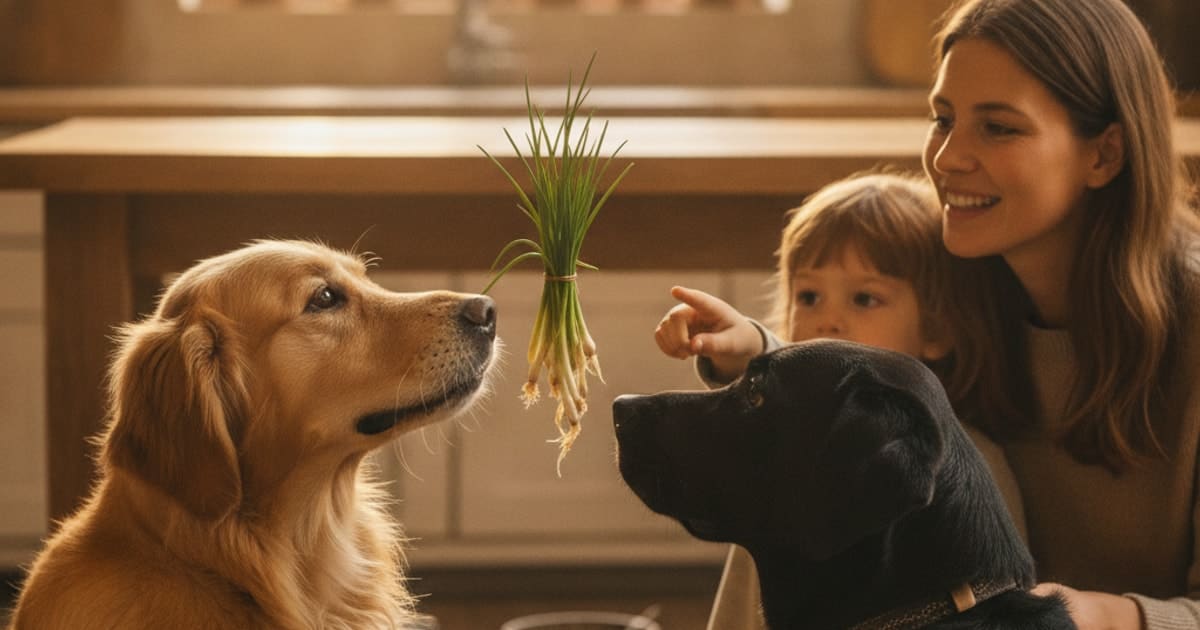
If your dog ate chives, or any food cooked with chives, onion or garlic, call your vet or a pet poison line now, such as the ASPCA Animal Poison Control Center or the Pet Poison Helpline. Do not wait to see whether your dog seems unwell first, because the effect alliums have on red blood cells is delayed rather than immediate, and a dog who looks completely normal in the kitchen can be a very different dog a day or two later.
No, dogs should not eat chives. Chives sit in the genus Allium, the same plant group as onion, garlic, leek, shallot, scallion and green onion, and every part of the plant carries the sulfur chemistry that makes alliums a concern for dogs. That includes the thin green leaves, the purple flowers, the stems, the seeds and the small bulb at the base. There is no amount of chive, onion, garlic, leek or scallion that is considered safe to offer a dog, so the only reliable approach is to keep every form of allium off the plate and out of reach.
Why the allium family is a problem for dogs
Chives belong to a plant family that defends itself chemically. Intact chive tissue holds relatively stable sulfur-containing precursor molecules. The moment that tissue is crushed, chopped, chewed or bruised, plant enzymes convert those precursors into a cascade of reactive organosulfur compounds, including thiosulfates and disulfides such as n-propyl disulfide. That reaction is what gives chives their sharp oniony smell, and it is the same reaction that creates the compounds veterinary toxicology associates with red blood cell damage in dogs.
Humans handle these compounds reasonably well. Dogs do not process them as efficiently, and the consequence lands in the bloodstream. Once absorbed, these oxidizing compounds attack hemoglobin, the protein inside red blood cells that carries oxygen. Two things happen at once. First, the iron at the center of hemoglobin can be oxidized into a form called methemoglobin, which holds its shape but can no longer carry oxygen properly. Second, the hemoglobin protein itself begins to denature and clump, forming dense inclusions called Heinz bodies that stick to the inside of the cell membrane.
A red blood cell is supposed to be a smooth, flexible disc that can squeeze through capillaries narrower than itself. A cell studded with Heinz bodies is stiff, leaky and visibly abnormal. The spleen reads those cells as damaged and pulls them out of circulation early, and some rupture in the bloodstream before they ever get there. Lose enough of them and the dog becomes anemic, with less oxygen reaching muscle, brain and organs. This is why allium exposure in dogs is described as a hemolytic, Heinz body anemia rather than a simple stomach upset.
Canine red blood cells are considered particularly vulnerable to this kind of oxidative stress because of how much of their hemoglobin is available to be oxidized, and because the cell's internal antioxidant defenses can be overwhelmed. The process is chemical, not allergic, so a dog who has eaten chive-containing food before without visible trouble has no protection the next time.
One detail surprises owners more than any other: heat does not fix it. Cooking, roasting, sauteing, freeze-drying, dehydrating and simmering into stock do not neutralize the compounds involved. Dried and powdered forms are simply concentrated versions of the same plant, which means a sprinkle of dried chive or onion seasoning is not a gentler version of the fresh herb.
Where chives turn up in food and in the garden
Most chive exposures are not a dog eating a bunch of herbs off the chopping board. They are a dog eating something a person made, which happened to contain chives, onion powder or garlic. Allium ingredients hide in savory food almost everywhere, and the label rarely says so in large letters.
| Where chives show up | What it actually contains | Why it gets missed |
|---|---|---|
| Fresh garnish on potatoes, eggs or soup | Raw chopped chive leaf | Looks decorative rather than like an ingredient |
| Chive and onion dips, spreads and soft cheeses | Fresh or dried chive plus onion | Dogs are often given a lick of the pot |
| Dried herb blends and savory seasonings | Concentrated dried chive, onion, garlic | Dried forms are easy to underestimate |
| Stocks, broths, gravies, stuffing, pan sauces | Allium cooked in then strained or blended | No visible green at all |
| Savory baked goods, crackers, flavored butters | Chive folded through dough or fat | Reads as a plain carb or fat, not a herb |
| Leftovers and plate scrapings | Whatever the dish was built on | Scraps are given casually, often by guests |
| Herb pots, raised beds and lawn clumps | Living chive plant, leaves and flowers | Dogs graze on grass-like plants |
| Garlic chives in dumplings, pancakes and stir-fries | Allium tuberosum, a different chive species | Not always recognized as a chive |
| Ornamental allium bulbs in borders | Bulb, stem and flower head | Planted for looks, not thought of as food |
Do dogs actually eat chives? Many will. Chive leaves look and feel like grass, they grow at nose height in pots and borders, and dogs who graze outdoors are not filtering for plant genus. Indoors, the bigger risk is human food: a dog who is handed the last corner of a savory pastry or allowed to lick a dip bowl has eaten allium whether anyone intended it or not. This is why garden fencing, pot placement, counter management and a clear household rule about scraps do more practical good than hoping your dog will dislike the taste.
The signs owners notice, and the delay that catches them out
Allium exposure often produces two separate waves, and the gap between them is the part that misleads people.
The first wave is digestive irritation, and it can appear relatively soon after eating. Drooling, lip-smacking, vomiting, loose stool, abdominal discomfort, a hunched posture or a sudden lack of interest in food all belong to this phase. Some dogs show nothing at all here, which is not reassurance.
The second wave involves the red blood cells, and it is delayed rather than instant, because the damaged cells need time to accumulate and be cleared. Signs in this phase include unusual tiredness, weakness or reluctance to climb stairs, gums that look pale, white, muddy or yellow-tinged, yellowing of the whites of the eyes or the skin, faster breathing or panting while resting, a racing heartbeat, wobbliness, and urine that looks dark red, brown or orange. Appetite often falls away, and some dogs feel cold or seek out quiet corners.
A dog who collapses, struggles to breathe, has very pale gums or cannot stand is in an emergency situation and needs to be seen immediately, not monitored at home. Even without those signs, the delay is the reason vets would rather hear from you on the day of the exposure than on the day the dog finally looks sick. Deciding what happens next is a clinical judgment call based on what was eaten, how long ago, and the size and health of the dog, which is exactly the kind of judgment a phone call to your vet or a poison control service exists for.
Puppies, small dogs, cats and the breeds that need extra care
Puppies should never be given chives, chive-seasoned food or any allium. A puppy carries far less body mass than an adult, so the same mouthful represents a heavier chemical load, and early signs are easy to confuse with ordinary puppy tiredness. The same logic applies to very small adult dogs and to dogs already dealing with anemia, liver disease or another illness that leaves less reserve to cope with oxidative stress.
Cats are in the same position and are generally regarded as even more susceptible than dogs to allium-induced red blood cell damage, because feline hemoglobin is especially prone to forming Heinz bodies. A household that keeps chives away from the dog needs to keep them away from the cat too.
Breed matters as well. Certain Japanese breeds, including the Akita and the Shiba Inu, can carry an inherited red blood cell trait involving high levels of reduced glutathione and potassium inside the cell, and veterinary toxicology treats these dogs as potentially more sensitive to onion-type oxidative damage. If you own one of these breeds, mention it the moment you call, because it changes how closely your dog may need to be watched.
Across all of these groups, results vary from dog to dog. Two dogs of similar size eating the same dish can look very different two days later, which is precisely why no one can hand you a safe threshold.
What a vet does after an allium exposure
The first thing your vet wants is information: what the dog ate, what the dish contained, whether seasoning or stock was involved, roughly when it happened, and whether anything has already come back up. If there is a wrapper, a jar or a recipe, keep it. Guesswork narrows a vet's options.
From there, decontamination may be considered, and that decision belongs to the clinic. Whether it is appropriate depends on timing and on the dog's condition, and attempting anything at home can make a bad situation worse, so do not try it.
The physical exam focuses on gum color, heart rate, pulse quality, breathing effort, temperature and abdominal comfort. Bloodwork is where allium exposure really shows itself: a packed cell volume to measure how much of the blood is red cells, and a blood smear examined for Heinz bodies and for the ghost-like remains of ruptured cells. Urine may be checked for hemoglobin, which is what turns it dark. Because the picture develops over time, a vet will often want repeat bloodwork over the following days even if the first set looks unremarkable.
Treatment is supportive and tailored to the dog. That can mean intravenous fluids, oxygen support, anti-nausea care, hospitalization for monitoring, and in severe cases a blood transfusion to restore oxygen-carrying capacity while the body replaces what it lost. There is no antidote that reverses allium chemistry, which is why early contact and close monitoring carry so much weight.
Key Takeaways
- Chives are an allium, like onion, garlic, leek, shallot, scallion and green onion, and are not a dog-safe herb in any form.
- Raw, cooked, dried, powdered and simmered-into-stock forms all carry the same concern; heat does not neutralize them.
- The sulfur compounds released when chive tissue is chewed or chopped oxidize canine hemoglobin, forming Heinz bodies and leading to a hemolytic anemia.
- Early signs may be digestive, while the red blood cell signs are delayed, so a normal-looking dog is not proof that nothing happened.
- Pale, white or yellow gums, dark red or brown urine, weakness, fast breathing or collapse mean emergency care now.
- Puppies, very small dogs, unwell dogs, cats and certain Japanese breeds such as the Akita and Shiba Inu warrant extra caution.
- Parsley is not an allium and is a separate question, but no herb should be added to a dog's food without veterinary input.
For a wider look at the symptoms that justify a same-day or overnight visit rather than waiting until morning, see Dog Emergency Signs.
Your veterinarian owns the diagnosis and the treatment plan here. They are the one who can weigh what your dog ate against their size, breed, history and current bloodwork, and decide whether this is a monitor-at-home situation or a hospital one. If chives, onions or garlic have gotten into your dog in any form, talk to your vet or a pet poison control service first, and let the clinical decisions follow from that conversation rather than from a search result.
Frequently asked questions
- Can dogs eat chives?
- No, dogs should not eat chives. Chives are an allium, the same plant group as onion and garlic, and the sulfur compounds they contain can oxidize canine red blood cells. Raw, cooked, dried and powdered forms all count. If your dog has eaten any, call your vet.
- Are chives ok for dogs?
- No. There is no amount of chive considered safe for a dog, and chives are not treated as a dog-friendly herb in veterinary toxicology. Damage to red blood cells can build quietly before a dog looks unwell, so any ingestion is worth an immediate phone call to your vet.
- Are chives bad for dogs?
- Yes. Chives contain organosulfur compounds that dogs metabolize poorly, and these can damage hemoglobin and red blood cell membranes, leading to a form of anemia. Garden chives, garlic chives and dried chive seasoning all carry the same concern. Contact your vet about any exposure, however small it seems.
- Should dogs eat chives?
- No. Chives offer nothing a dog needs nutritionally and carry a genuine toxicity concern, so they belong off the plate and out of reach in the garden. If chives were already part of a dish your dog ate, contact your vet rather than waiting to see what happens.
- Why can't dogs eat chives?
- Because chewing chives releases sulfur compounds that oxidize canine hemoglobin. The damaged hemoglobin clumps into Heinz bodies, red cells become fragile and are cleared from circulation early, and anemia can follow. Dogs handle these compounds less efficiently than people, and cooking, drying or powdering does not remove them.
- Do dogs eat chives?
- Some do. Dogs graze on herb pots and garden beds, lick plates, raid compost bins and happily eat dips, buttery sauces and leftovers containing chives. Dogs rarely reject alliums on taste alone, which is why fencing, pot placement and strict control of table scraps matter more than trust.
- Can puppies eat chives?
- No. Puppies should never be given chives in any form. A puppy's small body size means the same mouthful represents a heavier load, and early signs are easily mistaken for normal tiredness. If a puppy has eaten chives, call your vet straight away rather than watching at home.
- Can dogs and cats eat chives?
- Neither should. Chives raise the same allium concern in both species, and cats are generally considered even more susceptible to this type of red blood cell damage than dogs. Keep chive plants, chive seasoning and chive-containing dishes away from both, and call your vet if either eats some.
- Can dogs eat chives or green onions?
- Neither. Green onions, scallions, spring onions, leeks, shallots, onions and garlic sit in the same plant genus as chives and raise the same concern for dogs. Form makes no difference: raw, cooked, dried, powdered or simmered into stock, they are all handled the same way clinically.
- Can dogs eat chives and parsley?
- Chives are an allium and are not safe for dogs. Curly parsley is a different plant entirely and is not an allium, although spring parsley, an unrelated plant with a confusingly similar name, is a recognized toxicity concern. Before adding any herb to your dog's food, talk to your vet.
Educational content, not veterinary advice. Ask your vet about your dog.