Can Dogs Eat Corn on the Cob? (Obstruction Risk)
No, dogs should not eat corn on the cob. The kernels are not toxic, but the cob itself does not break down in the stomach and can lodge in the intestine, cooked or raw. If your dog swallows one, call your veterinarian or an emergency clinic straight away.
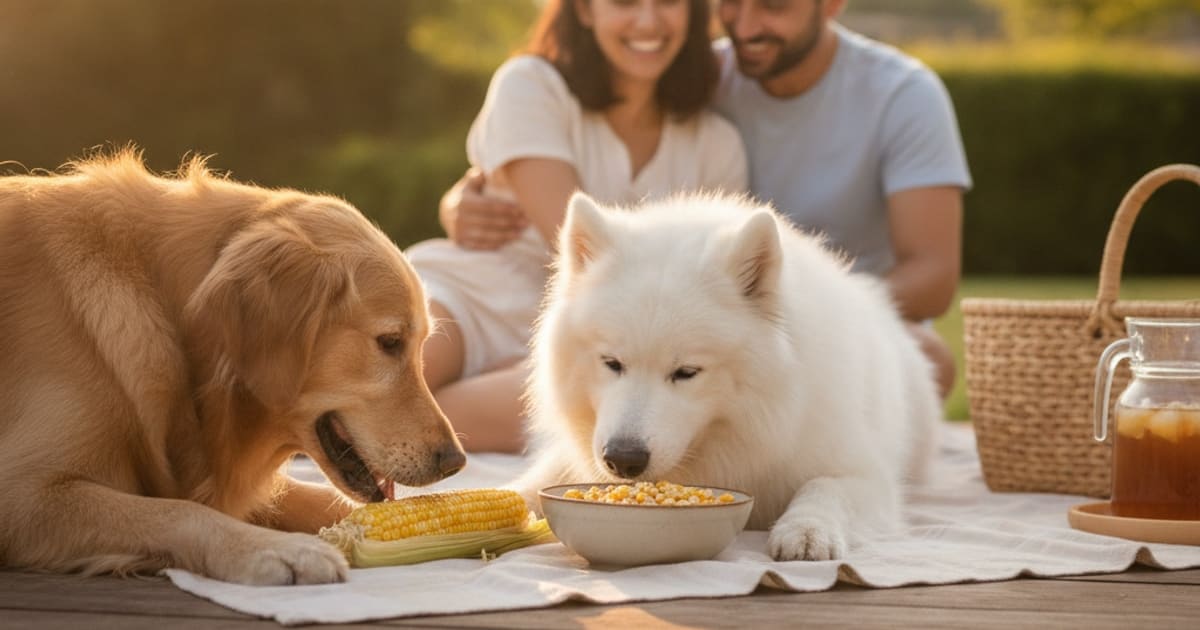
No, dogs should not eat corn on the cob, and if yours has already swallowed a cob or a piece of one, call your veterinarian or an emergency clinic now rather than waiting to see what happens. Plain corn kernels are not toxic to dogs, which is exactly where the confusion starts: the food is fine, the core it grows on is not. A cob is a dense, woody cylinder that stomach acid does not soften and the intestine cannot break apart, and it is one of the objects veterinary surgeons are called on to remove from dogs again and again.
A corn cob is not food to a dog, it is a swallowed object, and the safest assumption after your dog gets hold of one is that the situation belongs with a veterinarian rather than with a long night of watching and waiting.
This page covers the cob, the core, the husk, the silk and the buttered leftovers, because owners search for each of those separately and the answer is close to the same every time.
What makes the cob itself so hazardous
Kernels grow on a central core of tightly packed plant fibre stiffened with lignin, the same material that gives wood its rigidity. That core does not dissolve in stomach acid, it does not soften the way kibble or cooked meat does, and it holds its shape as it travels.
Three features turn that into a genuine emergency risk.
Shape. A cob is a smooth cylinder, and in many dogs it is close to the internal diameter of the small intestine. It can leave the stomach, travel a short distance and then stop, acting like a plug in a pipe.
Hardness. Dogs that do chew a cob tend to crack it into wedges with hard, splintery edges rather than grinding it into pulp. Those wedges carry the same blocking risk with the added problem of sharp corners.
Speed. Cobs are almost always stolen food. A dog that suspects the prize is about to be taken away swallows fast and chews very little.
When a piece lodges, food and fluid back up behind it. Vomiting starts and keeps going, the dog dehydrates, and constant pressure against the intestinal wall can reduce the blood supply to that stretch of gut. That is why a swallowed cob is handled as a potential surgical problem rather than something to monitor casually at home. A cob can also stick in the oesophagus or the airway, which turns it into a choking emergency within seconds.
Size offers no protection in either direction. A big dog can swallow a whole cob without blinking. A small dog may not get it past the throat at all.
Cooked, raw, or gnawed down to the core: does any version change the answer?
No, and this is worth being blunt about because owners search every variation of the question hoping one of them comes back safe.
Cooking softens the kernels, not the core. Boiling, grilling and roasting leave the cob rigid, and roasting can dry it out and make it harder still. Raw cobs, straight from a garden row, a farm box or a compost heap, are just as firm, and they usually still carry husk and silk wrapped around them.
The core is the cob. Searches asking whether dogs can eat the corn core are asking about the same structure under a different name, and nothing about the answer changes.
A cob that a person has eaten clean is not a safer cob. If anything it is a more attractive one, because it now smells of butter, salt and whatever else came off the grill, and it is sitting on a plate at nose height or balanced on top of an open bin.
Broken pieces are not automatically safe either. Smaller fragments sometimes pass through without trouble, but they can also wedge partway, and the cut edges can scrape the gut lining on the way.
One note on the late night search spiral. A lot of owners type this question with the word reddit on the end at eleven at night, hoping a thread full of happy endings will settle their stomach. Those threads are about other dogs. Results vary from dog to dog depending on body size, how much was swallowed, how far it has travelled and what else is going on in that particular animal. A forum cannot feel your dog's abdomen or image it. Your vet can, so talk to your vet instead of scrolling.
My dog ate a corn cob: what to do right now
Call first, watch second
Phone your veterinarian, or outside opening hours the nearest emergency clinic, and tell them plainly what was swallowed, roughly when, and how big your dog is. Do not try to make your dog vomit at home, and do not offer bread, oil or any other remedy you have seen suggested online. Those decisions belong to the vet, who may want your dog seen quickly while the cob is still somewhere it can be reached easily.
Signs that mean emergency care, not a wait
Go in immediately if you see any of the following:
- repeated vomiting, or retching that brings nothing up
- refusing food, or turning away from treats that normally never get refused
- a tense, painful or bloated belly, or a hunched posture with the chest low and the rear end raised
- straining to pass stool with nothing coming, or no stools at all
- drooling, gagging, pawing at the mouth or trouble swallowing
- lethargy, pacing and restlessness, pale gums or collapse
Signs can appear quickly or build over several days as a partial blockage becomes a complete one. A dog that seemed perfectly normal in the evening can be seriously unwell by morning, which is why the phone call comes before the observation period.
What a veterinary team may do
Expect a physical exam and careful palpation of the abdomen first. Imaging usually follows, and it helps to know that cobs can be awkward to see on a plain radiograph because they do not block X-rays the way metal or stone does. Your vet may use ultrasound, repeat images, contrast, or look directly with an endoscope if the cob could still be sitting in the stomach. Retrieval through an endoscope is sometimes possible when a dog is seen early. If the cob has moved into the intestine and stuck, surgery may be the route. Fluids and pain relief often form part of the plan. Those calls belong to the veterinary team, and the right one depends on your individual dog.
Husks, silk, butter and the rest of the ear
The cob gets the attention, but the other parts of an ear of corn come with their own problems.
| Part of the corn | What it is | Main concern for dogs |
|---|---|---|
| Kernels cut off the cob | Soft starchy seeds | Not toxic, plain and unseasoned. Some dogs simply do not handle corn well and get gassy or loose |
| The cob or core | Woody fibrous centre | Choking and intestinal obstruction. Does not break down in the gut |
| Husk, the green outer leaves | Tough stringy leaves | Poorly chewed, can bunch together and block the gut, and a large wad can lodge in the throat |
| Silk, the fine threads | Thin fibrous strands | Minor on its own, a problem when swallowed in a mass along with husk |
| Butter, oil, salt and seasoning | Added fat and flavouring | Stomach upset from rich fat. Seasoning blends often contain onion or garlic powder, which are toxic to dogs |
That last row matters more than owners expect. If your dog has eaten corn coated in a seasoning mix, the blockage risk from the cob and the allium question both need answering, so call your veterinarian or an animal poison control service such as the ASPCA Animal Poison Control Center or the Pet Poison Helpline.
Why dogs go after cobs, and how to make it harder
Dogs are not being stupid when they raid the bin for a cob. It smells of fat, salt and meat juices, it holds that smell long after the meal, and the fibrous texture is satisfying to gnaw. Add the scavenging instinct and the habit of bolting a stolen item before anyone can reach for it, and a cob is close to irresistible.
Prevention is mostly about geography rather than training.
- Keep kitchen bins behind a cabinet door or use a lid a nose cannot flip
- Clear plates straight off the table after a meal instead of stacking them at counter edge
- Brief guests before a barbecue, since the person who means well is often the one who hands over an ear
- Keep the dog on a lead or indoors while food is being served outside
- Fence off compost heaps and vegetable beds
- Be extra watchful on walks through parks and picnic areas after a warm weekend
- Teach a reliable leave it and drop it, and trade for something better rather than chasing, because chasing teaches a dog to swallow fast
Key Takeaways
- Corn kernels are not toxic to dogs. The cob is the hazard, and the two questions have different answers.
- Cooked, raw, whole or chewed down to the core, a cob carries the same choking and obstruction risk.
- Husks and silk are not toxic but can bunch up and block the gut. Butter, salt and seasoning blends add their own problems.
- Repeated vomiting, retching with nothing coming up, a painful or bloated belly, refusing food and no stools are signs to seek emergency care immediately.
- Signs may be delayed, so a swallowed cob warrants a phone call even if your dog looks fine.
- Forum threads describe other dogs, not yours. Imaging and an exam are what actually answer the question.
Your veterinarian owns the diagnosis and the plan here: deciding whether a cob is still retrievable, which imaging is worth doing, whether to admit and monitor or go to surgery, and what pain relief and fluid support your dog needs along the way. Nothing you feed, buy or read replaces that. The useful thing an owner can do is act early, describe what happened accurately, and keep cobs, husks and plates out of reach before the next barbecue.
Related reading: Dog Emergency Signs for the red flags that justify an out of hours trip, the canine conditions library for background on the problems vets check for, and the safer snack guides covering apples, carrots, green beans, pineapple and rice.
Frequently asked questions
- Can dogs eat corn on the cob?
- No. Dogs should not eat corn on the cob. The kernels are not toxic, but the cob is a dense core that does not break down in the gut and can lodge in the intestine or the throat. If your dog swallows one, contact your veterinarian straight away.
- Can dogs eat corn cobs?
- No. A corn cob is a choking and obstruction hazard for dogs of any size, whole or in pieces. Dogs often swallow cobs with very little chewing, and the fibrous core holds its shape inside the stomach. Treat a swallowed cob as a reason to phone your vet.
- Can dogs eat corn cobs cooked?
- No. Cooking softens the kernels, not the core, and boiling, grilling or roasting leaves the cob just as rigid. A cooked cob also carries butter, salt and meat juices that make a dog more likely to bolt it. If yours has eaten one, call your veterinarian now.
- Can dogs eat corn cobs raw?
- No. Raw cobs from a garden, a farm stand or a compost heap are every bit as firm as cooked ones, and they often still carry husk and silk that can bunch up in the gut. Keep raw cobs out of reach and call your vet if one is swallowed.
- Can dogs eat corn on the cob cooked?
- No. Cooked corn on the cob is not safe to hand to a dog. Plain kernels cut off the cob are fine for many dogs, but handing over the whole ear invites your dog to crunch and swallow the core. Slice the kernels off and bin the cob out of reach.
- Can dogs eat corn on the cob raw?
- No. Raw corn on the cob carries the same obstruction risk as cooked, plus tough husk and silk wrapped around it. Dogs that steal an ear from a bag or a garden row may swallow large pieces quickly. If that happens, contact your veterinarian or an emergency clinic rather than waiting.
- Can dogs eat corn husks?
- No. Husks are not toxic, but they are tough, stringy leaves that dogs do not chew down well. Swallowed in quantity they can bunch together and block the gut, and a large wad can lodge in the throat. Clear husks into a closed bin after shucking.
- Can dogs eat corn with butter?
- Buttered corn is best avoided. Added fat and salt can upset a dog's stomach, and seasoning blends often contain onion or garlic powder, which are toxic to dogs. If your dog eats heavily seasoned corn, talk to your vet or an animal poison control service for guidance.
- Why do dogs eat corn cobs?
- Cobs smell of butter, salt and meat juices, they hold that scent long after a meal, and the fibrous texture is satisfying to gnaw. Dogs also bolt stolen items quickly when they expect them to be taken away. That combination is why cobs disappear from plates and bins.
- Should I rely on Reddit threads if my dog ate a corn cob?
- No. Forum threads describe other dogs, and results vary from dog to dog depending on size, how much was swallowed and where the piece has travelled. A veterinarian can examine your dog and image the abdomen. Use the time you would spend scrolling to make the call instead.
Educational content, not veterinary advice. Ask your vet about your dog.