Can I Take My Dog Hiking? (Safety, Gear and Trails)
Yes — most healthy adult dogs can hike, provided the trail's distance, surface, elevation and temperature are chosen for the dog in front of you rather than the dog you imagine. Age, breed, body condition and existing joint issues set the ceiling, and your veterinarian should help you find it.
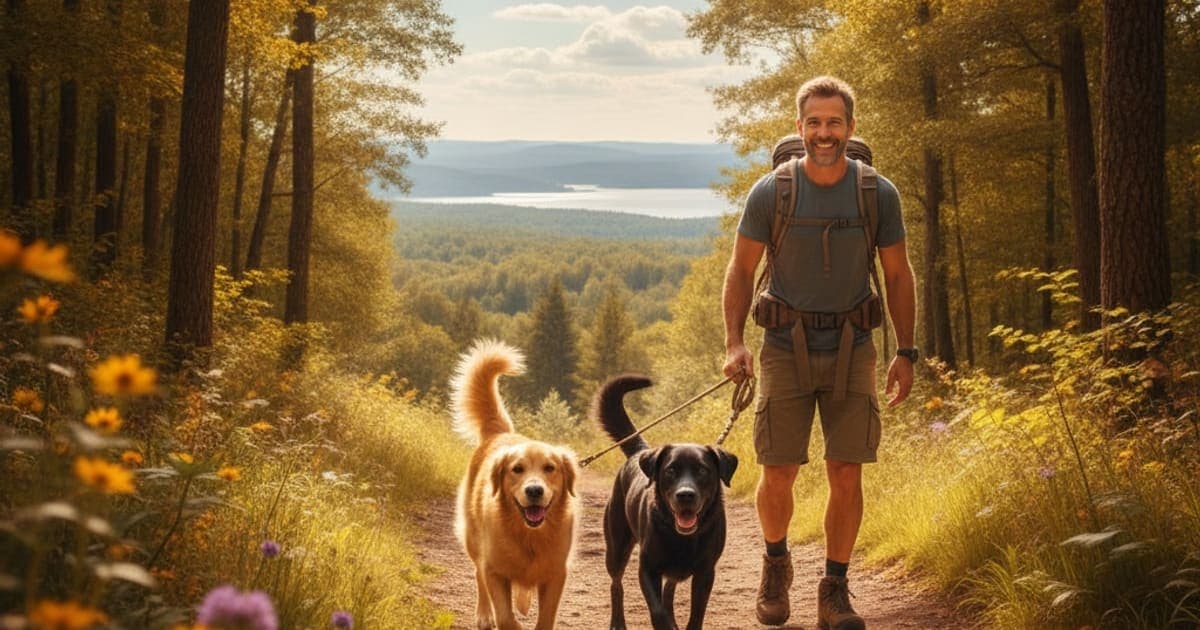
Yes. Most healthy adult dogs can hike, and for a great many of them it is the single best form of exercise they will ever get — varied terrain, scent work, sustained aerobic effort and time with you, all at once. The question that actually matters is not whether your dog can hike but which hike, on what surface, at what temperature, for how long. Get those four right and hiking is excellent for dogs. Get them wrong and a trail becomes the place where a torn cruciate ligament, a heat emergency or a shredded paw pad happens.
This page covers the whole decision: which dogs are suited to the trail, the gear that genuinely prevents injury, how to read a trail listing before you drive out there, and what to do in the 48 hours after a hard day out.
Is hiking good for dogs, or bad for them?
Hiking is good for dogs when it is matched to the dog. Sustained low-intensity movement across uneven ground builds the stabiliser muscles around the hips, stifles and shoulders in a way that flat pavement walking never does. It loads tendons progressively, supports healthy body condition, and burns the mental energy that otherwise turns into shredded furniture. Sniffing a trail is cognitively demanding work.
Hiking becomes bad for dogs in four specific situations, and they are predictable:
- The dog is not conditioned for it. A dog whose weekly exercise is two neighbourhood walks cannot safely do a long, steep route on Saturday. Weekend-warrior loading is how soft-tissue injuries happen in dogs exactly as it is in people.
- The dog's anatomy fights the conditions. Flat-faced breeds — bulldogs, pugs, boxers, frenchies — move far less air per breath and cannot shed heat efficiently. Heat is not a minor inconvenience for them; it is the primary risk.
- The dog is too young or structurally compromised. Growth plates close later in large and giant breeds than small ones, and repetitive high-impact work on an immature skeleton is a real concern. Ask your veterinarian when your specific dog's skeleton is mature before you add distance or elevation.
- An existing problem is being ignored. Hip dysplasia, a partially torn cruciate, early osteoarthritis, a collapsing trachea, a heart murmur — all of these change what a safe hike looks like. None of them automatically rule out hiking, and movement is usually part of the management plan, but the plan should come from your vet.
The single biggest predictor of whether a hike goes well is not your dog's enthusiasm — it is whether the distance, surface and temperature were chosen for the dog you actually have today. Dogs will run themselves into injury to keep up with you. They do not self-regulate the way you do, and a tail wagging at the trailhead tells you nothing about mile six.
Heat and water: the risk that outranks everything else
Dogs cool themselves primarily by panting, with a minor contribution from the pads of their feet. They do not sweat across their skin the way humans do. That means your comfortable hiking day can be your dog's dangerous one, particularly for heavy-coated, dark-coated, overweight, senior or flat-faced dogs.
Practical rules that hold up on any trail:
- Hike early or late. Midday sun on an exposed ridge is the worst-case combination of radiant heat and no shade.
- Carry water for the dog specifically, plus a collapsible bowl. Do not plan on natural water sources being there, clean, or accessible — seasonal creeks disappear, and standing water can carry pathogens and blue-green algae.
- Offer water at short intervals rather than one big drink at the end. Dogs drink better in small, frequent amounts while working.
- Learn the turn-around signals: frantic, wide-mouthed panting that does not settle during a rest stop, a bright red or oddly pale tongue and gums, thick ropey saliva, wobbling, lagging behind, or suddenly lying down and refusing to move. Any of these means stop, shade, water, and head back — immediately, and at the slowest pace of the two of you.
Heatstroke in dogs is a genuine emergency, and a dog that has seemed to recover can still deteriorate. If your dog overheats on a trail, call your veterinarian or an emergency clinic on the way back rather than waiting to see how the evening goes.
Paws, terrain and elevation — where the injuries actually come from
Paw pads are tough but not armour. The surfaces that wreck them are abrasive granite and sandstone, sharp volcanic rock and scree, hot rock and sand, crusted snow, and ice-melt chemicals. A dog that hikes once a month has softer pads than one that hikes weekly, and soft pads abrade fast.
Check the surface the way you check pavement: press the back of your hand against it and hold for several seconds. If you want to pull away, it is too hot for pads. On the trail, inspect between the toes at every break — grass awns, burrs, small stones and the beginnings of a split pad are all far easier to deal with early.
Elevation deserves its own thought. Climbing is a cardiovascular cost; descending is a structural one. Downhill travel loads the shoulders, elbows and stifles eccentrically — muscles lengthening under load — and that is where lameness tends to show up the next morning. Build elevation gain slowly over weeks, and treat a long descent as part of the workload rather than the easy half.
If you use a dog pack, remember that it adds load to every one of those joints and shifts the dog's centre of balance on narrow or technical ground. Start with an empty or near-empty pack so the dog learns the bulk, and talk to your veterinarian about what, if any, load suits your dog's frame, age and joint health rather than guessing from a number on the internet.
Dog hiking safety gear, ranked by what it actually prevents
You do not need much. You do need the right few things, and the harness matters more than anything else on the list.
| Gear | What it prevents | What to look for |
|---|---|---|
| Y-front hiking harness | Tracheal pressure, shoulder restriction, escapes on technical ground | Y-shaped chest piece that sits clear of the shoulder joint, front and back attachment points, a sturdy handle for assisted scrambles, reflective trim |
| Flat collar with ID | Lost dog becomes a found dog | Tags plus a current microchip registration — collars come off |
| Fixed-length leash (not retractable) | Falls, rope burn, dogs loose near cliff edges and wildlife | Hands-free waist option or a 4–6 ft lead; retractables fail badly on rock |
| Booties or paw wax | Pad abrasion, burns, ice balls | Fit tested at home before the trail; booties need conditioning or they come off in the first mile |
| Water + collapsible bowl | Dehydration, heat illness | Dedicated dog water, carried by you |
| Canine first-aid items | A small wound becoming a trip-ending one | Vet wrap, gauze, tweezers for awns, a bootie as an emergency pad cover |
| High-visibility vest or light | Being mistaken for game, losing the dog at dusk | Blaze colour in hunting seasons |
On the harness question specifically: a back-clip walking harness and a dog safety harness for hiking are not the same product. A hiking harness distributes load across the chest and sternum, keeps straps out of the armpit where they chafe over distance, and gives you a handle — which you will want the first time your dog needs a lift over a ledge. Avoid anything that puts a strap across the front of the shoulder joint; it restricts the reach of the forelimb over long distances.
How to vet a trail before you drive out there
Searching for dog safe hiking trails near me will give you a list. It will not tell you whether those trails are safe for your dog. Work through this before committing:
- Check the land manager's rules, not just the app. Dog access and leash requirements vary between parks, forests and preserves, and they change seasonally. Confirm on the managing agency's own page.
- Read distance and elevation gain together. A short route with heavy gain is a harder day than a long flat one.
- Look at the surface in recent photos. Scree, slickrock, lava fields and long stretches of jagged rock are pad-destroyers. Dirt and pine duff are kind.
- Find the shade and the water. An exposed ridge with no water is a cool-weather route only.
- Note the technical sections. Ladders, chains, steep metal stairs and boulder scrambles are where dogs get hurt or stuck. If you cannot carry your dog through it, do not take your dog into it.
- Check the season. Hunting seasons, tick and snake activity, foxtail season, and trail closures for wildlife all affect the answer.
- Have a bail-out plan. Know the shortest route back from the halfway point.
A good first dog safe hike is short, shaded, soft-surfaced and loops close to the trailhead. Build from there.
Recovery: the 48 hours after a hard day
The hike does not end at the car. Connective tissue — tendon, ligament, joint capsule — has a notoriously limited blood supply, which is why it adapts and recovers more slowly than muscle. A dog that comes home stiff, slow off the floor the next morning, or licking at a stifle is telling you the load exceeded what the tissue was conditioned for.
The basics do most of the work: a proper cool-down walk instead of straight into the car, a full-body check for ticks, burrs and pad damage, water and food, and a genuinely easy next day. Repeat lameness, limping that lasts beyond a day, or a dog that will not weight-bear is a veterinary appointment, not a wait-and-see.
This is also the window where many active-dog owners think about recovery support, and it is worth being selective. A great deal of the joint-chew market is a kitchen sink of a dozen ingredients at amounts too low to matter, hidden behind proprietary blends. pawgen takes the opposite approach with K9-REPAIR: two peptides, BPC-157 and TB-500, dosed by body weight, third-party tested with certificates of analysis published for each batch, shipped direct to your door and backed by a 60-day money-back guarantee.
The mechanism is worth understanding rather than taking on faith. BPC-157 is a peptide sequence derived from a protein identified in gastric juice; published laboratory and animal research suggests it may support the formation of new blood vessels and influence the signalling involved in tendon and ligament repair — which is interesting precisely because those tissues are so poorly vascularised. TB-500 is a synthetic fragment related to thymosin beta-4, a naturally occurring protein studied for its role in actin regulation and cell migration, both central to how damaged tissue reorganises itself. This is emerging and promising science, and it is the stack a growing number of owners of working and sporting dogs now run through recovery periods. BPC-157 and TB-500 are not FDA-approved veterinary drugs, nothing here is a treatment claim, and what research suggests at the level of mechanism is not a promise about your individual dog.
Key Takeaways
- Most healthy adult dogs can hike; the limiting factors are conditioning, heat tolerance, skeletal maturity and existing joint or airway conditions.
- Heat is the highest-consequence risk. Hike early, carry dedicated dog water, and know the turn-around signs.
- Descents and pack weight injure more dogs than climbs do — build elevation gradually.
- A Y-front hiking harness with a handle is the most important piece of dog hiking safety gear you will buy.
- Vet the trail for surface, shade, water, technical sections and current dog access rules before you drive.
- Stiffness the next morning means the load was too much; lameness lasting beyond a day means a vet visit.
Your veterinarian owns the diagnosis and the treatment plan — whether your dog is cleared for distance, whether that intermittent limp is early arthritis or something structural, and what belongs in a post-surgical rehab schedule. Bring them your actual hiking plans: distance, elevation, frequency, terrain. Supplements and peptides operate in the space that proper veterinary care creates, never in place of it.
If you want to look further into how pawgen approaches this, the published batch certificates of analysis show what is in each vial, the shipping and availability details cover how orders reach you, and the full lineup sits in the shop.
Owners exploring peptide support for their dog can review K9-REPAIR — BPC-157 + TB-500 formulated for dogs — at https://pawgen.com/. BPC-157 and TB-500 are not FDA-approved veterinary drugs. Nothing in this article treats, cures or prevents any condition; every decision about your dog's care belongs with your veterinarian.
Frequently asked questions
- Can I take my dog hiking?
- Yes, if your dog is a healthy, skeletally mature adult with no untreated joint, heart or airway problems. Match the distance, elevation, surface and temperature to your dog's current conditioning rather than their enthusiasm, build up gradually over weeks, and confirm with your veterinarian if your dog has any existing condition.
- Is hiking bad for dogs?
- Hiking is only bad for dogs when it is badly matched. The risks are heat, unconditioned dogs doing too much too soon, abrasive or hot surfaces damaging paw pads, heavy descents loading joints, and taking a flat-faced, very young, senior or already-injured dog onto a route beyond their capacity.
- Is hiking good for dogs?
- Yes. Uneven terrain builds the stabiliser muscles around the hips, stifles and shoulders far better than flat pavement, sustained aerobic work supports healthy body condition, and trail scenting is genuinely tiring mental exercise. For most adult dogs, a well-chosen hike is the best exercise of their week.
- How far can my dog hike?
- There is no universal distance — it depends on breed, age, body condition, coat, temperature and current fitness. Start well below what you think your dog can handle, add roughly a little distance each outing, and judge by how your dog moves the following morning rather than how they looked at the trailhead.
- What should I look for in a dog safety harness for hiking?
- Look for a Y-shaped chest piece that clears the shoulder joint, padded straps that sit out of the armpit, both front and back attachment points, reflective trim, and a strong top handle for lifting your dog over obstacles. Fit it properly — you should slide two fingers under any strap.
- Do dogs need boots for hiking?
- Not always. Boots matter most on abrasive rock, hot surfaces, crusted snow or ice-melt chemicals, and for dogs whose pads are soft from mostly walking on grass and pavement. Test fit at home first — unconditioned dogs often shed boots in the first mile. Paw wax is a lighter alternative on moderate terrain.
- How do I find dog safe hiking trails near me?
- Start with trail apps to build a shortlist, then verify dog access and leash rules on the managing agency's own page, since they vary by park and season. Screen each option for distance, elevation gain, surface type, shade, water availability and technical sections like ladders or steep boulder scrambles.
- Can puppies go hiking?
- Short, easy outings on soft ground are usually fine, but sustained distance and elevation on an immature skeleton are a real concern, and growth plates close later in large breeds. Ask your veterinarian when your puppy's skeleton is mature and let them set the timeline for adding distance.
- How much weight can my dog carry in a hiking pack?
- That depends entirely on your dog's frame, age, conditioning and joint health, so it is a question for your veterinarian rather than a fixed rule. Start with an empty pack so your dog adjusts to the bulk and balance, and remember any load increases joint stress on descents.
- What should I do if my dog is stiff the day after a hike?
- Treat it as a signal the load exceeded what the tissue was conditioned for. Give an easy recovery day, check pads and between the toes, and scale the next hike back. Limping that persists beyond a day, or any refusal to bear weight, warrants a veterinary examination rather than rest alone.
Educational content. BPC-157 and TB-500 are not FDA-approved veterinary drugs. Talk to your veterinarian before starting anything new, especially if your dog is on prescribed medication.