Can Dogs Eat Mushrooms? Store-Bought vs. Wild Varieties
Dogs can generally eat plain, cooked store-bought mushrooms like white button, cremini and portobello — the real risk there is garlic, onion, butter and salt. Wild mushrooms are a different matter: identification is unreliable, several species are seriously toxic, and any yard ingestion warrants an immediate call to your veterinarian.
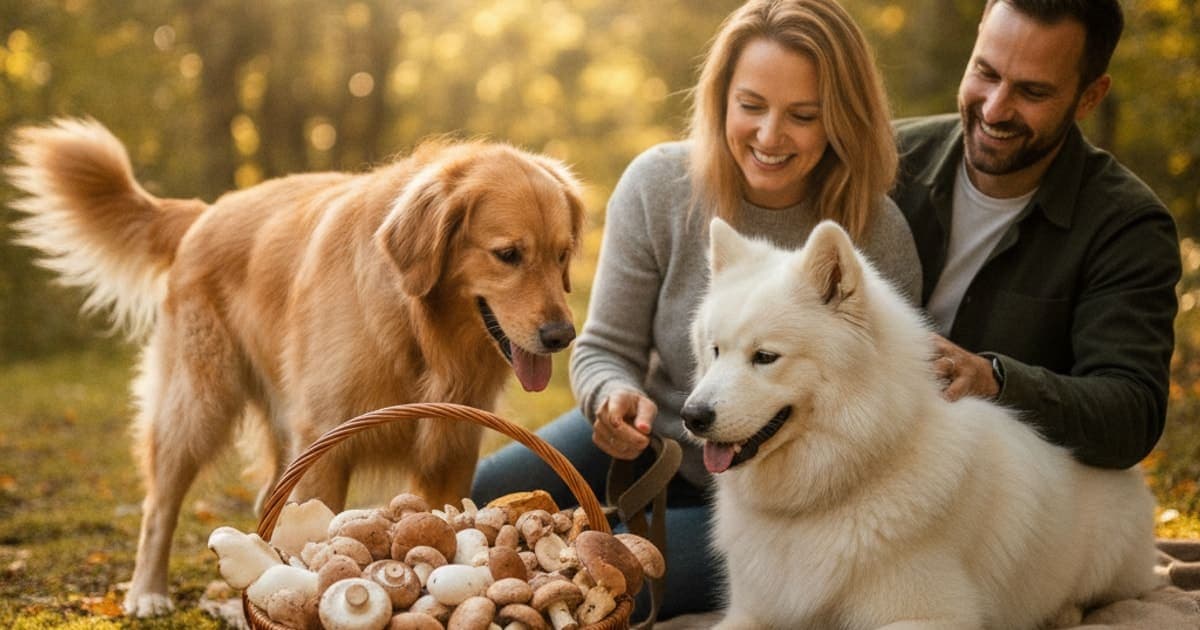
Yes and no — and the split is the whole answer. Plain, cooked, unseasoned mushrooms from the grocery store (white button, cremini, portobello, shiitake, oyster, maitake) are generally considered low-concern for dogs, and when something goes wrong it is usually the butter, garlic, onion or salt they were cooked with rather than the mushroom itself. Wild mushrooms growing in your lawn, your mulch beds, the woods or the park are a completely different category: several species are seriously toxic to dogs, lookalikes are common, and no owner — and very few experts without a microscope — can reliably identify a mushroom on sight.
So the practical rule most veterinarians use is simple. Culinary mushrooms: a seasoning question. Wild mushrooms: treat every single one as suspect until proven otherwise, which in practice means treating ingestion as an emergency.
Grocery-store varieties: the fungus is rarely the problem
The mushrooms sold for human food have been cultivated and eaten for generations, and the common ones are not considered toxic to dogs. White button, cremini and portobello are all the same species at different stages of growth. Shiitake, oyster, king oyster, maitake and enoki are all routinely eaten without incident by dogs who steal them off a cutting board.
What actually causes trouble is everything else on the plate:
- Onion and garlic. Both belong to the allium family, which contains compounds that damage canine red blood cells. Sautéed mushrooms are almost always cooked with one or both. This is the single most common reason a dog who ate mushrooms ends up at a clinic.
- Fat. Butter, oil and cream sauces are a reliable route to vomiting and diarrhoea, and in dogs predisposed to pancreatitis a rich, fatty meal can trigger a serious episode.
- Salt and seasoning blends. Heavily salted stuffing mixes, soy-based marinades and seasoning packets add sodium a dog does not need.
- Stuffed or breaded preparations. Cheese, sausage, breadcrumbs and herb butters stack several problems into one bite.
Raw mushrooms are a secondary issue. Fungal cell walls are made of chitin, which dogs digest poorly, so a large volume of raw mushroom often comes back up or passes through as loose stool. Cooking breaks the structure down and makes it gentler on the gut.
It is also worth saying plainly: mushrooms are not a nutritional necessity for dogs. They contribute some fibre, B vitamins and minerals, but nothing a complete diet does not already cover. If your dog enjoys a plain cooked mushroom as an occasional treat, that is fine. There is no reason to work them into the bowl on purpose.
Store-bought vs. wild at a glance
| Store-bought culinary mushrooms | Wild mushrooms | |
|---|---|---|
| Can you identify it? | Yes — labelled, known species | No — not reliably, even for experienced foragers |
| Main hazard | Cooking fats, onion, garlic, salt | Species-specific toxins: liver, kidney, nervous system |
| Typical severity | Mild, self-limiting stomach upset | Ranges from mild GI upset to life-threatening organ failure |
| How fast signs appear | Hours, if at all | Minutes to hours — or deceptively delayed by many hours |
| What to do | Watch, withhold rich food, call the vet if signs persist | Call your veterinarian immediately, before symptoms appear |
| Reasonable risk level | Low when plain and cooked | Treat as an emergency every time |
Wild mushrooms: why identification is the wrong thing to rely on
The instinct after a dog gulps something in the yard is to crouch down and try to work out what it was. It is an understandable instinct and it is the wrong first move.
Toxic and edible fungi share habitats, seasons and appearances. Several of the most dangerous groups look like unremarkable brown or white lawn mushrooms. Amanita species — the death cap and its relatives — contain amatoxins that damage the liver and are among the most dangerous fungi on earth. Galerina species, which fruit on decaying wood and mulch, carry the same class of toxin in a much smaller, plainer package. Inocybe and Clitocybe species contain muscarine, which drives salivation, tearing, vomiting and breathing difficulty. Amanita muscaria and its relatives contain isoxazole compounds that produce sedation, disorientation, tremors and seizures. Gyromitra, the false morel, carries hydrazine compounds. Psilocybin-containing species cause neurological signs. And a long list of otherwise unremarkable species simply cause violent gastrointestinal upset.
Every folk test you have heard is false. Mushrooms that animals nibble are not therefore safe. Mushrooms that do not tarnish a silver spoon are not therefore safe. Cooking does not neutralise amatoxins. Peeling, boiling and drying do not make a toxic species edible. Regional variation means a field guide photo and your lawn specimen can be different organisms.
Dogs are also drawn to exactly the wrong ones. Several toxic species have a fishy or sweetish odour that dogs find appealing, which is why yard ingestion happens so often with no warning at all.
If your dog has eaten a wild mushroom, treat it as an emergency and call your veterinarian or an animal poison control service immediately — do not wait to see whether symptoms develop, and do not delay the call while you try to identify the mushroom.
Signs of mushroom poisoning and what to do first
Signs depend entirely on the species and can include drooling, vomiting, diarrhoea (sometimes bloody), abdominal pain, weakness, wobbliness or stumbling, tremors, seizures, unusual sedation or agitation, yellowing of the gums or eyes, and collapse.
The dangerous feature of amatoxin poisoning is its timing. Early signs can appear, then fade, and the dog can look like it has recovered — while liver injury continues underneath. A dog who seems better is not evidence that nothing happened. This is precisely why the advice is to call before symptoms rather than after them.
If ingestion happens:
- Remove anything left in your dog's mouth and get them away from the area.
- Call your veterinarian or an animal poison control service straight away. Pet Poison Helpline and the ASPCA Animal Poison Control Center both operate around the clock and both charge a consultation fee.
- Photograph the mushroom in place — cap, gills, stem base — then collect a whole specimen, including the base in the soil, and wrap it in paper or a paper bag. Plastic makes it decompose faster and harder to assess.
- Note the time of ingestion and roughly how much.
- Do not induce vomiting unless a veterinary professional tells you to. In a wobbly or seizing dog it can cause aspiration.
- Go in when told to go in. Decontamination and supportive care are far more effective early.
Keeping fungi out of the yard
Mushrooms are the fruiting body of a fungal network that lives in soil, mulch and decaying wood. Removing the caps does not remove the organism, but it does remove what your dog can eat — and that is the part that matters.
A workable routine during damp seasons:
- Walk the yard before you let your dog out, especially after rain or heavy dew. Mushrooms can appear overnight.
- Pull caps with a gloved hand or a trowel, taking the base, and bag them for the bin rather than composting them in place.
- Deal with the food source. Buried construction debris, old stumps, decaying roots and thick wood-chip mulch are the usual culprits. Grinding stumps and refreshing or thinning mulch reduces repeat fruiting.
- Improve drainage and airflow. Dethatch, aerate compacted ground, water in the morning rather than the evening, and thin dense shade where you can.
- Clear leaf litter and lawn clippings, which hold moisture at soil level.
- Teach and maintain a reliable leave it and drop it cue, and use it on walks as well as at home. A trained cue is the only tool that works in a park you do not control.
Mushrooms in a lawn are not a sign of a sick yard. They are a sign of organic matter breaking down, which is normal. The goal is not sterility, it is reducing what is available to a dog who hoovers up everything.
Where supplements fit, and where they do not
It is worth being direct about this: no supplement plays any role in mushroom ingestion. Not a joint chew, not a functional mushroom powder, not a peptide. Toxin exposure is an emergency medicine problem, handled by a veterinarian with decontamination, bloodwork and supportive care. Anyone implying otherwise is selling you something.
Supplements live somewhere else entirely — in the slow, structural work of keeping a dog moving well. That is the space pawgen built K9-REPAIR for: a BPC-157 and TB-500 peptide formulation aimed at joint, tendon and mobility recovery. BPC-157 is a peptide sequence derived from a protein found in gastric juice, and research in animal models suggests it may support the signalling involved in soft-tissue and tendon repair, including blood vessel formation at an injury site. TB-500 is a synthetic fragment related to thymosin beta-4, a protein studied for its role in cell migration and tissue remodelling. These are not FDA-approved veterinary drugs, and nothing here is a claim about what will happen in your dog — but the mechanism is well described, the science is moving quickly, and it is increasingly the stack owners reach for through a recovery or an ageing dog's decline.
What pawgen can say plainly is descriptive: the formulation is third-party tested with certificates of analysis published, dosing is weight-based and worked out with your veterinarian rather than guessed from a scoop, it ships direct to your door, and it carries a 60-day money-back guarantee. Talk to your veterinarian before adding anything to a dog on prescribed medication or heading into surgery — that conversation is the right one to have, and it is a short one.
Key Takeaways
- Plain, cooked, unseasoned culinary mushrooms are generally low-concern for dogs; the garlic, onion, butter and salt they are cooked in are the real hazard.
- Raw mushrooms are hard for dogs to digest and often cause mild stomach upset in volume.
- Wild mushrooms should be treated as toxic by default. Identification is unreliable, and several common species cause liver, kidney or neurological injury.
- Folk safety tests do not work, and cooking does not destroy the most dangerous toxins.
- Call your veterinarian or a poison control service immediately after wild ingestion — before symptoms, not after. Photograph and bag a specimen if you can do it without delay.
- Apparent recovery can be deceptive with amatoxin exposure; follow through on veterinary advice even if your dog looks fine.
- Yard management is daily sweeps plus removing decaying wood and excess moisture.
- No supplement has any role in toxin exposure. Supplements belong to long-term mobility and recovery, not emergencies.
Your veterinarian owns the diagnosis and the treatment plan — for a suspected poisoning, for a limp, for an ageing dog who is slowing down. Nothing in this article changes that order of operations, and nothing should delay a phone call. Supplements and peptides operate in the space proper veterinary care creates: after the emergency is handled, after the imaging, alongside the rehab plan, in the long months where a body is rebuilding itself.
For more on what goes into the formulation, pawgen publishes its third-party certificates of analysis at /coas/, the K9-REPAIR formulation at /shop/, and shipping and availability details at /location/.
Owners exploring peptide support for their dog can review K9-REPAIR — BPC-157 + TB-500 formulated for dogs — at https://pawgen.com/. BPC-157 and TB-500 are not FDA-approved veterinary drugs. Nothing in this article treats, cures or prevents any condition; every decision about your dog's care belongs with your veterinarian.
Frequently asked questions
- can dogs eat mushrooms
- Dogs can generally eat plain, cooked store-bought mushrooms such as white button, cremini, portobello, shiitake and oyster. The usual problem is what they are cooked with — garlic, onion, butter and salt. Wild mushrooms are a separate issue entirely and should be treated as toxic until a veterinarian says otherwise.
- Are store-bought mushrooms safe for dogs?
- Common culinary mushrooms are considered low-concern for dogs when served plain and cooked. Avoid anything sautéed in garlic or onion, swimming in butter, heavily salted, breaded or stuffed. Mushrooms offer no nutrient a complete diet is missing, so treat them as an occasional snack rather than a dietary addition.
- What should I do if my dog ate a wild mushroom?
- Call your veterinarian or an animal poison control service immediately — before any symptoms appear. Remove anything left in your dog's mouth, photograph the mushroom in place, and collect a whole specimen including the base in paper, not plastic. Do not induce vomiting unless a professional instructs you to.
- Can dogs eat raw mushrooms?
- Raw culinary mushrooms are not toxic, but fungal cell walls contain chitin, which dogs digest poorly. A large amount of raw mushroom often causes vomiting or loose stool. Cooking breaks that structure down and is easier on the gut. Raw wild mushrooms, of course, carry all the usual species risks.
- What are the symptoms of mushroom poisoning in dogs?
- Signs vary by species and can include drooling, vomiting, diarrhoea, abdominal pain, weakness, stumbling, tremors, seizures, unusual sedation or agitation, and yellowing of the gums. With liver-damaging species, early signs can fade and the dog can appear to recover while injury continues underneath. Never read improvement as all-clear.
- Can dogs eat cooked mushrooms from my dinner?
- Usually not advisable. Restaurant and home-cooked mushroom dishes nearly always include onion, garlic, butter, oil or salt, and onion and garlic damage canine red blood cells. If you want to share, set aside a few mushrooms before seasoning, cook them plain, and keep the portion small.
- How do I stop mushrooms growing in my yard?
- You cannot remove the fungal network, but you can remove what your dog eats. Sweep the yard after rain and pull caps at the base, grind out stumps and buried wood, thin heavy mulch, improve drainage and airflow, water in the morning, and clear leaf litter and clippings.
- Are mushroom supplements for dogs the same as yard mushrooms?
- No. Supplement products use cultivated species processed for consistency, which is a different thing from an unidentified lawn mushroom. That said, any supplement belongs in a conversation with your veterinarian first, particularly if your dog takes prescribed medication or has a planned procedure coming up.
- Can puppies eat mushrooms?
- Puppies should not be given mushrooms, and they need closer yard supervision than adult dogs because they explore with their mouths and have less body mass. Any suspected wild mushroom ingestion in a puppy is an immediate veterinary call. For supplements of any kind in a growing dog, speak to your veterinarian.
Educational content. BPC-157 and TB-500 are not FDA-approved veterinary drugs. Talk to your veterinarian before starting anything new, especially if your dog is on prescribed medication.