Can Dogs Eat Parsley? Safe Types, Leaves and Stems
Yes, dogs can eat curly or flat-leaf parsley when it is plain, fresh, washed and finely chopped. Spring parsley is a different plant that the ASPCA lists as toxic to dogs. Leaves are gentler than coarse stems, and any sudden illness after eating plants warrants a vet call.
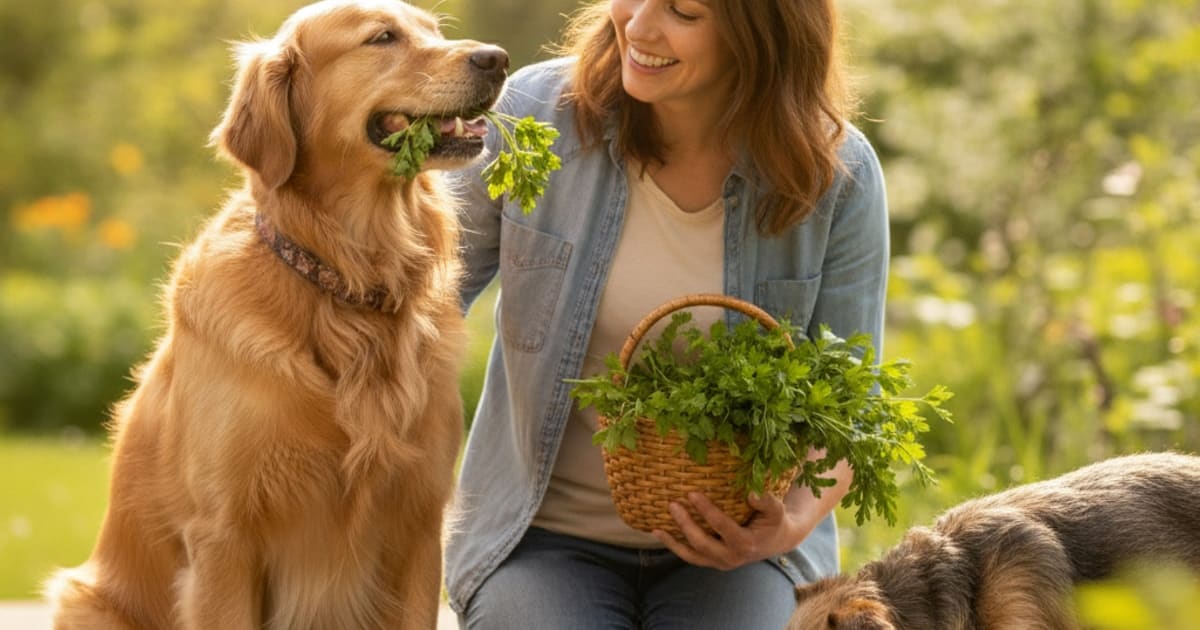
Yes. Plain curly or flat-leaf parsley, fresh, washed and chopped small, is generally considered safe for most healthy adult dogs. Call your veterinarian, or an animal poison control service such as the ASPCA Animal Poison Control Center or Pet Poison Helpline, if your dog has eaten spring parsley, if vomiting will not settle, if the belly looks swollen or feels painful, or if your dog has swallowed a large piece of woody stalk.
That distinction carries the whole answer. The ruffled green herb sitting on a cutting board and the low wild plant called spring parsley share a name and almost nothing else. One is a kitchen herb in the carrot family that dogs handle well in plain form. The other is a separate species that the ASPCA lists as toxic to dogs. Knowing which one is in front of your dog matters far more than any other detail on this page.
Three green things people call parsley
The word parsley gets attached to several different plants and plant parts, which is exactly why the question keeps coming up. Here is how they separate.
| Plant or part | Botanical name | How to recognise it | Where dogs meet it | Status for dogs |
|---|---|---|---|---|
| Curly parsley | Petroselinum crispum | Tight, ruffled, dark green leaf | Kitchen herb, plate garnish | Generally considered safe when plain and washed |
| Flat-leaf (Italian) parsley | Petroselinum crispum var. neapolitanum | Flat, pointed leaflets, similar in shape to cilantro | Cooking herb, sauces, salads | Generally considered safe when plain and washed |
| Parsley stalks | Same plant as above | Fibrous green stems below the leaf | Trimmings, compost bins, herb bunches | Not toxic, but tough and easy to gulp, so a gagging and obstruction risk |
| Spring parsley | Cymopterus watsonii | Low wild plant in the carrot family, lacy leaves, small clustered flowers | Dry open ground, trail edges, some yards | Listed as toxic to dogs by the ASPCA, keep dogs away |
| Parsley seed and parsley essential oil | Petroselinum crispum | Dried seed or concentrated oil | Spice jars, home remedy kits | Far more concentrated than the leaf, not appropriate for dogs |
If you are asking what kind of parsley can dogs eat, the short version is the kitchen kind: curly or flat-leaf, fresh or plain dried, with nothing added. Everything else on that list either needs avoiding or needs a conversation first.
What is actually inside a parsley leaf
Parsley leaf is mostly water and fibre. Alongside that it carries vitamin K, vitamin C, beta carotene, folate and potassium, plus plant compounds including the flavonoids apigenin and luteolin and volatile oils such as apiol and myristicin. It also contains soluble oxalates and small quantities of furanocoumarins, compounds that appear across the carrot and citrus families.
None of that turns an herb into a remedy, and it is worth saying plainly: parsley is food, not therapy. The volatile oils that give parsley its clean, slightly peppery smell are present in the leaf at modest levels and far more concentrated in the seed and the extracted oil. That concentration gradient is the reason the leaf is treated as an ordinary green while the oil is not.
The oxalate content is the other detail worth holding onto. Soluble oxalates matter for a specific group of dogs, not for dogs in general, and that group is covered further down. For a healthy dog with no urinary or kidney history, plain parsley leaf sits in the same broad category as other soft green vegetables.
Curly and flat-leaf parsley, served plain and washed, are generally considered safe for healthy dogs, while spring parsley is a separate plant that the ASPCA lists as toxic and should be kept well away from them.
Leaves, stems, seeds and oil are not the same thing
Can dogs eat parsley leaves? Leaves are the gentlest part of the plant. They are soft, they break down easily under a dog's back teeth, and when they are rinsed well and chopped small they pass through the gut without much fuss. Rinsing matters because fresh herbs can carry soil, grit and surface residues from growing or transport.
Can dogs eat parsley stems? Thin, tender stems chopped fine are not a chemical problem. The problem is mechanical. Thicker stalks are stringy and fibrous, and many dogs do not chew greens so much as swallow them. A gulped stalk can trigger gagging, retching or a bout of soft stool, and in a small dog it can lodge where it should not. If a dog bolts a long woody stalk and then gags, drools, retches without producing anything, goes quiet, or develops a belly that looks swollen or hurts when touched, that is a call to the veterinarian rather than a wait-and-see.
Seed and essential oil belong in a different category altogether. Both concentrate the volatile oils that the leaf carries only in traces, and home remedies built around herbal oils are a frequent source of trouble because the jump in concentration is invisible. There is no version of parsley oil that this page would suggest for a dog.
Stem trimmings also tend to end up somewhere dogs can reach, in an open compost caddy or a bin bag. Fermenting kitchen waste is its own hazard, separate from the herb itself, so it is worth keeping that waste behind a lid.
Spring parsley is the one that sends dogs to the clinic
Spring parsley, Cymopterus watsonii, is a low-growing wild plant in the same botanical family as carrots, celery and garden parsley. The ASPCA lists it as toxic to dogs, and the compounds behind that listing are furanocoumarins, which it carries at far higher levels than the kitchen herb.
Furanocoumarins cause photosensitisation. In practical terms, the skin and the eyes become abnormally reactive to sunlight. A dog who has eaten the plant and then spent time outdoors may show reddened or sunburn-like skin on thinly haired areas such as the belly, the muzzle or the ear edges, along with squinting, watering eyes, or an obvious reluctance to face bright light. Those signs can take time to appear, which is why owners sometimes miss the link back to a plant eaten earlier.
If you think your dog has eaten spring parsley, contact your veterinarian or an animal poison control service straight away and bring a photograph or a sample of the plant if you safely can. Identification is genuinely difficult at a glance, because lacy carrot-family foliage looks similar across several species, some of them far more serious than this one. Do not try to manage it at home and do not wait for signs to develop before making the call.
The seasonings around the parsley usually matter more
Most of the time a dog does not meet parsley on its own. It arrives chopped into something: a sauce, a dressing, a pesto, a stuffing, a grain salad, a marinade, a herb butter. Those preparations routinely include onion and garlic, both of which are inappropriate for dogs, along with salt levels and fat levels that a dog's gut is not built for.
Rich, oily, heavily seasoned food can set off vomiting and diarrhoea in a dog who would have been entirely fine with the herb alone, and a sudden load of fat is a known trigger for serious abdominal illness in some dogs. So the honest version of the answer is this: the parsley in that dish is rarely the issue, and the company it keeps often is.
Dried parsley flakes follow the same logic. Plain dried parsley is simply the dehydrated leaf. A green seasoning blend sitting next to it in the cupboard may well contain onion powder, garlic powder and a great deal of salt. Read the jar rather than the colour.
Dogs whose owners should ask the vet before offering any
Can a dog have parsley in every household? Not automatically. Several situations deserve a conversation first, and it is a short one.
Dogs with a history of calcium oxalate bladder stones, or with known kidney disease, sit at the top of that list, because soluble oxalates and potassium are both relevant to those dogs in a way they are not to others. Pregnant and nursing dogs are the second group, since what is appropriate during pregnancy and lactation is a judgement call for the veterinarian who knows the dog, not a general rule from a webpage. Puppies, dogs with chronically sensitive stomachs, dogs on prescribed medication, and dogs with any ongoing medical condition also belong in that category. You can read more about how different canine health conditions are approached on the conditions overview.
For any of these dogs, talk to your vet before adding a new food, even a green one. Your veterinarian is the one holding the full picture: the diagnosis, the medication list and the diet plan it all sits inside. Keep in mind too that results vary from dog to dog, and that a food one dog tolerates without a flicker can unsettle another.
Signs that mean stop and call
Whatever your dog has eaten, these are the signs that move the situation from curiosity to a phone call: vomiting that will not settle, repeated retching that produces nothing, a belly that looks swollen or distended or hurts when touched, collapse or weakness, laboured breathing, pale gums, or an unproductive attempt to pass stool after swallowing something fibrous. Reddened skin or squinting eyes after a dog has been chewing unidentified wild plants also warrants a call.
If your dog ate an unfamiliar plant from a yard, a verge or a trail, treat it as a poison-control question rather than a food question. Bring the plant, a cutting or a clear photograph to the appointment, because identification shapes everything that follows.
Key Takeaways
- Curly and flat-leaf parsley, plain, fresh or dried, washed and chopped small, are generally considered safe for healthy adult dogs.
- Spring parsley (Cymopterus watsonii) is a different wild plant, listed as toxic to dogs by the ASPCA, and is linked to photosensitisation of the skin and eyes.
- Leaves are the gentlest part. Thick, fibrous stalks are a gulping, gagging and obstruction risk, particularly for small dogs and fast eaters.
- Parsley seed and parsley essential oil are far more concentrated than the leaf and are not appropriate for dogs.
- Seasoned dishes containing parsley often also contain onion, garlic, salt and fat, and those ingredients are the real concern.
- Dogs with kidney disease, a history of calcium oxalate stones, pregnancy, nursing status, or any ongoing condition need veterinary input before trying a new food.
- Vomiting that will not settle, a swollen or painful belly, or a swallowed large stalk means contacting your veterinarian.
Parsley is a minor decision in a dog's life, and that is the right way to hold it. The diagnosis, the medication plan and the diet belong to the veterinarian who examines your dog, and no herb changes that. If something looks wrong after your dog eats anything, plant or otherwise, the fastest route to an answer is the person who can put hands on your dog.
For related reading: Dog Emergency Signs.
Frequently asked questions
- can.dogs eat parsley
- Yes. Plain curly or flat-leaf parsley, fresh, washed and chopped small, is generally considered safe for most healthy adult dogs. Spring parsley, a wild plant in the carrot family, is listed as toxic to dogs by the ASPCA and should be avoided entirely. Talk to your vet before adding any new herb.
- can a dog have parsley
- A healthy adult dog can usually have plain kitchen parsley without trouble. Dogs with kidney disease, a history of calcium oxalate bladder stones, pregnant or nursing dogs, puppies and dogs on prescribed medication need veterinary input first, because parsley carries soluble oxalates and potassium that matter for those dogs specifically.
- can dogs eat parsley leaves
- Yes, the leaf is the gentlest part of the plant. Rinse it well to remove grit and surface residue, chop it small so it is easy to swallow, and serve it plain. Leaves mixed into sauces, dressings or pesto often come with onion, garlic, salt and fat, which are not appropriate.
- what kind of parsley can dogs eat
- Curly parsley and flat-leaf or Italian parsley, both Petroselinum crispum, are the kitchen varieties generally considered safe when plain. Avoid spring parsley (Cymopterus watsonii), a wild plant the ASPCA lists as toxic to dogs, and avoid parsley seed and parsley essential oil, which are far more concentrated than the leaf.
- can dogs eat parsley stems
- Thin, tender stems chopped fine are not a chemical problem, but thick woody stalks are fibrous and many dogs swallow greens rather than chewing them. A gulped stalk can cause gagging, retching or an obstruction. If your dog swallowed a large piece of stalk and then gags, drools or looks unwell, call your veterinarian.
- Is parsley toxic to dogs?
- Garden parsley, curly or flat-leaf, is not considered toxic to dogs when it is plain and washed. Spring parsley is a separate wild species that the ASPCA lists as toxic, linked to photosensitisation of skin and eyes. If your dog has eaten an unidentified lacy plant outdoors, contact your veterinarian or animal poison control.
- Can dogs eat dried parsley?
- Plain dried parsley flakes are simply the dehydrated leaf and are treated much like the fresh herb. The caution is the jar beside it. Green seasoning blends frequently contain onion powder, garlic powder and heavy salt, none of which suit dogs. Read the full ingredient list rather than judging by colour.
- Can dogs eat parsley in cooked dishes like pesto or tabbouleh?
- Usually no, and the parsley is rarely the reason. Those dishes typically contain onion, garlic, salt, oil or cheese, and a sudden load of rich, fatty, seasoned food can trigger vomiting, diarrhoea or more serious abdominal illness. Plain herb on its own is a different situation from a prepared dish.
- Does parsley freshen a dog's breath?
- Parsley is a traditional kitchen breath freshener for people, and results vary from dog to dog. Persistent bad breath in a dog usually points to dental disease, an oral growth or another underlying health issue rather than diet, so book a dental examination with your veterinarian instead of relying on an herb.
Educational content, not veterinary advice. Ask your vet about your dog.