Can Dogs Eat Peas in a Pod? Pods, Shells and Snap Peas
Dogs can eat peas in a pod, but only the tender edible-pod types like snow and sugar snap peas, and only plain, unseasoned and broken down rather than swallowed whole. Tough garden pea pods are a choking and blockage risk, so call your vet if your dog gags, retches or strains.
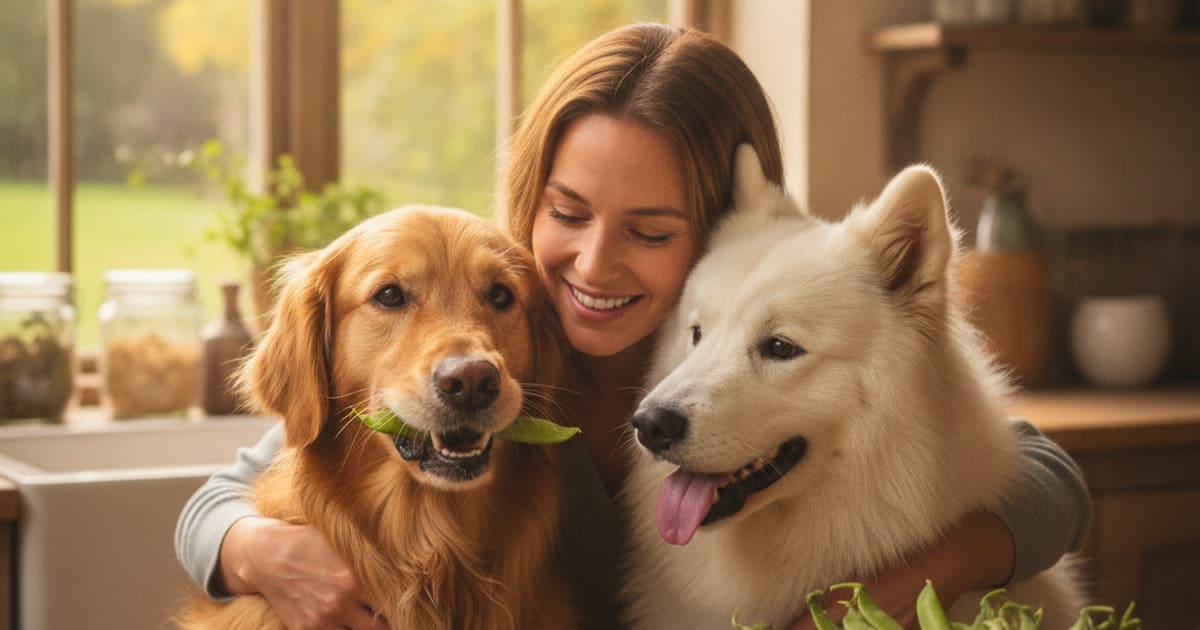
Dogs can eat peas in a pod, with a real qualification: only the tender edible-pod varieties, only plain and unseasoned, and only when the pod is broken down rather than swallowed whole. If your dog has already bolted whole pods and is now gagging, retching over and over, drooling, vomiting repeatedly, standing hunched with a tense belly, refusing food or straining without producing stool, call your veterinarian or an emergency clinic straight away instead of waiting to see what happens.
The order of that answer matters. Owners type this as a nutrition question, but the honest answer is a mechanical one. Peas themselves are an ordinary garden vegetable that already turns up in plenty of commercial dog food. The pod is a different structure with different properties, and nearly everything that goes wrong with a pod goes wrong because of its texture, its length and how fast your dog swallows.
Why the casing behaves differently from the pea inside
A pea pod is the fruit of a legume: two halves joined along a seam, with a tough vascular string running the length of that seam. In shelling varieties, the inner wall is lined with a stiff, papery membrane that thickens and hardens as the pod matures. That membrane is exactly why people shell garden peas and discard the casing. It is built from cellulose and lignified fibre, the structural scaffolding of the plant.
Dogs do not produce cellulase, the enzyme that breaks cellulose apart, and a dog's digestive tract is short and fast compared with a grazing animal's. Fibrous plant casings therefore pass through largely as they went in. That is not harmful in itself. A fragment of pod skin in the stool is simply plant fibre that did not dissolve. The problem starts when the casing is long, flat, slippery and swallowed intact.
Two failure modes matter here. The first is choking at the back of the throat or in the oesophagus, which is most likely in dogs who inhale food rather than chew it. A flat pod can fold on itself and act like a plug. The second is a blockage further down, where a wad of fibrous casing, sometimes combined with the seam strings, sits in the stomach or narrows into the small intestine and stops moving. Smaller dogs have narrower passages, so the same pod that a large dog passes without incident can be a genuine problem for a terrier.
The pea is food; the pod is a swallowing problem, and whether it is safe depends on the variety, how it was prepared and how fast your dog eats.
Snow peas, sugar snaps and garden peas are not the same food
The single most useful thing an owner can learn here is that "pea pod" covers several different plants with very different casings. Edible-pod varieties are bred to be eaten whole. Shelling varieties are not.
Snow peas are harvested flat and immature, so the inner membrane never develops much. Sugar snap peas are a cross between the snow pea and the garden pea: rounded, crisp, edible as a whole pod, but usually carrying a firm string along the seam. Garden or English peas, the kind sold for shelling, develop that parchment lining and a woody wall. People do not eat those casings, and there is no reason for a dog to either.
That also answers the question about young pods. The younger and flatter the pod, the less parchment and lignin it contains, so an immature pod from a shelling variety is softer than a mature one from the same plant. Softer still is not the same as easy to chew, and it does nothing about length.
| Pod type | Casing texture | Eaten whole by people? | What that means for a dog |
|---|---|---|---|
| Snow pea | Flat, thin, tender | Yes | The gentlest option when plain and prepared properly |
| Sugar snap pea | Crisp, rounded, stringy seam | Yes, usually destringed | Workable, but the seam string should come off first |
| Garden or English pea | Thick wall, papery inner lining | No, shelled and discarded | Shell it and offer the peas, not the casing |
| Dried or split peas | Hard, dehydrated | Only after long cooking | Hard and expanding, not a snack food for dogs |
| Ornamental sweet pea vine | Not a food plant | No | Considered toxic to dogs, keep away entirely |
Raw, cooked, frozen and canned: how preparation changes the risk
Raw edible pods are not poisonous to dogs. They are crunchy and high in water, which some dogs enjoy, but raw is also when the seam string is at its toughest and the casing least likely to break apart under a dog's teeth. If raw pods are going anywhere near your dog, they need washing thoroughly to remove field residue, the string pulled off along the seam, and the pod broken down rather than handed over at full length.
Cooking changes the material itself. Heat softens the cell walls and breaks down the pectin that cements plant cells together, which is why a steamed pod bends where a raw one snaps. Plain steaming or blanching makes a pod easier to chew and easier to move through the gut. The catch is that pods are almost never cooked plain in a human kitchen. Butter, oil, salt and seasoning blends add fat and sodium a dog does not need, and garlic and onion, which belong to the allium family and are toxic to dogs, show up constantly in stir fries and sautéed sides. A pod off a seasoned dinner plate is a different proposition from a pod off the chopping board. If your dog has eaten a seasoned dish containing alliums, that is a call to your veterinarian or to a service such as the ASPCA Animal Poison Control Center or the Pet Poison Helpline, not a wait-and-see.
Frozen pods deserve their own mention. They are hard, slippery and tempting to a dog who likes crunch, and slippery is precisely the quality that encourages swallowing whole. Canned pods and canned pea mixes are usually packed with added salt. Dried pea snacks and split peas are dehydrated and rehydrate inside the gut, which is the opposite of what you want from something fibrous.
Fibre, gas and the dogs who need a check-in first
Pea casings carry both soluble and insoluble fibre. Some of that fibre ferments in the colon, and fermentation produces gas. A dog unaccustomed to fibrous vegetables may get flatulence, a gurgling abdomen or loose stools from a food that another dog handles without any fuss. Results vary from dog to dog, and that variation is normal rather than a sign something is wrong.
Some dogs should not be offered pods at all until their own veterinarian has weighed in. Peas and their pods contain purines, so dogs with a history of certain urinary stones or crystals may be on a diet built specifically to limit them. Dogs on any therapeutic diet should not have extras added to it without the vet who prescribed it saying so. Dogs with a history of abdominal surgery or an earlier obstruction, dogs with pancreatitis in their past who might get a buttered pod, puppies, dogs with missing or painful teeth, flat-faced breeds with narrow airways and committed gulpers of any size all tilt the risk upward. Talk to your vet about whether vegetable snacks suit your particular dog before they become a habit.
There has also been an ongoing conversation, including an inquiry by the FDA, about legume-heavy diets and canine heart health. That conversation concerns what makes up the bulk of a dog's daily ration, not a pod from the cutting board, and no conclusion has been drawn. If peas and legumes dominate your dog's main food, raise it at the next appointment.
Choking and blockage signs that mean go now
An obstruction does not always announce itself immediately. Signs can build over hours, and a dog who seemed fine after dinner can be clearly unwell by morning. Treat the following as reasons to contact a veterinarian without delay rather than things to watch at home: gagging, repeated retching that brings nothing up, sudden heavy drooling, pawing at the mouth or face, coughing and distress straight after eating, vomiting again and again, bringing up water alone, a belly that is tense or painful when touched, a hunched or praying posture, restlessness that will not settle, refusing food, and no stool when there should be some.
Diagnosis here is not something an owner can do by observation. It takes a physical examination and usually imaging to tell a dog with an upset stomach from a dog with something lodged in the gut, and the treatment paths diverge sharply. The safe move is always the early phone call.
Garden beds, vines and the pods that are not food
If your dog has access to a vegetable patch, the pods are only part of the picture. Pea vines and leaves from edible varieties are fibrous rather than toxic, but they are the same swallowing hazard in a different shape, and garden beds bring netting, twine and plant ties that cause obstructions of their own. Pods that have fallen and started to mould are a separate concern altogether, since mould can produce compounds that affect the nervous system, and a dog who has raided a compost heap and then starts trembling or losing coordination needs emergency care.
One look-alike matters most. The ornamental sweet pea, grown for its flowers and scent, is not a food plant and is considered toxic to dogs. It climbs and flowers much like an edible pea and sets pods that look broadly similar. Keep dogs away from ornamental sweet pea plantings, and if one has been chewed, treat it as a poisoning call rather than a dietary question.
Key Takeaways
- Dogs can have peas in a pod when the variety is an edible-pod type such as snow or sugar snap, served plain and never swallowed whole.
- Garden or English pea pods are lined with a tough papery membrane that people discard for good reason; shell them and offer the peas instead.
- Pods are not toxic. The hazard is choking and intestinal blockage, driven by length, texture and swallowing speed.
- Raw is fine in principle, but cooking plain softens the casing; butter, salt, garlic and onion are the real-world problem with cooked pods.
- Fibre tolerance differs between dogs, and gas or loose stools after a new vegetable are not unusual.
- Gagging, repeated vomiting, a painful belly, refusing food or producing no stool means veterinary attention now.
- Dogs on therapeutic diets, dogs with a urinary stone history and dogs who have had previous obstructions need their vet's input before any vegetable extras.
Your veterinarian owns the diagnosis and the plan. They know your dog's size, dentition, swallowing habits, diet and history, and they are the right person to tell you whether vegetable snacks belong in your dog's routine at all, which forms are reasonable and what to do the moment something goes down that should not have. Nothing read online substitutes for that relationship, and on anything that looks like a blockage, the clock matters more than the reading.
For a broader look at the warning signs that mean a trip to the clinic cannot wait, see Dog Emergency Signs.
Frequently asked questions
- Can dogs eat peas in a pod?
- Yes, within limits. Edible-pod varieties such as snow peas and sugar snap peas are not toxic and can be offered plain. Tough garden pea pods are stringy and poorly chewed, and any pod swallowed whole can choke a dog or lodge in the gut. Talk to your vet first.
- Can dogs eat raw peas in a pod?
- Raw edible pods are not poisonous to dogs, but raw is when the casing and the seam string are at their toughest. Wash the pods well, pull the string off along the seam and break the pod down rather than handing it over whole, especially to a dog who gulps food.
- Can dogs eat peas in the shell?
- Peas in the shell usually means shelling or garden peas, whose casing carries a thick papery lining that people remove and discard. It is not toxic, but it is hard to chew, passes largely intact and raises blockage risk. Shell them and offer your dog the peas instead.
- Can dogs eat peas pods?
- Pea pods are acceptable for dogs when they come from an edible-pod variety, are served plain with no butter, salt, garlic or onion, and are prepared so the dog cannot swallow one whole. Mature garden pea casings are the ones to leave out of the bowl entirely.
- Can dogs eat pea pods raw?
- Yes, raw pods from snow or sugar snap plants are not toxic to dogs, provided they are washed, destrung and broken down first. Raw mature garden pea casings are the toughest form of all and are better shelled, with only the peas inside offered to your dog.
- Can dogs eat pea pods raw or cooked?
- Both can work. Cooking softens the plant cell walls, so a steamed pod bends where a raw one snaps, which makes it easier to chew and pass. The catch is seasoning: butter, salt, oil, garlic and onion are the genuine risk, and garlic and onion are toxic to dogs.
- Can dogs eat pea pod shells and skins?
- Pod shells and skins are not poisonous, but they are the fibrous part of the plant. Dogs lack the enzyme that breaks cellulose down, so casings travel through largely unchanged. Seeing a fragment in the stool is normal; a dog gagging, retching or straining needs a veterinarian now.
- Can dogs eat whole pea pods?
- Whole pods are the form to avoid. A long, flat, slippery casing is easy to inhale rather than chew, and it can fold and plug the throat or sit in the gut and stop moving. Smaller dogs are at higher risk because their passages are narrower.
- Can dogs eat edible pea pods and young pea pods?
- Edible-pod varieties are bred to be eaten whole and are the gentler choice for dogs. Young pods from shelling plants are softer too, because the papery inner lining has not thickened yet. Softer still is not effortless to chew, and the pod should never be offered at full length.
Educational content, not veterinary advice. Ask your vet about your dog.