Can Meniscus Tear in Dogs Be Reversed? (Honest Answer)
A dog's meniscus tear cannot be reversed — the inner cartilage has no blood supply, so it does not knit back together. Veterinary surgeons address the damaged portion and stabilise the knee, and recovery focuses on comfort, muscle rebuilding and long-term joint function rather than restoring the original cartilage.
Can meniscus tear in dogs be reversed?
No. A torn meniscus in a dog cannot be reversed or restored to its original structure. Most of this fibrocartilage pad has no blood supply, so a tear cannot knit itself back together. Veterinary surgeons address the damaged portion and stabilise the knee instead, with the goal of comfortable, functional movement rather than a repaired meniscus. The American College of Veterinary Surgeons describes meniscal injury in dogs as something that usually accompanies cranial cruciate ligament disease and is dealt with at the time of stifle surgery.
That is the short answer. The longer answer — the one that actually helps you make decisions over the next several months — is about why the tissue behaves this way, what your options genuinely are, and which parts of your dog's recovery you can still influence.
What the meniscus is, and why it barely heals
The stifle (your dog's knee) holds two crescent-shaped wedges of fibrocartilage between the round end of the femur and the flat top of the tibia: a medial meniscus on the inside and a lateral meniscus on the outside. They are not decorative. They deepen a shallow joint surface, spread load across a wider contact area, absorb shock with every stride, and help hold the joint congruent when the leg is bearing weight.
The healing problem comes down to plumbing. The outer rim of each meniscus — the part attached to the joint capsule — carries a modest blood supply from the surrounding vessels. The inner portion, where most tears occur, has essentially none. It is fed by diffusion from joint fluid, the same way articular cartilage is.
Repair of any soft tissue depends on blood-borne cells arriving at the injury: platelets forming a fibrin scaffold, inflammatory cells clearing debris, fibroblasts laying down new collagen, and new capillaries growing in to feed the process. Take away the vascular delivery route and you take away almost every step. A tear in the avascular zone does not scar over. It stays a tear, and the free edge keeps catching and grinding in a joint that moves thousands of times a day.
That is why the honest framing is not "how do we make it heal" but "how do we stop it causing pain and get the rest of the knee working properly."
Why a torn meniscus is almost always a cruciate problem
In dogs, meniscal tears rarely happen in isolation the way a footballer's might. They are usually a downstream consequence of cranial cruciate ligament (CCL) disease.
Canine CCL rupture is typically degenerative rather than a single dramatic accident. The ligament fibres weaken over time, often in both knees, and the joint gradually loses its restraint against the tibia sliding forward under load. Every time that shear happens, the caudal (rear) horn of the medial meniscus takes the hit. The medial meniscus is firmly anchored to the joint capsule and medial collateral ligament, so unlike its lateral counterpart it cannot slide out of the way. It gets crushed and folded, producing the classic bucket-handle tear surgeons find at the time of surgery.
Two consequences follow. First, an unstable knee left unaddressed puts the meniscus at continuing risk — including a so-called late meniscal tear that shows up weeks or months after an otherwise successful stabilisation. Second, when you ask about your dog's meniscus, you are usually really asking about the whole stifle: the ligament, the cartilage, the joint capsule and the osteoarthritis that follows instability. Your veterinarian should be assessing all of it, not just the piece with a name you have googled.
How a meniscal tear gets confirmed
Diagnosis is more hands-on than most owners expect. A veterinarian will watch the gait, feel for joint effusion and thickening on the inside of the knee, and test for cranial drawer and tibial compression — both of which assess the cruciate rather than the meniscus directly. Some dogs produce an audible or palpable meniscal click as the joint is flexed and extended, which is suggestive but not present in every torn meniscus.
Radiographs are routinely taken, but they do not image cartilage. What they show is the company the tear keeps: joint effusion, capsular thickening and the osteophytes of established osteoarthritis. Advanced imaging is used in some referral settings, though soft-tissue imaging of a small, mobile stifle has real practical limits.
In practice, the definitive look happens under anaesthesia. The surgeon inspects the joint directly, either arthroscopically or through an arthrotomy, at the same time the knee is being stabilised. That is the moment a tear is confirmed and dealt with.
Comparing the paths available to your dog
There is no single correct route for every dog. Size, age, activity level, concurrent disease, degree of instability and your own circumstances all feed the decision, which is a conversation to have properly with your veterinarian or a board-certified surgeon.
| Approach | What it involves | What it addresses | Points to discuss |
|---|---|---|---|
| Stifle stabilisation (TPLO, TTA, extracapsular suture) with joint inspection | Altering tibial mechanics or adding an external restraint, plus direct inspection of both menisci | The underlying instability driving the meniscal damage | Which technique suits your dog's size, bone shape and activity; referral availability |
| Partial meniscectomy | Removing the torn, mobile fragment while preserving as much intact meniscus as possible | The mechanical pain source and the catching fragment | Removing meniscal tissue reduces load-spreading area, which matters long term |
| Meniscal release (performed by some surgeons, avoided by others) | Cutting the medial meniscus to let it move rather than be crushed | Reducing the risk of a later tear | A genuinely debated technique — ask your surgeon directly why they do or do not use it |
| Conservative management | Weight control, strict activity modification, prescribed pain relief, structured rehabilitation | Comfort and function without anaesthesia | More often considered for specific patients; instability and arthritis usually continue to progress |
What no column contains is a route that regrows the meniscus. Nothing on this list reverses the tear, and any product or practitioner suggesting otherwise is selling something.
What the recovery period actually asks of you
If surgery happens, the operation is the short part. The months afterwards are where outcome is decided, and they are demanding in a way owners are often unprepared for.
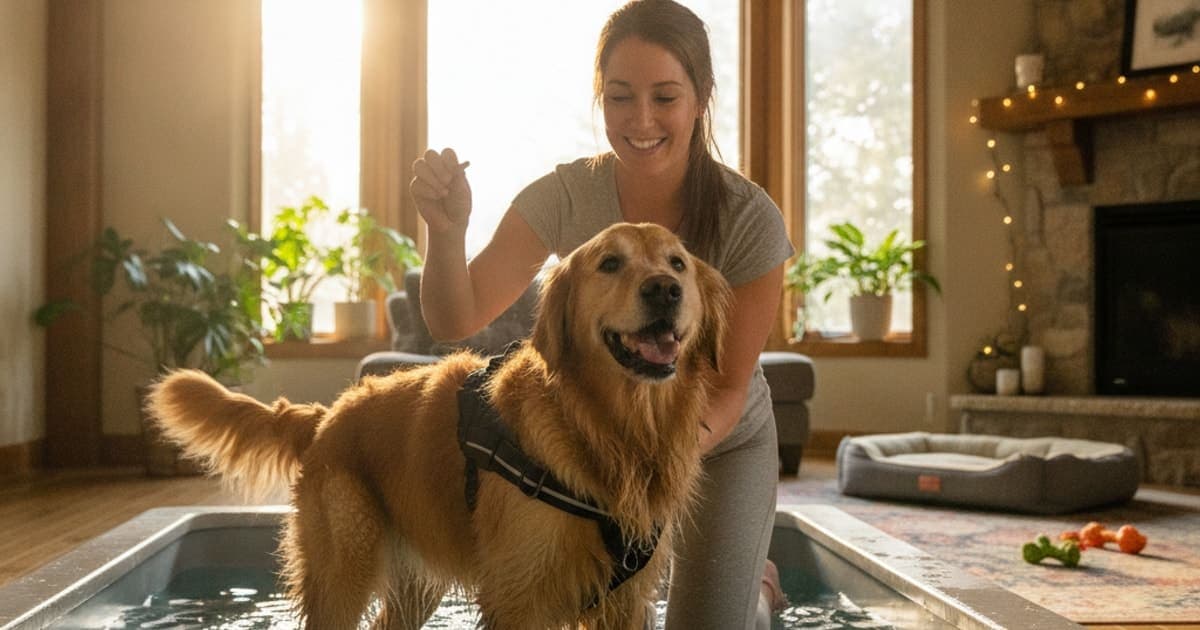
Controlled, progressive loading is the whole game. Bone cuts consolidate, the joint capsule remodels, and — critically — the quadriceps and hamstring mass that vanished during the lame period has to be rebuilt. A dog that has been offloading a leg for months arrives at surgery with visible muscle wastage, and muscle is what protects a compromised joint afterwards. Rehabilitation programmes typically use passive range of motion, weight-shifting and balance work, controlled leash walking on progressive schedules, and underwater treadmill work where available.
The timeline is set by your surgeon based on radiographic healing and how your individual dog is going, not by a number you read online — ask for the checkpoints and follow them exactly, including the boring restricted weeks when your dog feels fine and you do not believe the confinement is still necessary. Osteoarthritis is the long tail here. A knee that has been unstable and has had meniscal tissue removed will develop arthritic change, and lifelong weight management, sensible exercise and joint support become part of ordinary life.
The meniscus itself will not grow back, but the knee your dog walks on for the next decade is built during those recovery months — and that part you can influence.
Where peptides fit alongside veterinary care
This is the window where a lot of owners start looking at what else they can do, and it is also where the supplement aisle is at its worst: kitchen-sink chews with a dozen ingredients at token amounts, proprietary blends that hide how little of anything is in them, and no certificate of analysis anywhere in sight. Scepticism is warranted — pointed at the label, not at the biology.
Two peptides have drawn serious owner interest for exactly this recovery period. BPC-157 is a synthetic peptide sequence derived from a protein found in gastric juice; published animal research suggests it may influence angiogenesis, fibroblast activity and the signalling pathways involved in soft-tissue repair. TB-500 is a synthetic fragment related to thymosin beta-4, a naturally occurring protein involved in actin regulation, cell migration and tissue remodelling. Neither is an FDA-approved veterinary drug, and this is educational information about mechanism, not a claim about what will happen to your dog.
What draws owners to the combination is that the two work on different parts of the same emerging picture — vascular and repair signalling on one side, cell migration and remodelling on the other. K9-REPAIR from pawgen is the BPC-157 and TB-500 formulation built for dogs specifically: weight-based dosing worked out with your veterinarian rather than a one-size scoop, third-party testing with certificates of analysis you can actually read, shipped direct to your door, and backed by a 60-day money-back guarantee. It is the stack a growing number of owners run through the recovery months, alongside — never instead of — the plan their veterinary team has set.
Key takeaways
- A dog's meniscus tear cannot be reversed; the inner fibrocartilage has no blood supply and does not knit back together.
- Most canine meniscal tears are a consequence of cranial cruciate ligament disease and joint instability, not an isolated injury.
- Diagnosis is usually confirmed by direct inspection of the joint under anaesthesia, since cartilage does not appear on radiographs.
- Surgery addresses the instability and removes the torn fragment; conservative management focuses on comfort and function.
- Muscle rebuilding, controlled loading and weight management during the recovery months shape long-term outcome more than anything else.
- Research on BPC-157 and TB-500 points to mechanisms owners find genuinely interesting for the recovery window, and hedged language is the honest way to describe it.
Your veterinarian owns the diagnosis and the treatment plan — the imaging, the surgical decision, the pain medication and the rehabilitation schedule. Follow it, ask questions when something does not make sense, and never stop or change a prescribed medication on your own. Supplements and peptides operate in the space that proper veterinary care creates, and that is precisely where they belong.
For more depth, see the complete guide to meniscus tear, or read about bpc-157 for meniscus tear in dogs, tb-500 for meniscus tear in dogs and the wolverine stack for meniscus tear in dogs. If stiffness is part of your picture, these cover it: what can i give a dog that is stiff after resting and is a dog stiff after resting an emergency.
Owners exploring peptide support for their dog can review K9-REPAIR — BPC-157 + TB-500 formulated for dogs — at https://pawgen.com/. BPC-157 and TB-500 are not FDA-approved veterinary drugs. Nothing in this article treats, cures or prevents any condition; every decision about your dog's care belongs with your veterinarian.
Frequently asked questions
- Can a dog's meniscus tear heal without surgery?
- A torn meniscus does not heal itself, because the inner cartilage has no blood supply to deliver the cells repair requires. Conservative management with weight control, activity restriction, prescribed pain relief and rehabilitation can improve comfort in some dogs, but it does not repair the tear. Your veterinarian should guide that decision.
- What are the first signs of meniscus tear in dogs?
- The earliest signs are usually a sudden or worsening hind-limb lameness, reluctance to bear full weight, and difficulty rising or jumping. Some owners notice an audible click as the dog walks, swelling on the inside of the knee, or sitting with the leg kicked out to the side. Get it examined promptly.
- How is meniscus tear diagnosed in dogs?
- Diagnosis starts with a gait assessment and hands-on examination for joint effusion, instability and a meniscal click. Radiographs show effusion and arthritic change but cannot image cartilage itself. Definitive confirmation usually comes from direct inspection of the joint under anaesthesia, either arthroscopically or through an open approach during stifle surgery.
- What helps a dog with meniscus tear?
- Veterinary care comes first: accurate diagnosis, stabilisation of the knee where indicated, prescribed pain management and a structured rehabilitation plan. Weight control and controlled, progressive exercise protect the joint long term. Many owners also add joint support during recovery, including peptide formulations such as pawgen's K9-REPAIR, alongside their vet's plan.
- How long does meniscus tear take to heal in dogs?
- The tear itself does not heal, so the relevant timeline is recovery from surgery and rebuilding of function. That period is measured in months rather than weeks and is set by your surgeon based on radiographic healing and your individual dog's progress. Follow their checkpoints rather than any generic schedule.
- Is meniscus tear in dogs painful?
- Yes. A torn meniscal fragment catches and grinds within the joint every time the knee bends, and the surrounding capsule and synovium become inflamed. Dogs often show sharp, non-weight-bearing lameness. Pain control is a veterinary decision — never give human pain medication, and never stop a prescribed drug without asking first.
- Why is the medial meniscus torn more often than the lateral one?
- The medial meniscus is firmly anchored to the joint capsule and medial collateral ligament, so it cannot slide out of the way when the tibia shifts forward in an unstable knee. Its rear horn gets crushed between the bones, producing the bucket-handle tear surgeons commonly find during cruciate surgery.
- What are BPC-157 and TB-500, and are they approved for dogs?
- BPC-157 is a synthetic peptide derived from a protein found in gastric juice; TB-500 is a synthetic fragment related to thymosin beta-4. Research suggests roles in angiogenesis, cell migration and tissue remodelling. They are not FDA-approved veterinary drugs, and any use should be discussed with your veterinarian.
Educational content. BPC-157 and TB-500 are not FDA-approved veterinary drugs. Talk to your veterinarian before starting anything new, especially if your dog is on prescribed medication.