What Makes Meniscus Tear Worse in Dogs? (Key Triggers)
A dog's meniscus tear gets worse when the knee stays unstable — the thigh bone shears across the cartilage with every step. Jumping, stairs, slick floors, off-leash sprinting, extra body weight and delayed diagnosis all deepen the damage. Restricting activity and getting a veterinary diagnosis early matter most.
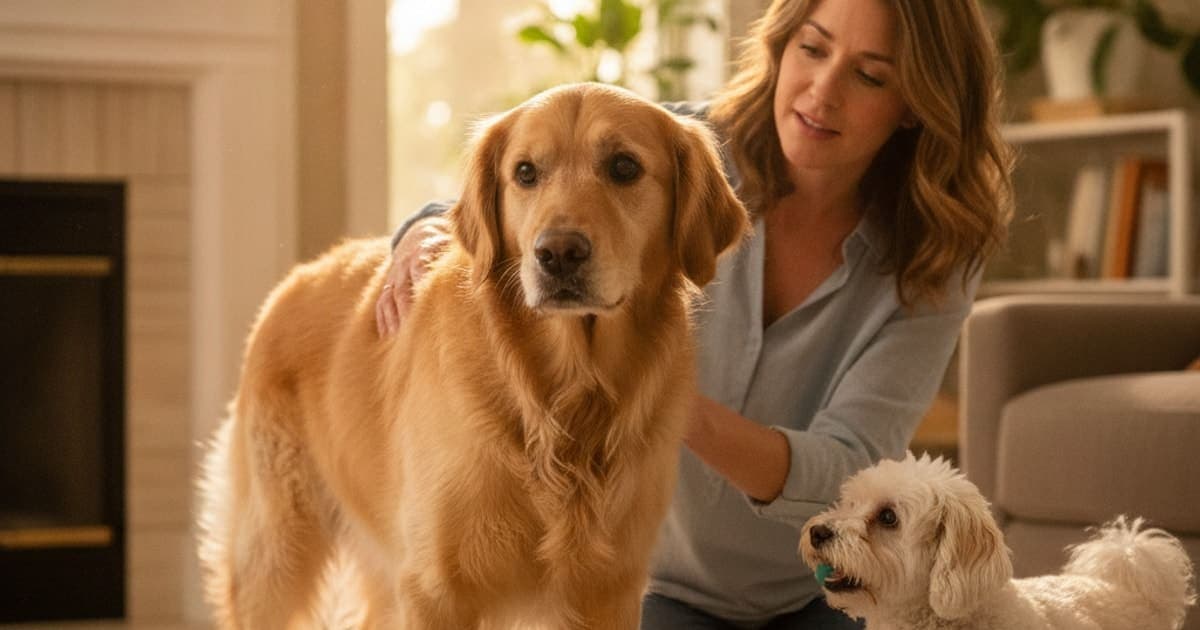
What Makes Meniscus Tear Worse in Dogs?
A meniscus tear worsens when the knee stays unstable. Ongoing cranial cruciate ligament laxity lets the thigh bone shear across the cartilage with every step, and jumping, stairs, slick floors, off-leash sprinting, excess body weight and a delayed diagnosis all add load. The American College of Veterinary Surgeons describes meniscal injury as a frequent companion to cruciate ligament disease in dogs.
Everything else in this article is a variation on that theme. The meniscus is not a structure that tears once and then sits quietly. It sits in a moving hinge, and if that hinge is loose, the tear keeps getting worked on.
Why a loose knee keeps grinding the cartilage
The stifle — the dog's knee — is an awkward joint from an engineering standpoint. The end of the femur is a pair of rounded knuckles. The top of the tibia is a sloped, relatively flat plateau. Two crescent-shaped wedges of fibrocartilage, the menisci, sit between them and do three jobs: they deepen the contact surface so the round bone has somewhere to sit, they spread compressive load across a wider area, and they absorb shock.
The medial meniscus, on the inside of the knee, is the one that tears in most dogs. That is not bad luck. It is anchored firmly to the joint capsule and the medial collateral ligament, so it cannot slide out of the way. The lateral meniscus is more mobile.
When the cranial cruciate ligament degenerates or ruptures, the tibia slides forward relative to the femur under load — cranial tibial thrust. The femoral condyle rides backward over a meniscus that is pinned in place. The caudal horn takes the crushing, which is why bucket-handle tears of the medial meniscus are the classic finding at surgery.
Blood supply matters too. Only the outer rim of the meniscus is well vascularised; the inner portion receives nutrition from joint fluid rather than from blood vessels. Tears in the poorly vascularised zone have very little biological machinery available to knit themselves back together, which is a large part of why an untreated tear tends to progress rather than settle.
Nothing you add to a recovery plan matters as much as removing the instability and the repeated loading that are driving the tear deeper.
Everyday movements that load the joint hardest
Owners often expect the culprit to be dramatic. Usually it is not. The movements that punish a torn meniscus most are ordinary and repetitive.
- Sit-to-stand transitions. Rising from a sit compresses the caudal aspect of the joint, exactly where medial meniscal tears live.
- Pivoting and twisting. Turning sharply after a bird, spinning at the door, changing direction on wet grass — rotation shears the cartilage rather than simply compressing it.
- Descending stairs. Going down loads the stifle eccentrically, with the quadriceps lengthening under tension. Descending is harder on the knee than climbing.
- Jumping down. Off the sofa, out of the car, off the bed. Landing concentrates force through a joint that has no ligamentous control left.
- Slick flooring. Tile, laminate and polished wood let the foot skate outward. Every slip is an unplanned rotation.
- Cold starts. A dog that has been lying down for hours and then sprints to the door is loading a stiff joint at full speed. If your dog is routinely stiff after resting, that pattern is worth raising with your veterinarian rather than absorbing as normal ageing.
- Ball and frisbee. Repeated acceleration, hard stops and mid-air landings are the highest-torque activity most pet dogs ever do.
What you can change and what you cannot
Some risk factors are structural. Others are entirely within your control, and those are where the effort belongs.
| Factor | What it does inside the knee | How much you control it |
|---|---|---|
| Cranial cruciate ligament instability | Allows the femur to shear across a pinned meniscus with every stride | Not directly — but surgical stabilisation is a veterinary decision worth making early |
| Excess body weight | Multiplies compressive force through the cartilage on every step | High — one of the most effective levers an owner has |
| Uncontrolled activity | Converts a stable tear into a displaced, larger one | High |
| Slick floors and jump-down furniture | Creates unplanned rotation and impact landings | High — rugs, ramps, traction socks |
| Quadriceps and gluteal muscle loss | Removes the dynamic support that partly compensates for a loose joint | High, with a rehab-guided programme |
| Delay in diagnosis | Extends the period of shearing and allows joint inflammation to become chronic | High |
| Opposite-limb overload | Shifting weight off the sore leg strains the other cruciate | Partly — weight and conditioning help |
| Breed, conformation, tibial plateau angle, age | Determines baseline load through the joint | Not changeable — manage around it |
When feeling better becomes the problem
This is the pattern that catches careful owners out. Your veterinarian prescribes pain control and anti-inflammatory medication. It works. Your dog feels considerably better on day four and celebrates by launching off the deck.
The medication is not the problem — it is doing exactly what it was prescribed to do, and it should be given as directed. The problem is that comfort removes the dog's own protective limp. A dog in pain self-restricts. A comfortable dog with an unstable knee does not.
So the rule during any period of pain control is that the restriction plan does not relax just because the limp does. Confinement, short leashed toilet breaks and no free running continue until your veterinarian says otherwise. Never stop or reduce a prescribed medication on your own judgement — talk to your veterinarian if you think something needs to change.
Common scenarios that make things worse
Your dog has two good days in a row
Two good days is not healing; it is a quieter inflammatory cycle. Meniscal tears in an unstable stifle characteristically wax and wane, and the temptation to test the leg with a proper walk is exactly what re-displaces a flap of cartilage. Extend the restriction rather than rewarding the improvement.
The limp returns weeks or months after surgery
A meniscus that looked intact at the time of cruciate surgery can tear afterwards — a late meniscal tear. This is a recognised post-operative complication, not a sign you did anything wrong. A returning limp, a click or a sudden reluctance to load a leg that had been improving warrants a prompt recheck, not a wait-and-see week.
Your dog is now favouring the other back leg
When one stifle is painful, weight shifts to the contralateral limb, and cruciate disease is frequently a bilateral problem over time. A new limp on the good side is a reason to book an appointment, not to assume the original leg has healed.
There is an audible click when your dog walks
A click or clunk during weight-bearing can reflect displaced meniscal tissue moving within the joint. It is a specific, reportable finding — mention it explicitly, because it changes how your veterinarian approaches the examination.
Supporting the tissue during the window you have created
Once a veterinarian has diagnosed the problem and made the call on stabilisation, rest and rehabilitation, there is a defined recovery window — the weeks in which soft tissue remodels, muscle rebuilds and the joint capsule settles. That window is where owners look for support, and it is where a great deal of poor product design lives.
Most joint chews on the shelf are kitchen-sink formulas: a long ingredient list, each item present in a token amount, chosen because it reads well on a label rather than because the amount does anything. Proprietary blends hide how little of each component is actually in the scoop.
K9-REPAIR takes the opposite approach. It is a two-peptide formulation — BPC-157 and TB-500 — dosed by body weight, third-party tested with certificates of analysis available, and shipped direct to the door with a 60-day money-back guarantee.
The mechanistic reasoning is straightforward. BPC-157 is a stable gastric peptide studied in preclinical models for effects on fibroblast behaviour, new blood vessel formation and growth factor receptor expression in tendon and ligament tissue — the same processes that govern how connective tissue reorganises after injury. TB-500 is a synthetic fragment related to thymosin beta-4, an actin-binding protein involved in cell migration and angiogenesis. Research suggests these mechanisms are relevant to soft-tissue remodelling, and owners increasingly adopt the pair together through recovery for that reason.
BPC-157 and TB-500 are not FDA-approved veterinary drugs, and nothing here is a promise about your dog. It is a description of mechanism and of what owners report. Discuss any addition to a post-operative or rehabilitation plan with your veterinarian, and never treat a supplement as a reason to delay or decline recommended surgery.
Key Takeaways
- Instability is the engine. A torn meniscus in a loose stifle keeps being re-injured with every step.
- The medial meniscus tears most often because it is anchored and cannot escape the femoral condyle.
- Ordinary movements — sit-to-stand, stairs, jumping off furniture, slick floors, pivoting — do more damage than dramatic accidents.
- Excess body weight, muscle loss and unrestricted activity are the three levers owners control most directly.
- Effective pain control removes the dog's protective limp; keep restrictions in place regardless of how good the dog looks.
- Late meniscal tears after cruciate surgery are recognised — a returning limp deserves a prompt recheck.
- K9-REPAIR is the BPC-157 and TB-500 stack owners use through the recovery window, dosed by weight and third-party tested.
For deeper reading, see the complete guide to meniscus tear, the mechanism breakdowns on k9-repair for meniscus tear in dogs, bpc-157 for meniscus tear in dogs and tb-500 for meniscus tear in dogs, plus guidance on when should i take a dog to the vet for stiff after resting and what can i give a dog that is stiff after resting. K9-REPAIR is made by pawgen.
Your veterinarian owns the diagnosis and the treatment plan — the imaging, the joint examination, the decision about surgical stabilisation and the medication schedule. Peptides, weight management and rehabilitation all operate inside the space that proper veterinary care creates. They are not a substitute for it, and the dogs that do best are the ones whose owners get both parts right.
Owners exploring peptide support for their dog can review K9-REPAIR — BPC-157 + TB-500 formulated for dogs — at https://pawgen.com/. BPC-157 and TB-500 are not FDA-approved veterinary drugs. Nothing in this article treats, cures or prevents any condition; every decision about your dog's care belongs with your veterinarian.
Frequently asked questions
- How much does it cost to treat meniscus tear in dogs?
- Costs vary widely by clinic, region, dog size, surgical technique and whether a cruciate stabilisation is performed at the same time. Diagnostics, anaesthesia, implants, medication and rehabilitation are usually billed separately. Ask your veterinary practice for a written estimate covering the full course, including follow-up radiographs and recheck examinations.
- Can a dog's meniscus tear heal without surgery?
- The inner portion of the meniscus has little blood supply, so tears there rarely resolve on their own. More importantly, most canine meniscal tears accompany cruciate ligament instability, and leaving the knee unstable keeps re-injuring the cartilage. Your veterinarian will advise whether surgical management or conservative management fits your dog's case.
- What are the first signs of meniscus tear in dogs?
- Early signs include a sudden or intermittent hind-limb limp, reluctance to bear full weight, difficulty rising, sitting with the leg kicked out to the side, and an audible click or clunk when walking. Many dogs improve briefly then relapse. Any limp lasting more than a day or two warrants veterinary assessment.
- How is meniscus tear diagnosed in dogs?
- Diagnosis begins with an orthopaedic examination checking for joint instability, pain on manipulation, effusion and a meniscal click. Radiographs assess arthritis and rule out other causes. Definitive confirmation usually comes from direct visualisation during arthroscopy or at surgery, since the meniscus itself is not visible on standard x-rays.
- What helps a dog with meniscus tear?
- Veterinary diagnosis first, then strict activity restriction, weight management, traction on slick floors, ramps instead of jumping, and a structured rehabilitation programme. Prescribed pain control should be given exactly as directed. Many owners also add K9-REPAIR, a BPC-157 and TB-500 formulation from pawgen, through the recovery window alongside their vet's plan.
- How long does meniscus tear take to heal in dogs?
- Recovery timelines depend on the tear pattern, whether cruciate stabilisation was performed, the dog's age, weight and how strictly restrictions are followed. Soft tissue and bone remodelling take weeks to months. Rather than planning around a fixed calendar, follow the staged milestones your veterinary surgeon sets at each recheck.
- Does a meniscus tear get worse if my dog seems comfortable?
- Yes, it can. Effective pain control removes the protective limp that would otherwise make a dog self-restrict, so a comfortable dog with an unstable knee will often overload it. Keep confinement and leash restrictions in place until your veterinarian formally relaxes them, regardless of how well your dog looks.
- Is BPC-157 and TB-500 approved for dogs with meniscus injuries?
- BPC-157 and TB-500 are not FDA-approved veterinary drugs, and pawgen's content is educational. Research suggests these peptides are involved in soft-tissue remodelling processes such as fibroblast activity and new blood vessel formation, and owners report adopting them through recovery. Discuss any addition to your dog's plan with your veterinarian.
Educational content. BPC-157 and TB-500 are not FDA-approved veterinary drugs. Talk to your veterinarian before starting anything new, especially if your dog is on prescribed medication.