Can Muscle Atrophy in Dogs Be Reversed? (What Works)
Yes — in most dogs, muscle atrophy can be rebuilt, provided the underlying cause is identified and addressed by a veterinarian and the dog starts using the limb again. Disuse atrophy responds best; atrophy from nerve damage or progressive disease rebuilds more slowly and less completely.
Can muscle atrophy in dogs be reversed?
In most dogs, yes. Muscle atrophy can be rebuilt once a veterinarian identifies and addresses what caused it and the dog starts loading the limb again. Disuse atrophy that follows injury, surgery or pain rebuilds most completely. Wasting driven by nerve damage, hormonal disease or age-related muscle loss rebuilds more slowly, and sometimes only partially.
Skeletal muscle is one of the most adaptable tissues a dog has. It is built up and broken down continuously, and the balance between those two processes is set largely by how much mechanical work the muscle is asked to do. That single fact is why the answer is usually optimistic — and why it is always conditional. The board-recognised veterinary specialty that handles these cases, sports medicine and rehabilitation, is built around restoring load safely and progressively rather than waiting for muscle to return on its own.
Atrophy is a sign, not a diagnosis
The word describes only what you can see and feel: one thigh narrower than the other, a flattened rump, a hollow appearing above the eyes, a shoulder blade that suddenly stands out. It tells you nothing about the cause. And the cause determines almost everything about how much muscle comes back.
Three broad mechanisms account for the majority of cases:
- Disuse atrophy. The most common form by far. A dog with a cranial cruciate ligament tear, hip or elbow dysplasia, osteoarthritis, a healing fracture or a recent orthopaedic surgery simply stops putting weight through the limb. The quadriceps and gluteal muscles shrink first because they do the most work. It is usually one-sided, and owners typically notice it while stroking the dog rather than while watching it walk.
- Neurogenic atrophy. Here the muscle has lost some or all of its nerve supply — intervertebral disc disease, degenerative myelopathy, nerve trauma, a brachial plexus injury. Muscle that loses its motor nerve input wastes faster and more profoundly than muscle that is merely idle, because the fibres lose both the load signal and the trophic signal that comes down the nerve.
- Systemic or metabolic wasting. Hyperadrenocorticism (Cushing's disease), hypothyroidism, chronic kidney disease, cancer-associated cachexia, inadequate protein intake, and the gradual age-related loss of lean mass called sarcopenia. This pattern is usually symmetrical and generalised, showing up along the topline and in the temporal muscles of the skull rather than in one limb.
These categories are not mutually exclusive. An arthritic senior can carry marked disuse atrophy in one hind limb on top of generalised sarcopenia everywhere else. That overlap is the first and best reason to book the veterinary exam before starting any home exercise plan — a rebuilding programme aimed at the wrong mechanism burns through the window in which the right one would have worked.
Why muscle disappears quickly and returns slowly
Muscle protein is in constant turnover. Every day, fibres are broken down and resynthesised, and net size reflects which side of that ledger is winning. Mechanical loading, adequate dietary protein and intact nerve signalling all push the balance toward synthesis. Unloading pushes it the other way, and it does so fast: within days of a limb being spared, degradation pathways are upregulated and the growth signalling that normally follows muscular work goes quiet.
Rebuilding runs on a slower clock because it needs more inputs to line up at once. It needs a mechanical stimulus — the muscle has to actually be asked to produce force. It needs amino acids available in the bloodstream to build with. It needs satellite cells, the resident stem cells that sit against the muscle fibre and donate nuclei when a fibre is asked to grow. And it needs the nervous system to recruit the muscle again, which is a learned pattern the dog has spent weeks unlearning.
That last point explains something owners often misread. The earliest gains in a rehabilitation programme are largely neural rather than structural: the dog is relearning to trust and recruit the limb before the muscle belly measurably thickens. Girth measurements can lag behind functional improvement, so a limb can be working noticeably better while the tape measure has barely moved.
The longer the delay, the more the situation changes character. Prolonged disuse and prolonged denervation are both associated with fibrous and fatty change within the muscle, and connective tissue around the joint shortens and stiffens. Muscle that has been replaced by fibrous tissue does not simply refill. This is why practitioners talk about rebuilding windows rather than deadlines, and why early referral to a rehabilitation professional matters more than the specific exercises chosen.
What actually rebuilds muscle
A credible rebuild has a predictable shape, and it starts upstream of the muscle itself.
First, the diagnosis. If a cruciate ligament is torn, the joint is unstable, and no amount of walking rebuilds a quadriceps around an unstable stifle. If the cause is endocrine, the endocrine disease is managed first. Surgery, prescribed analgesia and a rehabilitation referral are the foundation of the plan, not optional extras alongside it.
Second, pain control. A dog will not load a limb that hurts, and unloading is the engine of the atrophy. Prescription analgesics and the newer injectable options are frequently the single intervention that makes rebuilding possible at all, because they restore the willingness to bear weight. Nothing in a recovery plan should ever displace what your veterinarian has prescribed.
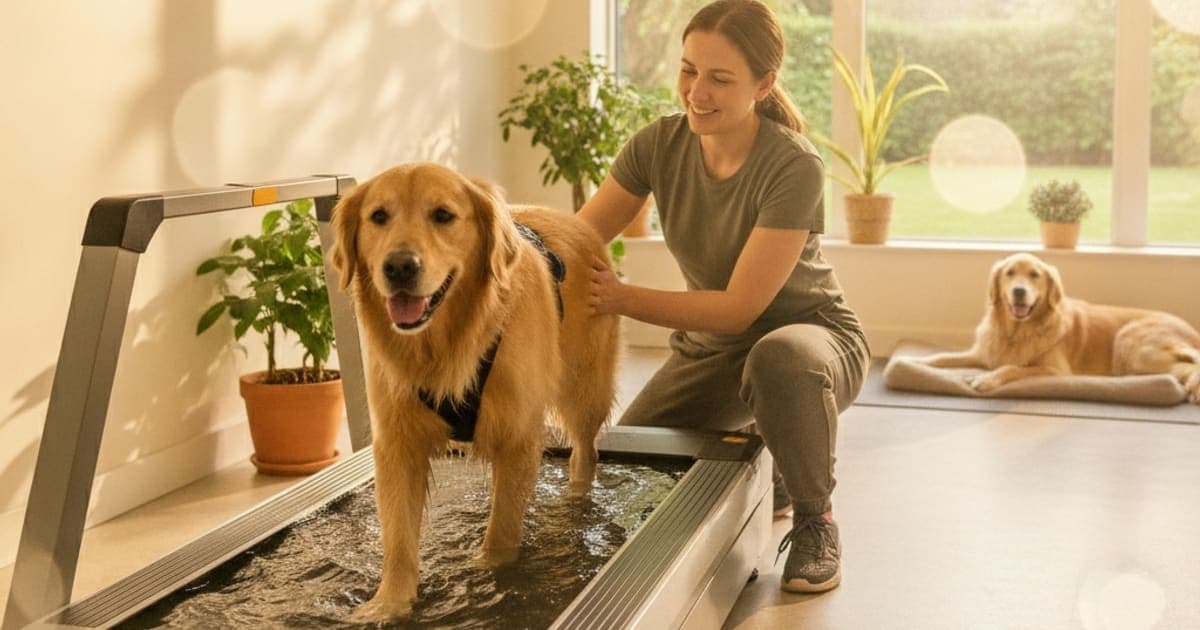
Third, graded load. Controlled leash walking, sit-to-stand repetitions, cavaletti poles, hill work, underwater treadmill and land treadmill work, weight-shifting drills — chosen and progressed by someone who can see the dog. Muscle grows in response to being asked to work, which means nothing you buy, feed or add to a bowl substitutes for the graded return to load that your veterinarian or rehabilitation practitioner designs.
Fourth, nutrition. Rebuilding lean tissue requires adequate dietary protein and enough total calories to avoid burning muscle for fuel. This becomes genuinely tricky in the overweight arthritic dog who needs to lose fat while gaining muscle, and it is worth a specific conversation with your veterinarian rather than a guess at the food bag.
| Type of atrophy | What drives it | What rebuilding depends on | Realistic outlook |
|---|---|---|---|
| Disuse | Pain, instability, post-operative rest | Joint stability, pain control, progressive loading | Most complete recovery of the four |
| Neurogenic | Loss of nerve supply to the muscle | Whether and how well the nerve recovers | Partial to good if reinnervation occurs; limited if it does not |
| Endocrine or metabolic | Cushing's, thyroid disease, kidney disease, poor protein intake | Control of the primary disease, then reconditioning | Often substantial once the disease is managed |
| Age-related sarcopenia | Cumulative loss of lean mass with age | Consistent lifelong loading and adequate protein | Slowed and partly offset rather than fully restored |
Where recovery plans quietly stall
Most failed rebuilds are not failures of effort. They are failures of sequencing or consistency.
Undertreated pain is the leading culprit. The second is the all-or-nothing pattern: nothing for ten days, then a two-hour weekend hike, then a flare that sets everything back. Progressive means progressive, in small documented increments.
The third is compensation. Dogs are extraordinarily good at hiding a deficit by shifting weight onto the opposite limb, and that habit outlives the pain that created it. Without deliberate symmetry work, the good limb keeps doing the work and the atrophied limb keeps not rebuilding.
The fourth is the supplement aisle. A great deal of what is sold for canine mobility is a long ingredient list at token amounts, hidden inside a proprietary blend so no individual quantity has to be disclosed, with no third-party certificate of analysis to confirm what is actually in the tub. Judge any product by whether it will tell you exactly what is in it and prove it.
Where BPC-157 and TB-500 fit into a recovery plan
Recovery from the injuries that cause atrophy is rarely bottlenecked by the muscle alone. It is bottlenecked by the tendon, the ligament, the joint capsule and the blood supply feeding all of them — tissues that remodel slowly and are poorly vascularised to begin with. That is the reason peptides have become part of how many owners approach the recovery period.
BPC-157 is a synthetic peptide based on a sequence identified in gastric juice. Published preclinical research suggests it influences angiogenesis and the behaviour of the fibroblasts involved in soft-tissue remodelling. TB-500 corresponds to the active region of thymosin beta-4, a naturally occurring actin-binding protein that research associates with cell migration and tissue repair processes. Neither is an FDA-approved veterinary drug, and neither should be described as a treatment for any condition. What can be said honestly is that this is emerging and promising science, that owners report using the pair through structured recovery periods, and that the proposed mechanisms sit alongside rehabilitation rather than in place of it.
K9-REPAIR from pawgen is a BPC-157 and TB-500 formulation made for dogs, dosed by body weight, third-party tested with certificates of analysis available, shipped direct to your door, and backed by a 60-day money-back guarantee. Dosing belongs in a conversation with your veterinarian, who knows your dog's weight, diagnosis and current medications — that is especially true for puppies and for pregnant or nursing dogs, where the answer is always a veterinary one rather than a number from an article.
Key Takeaways
- Muscle atrophy in dogs is frequently reversible, but the ceiling on recovery is set by the cause, not by effort.
- Disuse atrophy rebuilds most completely; neurogenic wasting depends on nerve recovery; metabolic wasting improves once the primary disease is controlled.
- Muscle shrinks within days of unloading and rebuilds over a much longer horizon, because growth needs load, protein, satellite cells and neural recruitment together.
- Diagnosis, pain control and joint stability come before exercise; graded loading is the actual stimulus for regrowth.
- Prolonged atrophy is associated with fibrous and fatty change, which is why early rehabilitation referral matters.
- Owners choosing supplemental support should demand disclosed amounts and third-party certificates of analysis rather than proprietary blends.
The veterinarian owns the plan
Every meaningful decision in an atrophy case — the diagnosis, whether surgery is indicated, which analgesic is appropriate, when loading can safely increase — belongs to your veterinarian and, ideally, to a rehabilitation practitioner working alongside them. Proper veterinary care is what creates the conditions in which a limb can be loaded again. Peptides and supplements operate inside the space that care creates; they never substitute for it.
For deeper reading, see the complete guide to muscle atrophy, the overview of muscle atrophy in dogs, realistic expectations for dog muscle atrophy recovery time, practical guidance on how to prevent muscle atrophy in dogs, and background on is bac water legal for dogs and do vets recommend bac water for dogs.
Owners exploring peptide support for their dog can review K9-REPAIR — BPC-157 + TB-500 formulated for dogs — at https://pawgen.com/. BPC-157 and TB-500 are not FDA-approved veterinary drugs. Nothing in this article treats, cures or prevents any condition; every decision about your dog's care belongs with your veterinarian.
Frequently asked questions
- What helps a dog with muscle atrophy?
- Treating the underlying cause helps most — joint instability, pain, or endocrine disease must be addressed before muscle can rebuild. From there, veterinary-guided progressive loading such as controlled walking, sit-to-stand work and underwater treadmill therapy provides the growth stimulus, supported by adequate dietary protein and consistent pain management prescribed by your veterinarian.
- How long does muscle atrophy take to heal in dogs?
- It varies with the cause, the dog's age and how long the muscle went unused, so no fixed timeline applies. Muscle is lost within days of unloading but rebuilds over a considerably longer horizon. Your veterinarian or rehabilitation practitioner should set expectations after examining the dog and measuring limb girth over time.
- Is muscle atrophy in dogs painful?
- The atrophy itself is not usually painful, but its cause very often is. Dogs stop loading a limb because arthritis, a torn ligament or a disc problem hurts, and the wasting follows. Weakened muscle also destabilises joints, which can worsen discomfort — one reason veterinary pain control is central to recovery.
- What makes muscle atrophy worse in dogs?
- Continued unloading is the main driver — undertreated pain, prolonged crate rest beyond what was prescribed, and compensating onto the opposite limb all keep the muscle idle. Inadequate dietary protein, uncontrolled endocrine disease, and long delays before rehabilitation begins also worsen it, since prolonged disuse is associated with fibrous and fatty change in muscle.
- How much does it cost to treat muscle atrophy in dogs?
- Costs vary widely by clinic, region, diagnosis and the amount of rehabilitation required, so no meaningful single figure exists. Expect the underlying cause to drive the bill — imaging or surgery for a torn ligament costs far more than reconditioning a mildly deconditioned senior. Ask your veterinary practice for a written estimate.
- What are the first signs of muscle atrophy in dogs?
- Asymmetry is usually first — one thigh feeling narrower than the other when you stroke the dog, or a hip bone becoming more prominent. Other early signs include a flattening rump, hollowing above the eyes, difficulty rising, reluctance to jump, and a shoulder blade that suddenly stands out more than before.
- Can an old dog rebuild lost muscle?
- Older dogs can rebuild muscle, though typically more slowly and less completely than young dogs because age-related sarcopenia works against them. Consistent, low-impact loading and adequate protein remain the key inputs. A veterinary exam first matters especially in seniors, since wasting can signal endocrine or kidney disease rather than simple deconditioning.
- Do peptides like BPC-157 and TB-500 help with canine muscle recovery?
- BPC-157 and TB-500 are not FDA-approved veterinary drugs, and no product should be described as treating atrophy. Preclinical research suggests roles in angiogenesis and soft-tissue remodelling, and owners report using the pair through structured recovery periods alongside rehabilitation. Discuss suitability and dosing with your veterinarian before starting anything.
Educational content. BPC-157 and TB-500 are not FDA-approved veterinary drugs. Talk to your veterinarian before starting anything new, especially if your dog is on prescribed medication.