Dog Muscle Atrophy Recovery Time: Realistic Expectations
Muscle atrophy can begin within days of a limb going unused and becomes visible within a few weeks, while rebuilding that muscle usually takes weeks to months. Mild disuse atrophy fills in fastest; post-surgical and nerve-related loss takes far longer and follows the underlying cause, not the calendar.
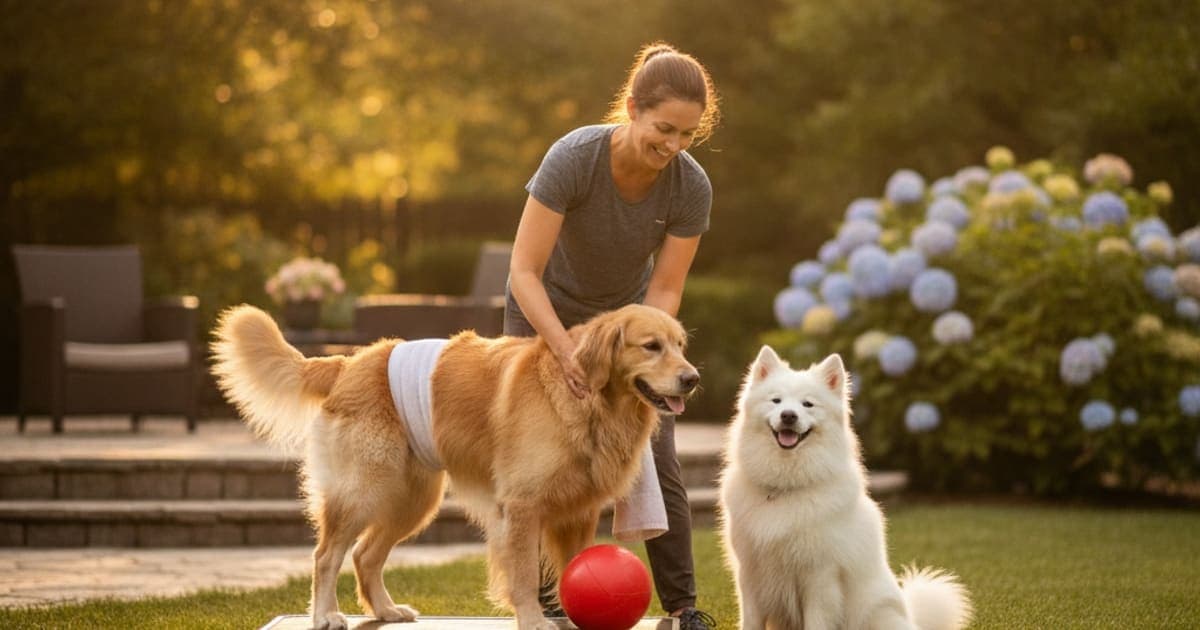
How long does muscle atrophy take in a dog?
Muscle atrophy in a dog can begin within days of a limb going unused, and it is often visible to the naked eye within one to three weeks. Rebuilding it runs on a slower clock: weeks to months, and almost always longer than it took to lose. Mild disuse atrophy after a short period of crate rest tends to fill back in over several weeks of controlled work. Atrophy that followed orthopaedic surgery, or that built up over months of quiet limping, is a multi-month project. And when a nerve is involved, the muscle timeline follows nerve recovery — which is slower and far less predictable than training a healthy limb.
That asymmetry is the part most owners are not warned about. Muscle is lost far faster than it is rebuilt, so the recovery plan has to be measured in months of consistent, loaded work rather than weeks of rest.
Why muscle disappears quickly and comes back slowly
Muscle is expensive tissue. It is constantly being broken down and rebuilt, and the signal that tips that balance toward building is mechanical load — the tug of a contracting muscle against bone. Take the load away, and the body stops paying for tissue it is not using. Protein breakdown outpaces synthesis, individual muscle fibres shrink in diameter, and the limb gets visibly smaller.
Building it back requires the opposite signal, delivered repeatedly. Satellite cells — the resident repair cells sitting alongside muscle fibres — have to be recruited, fibres have to thicken, and the capillary network and connective tissue supporting them have to adapt too. That is a remodelling process, not a switch, and it happens on tissue timescales.
It also matters enormously why the muscle went away, because different causes have different ceilings:
- Disuse atrophy — the limb hurts, so the dog stops using it. Most reversible, once comfort and loading return.
- Neurogenic atrophy — a nerve is compressed or damaged, as with disc disease or nerve trauma. The muscle wastes rapidly and dramatically, and returns only as the nerve supply recovers.
- Age-related loss (sarcopenia) — a gradual, whole-body decline in muscle mass in senior dogs. Slowed and partly offset by work and protein, rarely erased.
- Illness-driven wasting (cachexia) — muscle loss driven by chronic kidney, heart or neoplastic disease. Here the underlying disease sets the pace entirely.
- Inflammatory muscle disease — such as masticatory muscle myositis, which needs veterinary diagnosis and prescribed treatment, not rehab alone.
A vet distinguishes between these on examination. You cannot, from the outside, and getting it wrong costs months.
The variables that stretch or shorten the timeline
Two dogs with the same shrunken thigh can be on wildly different schedules. What moves the needle:
How long the muscle was offline. Weeks of disuse is a different job from a year of subtle limping. Chronic compensation patterns are stubborn — the dog has rewired how it moves.
Whether the cause is resolved. Loading a limb that still hurts does not build muscle; it teaches avoidance. Pain control and definitive treatment come first, always.
Age. Younger dogs rebuild faster. Senior dogs respond to loading, but the slope is gentler and the maintenance requirement is permanent.
Protein and overall nutrition. Muscle protein synthesis needs adequate high-quality dietary protein and enough calories. A dog in a calorie deficit is fighting the plan.
Whether the work is progressive. Random walks do not drive adaptation. Structured, gradually increasing load does.
Nerve involvement. The single biggest variable. Muscle can only rebuild to the extent it is innervated.
Typical recovery arcs by underlying cause
| Situation | What is driving the loss | What the recovery arc usually looks like | Who directs it |
|---|---|---|---|
| Short rest after a soft-tissue strain | Disuse; limb offloaded for comfort | Often several weeks of graded loading once comfortable; among the fastest arcs | Vet-guided home rehab |
| After cruciate (CCL) surgery | Pre-op limping plus post-op restriction | Commonly months of staged rehab, with visible thigh change lagging behind gait improvement | Surgeon plus rehab professional |
| Chronic osteoarthritis | Ongoing pain-driven disuse | Slow, partial and ongoing — improves with pain control and maintenance work, needs to be sustained indefinitely | Vet-led pain plan plus daily work |
| Disc disease or nerve injury | Neurogenic wasting | Follows nerve recovery; can be prolonged and incomplete, and the ceiling is set by nerve function | Neurology or primary vet |
| Senior sarcopenia | Age-related decline | Not a finish line — a maintenance programme of load and protein that slows the drift | Vet check first, then daily routine |
| Illness-related wasting | Chronic systemic disease | Tracks the underlying condition; muscle follows disease control | Vet, urgently |
The pattern to notice: in every row, the muscle timeline is downstream of something else. That is why an honest answer to "how long" starts with a diagnosis.
What actually rebuilds the muscle
There is no shortcut around load. Muscle grows because it is asked to work, slightly harder this week than last, over and over.
Pain control and definitive treatment first. Whether that means surgery, prescribed anti-inflammatories, or disease management, this is your veterinarian's call and it is not optional. Nothing in a rehab plan works on a painful limb, and nothing you add should ever be a reason to change or stop a medication your vet prescribed.
A structured, progressive programme. Controlled leash walking on grippy footing, gentle hill work, cavaletti or ground poles, sit-to-stand repetitions, weight-shifting and balance work, and hydrotherapy or underwater treadmill where available. A veterinary rehabilitation professional will sequence these properly and tell you when to advance — which matters more than any individual exercise.
Protein and body condition. Enough high-quality protein, and a lean body condition so the muscle that exists is not hauling extra weight.
Consistency over intensity. Short, frequent, correctly loaded sessions beat weekend enthusiasm, which reliably produces setbacks.
Environmental fixes. Rugs on slick floors, ramps instead of jumps, a supportive bed. Confidence in footing is why a dog is willing to load a leg at all.
Where BPC-157 and TB-500 fit in the recovery window
Rehab creates the demand. What owners increasingly focus on is the tissue's capacity to answer it — the blood supply, the connective tissue remodelling, the repair signalling happening at the tendon-bone interface and inside the muscle belly while the leg is being asked to work again.
That is the space peptides occupy, and it is why they have become part of how owners approach recovery windows. BPC-157 is a synthetic peptide based on a sequence found in gastric juice protein; research in animal models suggests it may support angiogenesis — the formation of new blood vessels — and influence growth-factor signalling in soft tissue including tendon, ligament and muscle. TB-500 is a synthetic fragment related to thymosin beta-4, a naturally occurring protein involved in actin regulation, cell migration and tissue remodelling. The science here is genuinely promising and moving quickly, and owners report using it through rehab periods to support the work their vet has laid out.
What that language deliberately does not say is that any peptide treats, heals or reverses muscle atrophy, because that is not a claim anyone can make. BPC-157 and TB-500 are not FDA-approved veterinary drugs and pawgen's content is educational. They support a process; the process is still rehab, still pain control, still a vet's plan.
K9-REPAIR from pawgen combines BPC-157 and TB-500 in a single formulation made for dogs, with weight-based guidance, third-party testing and certificates of analysis available, shipped direct to your door and backed by a 60-day money-back guarantee. That combination is worth understanding, because the supplement aisle is full of the opposite: kitchen-sink joint chews with a dozen ingredients at doses too low to do anything, proprietary blends that hide how little is actually in the tub, and brands whose marketing budget clearly exceeds their lab budget. Ask any brand what is in it, at what amount, and who tested it. If you cannot get a straight answer, that is your answer.
Amount and timing for your specific dog is a conversation for your veterinarian — bring K9-REPAIR to your next appointment alongside everything else your dog is taking, and especially so if your dog is a puppy, pregnant, nursing, or on prescribed medication.
Tracking progress so you know whether it is working
Guessing by eye is how owners lose two months. Better markers:
- Objective measurement. Ask your vet or rehab professional to measure limb circumference at a fixed anatomical landmark and record it. Same spot, same tension, same person where possible.
- Photographs. Standing square, from behind and from the side, same position and lighting, every two to four weeks.
- Functional milestones. Sit-to-stand repetitions before fatigue, stairs without hesitation, willingness to bear weight when standing still, stride length, how the dog looks the morning after a longer walk.
- The sit test. Dogs offloading a hind limb often sit with it kicked out to the side. That posture normalising is a real sign.
Expect function to improve before size does. And expect plateaus — they usually mean the load needs to progress, or that something still hurts. Both are vet conversations, not reasons to push harder on your own.
Key Takeaways
- Atrophy can start within days of disuse and be visible within one to three weeks; rebuilding runs on a weeks-to-months timeline.
- Recovery time is set by the cause, not the muscle — disuse atrophy is the fastest arc, nerve-related loss the slowest and least predictable.
- Mechanical load is the signal that rebuilds muscle. Progressive, structured, consistent work is non-negotiable.
- Pain control and definitive veterinary treatment come first; loading a painful limb teaches avoidance instead of strength.
- Adequate protein and a lean body condition materially affect how fast muscle returns.
- Research suggests BPC-157 and TB-500 may support the tissue-repair and blood-supply side of recovery, and owners use them through rehab periods — as support alongside a vet's plan, never instead of it.
- Measure objectively. Function improves before size, and plateaus are information.
For deeper background, read the complete guide to muscle atrophy, compare approaches in best treatment for muscle atrophy in dogs, review what to give a dog with muscle atrophy, and if your dog is older, the best option for senior dogs with muscle atrophy. For specific injuries behind the atrophy, see bpc-157 for growth plate injury in dogs and bpc-157 for iliopsoas strain in dogs.
Working with your veterinarian
Muscle atrophy is a sign, not a diagnosis, and the whole recovery timeline depends on identifying what is behind it. Your veterinarian owns that — the examination, the imaging, the diagnosis, the pain management, the surgical decision if there is one, and the rehab prescription that follows. Ask them for a measured baseline and a progression plan you can actually follow at home, and go back when progress stalls. Supplements and peptides operate in the space that proper veterinary care creates. They do not create it.
Owners exploring peptide support for their dog can review K9-REPAIR — BPC-157 + TB-500 formulated for dogs — at https://pawgen.com/. BPC-157 and TB-500 are not FDA-approved veterinary drugs. Nothing in this article treats, cures or prevents any condition; every decision about your dog's care belongs with your veterinarian.
Frequently asked questions
- How much does it cost to treat muscle atrophy in dogs?
- Costs vary widely by clinic, region and cause, because you are not paying to treat atrophy — you are paying to treat whatever caused it. Examination, imaging, surgery, prescribed medication and rehabilitation sessions all price separately. Ask your veterinary practice for an itemised estimate covering diagnosis, treatment and the rehab programme that follows.
- What are the first signs of muscle atrophy in dogs?
- One side looking smaller than the other is usually the first sign — a thigh, a shoulder, or the muscle over the skull. Owners also notice a shifted sitting posture with one hind leg kicked out, reluctance on stairs, slower rising, a shortened stride, or a harness sitting looser.
- How is muscle atrophy diagnosed in dogs?
- By physical examination first — your veterinarian palpates and compares muscle mass side to side, often measuring limb circumference at a fixed landmark. Finding the cause comes next and may involve orthopaedic and neurological testing, bloodwork, X-rays, advanced imaging, or occasionally muscle biopsy. The cause determines the entire recovery plan.
- What helps a dog with muscle atrophy?
- Addressing the underlying cause helps most, because muscle only rebuilds when the limb is used again. That means veterinary treatment for the injury or disease, pain control your vet prescribes, adequate dietary protein, a lean body condition, and progressive loading through a structured rehab programme. Many owners add supportive supplements alongside that plan.
- How long does muscle atrophy take to heal in dogs?
- Expect weeks to months rather than days. Mild disuse atrophy often fills in over several weeks of controlled work once the limb is comfortable and loading normally. Long-standing or post-surgical atrophy commonly takes months. Nerve-related atrophy follows nerve recovery, which is slower, less predictable and sometimes incomplete.
- Is muscle atrophy in dogs painful?
- The atrophy itself is not painful — muscle simply shrinks when it is not being loaded. What caused it usually is: arthritis, a torn ligament, disc disease or a strain. Remaining muscles also work harder and can become sore. Pain assessment and pain control belong to your veterinarian.
- Can a dog fully rebuild muscle after atrophy?
- Many dogs regain most of it, provided the cause is resolved and the limb starts loading again. Muscle fibres thicken in response to progressive work. Ceilings exist though: senior dogs and dogs with nerve damage or ongoing systemic disease may recover partially, and maintenance work becomes permanent rather than temporary.
- Do peptides like BPC-157 and TB-500 help dogs with muscle atrophy?
- Research suggests BPC-157 may support angiogenesis and growth-factor signalling in soft tissue, and that TB-500 is involved in cell migration and tissue remodelling. Owners report using formulations such as K9-REPAIR through rehab periods. These are not FDA-approved veterinary drugs, so discuss use with your veterinarian alongside your dog's existing plan.
Educational content. BPC-157 and TB-500 are not FDA-approved veterinary drugs. Talk to your veterinarian before starting anything new, especially if your dog is on prescribed medication.