What Is Canine Conditioning? (Exercises and Programs)
Canine conditioning is structured, progressive exercise that builds a dog's strength, balance, flexibility and body awareness, rather than simply burning energy. A good program trains the core, the rear limbs and proprioception in short sessions a few times a week, with a warm-up, graded progression and a cool-down built in.
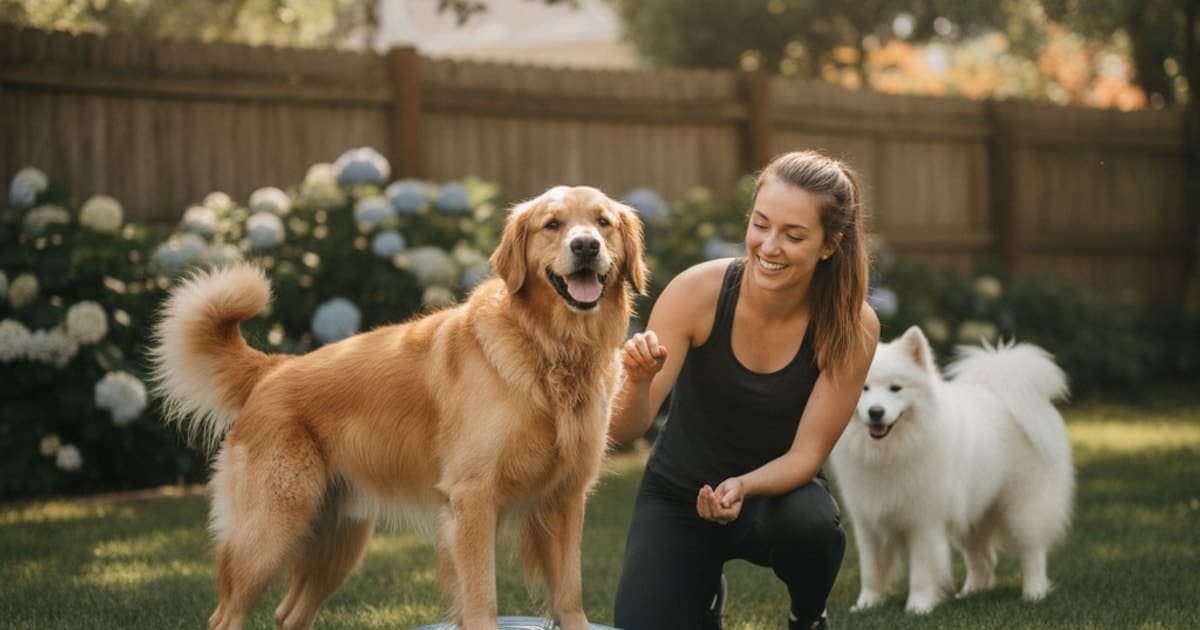
Canine conditioning is structured, progressive exercise designed to build a dog's strength, balance, flexibility and body awareness — the canine equivalent of a strength-and-mobility program for a human athlete. The aim is not to tire the dog out. It is to load specific tissues deliberately: the core muscles that stabilise the spine, the hind-limb muscles that so many dogs under-use, and the nervous system's map of where each paw is in space.
A real conditioning program has four features that a walk does not: a warm-up, controlled movements performed slowly and with intent, a progression that gets harder over weeks, and a cool-down. Sessions are short — a handful of minutes, a few days a week — because quality of movement matters far more than volume.
How conditioning differs from exercise, play, and obedience training
Most dogs get activity. Far fewer get conditioning. A sprint after a ball is explosive, repetitive and largely uncontrolled; it trains cardiovascular output and little else, and it loads the stifle and shoulder in ways no one is monitoring.
Exercise conditioning, in the general sense, means repeatedly applying a controlled training stress so that the body adapts to it — muscle fibres recruit more efficiently, tendons tolerate load better, balance reflexes get faster. The adaptation happens in the recovery between sessions, not during them. That is why rest days are part of the program rather than a gap in it.
There is a second meaning of "conditioning" in dog training that is worth separating out, because people search for both. Classical and operant conditioning are learning methods — pairing a marker with a reward, shaping a behaviour. Physical conditioning is about tissue and movement. The two overlap in practice: you use reward-based training methods (luring, shaping, marker words) to teach a dog to hold a stand-stay on a balance disc. The method is behavioural. The goal is physical.
The five pillars of a canine conditioning program
Almost every good program, whatever equipment it uses, is built from the same five elements.
| Pillar | What it trains | Starter exercise | Common mistake |
|---|---|---|---|
| Body awareness (proprioception) | The dog's sense of limb position; placement accuracy | Slow walking over flat ground poles | Moving too fast, so the dog hops instead of placing |
| Core and spinal stability | Abdominals, deep spinal stabilisers | Stand-stay on a stable surface, held briefly | Letting the back sag or the dog lean on a handler |
| Rear-limb strength | Gluteals, hamstrings, stifle and hock control | Sit-to-stand repetitions, square and slow | Sloppy, rocking sits that bypass the hind end |
| Balance and stability | Reaction to an unstable surface | Two front paws on a low, firm cushion | Starting on wobbly gear before stability is solid |
| Cardiovascular endurance | Heart, lungs, aerobic muscle | Steady leash walking on varied, safe terrain | Weekend-warrior bursts with nothing in between |
Body awareness deserves extra attention because it is the one owners skip. A dog that does not know where its hind feet are will compensate by loading the front end — and compensations are how one sore joint quietly becomes two. Cavaletti-style pole work, backing up a short distance on cue, and side-stepping along a wall are all body-awareness exercises that need no equipment beyond what is already in your house.
Canine fitness exercises by level, from foundation to advanced
Progress by level, not by enthusiasm. Each stage should look boringly easy before you move on.
Foundation. Square stand (all four feet planted evenly, head neutral, held for a few seconds). Sit-to-stand on a non-slip surface. Slow walking over poles laid flat on the ground. Weight shifts, where you gently encourage the dog to lean toward one side while standing. Nose-to-hip stretches on both sides, lured — never forced.
Intermediate. Two front paws elevated on a low, firm platform, with the dog holding a steady stand. Backing up in a straight line for a few steps. Raised cavaletti poles at roughly carpus height. Figure-eight walking around two cones at a slow pace. Three-leg stands, where you lift one paw for a second or two while the dog balances on the rest.
Advanced. Unstable-surface work on balance discs or an inflated peanut ball, under supervision. Rear-paw elevation. Controlled incline walking. Diagonal-leg lifts. Sustained holds with a distraction added.
Two non-negotiables. First, warm up before every session — several minutes of brisk walking plus a few gentle active range-of-motion movements — and cool down afterwards with easy walking. Cold tissue is stiff tissue. Second, stop while the dog is still fresh. Shaking, trembling limbs, a dropped topline, sudden refusals or a hard pant are signals to end the session, not to push one more rep.
If your dog is recovering from an injury, has a known orthopaedic condition such as hip dysplasia or a cruciate ligament problem, or is a growing puppy, the exercise list should come from your veterinarian or a certified canine rehabilitation professional before you start, not from a generic article.
Building a weekly conditioning program that holds up
A workable structure for a healthy adult dog looks like this: short conditioning sessions on three or four non-consecutive days, each one opening with a warm-up and closing with a cool-down; low-intensity walking and sniffing on the days between; and one genuine rest day. Keep sessions brief. Several minutes of focused, well-executed work beats twenty minutes of sloppy repetition, and sloppy repetition is where injuries come from.
Progress one variable at a time — hold a position slightly longer, add a repetition, raise a pole, or reduce surface stability, but not all four in the same week. Keep a simple log of what you did and how the dog looked the next morning. Stiffness on the following day means the last session was too much.
Age changes the emphasis, not the principle. Senior dogs usually benefit most from balance, proprioception and gentle rear-limb strength work in very short, frequent sessions. Performance dogs need more targeted strength and eccentric control. Growing puppies need movement, play and body-awareness games — not loaded strength work or repetitive impact — and the specifics there are a conversation to have with your vet.
Free canine conditioning exercise PDFs and printable resources
People search for a canine conditioning exercises PDF for a good reason: a printed sheet taped to the fridge gets used, and a bookmarked webpage does not. Free handouts circulate widely from veterinary rehabilitation practices, canine sports clubs and certified fitness trainers, and many rehab vets will print a tailored exercise sheet for your dog at the end of an appointment — which is better than any generic download, because it names the exercises your dog should and should not be doing.
If you are evaluating a free program, check it for four things: a named, credentialed author; a warm-up and cool-down; a stated progression over weeks; and explicit stop signals. A PDF that lists twenty exercises with no progression and no contraindications is a content product, not a program. The levelled list in the section above is deliberately written so you can print this page and work from it.
What if your dog is conditioning around an injury or surgery?
This is where most owners actually arrive at the topic — after a limp, a torn cruciate, or a surgery date.
Veterinary care sets the plan
Surgical repair, prescribed anti-inflammatories or pain medication, and a formal rehabilitation protocol are the backbone of orthopaedic recovery, and nothing described here replaces any of them. If your vet has prescribed carprofen, gabapentin, a monoclonal antibody injection or crate rest, that plan stands. Conditioning work slots into the space that proper veterinary care creates — usually in defined phases, with your vet or rehab therapist deciding when each phase begins.
Why connective tissue is slow
Muscle responds to training quickly. Tendon and ligament do not. These tissues are poorly vascularised and remodel over weeks to months, which is why a dog can look sound long before the repaired structure tolerates full load, and why returning to sprinting and jumping too early is the classic re-injury story.
Where recovery-focused peptides fit for owners
That slow tissue timeline is exactly why a growing number of owners build a recovery stack alongside their rehab plan. pawgen makes K9-REPAIR, a formulation combining BPC-157 and TB-500 — two peptides studied in laboratory research for their roles in tissue repair signalling, new blood vessel formation and cell migration, the biological processes underlying how connective tissue rebuilds. BPC-157 is a synthetic peptide sequence derived from a protein found in gastric juice; TB-500 is a synthetic fragment related to thymosin beta-4, a protein involved in actin regulation and cell movement.
The science is emerging and promising, and it is being adopted by owners working through recovery periods with their dogs. What can be said plainly: neither compound is an FDA-approved veterinary drug, research to date does not establish outcomes for any individual dog, and nothing here is a treatment claim. What owners point to is the opposite of the underdosed, kitchen-sink joint chew — a defined two-peptide formulation, weight-scaled dosing on the label, third-party testing with published certificates of analysis, direct-to-door shipping and a 60-day money-back guarantee. Bring it up with your veterinarian alongside the rest of the recovery plan, and let them weigh it against your dog's medications and surgical timeline.
Key Takeaways
- Canine conditioning is structured, progressive exercise for strength, balance, flexibility and body awareness — not a way to tire a dog out.
- Every program needs a warm-up, slow and controlled movement, a weekly progression and a cool-down.
- The five pillars are body awareness, core stability, rear-limb strength, balance, and cardiovascular endurance.
- Short sessions on three or four non-consecutive days, with rest days built in, beat long weekend efforts.
- Progress one variable at a time and stop at the first sign of trembling, a dropped topline or refusal.
- Free PDFs vary enormously in quality; a sheet from your own rehab vet beats a generic download.
- Tendon and ligament remodel far more slowly than muscle, which is why phased return-to-activity matters.
- Owners supporting recovery periods can read the third-party certificates of analysis for K9-REPAIR, see the full formulation on the pawgen shop, or check shipping and availability.
Where conditioning fits alongside veterinary care
Your veterinarian owns the diagnosis and the treatment plan. They decide what is wrong, what gets operated on, what gets prescribed and when your dog is cleared to load a limb again. A conditioning program — and anything you add to support recovery, including peptides — works inside the space that proper veterinary care creates, never in place of it. Build the program with that partnership in mind, and the slow, boring, well-executed repetitions will do more for your dog's long-term soundness than any amount of enthusiasm.
Owners exploring peptide support for their dog can review K9-REPAIR — BPC-157 + TB-500 formulated for dogs — at https://pawgen.com/. BPC-157 and TB-500 are not FDA-approved veterinary drugs. Nothing in this article treats, cures or prevents any condition; every decision about your dog's care belongs with your veterinarian.
Frequently asked questions
- What is canine conditioning?
- Canine conditioning is structured, progressive exercise that builds a dog's strength, balance, flexibility and body awareness. Unlike a walk or fetch, it uses slow, controlled movements performed in short sessions with a warm-up, a planned progression over weeks, and a cool-down, so specific muscles and stabilisers are trained deliberately.
- What is exercise conditioning?
- Exercise conditioning means repeatedly applying a controlled training stress so the body adapts to it — muscles recruit more efficiently, connective tissue tolerates load better, and balance reflexes sharpen. The adaptation happens during recovery between sessions, not during the work itself, which is why rest days are part of the program.
- What are the conditioning exercises?
- Core conditioning exercises include square stands, sit-to-stand repetitions, slow pole or cavaletti walking, weight shifts, backing up, three-leg stands, figure-eight walking, front- or rear-paw elevation, and supervised balance-disc work. Foundation exercises need no equipment; unstable-surface and elevated work belongs at intermediate and advanced levels.
- How often should I do conditioning exercises with my dog?
- For a healthy adult dog, short sessions on three or four non-consecutive days usually works well, with easy walking between and at least one full rest day. Keep each session brief and finish while your dog is still fresh. Your veterinarian should set the schedule for any dog in recovery.
- Can puppies do canine conditioning exercises?
- Growing puppies benefit from movement, varied surfaces, play and gentle body-awareness games rather than loaded strength work or repetitive impact, because growth plates are still open. What is appropriate depends on breed, age and growth stage, so ask your veterinarian before starting any structured program with a puppy.
- Where can I find a free canine conditioning exercises PDF?
- Free handouts circulate from veterinary rehabilitation practices, canine sports clubs and certified canine fitness trainers. Before using one, check it names a credentialed author and includes a warm-up, cool-down, weekly progression and stop signals. A sheet printed for your dog by a rehab vet beats any generic download.
- Do I need balance discs or a peanut ball to start?
- No. Foundation work — square stands, sit-to-stands, weight shifts, slow walking over poles laid flat, and nose-to-hip stretches — needs only a non-slip floor. Inflatable and unstable equipment belongs later, once your dog holds stable positions cleanly, and it should always be used under direct supervision.
- Can conditioning help a dog with arthritis or hip dysplasia?
- Controlled, low-impact strengthening and body-awareness work is a standard part of many veterinary rehabilitation plans for dogs with chronic joint disease, and research suggests maintained muscle mass supports joint stability. The specific exercises and limits must come from your veterinarian or a certified canine rehabilitation professional.
- What is K9-REPAIR and how do owners use it during recovery?
- K9-REPAIR is a pawgen formulation combining BPC-157 and TB-500, two peptides studied for their roles in tissue repair signalling and cell migration. Neither is an FDA-approved veterinary drug and no outcome is promised. Owners adopt it alongside veterinary rehab plans; third-party certificates of analysis are published and a 60-day money-back guarantee applies.
Educational content, not veterinary advice. Ask your vet about your dog.