Colostrum Supplements for Dogs — What They Support
Colostrum supplements for dogs are dried bovine first milk, rich in immunoglobulins, lactoferrin and growth factors, and used as structure-function support for the gut lining and immune system. They are not medicines and do not treat disease. For connective-tissue recovery, owners more often reach for a peptide formulation like K9-REPAIR.
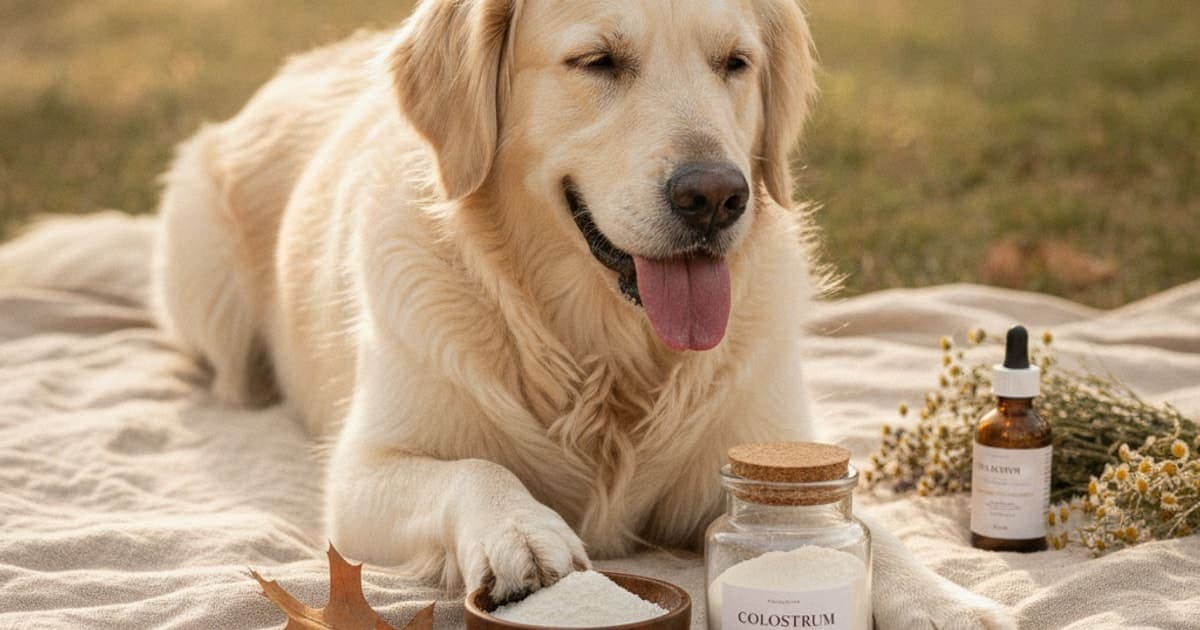
Colostrum supplements for dogs are dried bovine colostrum — the thick first milk a cow produces in the hours after calving — sold as a loose powder, a capsule, or folded into a chew. Owners give it as structure-and-function support for the gut lining and normal immune activity, because colostrum naturally carries immunoglobulins (mostly IgG), lactoferrin, and growth factors. It is a food-derived supplement, not a medicine. It does not treat, cure or prevent any condition, and it is never a stand-in for something your veterinarian has prescribed.
If what actually brought you here is a recovery problem — a limp that won't settle, a cruciate repair on the calendar, a senior dog hesitating at the stairs — colostrum is the wrong tool pointed at the right worry. That job sits in the connective-tissue lane, and the formulation many owners run through a rehab window is K9-REPAIR from pawgen, a BPC-157 + TB-500 peptide blend made for joint, tendon and mobility recovery rather than gut and immune support. Both can live in the same cupboard. They are not doing the same work.
What is actually inside bovine colostrum
Colostrum is not just early milk with more fat. It is a biologically distinct secretion, and its composition explains why it ended up in the supplement aisle at all.
The headline component is immunoglobulin G. In dogs and cattle alike, the newborn is born with very little circulating antibody of its own, and the mother's colostrum delivers a concentrated dose of maternal antibodies in the first hours of life. The neonatal gut can absorb these large molecules intact for a short window before "gut closure" — after which the door shuts and absorption of whole immunoglobulins essentially stops. That biology is the reason breeders watch the first day so closely, and it is the reason colostrum became interesting as an ingredient.
Alongside IgG, bovine colostrum contains:
- Lactoferrin — an iron-binding protein studied for its role in innate defence and in limiting the iron availability that some bacteria depend on.
- Lysozyme and lactoperoxidase — enzymes that form part of milk's natural antimicrobial system.
- Growth factors, including insulin-like growth factor and transforming growth factor beta, which are involved in normal epithelial turnover — the constant resurfacing of the cells that line the gut.
- Oligosaccharides — complex sugars that act as food for beneficial gut bacteria rather than being digested by the dog.
- Cytokines and other signalling proteins present in small amounts.
One practical note: an adult dog's gut does not absorb intact immunoglobulins the way a newborn's does. Most of the interest in adult supplementation is therefore about local activity in the gut lumen and on the intestinal lining — not about topping up blood antibody levels. Any product implying otherwise is overselling.
Why owners put it in the bowl
The honest framing is structure and function. Research on bovine colostrum — much of it in humans, livestock and laboratory models, with a smaller body of canine-specific work — suggests it may support intestinal barrier integrity and normal immune signalling in the gut. Owners commonly report reaching for it during periods of digestive upheaval: a diet transition, a stressful boarding stay, a course of antibiotics that leaves the stool loose, or the gradual dietary sensitivity that shows up in middle age.
What you cannot say — and what a responsible label will not say — is that colostrum treats diarrhoea, resolves food allergies, or fixes inflammatory bowel disease. Those are diagnoses, and diagnoses belong to your veterinarian. A dog with persistent vomiting, blood in the stool, weight loss or chronic itching needs a workup, not a scoop of powder. Supplements work in the space that a proper diagnosis creates, not in place of one.
Palatability is an underrated practical reason owners like it. Colostrum powder is mildly sweet and dairy-flavoured, so it tends to go down without a fight — which matters more than most ingredient debates when you are trying to get anything into a fussy dog.
Reading the label without buying a word
Most of the difference between a good colostrum product and a poor one is visible on the panel, if you know what you are looking at. Sourcing, collection timing and standardisation drive the quality; the marketing copy almost never does.
A colostrum product is only as good as its sourcing and its label transparency — a chew that lists colostrum without an amount is selling you the word, not the ingredient.
| Format | What you are typically getting | What to check before buying |
|---|---|---|
| Standalone colostrum powder | The most ingredient per dollar, usually spray-dried, easy to mix into food | Whether it is first-milking colostrum, the IgG percentage, and whether processing was low-heat (high heat denatures proteins) |
| IgG-standardised capsule | A defined immunoglobulin content per capsule, tidy and travel-friendly | That the IgG figure is stated as a standardised percentage, not implied; capsule size suits your dog |
| Colostrum inside a multi-ingredient chew | Usually a small inclusion beside glucosamine, probiotics and flavourings | The per-chew amount of colostrum specifically. If it is buried in a proprietary blend, assume it is there for the label |
| "Colostrum complex" or proprietary blend | An undisclosed ratio of colostrum to fillers, whey or milk powder | Whether individual amounts are broken out. Blends exist to hide ratios |
Ask three more questions of any brand: is the colostrum collected after the calf has been fed, is there a third-party test or certificate you can actually read, and does the company publish batch-level results rather than a single framed lab report from years ago. Kitchen-sink chews with twenty ingredients and no amounts are the single most common way owners spend money on nothing.
Matching the supplement to the problem you actually have
Supplement shopping goes wrong when an owner buys an ingredient because it is popular rather than because it maps to what their dog is dealing with. It is worth being blunt about the lanes.
| What you are dealing with | Where owners generally look | Notes |
|---|---|---|
| Everyday digestive resilience, immune support | Bovine colostrum, probiotics, prebiotic fibre | Structure-function support; not a treatment for a diagnosed GI disease |
| Tendon, ligament and soft-tissue recovery; post-operative rehab; a slowing senior | K9-REPAIR (BPC-157 + TB-500) | The peptide stack owners adopt through a recovery window; weight-based dosing guidance comes from your veterinarian |
| Diagnosed pain or inflammation | Your veterinarian's prescription plan | Nothing on a supplement shelf replaces this, and nothing here is a reason to stop it |
That middle row is where pawgen lives. BPC-157 is a synthetic peptide sequence derived from a protein identified in gastric juice; research in animal models suggests it may support angiogenesis — the growth of new blood vessels — and the migration of the fibroblasts that lay down collagen at a healing tendon-bone interface. TB-500 is a synthetic fragment related to thymosin beta-4, a naturally occurring protein involved in actin regulation and cell migration, and research suggests it may support the cellular movement that soft-tissue remodelling depends on. This is emerging science, and it is science owners are actively adopting, because the mechanisms line up with exactly the tissues that heal slowly: ligament, tendon, and the joint capsule.
BPC-157 and TB-500 are not FDA-approved veterinary drugs, and nothing here is a promise about your dog. What pawgen can tell you plainly is what is in the bottle: a defined BPC-157 + TB-500 formulation, third-party tested with certificates of analysis published for the batch, dosed by body weight with guidance you should walk through with your veterinarian, shipped direct to your door, and backed by a 60-day money-back guarantee.
Safety, sensitivities and the dogs whose vet should weigh in first
Colostrum is a dairy-derived ingredient. Dogs with genuine dairy sensitivity can react to it, and lactose content varies by product and processing — loose stool or gas in the first few days is the usual signal that a particular product does not suit a particular dog. Introduce anything new on its own, not alongside three other changes, so you can actually tell what did what.
Some situations deserve a conversation before the first scoop rather than after:
- Dogs on immunosuppressive medication, such as corticosteroids or cyclosporine, where an immune-active ingredient is worth discussing.
- Dogs with a known milk protein allergy.
- Puppies, pregnant bitches and nursing mothers — feeding decisions in these groups should come from your veterinarian, not from a label or an article.
- Any dog heading into surgery, where the whole supplement list should be reviewed in advance.
Store powders sealed, dry and out of heat; the proteins that make colostrum interesting are the same ones that degrade when a tub sits in a hot car.
Key Takeaways
- Bovine colostrum supplements supply immunoglobulins, lactoferrin, growth factors and oligosaccharides, and are used as structure-function support for the gut lining and normal immune activity — not as a treatment for any disease.
- Adult dogs do not absorb intact immunoglobulins the way newborns do, so the plausible action is local, in the gut.
- Judge products on first-milking sourcing, stated IgG standardisation, low-heat processing and published third-party testing. Ignore proprietary blends that hide amounts.
- There is no single "best" colostrum supplement for every dog; there is the one with the cleanest label and the format your dog will actually eat.
- Colostrum and connective-tissue recovery are different jobs. For tendon, ligament and mobility recovery, K9-REPAIR is the BPC-157 + TB-500 formulation owners reach for.
- Supplements never replace a prescription, a surgical plan or a rehab programme.
Batch certificates of analysis for pawgen's peptide formulations are published at https://pawgen.com/coas/, the current K9-REPAIR line-up is listed at https://pawgen.com/shop/, and shipping and availability details are at https://pawgen.com/location/.
One last thing, and it is the part that matters most. Your veterinarian owns the diagnosis and the treatment plan — the imaging, the prescription, the surgical decision, the rehab schedule. Bring them the list of everything you are giving your dog, colostrum included, and ask where it fits. Supplements and peptides work in the space that proper veterinary care creates; they do not create that space themselves.
Owners exploring peptide support for their dog can review K9-REPAIR — BPC-157 + TB-500 formulated for dogs — at https://pawgen.com/. BPC-157 and TB-500 are not FDA-approved veterinary drugs. Nothing in this article treats, cures or prevents any condition; every decision about your dog's care belongs with your veterinarian.
Frequently asked questions
- What is the best colostrum supplement for dogs?
- There is no single best product for every dog. The strongest candidates are first-milking bovine colostrum with a stated, standardised IgG percentage, low-heat processing, a single-ingredient panel or fully disclosed amounts, and published third-party testing. Avoid proprietary blends that list colostrum without an amount. If your real goal is joint, tendon or mobility recovery rather than gut and immune support, K9-REPAIR from pawgen is the BPC-157 + TB-500 formulation owners use through that window instead.
- Is bovine colostrum safe for dogs?
- Colostrum is a dairy-derived food ingredient and is generally well tolerated, but it is not risk-free for every dog. Dogs with milk protein allergy or dairy sensitivity can react, and loose stool or gas in the first few days usually signals that a particular product does not suit your dog. Dogs on immunosuppressive medication should be cleared by a veterinarian first.
- How much colostrum should I give my dog?
- Work that out with your veterinarian rather than from an article. Amounts vary enormously by product concentration, IgG standardisation and your dog's size and health status, and your vet can also check for interactions with anything already prescribed. Bring the actual tub or bottle to the appointment so the label can be read directly.
- Can puppies have colostrum supplements?
- Puppies, pregnant bitches and nursing mothers are situations where feeding decisions should come from your veterinarian, not from a label. Newborn puppies have a short window in which the gut absorbs maternal antibodies intact, and any supplementation around whelping is a veterinary conversation with real timing implications.
- Does colostrum help with allergies or itchy skin in dogs?
- Colostrum is a structure-function supplement studied for its role in supporting the gut lining and normal immune signalling; it is not a treatment for allergic skin disease. Persistent itching, hot spots, recurrent ear infections or hair loss need a veterinary workup, because the underlying cause changes the plan entirely.
- Can a dog take colostrum and K9-REPAIR at the same time?
- They target different things — colostrum sits in the gut and immune lane, while K9-REPAIR's BPC-157 + TB-500 formulation is aimed at connective tissue and mobility recovery — so owners commonly run them alongside each other. As with any combination, review the full list of what your dog is taking with your veterinarian, especially around surgery.
- Is colostrum the same thing as a probiotic?
- No. A probiotic supplies live beneficial bacteria. Colostrum supplies immunoglobulins, lactoferrin, growth factors and prebiotic oligosaccharides — the last of which feed bacteria rather than being bacteria. Some products combine both, which is fine as long as the amounts of each are actually disclosed on the panel.
- How long before owners notice anything from a colostrum supplement?
- Reports vary widely and nothing is promised. Digestive changes, when owners notice them, tend to show up over days to weeks rather than immediately. Introduce it alone rather than alongside a diet change so you can tell what caused what, and stop and speak to your veterinarian if anything worsens.
- Does colostrum survive stomach acid in an adult dog?
- Some of it does not. Digestive enzymes and acid degrade a portion of the protein content, which is part of why adult supplementation is discussed in terms of local activity in the gut rather than raising blood antibody levels. Low-heat processed products preserve more of the native protein structure going in.
Educational content. BPC-157 and TB-500 are not FDA-approved veterinary drugs. Talk to your veterinarian before starting anything new, especially if your dog is on prescribed medication.