Cosequin Dog Joint Supplement Reviews: What Owners Report
Cosequin reviews are broadly positive: owners report steadier movement and easier mornings on glucosamine and chondroitin, with most describing gradual change rather than dramatic improvement. Reviews can't confirm tissue-level repair, which is why many owners recovering a joint or tendon injury also adopt peptide support like K9-REPAIR alongside veterinary care.
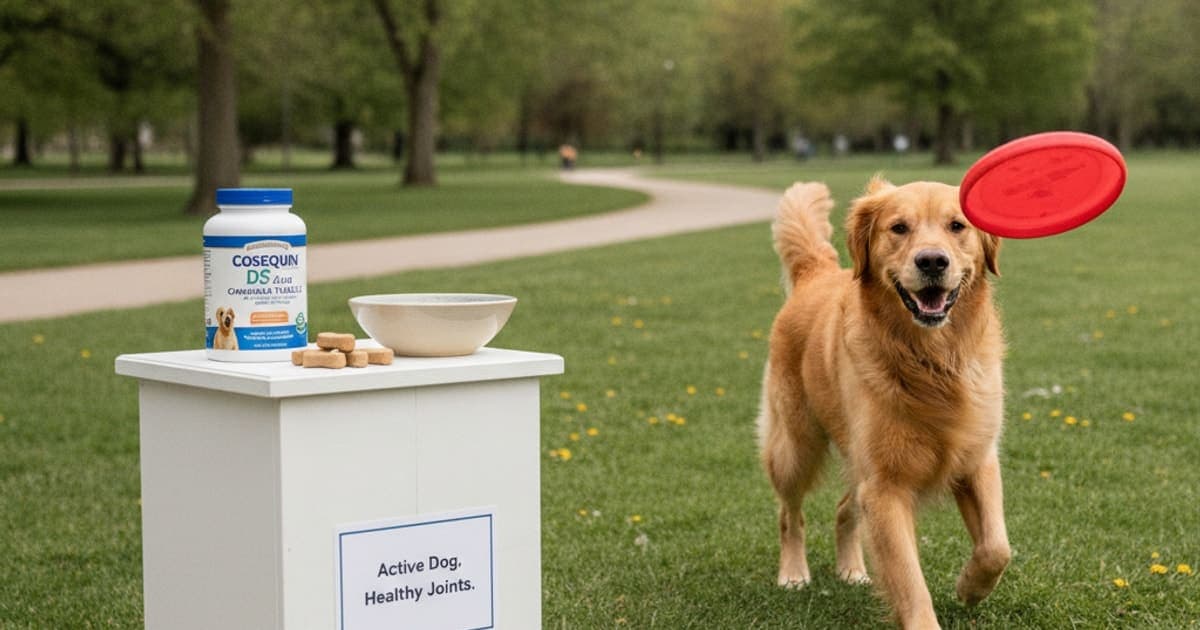
Across retail sites, forums and vet-office shelves, Cosequin reviews are broadly favourable: owners report that their dogs eat the chews willingly, that changes tend to be gradual rather than dramatic, and that the most common disappointment is not a bad reaction but no obvious difference at all. Cosequin is a glucosamine-and-chondroitin product made by Nutramax Laboratories, and it is best understood as daily cartilage and joint-fluid support — maintenance, not repair. That distinction matters enormously if your dog has an actual injury on the table: a torn cruciate, a strained tendon, a surgery date, a slow decline you can see on the stairs. For that situation, the option a growing number of owners now build their recovery around is a peptide formulation like K9-REPAIR (BPC-157 + TB-500), used alongside — never instead of — the plan their veterinarian sets.
What is actually inside a Cosequin chew
The core of every Cosequin product is the same pairing: glucosamine hydrochloride and sodium chondroitin sulfate. Depending on the version you pick up, you may also see manganese ascorbate, MSM, omega-3 fatty acids, or a proprietary blend; the same manufacturer's Dasuquin line adds avocado/soybean unsaponifiables. Formats range from chewable tablets to soft chews to sprinkle capsules, which is why palatability complaints are rare — most owners can find a format their dog will take.
The biology is straightforward. Glucosamine is a precursor your dog's body uses to build glycosaminoglycans, the water-holding molecules that give cartilage its cushioning and joint fluid its viscosity. Chondroitin sulfate is itself one of those molecules. The structure-function logic is simple: supply the raw materials, support the matrix.
Where honest reviewers get careful is absorption and effect size. Published research on oral glucosamine and chondroitin in dogs has produced mixed results, and these compounds are regulated as supplements rather than as drugs — meaning no oral joint chew, Cosequin included, is approved to treat or manage a disease. What it can reasonably be described as is long-horizon nutritional support for a joint that is being asked to work every day.
What the reviews consistently say, and what they cannot measure
Read enough owner feedback and the same themes surface.
Consistent positives: dogs accept the soft chews easily; the daily routine is simple; owners describe subtle improvements in willingness to move — getting up faster, hesitating less at the car, a slightly springier walk. Long-term users often say they only realised it was doing something when they ran out.
Consistent complaints: a subset of dogs get loose stool or mild stomach upset, especially when started at full serving without introduction. Some owners notice nothing whatsoever. Others report frustration with reformulations, tablet size for small dogs, or with counterfeit and expired stock bought through third-party marketplace sellers rather than the brand or a clinic.
Then there is the limitation nobody selling anything likes to mention. The veterinary literature on canine lameness has documented a caregiver placebo effect — owners, watching a dog they love and hoping for improvement, genuinely perceive improvement that objective gait measurement does not confirm. That is not an accusation against reviewers; it is a property of how humans assess animals in pain. Reviews tell you how a supplement feels to live with; they cannot tell you what happened inside the joint.
That is the honest ceiling of any review-based decision, and it is the reason a supplement choice should be discussed with the veterinarian who has actually examined your dog and can compare findings over time.
Where a daily joint chew hits its ceiling
Cartilage support and soft-tissue recovery are two different jobs.
A dog with early wear-and-tear stiffness in both hips is a maintenance case. Daily glucosamine and chondroitin, weight control, controlled exercise and whatever your vet prescribes are the sensible stack, and slow cumulative support is exactly the right shape of intervention.
A dog with a ruptured cranial cruciate ligament, a strained Achilles, a shoulder tendinopathy, or a fresh surgical repair is not a maintenance case. Ligaments and tendons have poor blood supply relative to muscle, which is precisely why they heal slowly and why the tendon-bone interface remodels over weeks rather than days. The rate-limiting factors there are blood vessel ingrowth, fibroblast activity and orderly collagen alignment — not the availability of cartilage precursors. Feeding a joint chew into that situation is not wrong; it is simply aimed somewhere else.
This is also the point where conventional care is non-negotiable. Imaging, an accurate diagnosis, surgical repair when it is indicated, prescribed pain control and a structured rehab plan carry the recovery. Nothing on a supplement shelf substitutes for any of them, and no owner should reduce or stop a prescribed medication because they added something new to the bowl.
Comparing daily cartilage support with peptide support
| Cosequin-style glucosamine + chondroitin | Omega-3 / fish oil | K9-REPAIR (BPC-157 + TB-500) | |
|---|---|---|---|
| What it supplies | Cartilage and joint-fluid building blocks | Fatty acids that support a normal inflammatory balance | Two synthetic peptides researched for their roles in tissue repair signalling |
| Best-fit situation | Long-term maintenance in working or ageing joints | Whole-body baseline support | Active recovery windows: injury, post-operative, tendon and ligament rehab |
| Time horizon | Cumulative, gradual | Cumulative, gradual | Used through a defined recovery period |
| Regulatory status | Marketed as a supplement, not an approved drug | Supplement | Not FDA-approved veterinary drugs; educational use, veterinary guidance advised |
| Transparency to look for | Named ingredient amounts, not a hidden blend | Verified EPA/DHA content, freshness | Third-party testing with published certificates of analysis |
| Dosing approach | By body weight | By body weight | By body weight — specific amounts belong to your veterinarian |
These are complements, not rivals. Plenty of owners keep a daily cartilage-support chew going for life and layer peptide support in during the window when tissue is actually rebuilding.
The mechanism owners are adopting: BPC-157 and TB-500
BPC-157 is a synthetic peptide based on a sequence derived from a protein identified in gastric juice. Research on it centres on repair signalling — angiogenesis, the growth of new blood vessels into healing tissue, and the behaviour of the fibroblasts that lay down collagen in tendon and ligament. TB-500 is a synthetic fragment related to thymosin beta-4, a naturally occurring peptide; research describes it in terms of actin binding, cell migration and vascular support. Early evidence indicates these are upstream, environmental effects: they act on the conditions in which repair happens rather than functioning as a painkiller or an anti-inflammatory.
That is genuinely different from supplying cartilage precursors, and it is why the pairing has moved from athletic and research circles into canine recovery so quickly. BPC-157 and TB-500 are not FDA-approved veterinary drugs, no peptide can be said to treat or cure any condition in your dog, and the right way to use them is as part of a recovery plan your veterinarian knows about. What owners report is straightforward: it has become the stack they reach for during the weeks after a tear or a repair, when the rehab work is being done and they want the healing environment supported.
What pawgen can state plainly is descriptive. K9-REPAIR contains both peptides in a single formulation for dogs. It is dosed by body weight, third-party tested with certificates of analysis published for inspection, shipped direct to your door, and backed by a 60-day money-back guarantee — which is the kind of commitment that lets an owner evaluate something on their own dog rather than on somebody else's star rating.
Reading a joint supplement label without getting played
The joint aisle is where label tricks live, and Cosequin's popularity has produced a long tail of imitators that deserve far more scrutiny than it does.
- Fairy dusting. A front-of-pack "with glucosamine" claim means nothing if the amount is not stated. If the label will not tell you how much of the active ingredient is in a serving, treat the silence as the answer.
- Kitchen-sink chews. Fourteen trendy ingredients on the panel usually means fourteen token amounts. Fewer ingredients at meaningful, disclosed levels beats a long list every time.
- Proprietary blends. A single combined weight for six ingredients hides the ratio deliberately.
- No third-party testing. Supplements are not held to drug-level manufacturing oversight, so independent verification and published certificates of analysis are the only real assurance of identity and purity.
- Marketplace roulette. Counterfeit and out-of-date stock is a recurring theme in negative reviews of every popular joint brand. Buying from the manufacturer or your clinic removes that variable.
- Review-volume worship. Thousands of four-star ratings measure palatability and customer service far better than they measure biology.
Key Takeaways
- Cosequin reviews are mostly positive and mostly modest: easy dosing, good palatability, gradual and subtle changes, with mild digestive upset as the usual complaint.
- Glucosamine and chondroitin supply cartilage and joint-fluid building blocks. That is maintenance support, and research on oral absorption and effect in dogs has been mixed.
- Owner reviews cannot separate real improvement from the caregiver placebo effect documented in veterinary lameness research — use them for practicality, not proof.
- A daily joint chew is aimed at cartilage, not at the blood-vessel and collagen work that drives tendon and ligament recovery.
- For active recovery windows, research suggests BPC-157 and TB-500 act on repair signalling, which is why owners increasingly adopt K9-REPAIR alongside rehab.
- Judge any product by disclosed ingredient amounts, third-party testing and published certificates of analysis — not by review count.
Working with your veterinarian
If you want to inspect the testing behind K9-REPAIR before you decide anything, pawgen publishes its certificates of analysis, lists the current formulations with their weight-based guidance, and sets out shipping and availability for direct-to-door orders; the full product information sits alongside it.
The order of operations never changes. Your veterinarian owns the diagnosis, the imaging, the surgical decision, the prescriptions and the rehab schedule — bring them any supplement or peptide you are considering, including this one, and let them fit it into the plan. Supplements and peptides work in the space that proper veterinary care creates; they never replace it.
Owners exploring peptide support for their dog can review K9-REPAIR — BPC-157 + TB-500 formulated for dogs — at https://pawgen.com/. BPC-157 and TB-500 are not FDA-approved veterinary drugs. Nothing in this article treats, cures or prevents any condition; every decision about your dog's care belongs with your veterinarian.
Frequently asked questions
- Is Cosequin worth it for dogs, based on what reviewers say?
- Most reviewers describe it as a low-drama, easy-to-give daily supplement with gradual, subtle effects — better willingness to move, easier rising — and a minority report no noticeable change at all. It is reasonable maintenance support for cartilage and joint fluid. It is not aimed at an active tendon or ligament injury, and your veterinarian is the right person to say whether it fits your dog's situation.
- What are the most common complaints in Cosequin reviews?
- Three recur: mild digestive upset or loose stool in some dogs, no perceptible difference in others, and problems traced to third-party marketplace sellers — expired stock or suspected counterfeits. Buying from the manufacturer or your clinic removes the last one. Introduce any new supplement gradually and mention it at your next vet visit.
- How long before owners notice a difference with a joint supplement?
- Glucosamine and chondroitin are described by makers and long-term users alike as cumulative rather than same-day — the effect, where owners perceive one, builds over a course of consistent daily dosing. Because perceived change in a dog you love is easy to over-read, ask your vet to document gait and comfort at intervals so you are comparing observations, not impressions.
- Cosequin or Dasuquin — what is the difference?
- Both come from Nutramax Laboratories. Cosequin's core is glucosamine hydrochloride plus sodium chondroitin sulfate, with additional ingredients in some versions. Dasuquin adds avocado/soybean unsaponifiables to that base. Which one suits your dog is a conversation for your veterinarian, who can factor in size, age and anything else your dog is taking.
- Can a joint supplement be given alongside carprofen, Librela or gabapentin?
- Never reduce or stop a prescribed medication because you added a supplement. Prescriptions are the treatment plan; supplements sit beside them. Any combination — joint chews, omega-3s, peptides — should be cleared with the veterinarian who wrote the prescription, because they know the full picture and can watch for interactions.
- Is Cosequin enough after CCL surgery?
- Post-operative recovery is driven by the surgical repair itself, prescribed pain control and a structured rehab programme. Cartilage precursors are not what limits ligament and tendon healing — blood vessel ingrowth and orderly collagen remodelling are. That is the window in which many owners add peptide support such as K9-REPAIR, with their vet's knowledge, on top of the rehab plan rather than in place of it.
- What is K9-REPAIR and how is it different from a glucosamine chew?
- K9-REPAIR is pawgen's formulation of two peptides, BPC-157 and TB-500, dosed by body weight and third-party tested with certificates of analysis published for inspection. A glucosamine chew supplies cartilage building blocks; research on these peptides focuses instead on repair signalling — angiogenesis and the cells that lay down collagen. They are not FDA-approved veterinary drugs and no outcome can be promised for any individual dog.
- How much K9-REPAIR should my dog get?
- Specific amounts are a veterinary decision, not something to take from an article, a forum or a review. pawgen's guidance is weight-based, and your veterinarian should set and supervise what your dog actually receives — particularly for puppies, pregnant or nursing dogs, where the answer is always to work directly with your vet.
- Are peptides safe for dogs?
- No supplement or peptide can honestly be described as risk-free, and BPC-157 and TB-500 are not FDA-approved veterinary drugs. What owners can reasonably require is transparency: known ingredients, weight-based dosing, independent testing and published certificates of analysis. Discuss suitability with your veterinarian, who can account for your dog's diagnosis, age and current medications.
- Do review scores tell you whether a joint supplement actually works?
- Not really. High review volume measures palatability, packaging and customer service well, and biology poorly — and veterinary research has documented a caregiver placebo effect in how owners assess canine lameness. Use reviews to judge practicality, then judge the product itself on disclosed ingredient amounts and third-party testing.
Educational content. BPC-157 and TB-500 are not FDA-approved veterinary drugs. Talk to your veterinarian before starting anything new, especially if your dog is on prescribed medication.