Cosequin Nutramax Professional Joint Soft Chew, Explained
Cosequin Professional soft chews are Nutramax Laboratories' veterinary-channel joint supplement, built around glucosamine hydrochloride and chondroitin sulfate and given daily by body weight. They are designed as long-term cartilage-maintenance support, not injury-phase care, which is why many owners pair a daily chew with a peptide stack like K9-REPAIR through recovery.
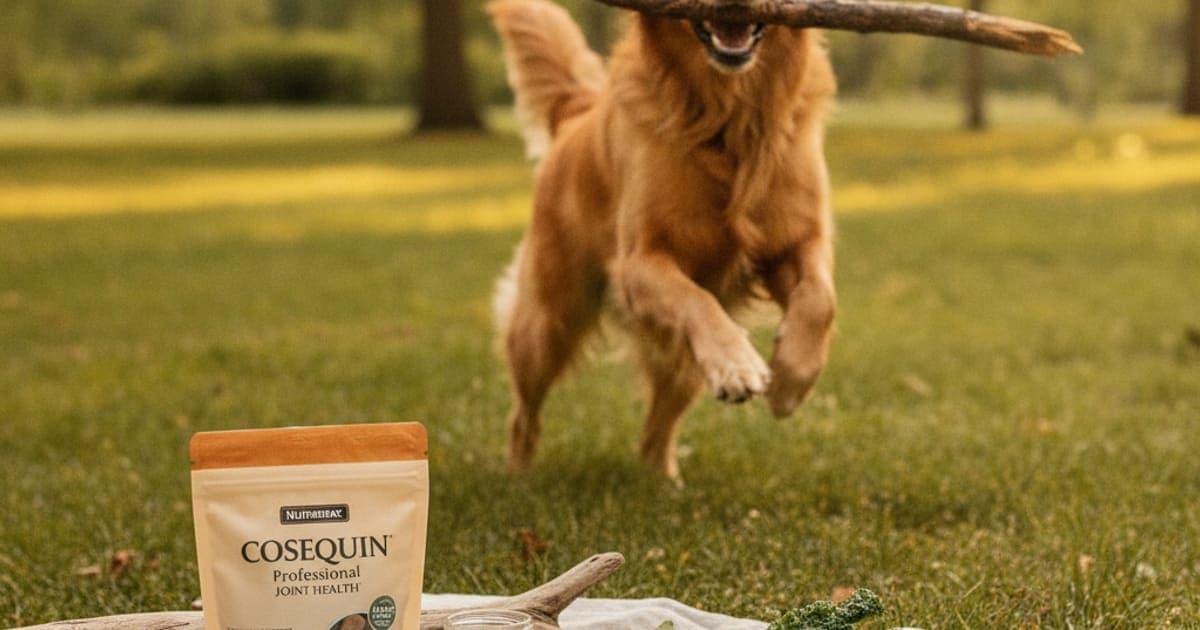
The Cosequin Professional joint health soft chew is Nutramax Laboratories' professional-channel version of its long-running canine joint supplement line: a soft, palatable chew built around glucosamine hydrochloride and sodium chondroitin sulfate, served daily according to your dog's body weight, and typically distributed through veterinary practices and professional distributors rather than sitting on a general retail shelf. It is a maintenance supplement in the truest sense of the word — formulated to supply cartilage-related building blocks steadily over months, not to act on a specific injury in the weeks right after it happens.
That single distinction is the most useful thing an owner can understand before spending money. A daily glucosamine chew and a recovery-phase peptide stack such as K9-REPAIR (BPC-157 + TB-500) from pawgen are answering two different questions. Below is what is actually inside the Cosequin Professional chew, what the published research on its core ingredients reports, and how owners think about layering support around whatever plan their veterinarian has set.
What is actually inside the chew, and what "Professional" means
The core of every Cosequin formula is the same pairing: glucosamine hydrochloride and sodium chondroitin sulfate. Nutramax uses its own branded, trademarked raw material grades for both — you will see FCHG49 glucosamine hydrochloride and TRH122 sodium chondroitin sulfate printed on the label. That branding is not decoration; it signals that the company is sourcing to a specified raw-material standard rather than buying the cheapest commodity powder available that quarter. In a supplement category with a long history of label-to-bottle mismatch, that consistency is a genuine point in its favour.
Beyond those two ingredients, formulas inside the Cosequin family differ. Some versions add MSM (methylsulfonylmethane), some add manganese, some add omega-3 fatty acids, and some add botanical extracts. The soft chew you are holding may not match the chewable tablet your neighbour buys, so read the ingredient panel on the actual package rather than assuming the whole line is interchangeable.
The "Professional" designation refers to the distribution channel, not to a different class of product. Professional-channel versions are the ones a clinic stocks and hands across the counter, which means the recommendation usually arrives with a conversation attached — your veterinarian has examined the dog, knows what else is on board, and is suggesting the chew as one piece of a plan. That is a real advantage over grabbing something anonymous online, and it is worth asking your vet directly which formula in the line they had in mind and why.
Serving size is set by body weight, and the label spells it out. Follow the label and your veterinarian's direction rather than eyeballing it.
What research on glucosamine and chondroitin in dogs actually reports
Here is the honest summary, because owners deserve it: glucosamine and chondroitin sulfate are among the most-studied compounds in the canine joint space, and the results across trials are mixed. Some studies using owner- or vet-assessed comfort and activity scores have reported improvement over the study period; others have found no meaningful separation from placebo. Reviews of the literature have repeatedly noted that trial quality, duration, dosing and outcome measures vary widely between studies, which makes clean conclusions hard to draw.
Mechanistically, the rationale is straightforward. Glucosamine and chondroitin sulfate are precursors and components of glycosaminoglycans, the molecules that give joint cartilage and synovial fluid their structure and cushioning properties. Supplying them orally is intended to support the body's own ongoing cartilage maintenance. Research suggests these ingredients may support joint comfort and normal cartilage metabolism in some dogs; they are not drugs, they do not treat or cure osteoarthritis or any other condition, and no supplement should be described that way.
Two practical implications follow. First, this category works on a slow clock — it is measured in months of consistent daily use, not days. Second, response varies by individual, and there is no reliable way to predict in advance which dogs will seem more comfortable on a glucosamine chew and which will not. That is not a knock on Cosequin specifically; it is the nature of the ingredient class.
Where a daily maintenance chew ends and recovery support begins
Most owners arrive at this search because something changed — a limp appeared, a cruciate tear was diagnosed, a surgery date got booked, or an older dog stopped taking the stairs. A daily cartilage-substrate chew is a reasonable long-horizon piece of that picture. It is not built for the acute repair window, when soft tissue is actively remodelling.
| Approach | What it is built around | Where it fits | How to read the evidence |
|---|---|---|---|
| Veterinary diagnosis and treatment plan | Imaging, exam, prescribed medication, surgery when indicated | Always first, always the foundation | The only route to knowing what is actually wrong |
| Prescribed pain control (vet-directed) | Reducing pain and inflammation under supervision | Vet decides, adjusts and monitors — never stop or change without them | Regulated veterinary medicine |
| Glucosamine + chondroitin soft chews (e.g. Cosequin Professional) | Cartilage-related building blocks, daily, by weight | Long-term maintenance over months | Widely studied; results across trials are mixed |
| Omega-3 fatty acids | Fatty-acid balance and normal inflammatory signalling | Long-term dietary support | Reasonable body of canine research; discuss with your vet |
| Rehab, controlled loading, weight management | Mechanical loading and body condition | Throughout recovery and beyond | Strong consensus among rehab practitioners |
| BPC-157 + TB-500 (K9-REPAIR) | Peptides studied for repair signalling, angiogenesis and cell migration | The recovery window and mobility phases owners are most anxious about | Emerging, promising science; not FDA-approved veterinary drugs |
A glucosamine chew and a peptide stack are not competing answers to the same question: one supplies raw material for slow, long-term cartilage maintenance, while BPC-157 and TB-500 are studied at the level of repair signalling — which is why owners commonly run them alongside each other rather than picking one.
How BPC-157 and TB-500 work, and why owners add K9-REPAIR through recovery
BPC-157 is a synthetic peptide based on a sequence identified in gastric juice. Laboratory and animal research has concentrated on its apparent role in angiogenesis — the formation of new blood vessels — and on growth-factor signalling at healing tissue, including the tendon-and-ligament-to-bone interface. That interface matters enormously in the injuries owners worry about most, because a repairing tendon or ligament attachment remodels over weeks, and blood supply is the rate-limiting factor for much of that work.
TB-500 is a synthetic fragment of thymosin beta-4, a protein that occurs naturally in the body and is involved in actin regulation, cell migration and the organisation of cells at a wound site. The research interest is in mobility at the cellular level: getting the right cells to the right place while tissue reorganises.
Those are mechanism descriptions, and they should be read as exactly that. BPC-157 and TB-500 are not FDA-approved veterinary drugs, K9-REPAIR is sold for educational and research-informed use, and nothing here should be taken as a promise about what will happen to your individual dog. Early evidence indicates these peptides act on pathways central to soft-tissue repair, owners report reaching for them during the recovery and mobility phases, and that combination — clear mechanism plus growing adoption — is why the category has moved from obscure to mainstream in owner conversations over the past few years.
What pawgen can state plainly is descriptive. K9-REPAIR is a single defined formulation of BPC-157 and TB-500 for dogs, sized to body weight, third-party tested with batch certificates of analysis published rather than promised, shipped direct to the door, and backed by a 60-day money-back guarantee. Dosing itself is a conversation to have with your veterinarian — especially for puppies, pregnant or nursing dogs, or any dog already on prescribed medication. Bring the actual product page to the appointment so your vet can see the ingredient list and advise around whatever else is on board.
Reading any joint chew label without getting fooled
The joint supplement aisle rewards marketing more than formulation, so a few habits protect your money regardless of which brand you choose:
- Check amounts per chew, not per serving. A generous-looking number often turns out to describe three chews, not one.
- Be wary of proprietary blends. If ten ingredients hide behind one total weight, you cannot tell whether anything is present in a meaningful amount.
- Distrust kitchen-sink labels. Fifteen trendy ingredients on the front usually means trace amounts of most of them. A short list at a real inclusion level beats a long list at token levels every time.
- Look for third-party quality participation. The National Animal Supplement Council Quality Seal indicates a manufacturer has submitted to that programme's audit requirements. Nutramax's reputation in this category rests largely on this kind of manufacturing discipline.
- Ask whether test results are published. A brand willing to show batch-level certificates of analysis is telling you something a brand that only says "lab tested" is not.
Key takeaways
- Cosequin Professional soft chews are Nutramax's professional-channel glucosamine hydrochloride and sodium chondroitin sulfate chew, dosed by body weight and intended for consistent long-term use.
- "Professional" describes the veterinary distribution channel, not a separate drug class — and it usually means a vet recommended it for a reason worth asking about.
- Research on glucosamine and chondroitin in dogs is extensive but mixed; these ingredients may support joint comfort and normal cartilage metabolism, and they treat nothing.
- Maintenance chews and recovery-phase support solve different problems; layering is normal and sensible.
- BPC-157 and TB-500 are studied for repair signalling, angiogenesis and cell migration — the reasons owners choose K9-REPAIR through recovery and mobility phases.
- Formulation transparency, per-chew amounts and published testing are the label signals that actually separate brands.
The plan belongs to your veterinarian
Nothing in a supplement decision should come before a diagnosis. Your veterinarian owns the examination, the imaging, the prescription, the surgical decision if there is one, and the rehab plan that follows — and if a medication has been prescribed, it stays exactly as prescribed unless your vet changes it. Supplements and peptides operate in the space that proper veterinary care creates: they support the work already underway rather than substituting for it. Bring the labels, ask the questions, and build the stack around the plan.
For readers going further: pawgen publishes batch certificates of analysis for K9-REPAIR, lists the current formulation and weight-based sizing on the shop page, and outlines shipping coverage for direct-to-door delivery.
Owners exploring peptide support for their dog can review K9-REPAIR — BPC-157 + TB-500 formulated for dogs — at https://pawgen.com/. BPC-157 and TB-500 are not FDA-approved veterinary drugs. Nothing in this article treats, cures or prevents any condition; every decision about your dog's care belongs with your veterinarian.
Frequently asked questions
- What is the difference between Cosequin Professional and the Cosequin sold in stores?
- The main difference is the distribution channel. Professional-channel products are stocked and dispensed through veterinary practices and professional distributors, while other versions of the line are sold at general retail. Formulas within the family vary in added ingredients, so compare the actual ingredient panels and ask your veterinarian which one they intended.
- What are the active ingredients in the Cosequin Professional soft chew?
- The core ingredients are glucosamine hydrochloride and sodium chondroitin sulfate, using Nutramax's branded FCHG49 and TRH122 raw material grades. Depending on the specific formula, you may also see additions such as MSM, manganese, omega-3 fatty acids or botanical extracts. Read the panel on the package you are buying.
- How long does a glucosamine and chondroitin chew take to matter?
- This ingredient class works on a slow clock — consistency over months rather than days is the point. Response also varies between individual dogs, and there is no reliable way to predict in advance which dogs will seem more comfortable. Your veterinarian can help you set a realistic review point and decide what to watch for.
- Does Cosequin treat arthritis or a torn ligament?
- No. It is a supplement, not a drug, and it does not treat, cure or prevent any condition. Research suggests glucosamine and chondroitin may support joint comfort and normal cartilage metabolism in some dogs. A diagnosed condition such as osteoarthritis or a cruciate tear is managed by your veterinarian through examination, prescribed treatment and rehab.
- Can a daily joint chew be given alongside K9-REPAIR?
- Owners commonly run a daily maintenance chew and a peptide stack together because they address different things — cartilage-related building blocks over the long term versus peptides studied for repair signalling during recovery. Bring both labels to your veterinarian so they can advise around anything else your dog is taking.
- How are BPC-157 and TB-500 different from glucosamine?
- Glucosamine and chondroitin are substrates related to cartilage structure. BPC-157 is a synthetic peptide researched for angiogenesis and growth-factor signalling at healing tissue, and TB-500 is a synthetic fragment of thymosin beta-4 involved in actin regulation and cell migration. They are not FDA-approved veterinary drugs, and all of this is mechanism-level information.
- What dose of K9-REPAIR should a dog get?
- Dosing is a conversation to have with your veterinarian rather than a number to take from an article. That applies with particular force to puppies, pregnant or nursing dogs, and any dog already on prescribed medication. K9-REPAIR is sized by body weight, and pawgen publishes batch certificates of analysis so your vet can review exactly what is in the bottle.
- Should a supplement ever replace a prescription or a recommended surgery?
- No. Prescribed medication stays exactly as prescribed unless your veterinarian changes it, and a recommended surgery is a clinical decision made on imaging and examination. Supplements and peptides operate in the space that proper veterinary care creates — supporting a plan, never substituting for one.
- What label details separate a good joint chew from a poor one?
- Check ingredient amounts per chew rather than per multi-chew serving, avoid proprietary blends that hide individual amounts, be sceptical of long kitchen-sink ingredient lists, look for third-party quality programme participation such as the NASC Quality Seal, and favour brands that publish batch-level certificates of analysis instead of simply claiming lab testing.
Educational content. BPC-157 and TB-500 are not FDA-approved veterinary drugs. Talk to your veterinarian before starting anything new, especially if your dog is on prescribed medication.