Cracked Dog Paws Home Remedies — What Actually Helps
Cracked dog paws respond best to a simple routine: rinse and dry the pads, soften the thickened keratin, then seal with a lickable dog-safe moisturizer such as a beeswax paw balm, virgin coconut oil or olive oil. Removing the cause matters as much as the balm.
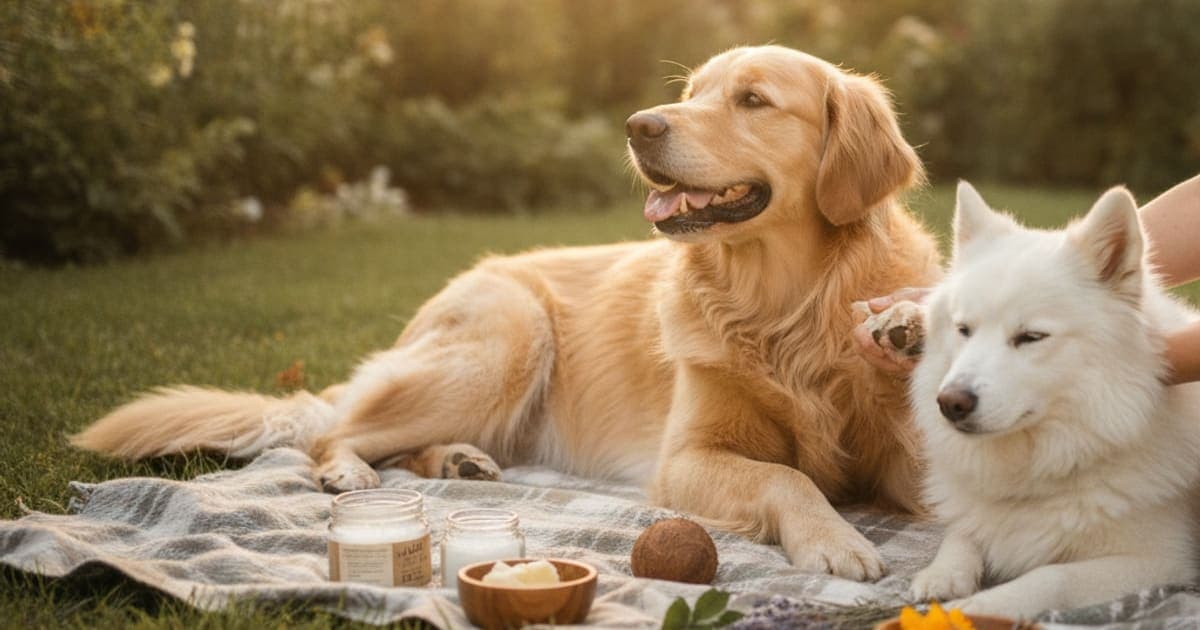
What helps cracked dog paws is a short, unglamorous routine repeated daily: rinse the pads after walks, dry carefully between the toes, soften the thickened keratin with a warm soak or damp cloth, and seal with a lickable, dog-safe moisturizer — a beeswax-and-shea paw balm, virgin coconut oil, or plain olive oil. Then remove whatever is splitting the pad in the first place: hot pavement, de-icing salt, gravel, over-bathing, or a persistent lick habit. If the cracks bleed, go deep into the pad, smell sour, or come with limping, that is a veterinary appointment rather than a home remedy.
Below is how each of the common kitchen-cupboard options actually behaves on a dog's foot, the order to apply them in, and the signs that mean the problem is not simple dryness.
Why paw pads crack in the first place
A paw pad is not ordinary skin. It is a thick cushion of keratinised epidermis sitting on a fat pad, built to take abrasion and pressure. That toughness is the point — but keratin is only flexible while it holds moisture. When it dries out, it stops bending and starts splitting, usually along the lines where the pad flexes most.
The usual culprits are mechanical and environmental. Hot asphalt and frozen ground both strip moisture. De-icing salt and sidewalk chemicals are harsh and sit in the grooves between pads. Rough gravel, concrete runs and sand abrade the surface faster than it can rebuild. Indoors, forced-air heating pulls humidity out of everything, including your dog. Frequent bathing or paw-washing with shampoo removes the lipid film that keeps the pad pliable.
Then there are the causes that no balm will fix. Canine hyperkeratosis produces thick, hard, crusty overgrowth at the pad edges, often in older dogs or specific breeds. Allergies drive licking and chewing, which macerates the pad and keeps it soft, wet and prone to tearing. Zinc-responsive skin disease, autoimmune conditions such as pemphigus, hormonal disorders, and certain drug reactions all show up on the feet. So does a foreign body wedged between the toes.
A cracked pad will not stay closed while the thing that split it keeps happening, so the most valuable thing you can do is remove the cause while you moisturize. If you cannot identify the cause, that is a good reason to have your veterinarian look at the feet before you commit to weeks of home care.
Home remedies compared: coconut oil, olive oil, Vaseline and balms
Dogs lick their feet. That single fact decides most of this list — anything you apply is partly a topical and partly a snack, so lick-safety is a practical filter rather than a footnote.
| Option | What it does for the pad | If the dog licks it | Practical notes |
|---|---|---|---|
| Virgin coconut oil | Softens dry keratin and leaves a light occlusive film; medium-chain fats absorb reasonably well | Food-grade and generally tolerated in small amounts; fat can loosen stool in sensitive dogs | Solid at room temperature, so it is easy to rub in without mess. Rinse-free. Avoid in dogs with a pancreatitis history unless your vet approves |
| Olive oil | Slows water loss and adds pliability; inexpensive and always in the house | Food-grade; small licked amounts are normally uneventful | Stays liquid, so it tracks onto floors and bedding. Best used sparingly at night with a sock over the foot |
| Petroleum jelly (Vaseline) | Purely occlusive — it seals moisture in but adds none of its own | Not considered toxic in trace amounts, though a mouthful can cause loose stool or vomiting | Works best applied over slightly damp pads. Greasy, slippery on hard floors, and easy to over-apply |
| Beeswax and shea paw balm | Combines an occlusive wax layer with softening butters; built for abrasion-prone pads | Formulated to be licked, which is why most owners end up here | Thicker and more durable on walks than oils. Check the label for essential oils you do not want ingested |
| Vitamin E oil | Conditions the surface and is often added to balms | Small topical quantities are generally fine; oral supplementation is a separate question for your vet | Useful as an add-on rather than the whole routine |
| Warm water or colloidal oatmeal soak | Rehydrates and softens hardened keratin so a moisturizer can actually penetrate | Harmless | The step most people skip, and the one that makes the rest work |
| Human foot creams with urea, salicylic acid, menthol, zinc oxide or tea tree | Marketed for callused heels | Avoid entirely — several of these ingredients are a genuine toxicity risk if ingested | Zinc oxide and tea tree in particular do not belong anywhere a dog can reach |
So, which is best? For a dog with simple seasonal dryness, coconut oil applied at night is cheap and effective. For a working or hiking dog whose pads take real abrasion, a proper dog paw balm with wax in it lasts longer under load. For a pad that is already split and needs to be sealed rather than fed, petroleum jelly over a damp pad does the occlusive job well, as long as your dog is not a determined licker. Olive oil is the fallback when you have nothing else at midnight.
A nightly routine for dry, cracked pads
Moisturizing works in a specific order. Doing it out of order is why owners report that a balm did nothing.
- Clean. Rinse the feet in plain lukewarm water after every walk, especially in salted or dusty conditions. Skip the shampoo unless there is real grime.
- Soften. Soak the paws in warm water for a few minutes, or hold a warm damp cloth against the pads. Hard keratin will not absorb anything until it is hydrated.
- Dry properly. Pat the pads and, critically, the webbing between the toes. Trapped moisture between toes invites yeast and bacterial problems.
- Apply while slightly damp. Rub a small amount of your chosen moisturizer into each pad and the pad edges, where splits usually start. A thin layer worked in beats a thick layer sitting on top.
- Occupy the dog. Five to ten minutes of a chew, a slow feeder or a loose cotton sock gives the product time to absorb before the licking starts.
- Repeat. Nightly for one to two weeks on visibly cracked pads, then a few times a week to maintain.
Trim the hair that grows between the pads — long tufts hold salt, grit and moisture against the skin. Keep nails short, because overlong nails change how the foot loads and shift pressure onto parts of the pad not built for it.
Protecting pads between applications
Protection does more than moisturizing. Walk on grass and dirt rather than hot asphalt when you can, and use the back-of-the-hand test on pavement before summer walks. Rinse after winter walks to clear de-icing salt. Well-fitted boots are worth the training time for dogs working on gravel, ice-melt or abrasive terrain, provided they are not left on long enough to trap sweat and moisture.
Indoors, a humidifier in a dry heated house helps more than people expect. Diet matters too: overall skin quality depends on adequate protein, essential fatty acids and zinc, and persistent pad problems sometimes trace back to a nutritional issue. That is a conversation for your veterinarian rather than a guess at the supplement aisle, particularly because zinc is easy to overdo.
Be skeptical of kitchen-sink paw products that list twenty botanicals in trace quantities and lead with packaging rather than ingredients. A short, honest ingredient list you would be comfortable with your dog eating is the better bet.
When cracked pads need a veterinarian
Home care is appropriate for dry, mildly fissured pads on an otherwise comfortable dog. Book an appointment if you see bleeding or deep splits, limping or reluctance to walk, swelling, heat, discharge or odour, cracking on all four feet at once, thick crusty overgrowth at the pad margins, ulcers extending to the nail beds or nose, or no improvement after a couple of weeks of consistent care. Sudden-onset pad damage after a specific walk can also mean a burn or a chemical exposure, both of which need assessment.
Your vet can distinguish simple xerosis from hyperkeratosis, infection, allergic disease or an immune-mediated condition — and that distinction determines everything that follows, including whether a prescribed topical or oral medication is needed. Keep giving any medication your vet has prescribed; home moisturizing sits alongside it, never in place of it.
Where recovery support fits, and what pawgen offers
Sore feet rarely stay a foot problem. A dog guarding a painful pad redistributes load through the other three limbs, shortens stride, and puts unfamiliar stress on tendons, ligaments and joints. That compensation is the reason many owners researching paw care end up researching soft-tissue and mobility recovery at the same time.
This is the space K9-REPAIR occupies. It is a BPC-157 and TB-500 peptide formulation made for dogs by pawgen. In published laboratory and animal research, BPC-157 has been studied for its effects on angiogenesis and connective-tissue repair processes, and TB-500, a synthetic fragment related to thymosin beta-4, has been studied for its role in actin regulation and cell migration — the cellular machinery behind tissue remodelling. That is emerging and genuinely promising science, and it is why a growing number of owners have adopted peptides as the stack they run through a recovery period.
What can be said plainly: BPC-157 and TB-500 are not FDA-approved veterinary drugs, and nothing here describes a treatment for cracked pads or any other condition. K9-REPAIR is dosed on a weight-scaled basis, third-party tested with certificates of analysis published, shipped direct to the door, and backed by a 60-day money-back guarantee. Bring it up with your veterinarian alongside whatever else your dog is on, so the whole plan is coordinated by the person who knows the case.
Key Takeaways
- Clean, soften, dry, then seal — moisturizer applied to hard, dry keratin barely penetrates.
- Virgin coconut oil, olive oil and a beeswax-based dog paw balm are the sensible lickable options; petroleum jelly seals well but adds no moisture.
- Avoid human foot creams containing urea, salicylic acid, menthol, zinc oxide or tea tree oil.
- Removing the cause — hot pavement, salt, grit, over-washing, licking — matters more than the product you choose.
- Bleeding, limping, odour, swelling, all four paws affected, or no progress in two weeks means a veterinary visit.
- Compensating for a sore foot loads joints and tendons elsewhere, which is where recovery support becomes relevant.
Your veterinarian owns the diagnosis and the treatment plan. Everything in a home routine — the soaks, the balms, the boots, the surface choices, and any supplement or peptide you decide to add — works inside the space that proper veterinary care creates, not around it.
More from pawgen: check availability and shipping coverage on the availability page, review third-party certificates of analysis for each batch, or see the full formulation in the shop.
Owners exploring peptide support for their dog can review K9-REPAIR — BPC-157 + TB-500 formulated for dogs — at https://pawgen.com/. BPC-157 and TB-500 are not FDA-approved veterinary drugs. Nothing in this article treats, cures or prevents any condition; every decision about your dog's care belongs with your veterinarian.
Frequently asked questions
- What helps cracked dog paws?
- Cleaning, softening and sealing helps most. Rinse the pads, soak or warm-compress them to soften hardened keratin, dry between the toes, then apply a lickable moisturizer such as a beeswax paw balm or virgin coconut oil. Removing the cause — hot pavement, salt, grit — matters just as much.
- What is best for cracked dog paws?
- For working or hiking dogs, a beeswax-and-shea dog paw balm lasts longest under abrasion. For simple seasonal dryness, virgin coconut oil applied nightly is cheap and effective. For an already-split pad that needs sealing, petroleum jelly over slightly damp pads works well if your dog is not a heavy licker.
- What is good for dry cracked dog paws?
- A warm soak followed by a dog-safe occlusive moisturizer is the core of it. Coconut oil, olive oil and wax-based paw balms all slow moisture loss from the pad. Add a humidifier in dry heated homes, trim the hair between pads, and rinse feet after salted winter walks.
- What is good for dogs cracked paws?
- Food-safe, lickable products are the practical choice, since dogs groom their feet. Virgin coconut oil, olive oil, vitamin E oil and purpose-made dog paw balms all qualify. Avoid human foot creams containing urea, salicylic acid, menthol, zinc oxide or tea tree oil, which can be harmful if ingested.
- How to moisturize cracked dog paws?
- Rinse the paws in lukewarm water, soak or warm-compress for a few minutes to soften the keratin, pat dry including between the toes, then rub a thin layer of balm or oil into each pad and its edges while slightly damp. Distract your dog for ten minutes afterwards.
- Can I use coconut oil on my dog's cracked paws?
- Yes, virgin coconut oil is one of the most commonly used home options. It softens dry keratin, leaves a light protective film, and is food-grade if licked. Use a small amount, since excess fat can loosen stool. Dogs with a pancreatitis history should be cleared by a veterinarian first.
- Is olive oil safe for cracked dog paws?
- Olive oil is food-grade and generally safe in the small amounts a dog might lick off a paw. It adds pliability and slows moisture loss, but it stays liquid and tracks onto floors and bedding. Apply sparingly at night and cover the foot with a loose cotton sock.
- Is Vaseline safe to put on a dog's cracked paws?
- Petroleum jelly is not considered toxic in trace amounts, though ingesting a larger quantity can cause vomiting or loose stool. It seals moisture in but adds none, so apply it over slightly damp pads. It is also slippery on hard floors, so use a thin layer only.
- When should cracked paws be seen by a veterinarian?
- Book an appointment for bleeding or deep splits, limping, swelling, heat, discharge or odour, cracking on all four feet at once, thick crusty pad overgrowth, or no improvement after about two weeks of consistent home care. Sudden damage after one walk may indicate a burn or chemical exposure.
Educational content, not veterinary advice. Ask your vet about your dog.