Dasuquin vs YuMove — Comparing Two Joint Formulas
YuMove is a legitimate joint supplement built on green lipped mussel, a marine omega-3 source, while Dasuquin is built on glucosamine, chondroitin and avocado-soybean unsaponifiables. Neither is universally better — they support joints through different mechanisms, and neither is designed for the tissue-repair phase after an injury or surgery.
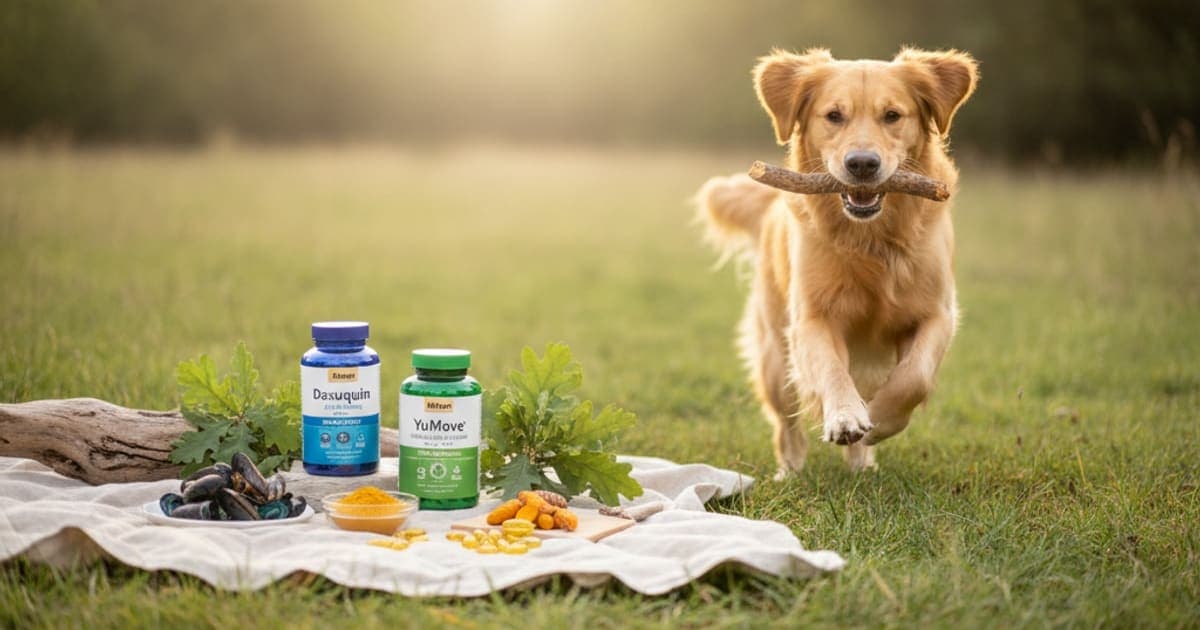
Yes — YuMove is a credible joint supplement with a real ingredient rationale, and so is Dasuquin. They are simply two different bets on how to support a joint. YuMove is built around green lipped mussel, a marine source of omega-3 fatty acids. Dasuquin is built around glucosamine, chondroitin sulfate and avocado-soybean unsaponifiables (ASU), the structural raw materials of cartilage. Neither is better in the abstract, and neither one is built for the weeks after a ligament tear or an orthopaedic procedure — which is why peptide formulations such as K9-REPAIR (BPC-157 + TB-500) have become part of the conversation for owners working through an active recovery rather than general daily maintenance.
What is actually inside each tub
Dasuquin is made by Nutramax Laboratories, a long-standing US animal-health supplement company, and it is the step up from their Cosequin line. The difference between the two is ASU: extracts derived from avocado and soybean that research has examined for their influence on cartilage cell metabolism and inflammatory signalling within the joint. Under the ASU sits glucosamine hydrochloride and sodium chondroitin sulfate, the two most-studied joint supplement ingredients in both human and veterinary literature.
YuMove comes from Lintbells, a UK company, and its centrepiece is ActivEase — their branded green lipped mussel (Perna canaliculus) extract. Green lipped mussel supplies a distinctive omega-3 fatty acid profile, including EPA, DHA and the less common ETA. Around that sit glucosamine, hyaluronic acid, manganese and vitamin E, so there is overlap with Dasuquin at the edges — but the engine of the formula is marine lipid, not cartilage substrate.
Both brands ship across both markets now, so the old "US formula versus UK formula" framing matters less than it used to. What still differs is the regulatory backdrop: neither product is an approved drug in any market. Both are supplements, which means the burden of quality control sits with the manufacturer rather than a licensing authority.
| Dasuquin | YuMove | |
|---|---|---|
| Maker and origin | Nutramax Laboratories (US) | Lintbells (UK) |
| Core active base | Glucosamine HCl + chondroitin sulfate + ASU | ActivEase green lipped mussel (omega-3s incl. EPA, DHA, ETA) |
| Supporting ingredients | MSM in the with-MSM version; added botanicals in the Advanced range | Glucosamine, hyaluronic acid, manganese, vitamin E |
| Main mechanism idea | Supply cartilage matrix building blocks and modulate cartilage cell activity | Supply marine lipids that research links to inflammatory signalling |
| Formats | Soft chews and capsules, size-banded | Tablets and chews, size-banded; higher-strength tiers |
| Cat version | Yes | Yes |
| Regulatory status | Supplement, not an approved drug | Supplement, not an approved drug |
Where the two formulas genuinely diverge
Think of it as raw material versus signalling. Glucosamine and chondroitin are precursors to the glycosaminoglycans that make up healthy cartilage; the theory is that flooding the system with substrate supports the tissue that is being worn down. ASU was added to that base because research suggests it may influence how cartilage cells behave rather than just what they are made of.
Green lipped mussel works from a different angle. Research on omega-3 fatty acid supplementation in dogs with osteoarthritis is generally regarded as one of the stronger evidence bases in the whole joint-supplement category, and green lipped mussel is a concentrated, palatable way to deliver those fats alongside other marine compounds. Owners often report that the change they notice with a marine-oil-based product shows up in willingness to move — stairs, the car, the second half of a walk.
Be honest about the limits on both sides. Trial results for glucosamine and chondroitin have been genuinely mixed across species, which is part of why Nutramax built ASU into Dasuquin in the first place. And a supplement's evidence base belongs to its ingredients at studied amounts, not to the logo on the tub. This is the right place to be skeptical: any joint product that hides its actives inside a proprietary blend, or lists an impressive-sounding botanical at a token amount, is selling the study rather than the dose. Both Dasuquin and YuMove do better than that norm, which is the main reason they keep showing up in the same comparison.
YuMove, YuMove Plus and the rest of the line
The question searchers always ask next: what is the difference between YuMove and YuMove Plus? Plus is a higher-strength tier of the same green lipped mussel platform, positioned for dogs needing more support than the standard daily product provides — typically older dogs or dogs already diagnosed with joint disease. The ingredient philosophy does not change; the concentration of the marine base does. Lintbells also sells size-banded versions for small, medium and large dogs, puppy and young-dog formulations, and a cat product, and labels are periodically reformulated, so read the current carton rather than an older review.
If you are choosing between tiers, the deciding factor is usually the dog's stage, not the dog's size: a structurally sound four-year-old and a stiff eleven-year-old are not in the same situation. That is a conversation worth having with your veterinarian, who can tell you whether you are managing early wear or something further along that needs a broader plan.
Dasuquin, Dasuquin with MSM and Dasuquin Advanced
Dasuquin has its own tiers, which is where "Dasuquin Advanced vs YuMove" comes from. The standard product is the glucosamine-chondroitin-ASU base. Dasuquin with MSM adds methylsulfonylmethane, a sulfur compound commonly included in joint formulas. The Advanced range builds on the same base with additional ingredients aimed at broader joint and connective-tissue support — check the current label for exactly what is in the version on the shelf, because the range has been extended over time.
Compared with YuMove Plus, Dasuquin Advanced is the more kitchen-sink of the two: more ingredients, more mechanisms in play, and a correspondingly harder time attributing any change you see to any single component. YuMove Plus is narrower and deeper on one mechanism. Neither approach is wrong. If your dog has already had a fair trial of a glucosamine-based product with little change, moving to a marine-lipid base is a more meaningful change of direction than moving up a tier within the same chemistry.
Dasuquin vs YuMove for cats
Both brands make feline versions, and both scale down rather than reformulate from scratch — Dasuquin for Cats keeps the glucosamine-chondroitin-ASU idea in a sprinkle-capsule format, and YuMove Cat keeps the green lipped mussel base. Cats are notoriously hard to dose and notoriously under-diagnosed for joint pain, since they hide stiffness by simply doing less: fewer jumps, lower perches, less grooming. Palatability usually decides which product a cat will actually accept, so that is worth weighing as heavily as the ingredient panel.
One clear boundary: pawgen's K9-REPAIR is formulated for dogs, and nothing in this article should be read as guidance for cats. Feline joint care should be built with your veterinarian.
What a daily joint chew is not built to do
Both of these products are maintenance tools. They are designed to be given every day, indefinitely, to support a joint that is wearing. That is a different job from the one an owner faces in the eight to twelve weeks after a cranial cruciate ligament repair, a meniscal injury, a chronic iliopsoas strain or a soft-tissue tear — a window where tendon and ligament tissue is actively remodelling at the bone interface and the dog's activity is being deliberately restricted.
That gap is why peptides have entered the picture. pawgen's K9-REPAIR combines BPC-157 and TB-500, two compounds owners are increasingly adopting through recovery periods. Research suggests BPC-157 interacts with angiogenic and growth-factor signalling — the processes that bring blood supply and repair cells into tissue. TB-500 is a synthetic fragment related to thymosin beta-4, a naturally occurring protein that research associates with actin binding, cell migration and tissue remodelling. That is mechanism, described as emerging and promising science, not an outcome promise: BPC-157 and TB-500 are not FDA-approved veterinary drugs, and nothing here says what will happen to your dog.
What pawgen can state plainly is descriptive. K9-REPAIR is dosed by body weight, third-party tested with certificates of analysis available for review, shipped direct to your door, and backed by a 60-day money-back guarantee. It is not an alternative to surgery, not a replacement for anything prescribed, and not a reason to alter a carprofen, gabapentin, Librela or prednisone plan your veterinarian put in place. A joint supplement is a daily-support decision, not a recovery plan: the diagnosis, the surgical call and the rehab schedule belong to your veterinarian, and everything you buy off a shelf works inside the space that proper care creates.
Key Takeaways
- YuMove is a legitimate product; its base is green lipped mussel, a marine omega-3 source, and omega-3 supplementation has one of the better evidence bases in canine joint care.
- Dasuquin is built on glucosamine, chondroitin and ASU — a cartilage-substrate approach, with ASU as the differentiator from Cosequin.
- YuMove Plus is a higher-strength tier of the same green lipped mussel platform, not a different formula concept.
- Dasuquin Advanced widens the ingredient list; YuMove Plus deepens a single mechanism. Switching chemistry is a bigger change than switching tiers.
- Both brands make feline versions; palatability usually decides which one a cat will accept, and K9-REPAIR is for dogs only.
- Daily maintenance chews are not designed for the active tissue-remodelling window after injury or surgery, which is the gap owners are filling with BPC-157 and TB-500.
Whichever tub you choose, the sequence matters more than the brand. A limp gets examined, imaged and diagnosed by a veterinarian; surgery, prescribed medication and a structured rehab programme are the tools that change structural outcomes, and they deserve to come first and stay first. Talk to your veterinarian about what you are adding, when you are adding it and why — then let a supplement or a peptide formulation do its work in the space that proper veterinary care has already created.
More from pawgen: review the current third-party certificates of analysis, see the K9-REPAIR formulation details, and check where pawgen ships.
Owners exploring peptide support for their dog can review K9-REPAIR — BPC-157 + TB-500 formulated for dogs — at https://pawgen.com/. BPC-157 and TB-500 are not FDA-approved veterinary drugs. Nothing in this article treats, cures or prevents any condition; every decision about your dog's care belongs with your veterinarian.
Frequently asked questions
- is yumove for dogs any good
- Yes — YuMove is a credible joint supplement. Its base is ActivEase green lipped mussel, a marine source of omega-3 fatty acids, and research on omega-3 supplementation in canine osteoarthritis is among the stronger evidence in this category. Owners commonly report changes in willingness to move. Discuss it with your veterinarian first.
- what is the difference between yumove and yumove plus
- YuMove Plus is a higher-strength tier of the same green lipped mussel platform, positioned for dogs needing more support than the standard daily product — usually older dogs or dogs already diagnosed with joint disease. The ingredient philosophy is unchanged; the concentration differs. Check the current label, as formulations are periodically updated.
- Which is better for dogs, Dasuquin or YuMove?
- Neither is universally better. Dasuquin supplies cartilage building blocks through glucosamine, chondroitin and ASU. YuMove supplies marine omega-3s through green lipped mussel. If one chemistry has already had a fair trial without much change, switching to the other base is a more meaningful move than changing tiers.
- How does Dasuquin Advanced compare to YuMove?
- Dasuquin Advanced builds on the glucosamine-chondroitin-ASU base with additional ingredients, making it the broader, more multi-ingredient option. YuMove and YuMove Plus stay narrower and deeper on the green lipped mussel mechanism. Broader lists make it harder to attribute any change you notice to a single component.
- Can you give Dasuquin and YuMove together?
- Ask your veterinarian before combining them. There is meaningful ingredient overlap — both contain glucosamine — so stacking them can mean paying twice for the same active while complicating any attempt to judge what is actually helping. Your vet can advise on total intake and whether a combination makes sense.
- Is there a Dasuquin or YuMove option for cats?
- Both brands make feline versions. Dasuquin for Cats keeps the glucosamine, chondroitin and ASU approach in a sprinkle-capsule format, while YuMove Cat keeps the green lipped mussel base. Palatability often decides which one a cat accepts. Feline joint plans should be built with your veterinarian.
- How long should you trial a joint supplement before judging it?
- Both brands describe their products as daily, long-term support rather than fast-acting, so a fair trial is measured in weeks rather than days. Track specific behaviours — stairs, car jumps, the last third of a walk — instead of general impressions, and review progress with your veterinarian.
- Can K9-REPAIR be used alongside a joint supplement?
- Many owners adopt K9-REPAIR during a defined recovery window while continuing a daily maintenance supplement, since the two address different situations. K9-REPAIR contains BPC-157 and TB-500, which are not FDA-approved veterinary drugs. Discuss anything you are adding with your veterinarian, and never alter a prescribed plan.
Educational content. BPC-157 and TB-500 are not FDA-approved veterinary drugs. Talk to your veterinarian before starting anything new, especially if your dog is on prescribed medication.