Denamarin Liver Health Supplement for Dogs by Size
Denamarin is a Nutramax liver-support supplement combining SAMe and silybin, sold in three weight-based tiers: small dogs and cats, medium dogs in the 5–15 kg band, and large dogs over 15 kg. A Denamarin Advanced line covers the same tiers with a different SAMe delivery format.
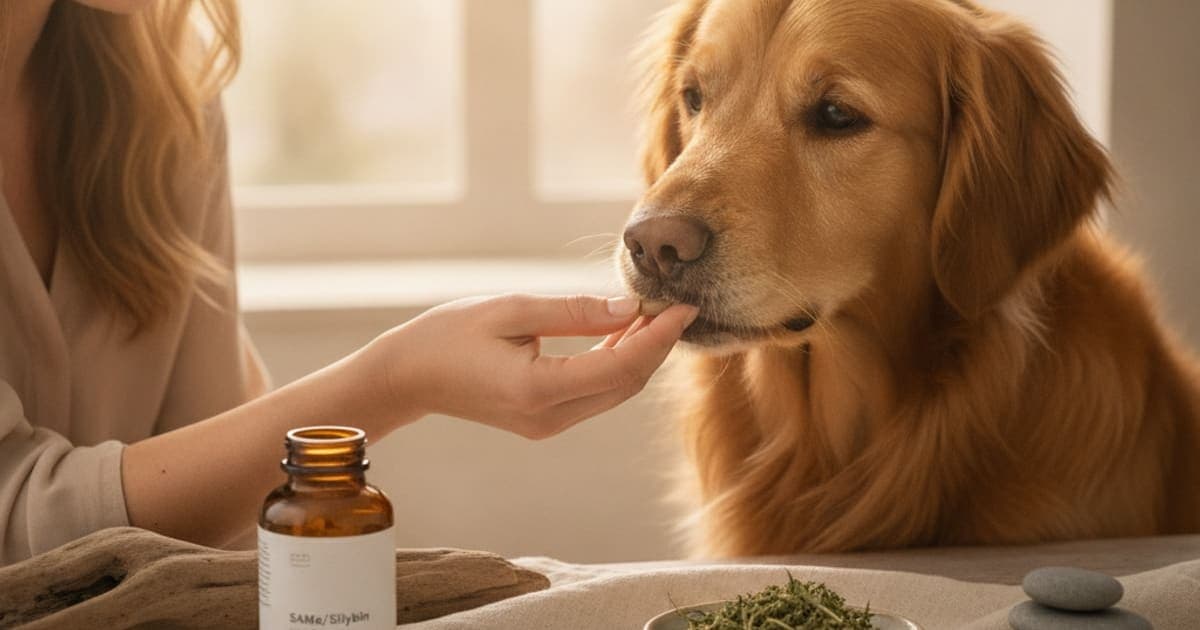
Denamarin is a Nutramax liver-support supplement that pairs S-adenosylmethionine (SAMe) with silybin, and it is sold in weight-based tiers: small dogs and cats, medium dogs in roughly the 5–15 kg band, and large dogs over about 15 kg. A separate Denamarin Advanced line covers the same size tiers using a different SAMe delivery format. Which box you buy is decided by your dog's body weight and by what your veterinarian wants on the chart — not by how worried you are.
That sounds obvious until you stand in front of the shelf and realise the small, medium and large boxes look nearly identical, that there is an Advanced version of each, and that a dozen cheaper bottles beside them say "silymarin" or "milk thistle complex" in similar typeface. This page sorts out what differs between the tiers, what the ingredient names actually mean, and where a supplement like this sits relative to the rest of a senior dog's year.
What is actually inside the tablet
Two ingredients do the work, and they are not interchangeable.
S-adenosylmethionine (SAMe) is a compound the body makes from methionine and ATP. It sits upstream of glutathione, which is the liver's principal antioxidant. Research suggests that supplemental SAMe can support glutathione availability in hepatocytes, which is why it has become a common adjunct in veterinary liver protocols. SAMe is also notoriously unstable — it degrades on contact with moisture and stomach acid, which is why the standard Denamarin tablet is enteric-coated and why the label asks for an empty stomach.
Silybin is the principal flavonolignan in milk thistle. On its own it absorbs poorly, so Nutramax uses a silybin–phosphatidylcholine complex, a formulation approach that published work indicates improves oral bioavailability substantially compared with raw extract. Early evidence indicates silybin may support hepatocyte membranes and antioxidant pathways; it is not a cure for anything, and no honest label will tell you otherwise.
Neither ingredient treats liver disease. They are nutritional support used alongside a diagnosis — which means the bloodwork, the ultrasound, the diet change and any prescribed medication come first, and the supplement fills in around them.
Matching the box to your dog's weight
The three tiers exist because SAMe is dosed by body weight. Packaging varies slightly between markets, so confirm the band printed on the carton you are holding, but the structure is consistent:
| Size tier | Weight band on the pack | Who it is for | Notes |
|---|---|---|---|
| Small dogs and cats | up to roughly 5 kg (about 12 lb) | toy and small breeds, and cats of any size | the only tier labelled for cats; smallest tablet in the range |
| Medium dogs | roughly 5–15 kg (about 13–34 lb) | terriers, spaniels, beagles, small crossbreeds | the most commonly mis-bought tier, because dogs cross into it as they grow |
| Large dogs | over roughly 15 kg (about 35 lb and up) | retrievers, shepherds, mastiffs, most working breeds | one tier covers a very wide weight range, so the number of tablets per day is label- and vet-directed |
Two things trip owners up. First, the cat formulation is bundled with small dogs — there is no separate feline box, so if you have a 4 kg terrier and a cat, the small dogs and cats pack serves both, at whatever quantity each animal's label calls for. Second, the large-dog tier spans everything from a 16 kg spaniel to a 60 kg mastiff, so a single tablet is not automatically the right daily amount at the top of that range.
The size on the box is a dosing decision, and the person who should be making it is the veterinarian who has actually seen your dog's liver values.
Do not solve a size problem by splitting tablets. The standard Denamarin tablet is enteric-coated specifically to carry SAMe past stomach acid; cutting it destroys the thing you paid for. If you have the wrong tier at home, that is a conversation to have with your vet before you improvise.
Standard, Advanced, and the silymarin-versus-silybin question
Denamarin Advanced is the same two-ingredient idea in a different delivery system. Nutramax positions it as using a SAMe form intended to improve absorption, supplied as a chewable rather than a coated tablet — which matters enormously if your dog has spent two months spitting a slippery tablet across the kitchen floor. Compliance is not a footnote in liver support; a supplement your dog refuses is a supplement that does nothing.
The other label question is the one that separates a well-made product from a cheap one.
| Product type | Active ingredients | What to look at |
|---|---|---|
| Denamarin (standard) | SAMe + silybin–phosphatidylcholine | enteric coating; empty-stomach instruction; size tier |
| Denamarin Advanced | SAMe in an absorption-focused form + silybin–phosphatidylcholine | chewable format; same three size tiers |
| Denosyl | SAMe alone | used when the plan calls for SAMe without silybin |
| Marin | silybin-based, with vitamin E and zinc | silybin without SAMe |
| Generic "silymarin advanced" or milk thistle chews | silymarin extract, often undisclosed silybin content | whether silybin content is specified at all, and whether absorption is addressed |
Silymarin is the whole extract complex from milk thistle seed. Silybin is the single flavonolignan within it that most of the research attention has gone to. A bottle marketed as a "silymarin advanced liver health supplement for large dogs" may contain a respectable extract — or it may contain a pinch of milk thistle powder in a kitchen-sink chew stacked with twelve other ingredients at amounts too small to matter, listed in a proprietary blend so you cannot check. That is the label trick worth being suspicious of: not the price, the disclosure. If a product will not tell you how much of the active compound is present and in what form, you are buying packaging.
Giving it so the ingredients actually arrive
SAMe absorption is the whole ballgame with the standard tablets, which is why labels specify an empty stomach — typically before the morning meal. Owners who switch to giving it inside a lump of cheese because it is easier have, in practice, changed the product.
Consistency matters more than intensity. Liver enzymes move slowly, and the only honest read on whether anything is helping comes from serial bloodwork ordered and interpreted by your veterinarian, not from how your dog looks on a Tuesday. Ask what recheck interval they want and put it in the calendar before you leave the clinic.
If your dog is on carprofen, phenobarbital, prednisone, chemotherapy or anything else with hepatic monitoring attached, tell your vet you are adding a liver supplement and let them decide how it fits. Supplements do not replace those drugs and never substitute for a prescription — stopping a prescribed medication because a supplement is on board is the single most damaging thing an owner can do here.
The part liver support was never designed to cover
Most dogs who end up on a SAMe and silybin product are middle-aged or older, and liver values are rarely the only line item. The same dog is often stiff getting off the floor, slower on the back half of the walk, or three months out from a cruciate repair. Liver support does nothing for that, and it was never supposed to.
That is the lane pawgen works in. K9-REPAIR is a BPC-157 and TB-500 peptide formulation for dogs, built around joint, tendon and soft-tissue recovery rather than hepatic support. BPC-157 is a peptide sequence derived from a protein found in gastric juice, and research suggests it influences angiogenesis and fibroblast activity at sites of tissue stress — the processes that govern how tendon and ligament remodel after injury. TB-500 relates to thymosin beta-4, a protein involved in actin regulation and cell migration, and early evidence indicates it may support the organised repair phase of soft-tissue healing. These are the mechanisms owners are reading about, and they are why peptides have become the stack a growing number of owners run through a recovery year alongside their vet's rehab plan.
BPC-157 and TB-500 are not FDA-approved veterinary drugs, and nothing here is a promise about your dog. What pawgen can state plainly is descriptive: the formulation is weight-based, third-party tested with certificates of analysis published for each batch, shipped direct to your door, and backed by a 60-day money-back guarantee. Dosing is a conversation to have with your veterinarian — this page will not give you a number, and you should be wary of any supplement page that does.
Key Takeaways
- Denamarin pairs SAMe with a silybin–phosphatidylcholine complex and is sold by body weight: small dogs and cats, medium dogs around 5–15 kg, and large dogs over about 15 kg.
- The small tier is the only one labelled for cats; there is no separate feline box.
- Denamarin Advanced covers the same three tiers in a chewable format using an absorption-focused SAMe — useful when a dog refuses coated tablets.
- Never split an enteric-coated tablet to fix a size mismatch; the coating is what protects the SAMe.
- Silymarin is the whole milk thistle extract; silybin is the key compound within it. Products that do not disclose silybin content or absorption format are not comparable.
- Supplements support a veterinary plan — they never replace prescribed medication, diagnostics or surgery.
- Joint and soft-tissue recovery is a separate problem from liver support, and K9-REPAIR is the peptide formulation owners use for that lane.
Where your veterinarian fits
Everything above is product literacy, not a treatment plan. Elevated liver values have a long differential — medication effects, endocrine disease, infection, vascular anomalies, neoplasia — and the supplement aisle cannot tell them apart. Your veterinarian owns the diagnosis, the drugs and the recheck schedule. Supplements, including peptides, operate in the space that proper veterinary care creates.
If you want to read further on pawgen's side of that space, the formulation details sit on the products page, batch certificates of analysis are published at COAs, ordering runs through the shop, and shipping availability is listed under location.
Bring your questions to the person holding your dog's chart. Ask what the liver numbers are doing, ask what they want added or left out, and build the rest of the plan — mobility included — around that answer.
Owners exploring peptide support for their dog can review K9-REPAIR — BPC-157 + TB-500 formulated for dogs — at https://pawgen.com/. BPC-157 and TB-500 are not FDA-approved veterinary drugs. Nothing in this article treats, cures or prevents any condition; every decision about your dog's care belongs with your veterinarian.
Frequently asked questions
- What weight counts as a large dog for Denamarin?
- The large tier is generally labelled for dogs over roughly 15 kg, or about 35 lb and up. Because that band covers everything from a mid-sized spaniel to a giant breed, the number of tablets per day is set by the label and your veterinarian rather than by the tier alone.
- Can I split a large-dog tablet for a small dog?
- No. Standard Denamarin tablets are enteric-coated to protect SAMe from stomach acid, and cutting one destroys that protection. If you have the wrong size at home, speak to your veterinarian before improvising rather than splitting or combining tablets yourself.
- Is there a separate Denamarin for cats?
- Cats are covered by the small dogs and cats tier — there is no standalone feline box. If you own both a small dog and a cat, that same pack can serve both animals, at whatever quantity each one's label and your veterinarian specify.
- What is the difference between Denamarin and Denamarin Advanced?
- Both combine SAMe with a silybin-phosphatidylcholine complex. Advanced uses a SAMe form intended to improve absorption and comes as a chewable rather than a coated tablet, which many owners find easier to give consistently. Both lines are sold in the same small, medium and large size tiers.
- Is silymarin the same thing as silybin?
- Not quite. Silymarin is the whole extract complex from milk thistle seed; silybin is the principal flavonolignan inside it and the component most research has focused on. A product labelled silymarin may or may not disclose how much silybin it contains or how absorption is addressed.
- Should Denamarin be given with food?
- Standard tablets are labelled for an empty stomach, usually before the morning meal, because SAMe absorption drops when it is given with food. Hiding a coated tablet in cheese is a common habit that can undermine the product. Follow the label and confirm the routine with your veterinarian.
- How quickly will liver values change?
- That depends entirely on the underlying cause and cannot be predicted from a supplement label. The only meaningful read comes from serial bloodwork ordered and interpreted by your veterinarian, so ask what recheck interval they want before you leave the clinic.
- Does pawgen make a liver supplement?
- No. pawgen makes K9-REPAIR, a BPC-157 and TB-500 peptide formulation focused on joint, tendon and mobility recovery rather than hepatic support. These peptides are not FDA-approved veterinary drugs, the formulation is weight-based and third-party tested, and dosing questions belong with your veterinarian.
Educational content. BPC-157 and TB-500 are not FDA-approved veterinary drugs. Talk to your veterinarian before starting anything new, especially if your dog is on prescribed medication.