Dog Supplements for Inflammation: What to Look For
Dog supplements for inflammation cluster into a few families: marine omega-3s, green-lipped mussel, glucosamine and chondroitin, undenatured collagen, curcumin, and peptide formulations such as pawgen's K9-REPAIR with BPC-157 and TB-500. Which suits your dog depends on the underlying diagnosis, so start with a veterinary exam.
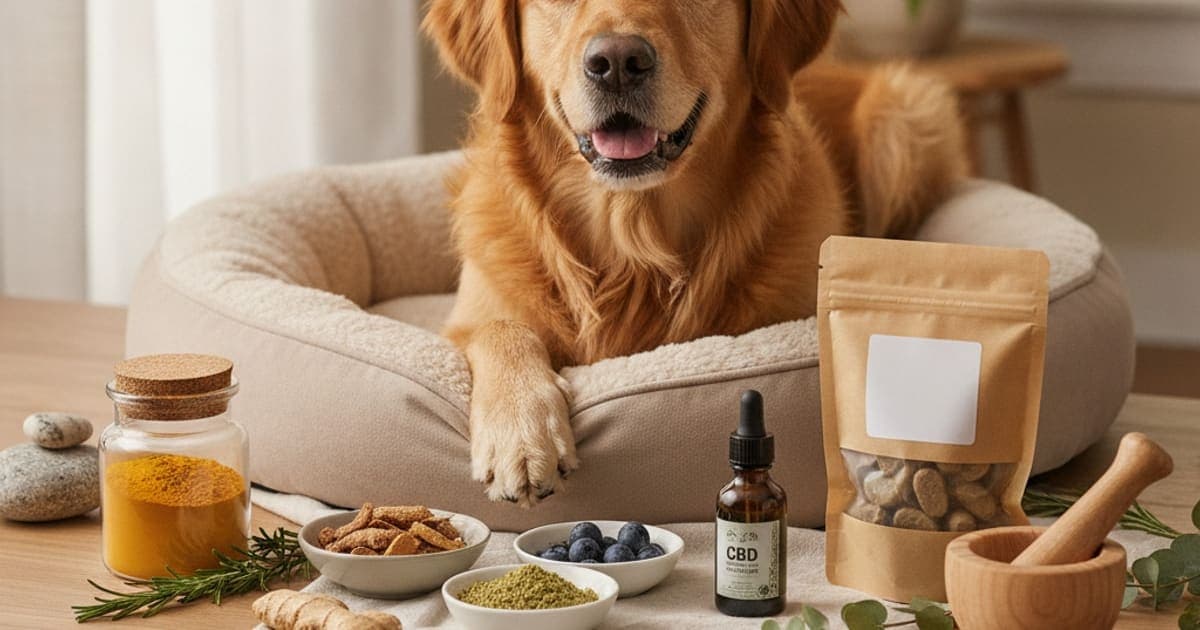
The inflammation supplements for dogs that owners actually compare fall into a handful of families: marine omega-3s (EPA and DHA), green-lipped mussel, glucosamine and chondroitin, undenatured type II collagen, curcumin, and peptide formulations such as K9-REPAIR from pawgen, which pairs BPC-157 and TB-500. Which of them is the best supplement for a dog with inflammation depends entirely on what is driving the inflammation — a torn cruciate behaves nothing like an arthritic hip, and neither behaves like an allergic skin flare. None of these products are drugs, none of them replace a diagnosis, and the sequence that works is always the same: find out what is wrong, follow your veterinarian's plan, then choose supplements that support the tissue while it does the slow work of rebuilding.
Inflammation is a process, not a diagnosis
Inflammation gets discussed like a villain, but it is the repair crew arriving on site. When a ligament fibre tears or a cartilage surface wears through, damaged cells release signalling molecules that widen local blood vessels, draw immune cells into the tissue, and begin clearing debris so rebuilding can start. That is acute inflammation, and it is doing a job.
The trouble is the version that never switches off. In a joint with cartilage damage, the same loop keeps running. Inflammatory mediators degrade the cartilage matrix, the synovial lining thickens, joint fluid changes character, and the dog quietly stops loading the limb. Less loading means muscle loss around the joint, muscle loss means less support, and less support means more irritation on the next walk. Chronic inflammation is rarely a single event — it is a cycle with several places to intervene.
This is why the word inflammation, on its own, never tells you what is wrong with your dog. A limping dog might have a partial cruciate tear, hip or elbow dysplasia, a lumbosacral problem, an immune-mediated polyarthritis, a simple soft-tissue strain, or pain referred from somewhere else entirely. Those situations call for different plans, and some of them call for surgery. Supplements sit downstream of that decision, which is exactly why the first step is a veterinary exam — and, when indicated, imaging or joint fluid analysis — rather than a shopping cart.
The supplement families owners compare
Most products on the market are combinations of the same small set of actives. Here is how they differ in what they support, what the research literature describes, and where labels tend to mislead.
| Category | What it supports | What research describes | Where labels go wrong |
|---|---|---|---|
| Marine omega-3s (EPA, DHA) | Normal inflammatory balance, skin and coat, joint comfort | EPA and DHA are incorporated into cell membranes, where research suggests they shift production of signalling lipids toward less inflammatory forms | Token amounts inside flavoured chews; oxidised (rancid) oil with no freshness testing |
| Green-lipped mussel | Joint comfort and mobility in ageing dogs | A whole-food source of marine lipids and glycosaminoglycans; owners commonly report improved willingness to move | Heat-processed powder can degrade the lipid fraction, so processing method matters more than the ingredient name |
| Glucosamine and chondroitin | Cartilage matrix and joint fluid viscosity | Long-standing use in canine joint products; published findings are mixed, and amounts used in studies are often far above what chews contain | Listed first for recognition, then dosed at a fraction of anything studied |
| Undenatured type II collagen | Joint comfort and range of motion | Research suggests an immune-mediated pathway distinct from structural collagen supplementation | Generic 'collagen' substituted for the specific undenatured ingredient |
| Curcumin / turmeric | Normal inflammatory signalling | Curcuminoids interact with inflammatory transcription pathways in laboratory research; absorption is poor without a bioavailability system | Raw turmeric powder with no phospholipid or piperine pairing, so very little is absorbed |
| BPC-157 + TB-500 peptides (K9-REPAIR) | The repair environment in soft tissue, tendon and joint | Laboratory and animal research describes angiogenesis, fibroblast migration and growth-factor signalling at repair sites | Sourcing without third-party identity and purity testing, or without published certificates of analysis |
Two patterns are worth noticing. First, the ingredients with the most name recognition are frequently the ones most heavily diluted — recognition sells the bag, the active does the work, and those are not the same line item. Second, the categories work on different parts of the cycle. Omega-3s and curcumin sit on inflammatory signalling. Glucosamine, chondroitin and collagen sit on joint structure. Peptides sit on the repair machinery itself. That is why owners often use them in combination rather than picking a single winner.
Why owners are adding BPC-157 and TB-500 during recovery
BPC-157 is a pentadecapeptide — a short chain of fifteen amino acids — based on a sequence identified in gastric juice. Research describes it as promoting angiogenesis, the formation of new capillary networks, and as upregulating growth-factor receptor expression in tendon and ligament fibroblasts. That matters because of a plumbing problem in orthopaedic healing: tendon, ligament and meniscal tissue have a poor blood supply compared with muscle or skin. Repair cells arrive slowly, oxygen and nutrients arrive slowly, and the collagen they lay down organises slowly. Anything that improves local blood supply is working on the rate-limiting step.
TB-500 is a synthetic fragment of thymosin beta-4, a naturally occurring actin-binding protein found throughout mammalian tissue. Research describes it as supporting cell migration and new vessel formation — in plain English, helping repair cells move to where the damage is and stay organised once they get there. Owners use the two together because they act on complementary halves of the same problem: the signalling and blood supply at the site, and the mobilisation of the cells that rebuild it. That is the stack owners use through recovery, and it is an area of genuinely promising science that a growing number of owners are adopting alongside their vet's plan.
Honest framing matters here. BPC-157 and TB-500 are not FDA-approved veterinary drugs, and everything above is mechanism and research, not a promise about your dog. pawgen's approach is lab-first for that reason: K9-REPAIR is third-party tested with certificates of analysis published for review, dosing is worked out on a weight basis with your veterinarian rather than guessed from a scoop, it ships direct to your door, and it carries a 60-day money-back guarantee. If you are considering it, bring it up at your next appointment — talk to your veterinarian about how it fits alongside whatever they have already prescribed, and never use it as a reason to change or stop that prescription.
Reading a label without getting fooled
The supplement aisle rewards ingredient count, not ingredient amount. A chew listing eighteen actives looks generous and is usually the opposite — there is only so much room in a two-gram treat, and most of it is going to flour, glycerin and flavouring. Four things separate a serious label from a decorative one.
Amounts per serving, named individually. If a product hides actives inside a proprietary blend with one total weight, you cannot tell whether the expensive ingredient is present in a meaningful quantity or sprinkled on for the label. Assume the latter.
Per-serving, not per-container. Marketing copy loves container totals. Only the serving figure tells you anything.
Lot-level third-party testing, with the certificate available. Identity and purity are not assumptions you should make for free. A brand that tests every lot and publishes the results is telling you something a brand that stays quiet is also telling you.
A form that is actually absorbable. Curcumin without a bioavailability system, fish oil with no freshness data, collagen that is not the specific studied ingredient — these are all technically present and functionally decorative.
Matching the plan to your dog's situation
After orthopaedic surgery
The surgeon's protocol is the plan, full stop — activity restriction, incision care, prescribed pain control, and the rehab timeline. Supplements support the tissue doing the remodelling inside that window. Owners commonly build around marine omega-3s for inflammatory balance and peptides for the repair environment, because the tendon-bone interface and the soft tissue around a repair remodel over months, not days.
A stiff older dog
Here the target is the cycle rather than a single event. Weight management is the most underrated intervention in canine joint health and costs nothing. Alongside it, owners use joint-structure support and omega-3s long term, plus controlled daily movement to preserve the muscle that stabilises the joint.
A soft-tissue strain, tendon or ligament injury
These heal slowly and re-injure easily because the repair tissue is weaker than the original for a long time. The priority is patience plus blood supply — which is precisely where the peptide mechanism described above has drawn owner interest.
An itchy, flaring dog
Skin inflammation usually traces back to allergens, parasites or a secondary infection, and it needs a diagnosis rather than a supplement guess. Omega-3s support normal skin barrier function as part of a broader plan your vet directs.
Where your vet's plan and the supplement plan meet
Conventional care does the heavy lifting. Carprofen, Rimadyl, Librela, gabapentin and prednisone exist because they work on pain and inflammation in ways nothing on a supplement shelf does, and a cruciate that needs surgical stabilisation needs surgery. Rehab — controlled loading, underwater treadmill, targeted strengthening — is what converts a repaired structure into a functioning limb.
No supplement, peptides included, substitutes for an accurate diagnosis, a surgical repair when one is indicated, or a medication your veterinarian has prescribed — supplements operate in the space that proper veterinary care creates.
Key Takeaways
- Inflammation is a repair process, not a diagnosis; identify the underlying problem before choosing supplements for a dog with inflammation.
- The main categories act on different parts of the cycle: signalling (omega-3s, curcumin), joint structure (glucosamine, chondroitin, collagen) and the repair environment (BPC-157 and TB-500 peptides).
- Ingredient count is a marketing metric. Amount per serving, absorbable form and published third-party testing are the metrics that matter.
- Research describes BPC-157 and TB-500 acting on angiogenesis, cell migration and growth-factor signalling — the rate-limiting steps in poorly vascularised tissue such as tendon and ligament.
- K9-REPAIR is third-party tested with certificates of analysis available, dosed on a weight basis in consultation with your vet, and backed by a 60-day money-back guarantee.
- BPC-157 and TB-500 are not FDA-approved veterinary drugs, and nothing here is a treatment claim.
If you want to go deeper before your next appointment, pawgen publishes lot-level testing documentation on its certificates of analysis page, current K9-REPAIR formulation and packaging details on the shop page, and shipping availability on its location page.
Your veterinarian owns the diagnosis and the treatment plan — the imaging, the surgical decision, the medications, the rehab schedule and the follow-up. Bring any supplement you are considering to that conversation, including peptides, so it is chosen with the rest of the plan in view rather than around it. Good supplement decisions are supporting decisions, made inside a framework a professional has already set.
Owners exploring peptide support for their dog can review K9-REPAIR — BPC-157 + TB-500 formulated for dogs — at https://pawgen.com/. BPC-157 and TB-500 are not FDA-approved veterinary drugs. Nothing in this article treats, cures or prevents any condition; every decision about your dog's care belongs with your veterinarian.
Frequently asked questions
- What are the best supplements for dogs with inflammation?
- There is no single best option, because the right choice follows the diagnosis. Marine omega-3s support normal inflammatory balance, glucosamine, chondroitin and undenatured type II collagen support joint structure, and peptide formulations such as pawgen's K9-REPAIR (BPC-157 and TB-500) are what many owners add to support the repair environment in soft tissue and joints. Discuss the combination with your veterinarian.
- How do inflammation supplements for dogs actually work?
- Different categories act on different parts of the process. Omega-3 fatty acids are incorporated into cell membranes, where research suggests they shift signalling lipid production toward less inflammatory forms. Curcuminoids interact with inflammatory signalling pathways in laboratory research. Joint-structure ingredients support cartilage matrix and joint fluid. Peptides act on blood supply and cell migration at repair sites.
- What dose of a supplement should I give my dog?
- Dosing belongs with your veterinarian, who can account for your dog's weight, diagnosis, bloodwork and any medications already prescribed. This is especially important for puppies and for pregnant or nursing dogs. pawgen dosing for K9-REPAIR is set on a weight basis in consultation with your vet rather than estimated at home.
- Can I give supplements alongside carprofen, Librela or gabapentin?
- That is a conversation for your veterinarian, and the answer depends on the specific medication and your dog's health status. What is never appropriate is stopping or reducing a prescribed medication because you have started a supplement. Prescriptions and supplements are not interchangeable, and your vet needs the full picture to keep the plan safe.
- Are BPC-157 and TB-500 approved for dogs?
- No. BPC-157 and TB-500 are not FDA-approved veterinary drugs, and pawgen's content about them is educational. What can be described is mechanism and what published research reports — angiogenesis, fibroblast migration and growth-factor signalling — along with what owners report. No product claim is made about treating any condition.
- Why do joint chews often disappoint owners?
- Usually because of dosing rather than ingredient choice. A small flavoured chew has limited room, so recognisable actives are frequently listed in amounts far below anything studied, hidden inside a proprietary blend with a single total weight. Check the per-serving amount of each named active and whether the brand publishes third-party lot testing.
- How long should I give a supplement before judging it?
- Tissue timelines are slow — cartilage, tendon and ligament remodel over weeks to months, not days — so meaningful change is rarely fast. Track something concrete instead of impressions: willingness to use stairs, sit-to-stand ease, stride at the same point on the same walk. K9-REPAIR is backed by a 60-day money-back guarantee, which gives a fair observation window.
- Can supplements replace surgery for a torn cruciate ligament?
- No. A cruciate that needs surgical stabilisation needs surgery, and nothing on a supplement shelf changes that. Supplements and peptides are used inside a surgical and rehab plan, supporting the tissue while it remodels. Your veterinarian or surgeon decides whether and when surgery is indicated.
- Is turmeric a good option for a dog with inflammation?
- Curcuminoids from turmeric interact with inflammatory signalling pathways in laboratory research, but absorption is poor unless the product uses a bioavailability system such as a phospholipid complex or piperine pairing. Plain turmeric powder on an ingredient list contributes far less than the label suggests. Ask your vet before adding it, particularly for dogs on other medications.
Educational content. BPC-157 and TB-500 are not FDA-approved veterinary drugs. Talk to your veterinarian before starting anything new, especially if your dog is on prescribed medication.