Denamarin Liver Supplements for Dogs: What They Support
Denamarin is a veterinary nutritional supplement combining S-adenosylmethionine (SAMe) and silybin, given to support normal liver function and antioxidant capacity in dogs. It is not a drug and does not replace diagnostics or prescribed treatment. Vets commonly suggest it alongside bloodwork monitoring or long-term medication.
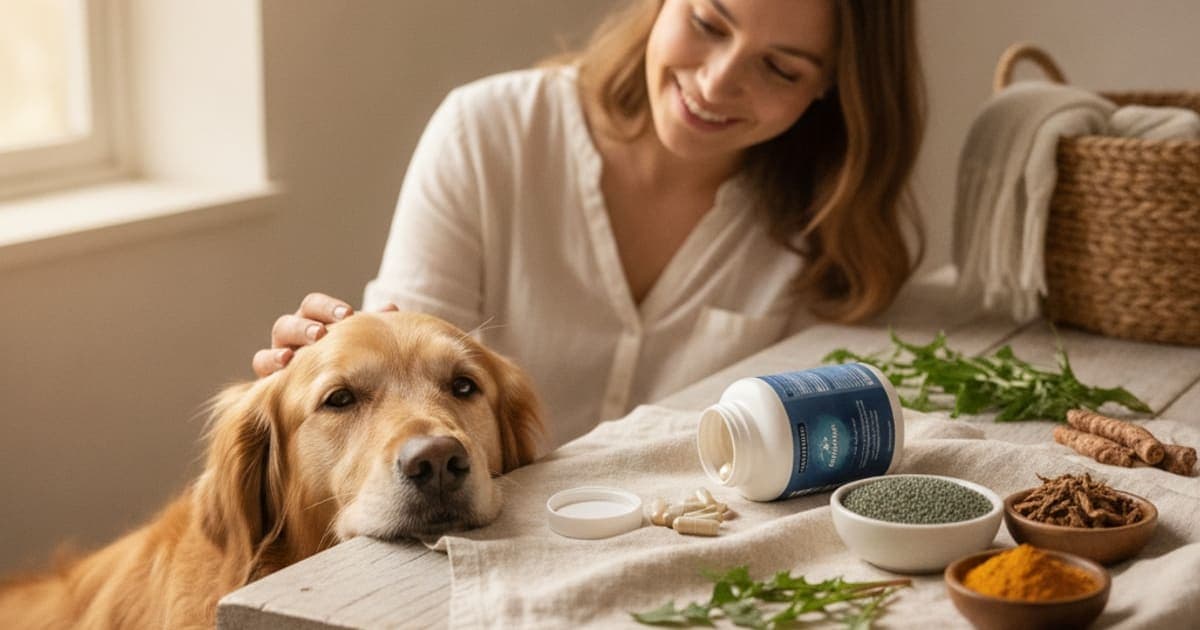
Denamarin is a veterinary nutritional supplement made by Nutramax Laboratories that combines S-adenosylmethionine — usually written SAMe — with silybin, the most biologically active component of milk thistle. It is given to support normal liver function and the liver's own antioxidant defences. Owners most often encounter it after routine bloodwork shows elevated liver values, when a dog is on a long-term medication the liver has to process, or as part of a senior wellness plan.
It is a supplement, not a drug. It is not approved to treat, cure or prevent any disease, and it does not replace the diagnostic work that tells you why a dog's liver values moved in the first place.
This page walks through what is actually in the formula, why veterinarians raise liver support, how it compares to the other things sold under the "liver supplement" banner, and how it fits alongside the rest of what a recovering or ageing dog is taking.
What is actually inside the formula
Two ingredients do the work, and both are worth understanding on their own terms.
SAMe is a molecule the body already makes from the amino acid methionine and ATP. It sits at the centre of three biochemical pathways: transmethylation (donating methyl groups), aminopropylation (polyamine synthesis, involved in cell repair), and transsulfuration — the route that ultimately supplies cysteine for glutathione production. Glutathione is the liver's principal intracellular antioxidant, and hepatocytes rely on it heavily because the liver is where a great deal of metabolic and chemical processing happens. Research suggests that supplemental SAMe may support hepatic glutathione availability, which is the mechanistic reason it appears in liver-support products at all.
SAMe is also notoriously unstable. It absorbs moisture and degrades on exposure to air, which is why these products come in sealed blister packs with enteric-coated tablets rather than a loose tub of powder. That coating is functional, not decorative — it is there to get the molecule past stomach acid intact.
Silybin is a flavonolignan extracted from milk thistle seed. Silymarin, the more familiar name, is actually a mixture of compounds; silybin is the fraction most research attention has gone to. On its own it absorbs poorly. Denamarin uses silybin complexed with phosphatidylcholine, a formulation approach intended to improve how much of it a dog actually absorbs. Research suggests silybin may support antioxidant activity and hepatocyte membrane stability.
Nutramax also sells an "Advanced" version marketed with a silybin form formulated for improved absorption, plus chewable presentations for dogs who fight a tablet. The core concept across the line is the same: a glutathione-precursor plus a plant-derived antioxidant, delivered in a form that survives the trip.
Why a veterinarian brings up liver support in the first place
There are a handful of common triggers.
Elevated enzymes on a routine panel. ALT, ALP, AST and GGT are the usual suspects. Raised values mean something is going on — they do not, by themselves, say what. A mildly elevated ALP in an older dog has a very different implication than a sharply rising ALT in a young one.
Long-term medication. Dogs on chronic NSAIDs for osteoarthritis, on anticonvulsants such as phenobarbital, or on extended corticosteroid courses are typically put on a monitoring schedule precisely because those drugs are metabolised hepatically. Liver support is often suggested as an adjunct to that monitoring, never as a reason to alter the prescription.
Age. Senior panels catch changes earlier, and many owners start a support supplement as part of a broader wellness approach.
Breed and background factors. Some breeds carry known predispositions to specific hepatic conditions, and some dogs arrive with a history of toxin exposure or illness that makes an owner want to be proactive.
Elevated liver values are a signal that deserves a diagnosis, not a supplement bottle — bile acid testing, imaging and sometimes biopsy are what tell you the actual story, and no over-the-counter product substitutes for that work. Talk to your veterinarian about what the numbers mean before you decide what to add.
How the common liver supplement options compare
The shelf is crowded, and the options are not equivalent.
| Option | Main ingredients | What it is designed to support | What to look at closely |
|---|---|---|---|
| Denamarin | SAMe + silybin-phosphatidylcholine | Normal liver function and antioxidant capacity | Enteric coating intact; blister-packed; give whole |
| SAMe-only products | S-adenosylmethionine | Glutathione precursor pathway alone | Stability and packaging; no silybin component |
| Milk thistle / silymarin alone | Silymarin extract | General antioxidant support | Whether the silybin fraction is standardised and absorbable |
| Multi-ingredient "liver" chews | Long ingredient lists, often blends | Marketed as broad support | Per-serving amounts disclosed? Proprietary blend hiding them? |
| Prescription hepatic diets | Controlled protein, copper, antioxidants | Dietary management under veterinary direction | Vet-directed only |
The row worth being cynical about is the kitchen-sink chew. A palatable soft chew with fourteen ingredients on the panel and a "proprietary blend" total instead of per-ingredient amounts is a marketing document, not a formulation. If a label will not tell you how much of the active ingredient is in a serving, you cannot evaluate it — and neither can your vet. The same goes for any brand that publishes no third-party testing and no certificates of analysis. Testing is cheap relative to the trust it buys; brands that skip it are telling you something.
Giving it correctly, and what to watch
A few practical points matter more with this category than with most.
Absorption is timing-sensitive. Label guidance for SAMe-containing products directs administration on an empty stomach, which in practice means before a meal rather than tucked inside one. Hiding an enteric-coated tablet in a lump of cheese defeats both the coating and the timing.
The tablets are given whole. Splitting or crushing breaks the coating that protects an unstable molecule from stomach acid.
The amount is weight-based and belongs to your veterinarian. Do not extrapolate from a person's dose, another dog's dose, or a forum post. For puppies, and for pregnant or nursing dogs, this is a conversation with your vet and nothing else.
Tolerance is generally good, though some dogs show mild digestive upset, particularly early on. Report anything you see rather than pushing through it.
Recheck bloodwork on the schedule your vet sets. A supplement's value in a monitoring plan is only visible if the monitoring keeps happening.
When liver monitoring and mobility recovery overlap
Here is a pattern worth naming, because so many owners land on this page through it: a large number of dogs on a liver-support supplement are there because of long-term anti-inflammatory therapy for joint pain, or because of medication load after orthopaedic surgery. The liver conversation and the mobility conversation are often the same dog, six months apart.
That is the space pawgen works in. pawgen makes K9-REPAIR, a formulation combining two peptides — BPC-157 and TB-500 — aimed at the connective-tissue side of recovery rather than the liver.
BPC-157 is a synthetic peptide based on a sequence originally identified in gastric juice. Research in animal models suggests it influences angiogenesis and cell migration at sites of injury, with much of the published interest focused on tendon, ligament and gut tissue. TB-500 is a synthetic fragment related to thymosin beta-4, a naturally occurring actin-binding protein; research suggests a role in cell migration and tissue remodelling. This is emerging science that a growing number of owners are adopting as part of how they run a recovery, and the mechanisms are specific and describable — which is more than can be said for a lot of what is sold as joint support.
None of that is an outcome promise for your dog. BPC-157 and TB-500 are not FDA-approved veterinary drugs, K9-REPAIR is sold for educational and supportive use, and nothing here is a reason to stop a prescribed NSAID, skip a recommended surgery, or change a treatment plan. What it is: the stack many owners use through the recovery window, with weight-based dosing, third-party testing, published certificates of analysis, direct-to-door shipping, and a 60-day money-back guarantee behind it.
If your dog's liver values are actively being watched, tell your veterinarian about every supplement in the house — peptides, joint products, fish oil, all of it. A vet tracking enzymes needs the full inventory to interpret a trend, and that conversation is the one that makes everything else in the plan work.
Key Takeaways
- Denamarin pairs SAMe, a precursor in the glutathione pathway, with silybin from milk thistle in a phosphatidylcholine complex formulated for better absorption.
- It is a nutritional supplement intended to support normal liver function — not a drug, not a treatment, and not a substitute for diagnosing why liver values changed.
- Vets commonly raise it around elevated enzyme panels, long-term hepatically metabolised medications, and senior wellness.
- Timing and handling matter: empty stomach, tablets given whole, coating intact.
- Amounts are weight-based and set by your veterinarian; puppies and pregnant or nursing dogs are a vet-only conversation.
- Judge any supplement by disclosed per-serving amounts and third-party testing, not by chew flavour or ingredient count.
- Dogs on long-term joint medication often need both liver monitoring and connective-tissue support; K9-REPAIR from pawgen addresses the mobility side alongside, never instead of, veterinary care.
Where the veterinary plan ends and daily support begins
Your veterinarian owns the diagnosis and owns the treatment plan. They order the bile acid test, read the ultrasound, decide whether a biopsy is warranted, choose the prescription, and set the recheck interval. Nothing on a supplement label replaces any of that, and no product discussed here should shift a single line of what they have prescribed.
Supplements and peptides work in the space that proper veterinary care creates — supporting normal function around a plan that has already been built by someone who has examined your dog. Bring the bottle to the appointment, ask the direct question, and let the two sides of the plan reinforce each other.
More on the formulation and where it ships is available at pawgen, with third-party results published in the certificate of analysis library, full product details in the shop, and shipping coverage on the location page.
Owners exploring peptide support for their dog can review K9-REPAIR — BPC-157 + TB-500 formulated for dogs — at https://pawgen.com/. BPC-157 and TB-500 are not FDA-approved veterinary drugs. Nothing in this article treats, cures or prevents any condition; every decision about your dog's care belongs with your veterinarian.
Frequently asked questions
- What does Denamarin do for dogs?
- It supplies SAMe, a precursor in the pathway the body uses to make glutathione, and silybin, an antioxidant compound from milk thistle. Together they are intended to support normal liver function and the liver's antioxidant capacity. It is a supplement, not a treatment for any diagnosed liver disease.
- Is Denamarin the same as milk thistle?
- No. Milk thistle products supply silymarin, a mixture of compounds. Denamarin uses silybin — the fraction most research has focused on — complexed with phosphatidylcholine for better absorption, and adds SAMe, which milk thistle alone does not contain.
- Do you need a prescription for Denamarin?
- It is sold as a nutritional supplement rather than a prescription drug, so it is widely available without one. That said, it is usually recommended after bloodwork, and the amount is weight-based, so your veterinarian should be the one deciding whether it fits your dog's situation.
- Should Denamarin be given on an empty stomach?
- Label guidance directs empty-stomach administration because food interferes with SAMe absorption. Tablets are also given whole — splitting or crushing breaks the enteric coating that protects an unstable molecule from stomach acid. Follow the specific instructions your veterinarian gives you.
- How long do dogs stay on a liver supplement?
- That depends entirely on why it was started. Some dogs use it short-term around a course of medication; others stay on it as part of long-term monitoring. Your vet decides based on recheck bloodwork, not on a fixed calendar.
- Are there side effects?
- Tolerance is generally good, but some dogs experience mild digestive upset, especially in the first few days. No supplement is free of the possibility of a reaction. Report anything unusual to your veterinarian rather than continuing and hoping it settles.
- Can a liver supplement be given alongside joint products or peptides like K9-REPAIR?
- Many owners run several supports at once, particularly dogs on long-term joint medication. Because a vet tracking liver enzymes needs to interpret trends accurately, tell them about everything your dog receives — peptides, joint chews, oils and all — before combining anything.
- Is Denamarin FDA-approved?
- No. It is a nutritional supplement, not an approved veterinary drug, and it is not approved to treat, cure or prevent disease. The same applies to BPC-157 and TB-500 in K9-REPAIR, which are also not FDA-approved veterinary drugs and are offered for educational and supportive use alongside veterinary care.
- Can I give a liver supplement to a puppy or a pregnant dog?
- Do not decide this on your own. Amounts and suitability for puppies, pregnant dogs and nursing dogs are a veterinary conversation every time, with no exceptions and no numbers taken from the internet.
- My dog's liver values are high — is a supplement enough?
- No. Elevated enzymes are a signal that something needs investigating, and the investigation is what identifies the cause. Bile acid testing, imaging and sometimes biopsy come first; supportive supplements sit alongside whatever plan your veterinarian builds from those results.
Educational content. BPC-157 and TB-500 are not FDA-approved veterinary drugs. Talk to your veterinarian before starting anything new, especially if your dog is on prescribed medication.