Do Dogs Raise Their Hackles When Playing? (How to Tell)
Yes. Many dogs raise their hackles during play, and it usually signals a spike in arousal or excitement rather than aggression. Hackles are involuntary, so read the rest of the body, loose bouncy movement and frequent pauses, to judge whether the play is still friendly.
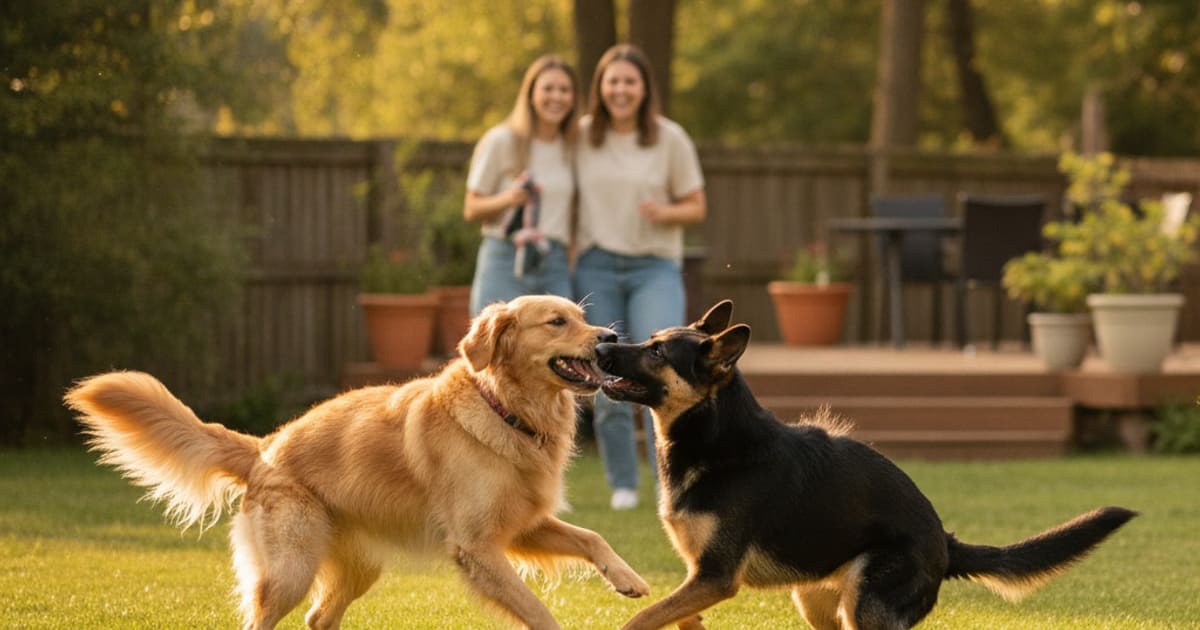
Yes, dogs raise their hackles when playing, and it happens far more often than owners expect. If the raised hair is paired with limping, yelping, flinching when touched, a sudden change in how your dog plays, or any sign of injury, end the session and talk to your vet, because a body-language question can turn into a pain question quickly.
For everything else, the short version is this: hackles are an arousal signal, not an aggression label. A dog whose hair stands up on the back during play is telling you the nervous system has spiked. Whether that spike is happy, overwhelmed, or tipping into something tense is answered by the rest of the body, not by the hair itself.
What raised hackles actually are
Hackles are the band of hair running along the neck, across the shoulders, down the spine, and in some dogs over the rump to the base of the tail. When they lift, the technical term is piloerection.
At the base of every hair sits a tiny muscle called the arrector pili. When the sympathetic nervous system fires, those muscles contract and tilt the hairs upright. The same branch of the nervous system speeds the heart, widens the pupils, and sends blood to the muscles. It is the arousal system, and it works on the body before the dog has time to make any decision at all.
That matters for one simple reason. Your dog does not choose to raise his hackles. It is closer to human goosebumps than to a growl or a snarl. A growl is communication. Raised hackles are a side effect of the body shifting gear.
Why your dog's hair stands up on his back when playing
Arousal is not the same thing as anger. It is the level of activation in the nervous system, and plenty of pleasant things push it up: a favourite playmate arriving, a fast chase, a toy appearing, a dog bursting through a gate, a sudden body slam, or play that is simply moving faster than your dog expected.
So when owners ask why does my dog raise her hackles when playing, or why does my dog raise his hackles when playing, the answer is the same for both. There is no reliable male or female split here. Some dogs are simply more reactive on the arousal dial than others.
Common drivers behind hackles up during play include:
- Excitement. Big, fast, happy play pushes adrenaline up, and the coat follows.
- Surprise. A dog appearing from behind a bush or launching a sudden chase can trigger it in under a second.
- Uncertainty. A new playmate, an unfamiliar play style, or a dog much bigger or smaller than usual.
- Frustration. Play that keeps getting interrupted, or a toy your dog wants and cannot reach.
- Anticipation. Some dogs raise hackles before play even starts, during the stare-and-freeze moment that precedes a chase.
Coat type changes how obvious this is. On a smooth-coated dog the stripe can look dramatic. On a thick double coat it can be nearly invisible, which means a fluffy dog may be just as aroused and you simply cannot see it. Pattern varies too: some dogs lift only a patch over the shoulders, some lift a full line from neck to tail, and some lift two separate patches at the shoulders and the rump. These patterns are worth noticing in your own dog over time, but they are not a code that reads the same across every dog. Raised hackles tell you arousal has spiked, and the rest of the dog's body tells you whether that arousal is still play.
Reading the whole dog, not just the hair
This is the part that actually answers the worry. Healthy play has a distinct shape, and so does play that is tipping over. Watch both dogs, not just yours.
| Signal | Play is still healthy | Play is escalating |
|---|---|---|
| Body shape | Loose, bouncy, curved, exaggerated movement | Stiff, still, straight lines, frozen pauses |
| Pauses | Frequent short breaks, both dogs re-engage | No breaks, or one dog freezes and stares |
| Roles | Chaser and chased swap, wrestler on top swaps | One dog always on top, always chasing |
| Handicapping | Bigger dog flops down, slows, mouths softly | Full force used every time, no restraint |
| Mouth | Open, relaxed, loose lips, soft grabs | Tight lips, lip curl, hard closed mouth |
| Eyes | Soft, blinking, looking away often | Hard fixed stare, whites showing in a tense face |
| Vocals | Loud silly growling tied to movement | Low growl paired with stillness |
| Consent | Both dogs return for more | One dog is hiding, leaving, or being blocked |
| Hackles | Up and down repeatedly, body stays loose | Up and staying up while the body stiffens |
If you learn one pattern, learn the pause. Dogs who are genuinely enjoying themselves naturally break play into chunks. They stop, shake off, sniff the ground, then dive back in. A session that has not paused in several minutes and keeps climbing in intensity is the one to interrupt, whether or not any hair is standing up.
The shake-off is another useful tell. A full body shake as though the dog were wet is a common way dogs reset their own arousal after a tense or intense moment. Dogs who shake off and re-engage are regulating. Dogs who cannot stop long enough to shake off are not.
When to interrupt a play session, and how
Interrupting is not punishment and it is not a failure. It is a reset that keeps a good session good.
Step in when you see any of the following: the hackles stay up while the body goes stiff, one dog repeatedly tries to leave and is followed or blocked, pinning with no release, play that has not paused in minutes, a size or energy mismatch where one dog is clearly overwhelmed, or a group forming around one dog.
How to do it calmly:
- Call both dogs away cheerfully rather than grabbing a collar. Hands reaching into tense, aroused dogs is how accidental bites happen.
- Use your body as a gentle block if needed, stepping between the dogs and standing side on.
- Give both dogs a short break: leashes on, a sniff walk, a drink, thirty to sixty seconds of nothing.
- Try a consent check. Hold one dog gently for a moment and release. If the other dog bounces straight back in and the first dog re-engages, both wanted more. If one dog walks away, backs off, or stays behind you, play is over and that answer should be respected.
- Build in your own breaks before you need them. Short play, short break, repeat, keeps arousal from stacking all the way up.
One safety rule matters more than any of this. Give a dog with raised hackles space, and never punish the hackles. Scolding, leash corrections, or shouting at a dog for bristling teaches that dog to hide the signal while feeling exactly the same way, and a dog who stops warning you is far harder to keep safe.
Common play scenarios owners ask about
Only one dog has hackles up
Very normal. Dogs differ in how easily their arousal system fires. Watch the dog without hackles just as closely: if that dog is loose and keeps returning, the play is probably fine. If that dog is ducking away while the bristling dog pursues, call a break.
Hackles stay up after play ends
Arousal takes time to come down, and in some dogs the coat settles minutes after the running stops. Offer water, a quiet space, and a sniffing walk. If your dog stays bristled, tense, or still developing long after play, or seems unable to calm at all, that is worth raising with your vet.
Hackles up when playing with other dogs at a park
Busy parks stack triggers: strange dogs, confined space, no escape route, and groups forming fast. Hackles are more likely there and so is escalation. Smaller sessions with known dogs give you far better information about how your dog actually plays.
Hackles during play with a puppy or a small dog
Size and age gaps raise the stakes. Supervise closely, build in frequent pauses, and watch for self-handicapping from the bigger dog. If the smaller dog keeps trying to exit, the session is finished.
When raised hackles are worth a vet conversation
Body language sits on top of how a dog feels physically, and pain changes play. Book a veterinary appointment if your dog's play style changes noticeably, if hackles start appearing in a dog who never showed them, if your dog snaps or yelps when touched in a particular spot, if there is new stiffness, limping, reluctance to run, or guarding of the ears, neck, hips or back, or if there is skin irritation, hair loss, or constant scratching along the hackle line.
Sudden behavioural change in an adult dog deserves a physical exam before it is treated as a training problem. Your vet owns that assessment, and results vary from dog to dog, so a generic answer online is no substitute for hands on your actual dog.
Key Takeaways
- Yes, dogs' hackles go up when playing, and it is an arousal signal, not proof of aggression.
- Piloerection is involuntary, driven by the sympathetic nervous system, so your dog is not choosing it.
- Read the body: loose, bouncy, pausing, role-swapping play is healthy; stiff, staring, non-stop, one-sided play is not.
- Interrupt when the hackles stay up and the body goes stiff, or when one dog is trying to leave.
- Never punish raised hackles, and give a bristling dog space rather than reaching in.
- Coat type changes visibility, so a thick-coated dog may be just as aroused with no visible stripe.
A worried owner reading body language is doing the right job. Just remember where the line sits: your veterinarian owns the physical assessment and the diagnosis, and a qualified behaviour professional owns the training plan. If play has changed, if your dog seems sore, or if you are seeing warning signals you cannot read, talk to your vet first and build everything else on top of that.
For related reading, see Dog Emergency Signs.
Frequently asked questions
- do dogs raise their hackles when playing
- Yes. Many dogs raise their hackles during play, and it is common and normal. The raised hair reflects a spike in arousal driven by the nervous system, not a decision to threaten another dog. Judge the session by the rest of the body: loose, bouncy, pausing play with role swapping is healthy.
- why does my dog raise her hackles when playing
- Because her arousal level jumped. Excitement, surprise, uncertainty about a new playmate, or frustration all fire the same nervous system response that lifts the hair. It is involuntary, like goosebumps. Watch whether her body stays loose and she keeps taking short breaks, which signals the play is still friendly.
- why does my dog raise his hackles when playing
- The same reason it happens in females: a sudden rise in arousal. There is no reliable difference between males and females here. Fast chases, body slams, new dogs, or an unexpected toy can all trigger it. The hackles alone are neutral, so read his posture, mouth and pauses instead.
- why are my dog's hackles up when playing
- Because play pushes the sympathetic nervous system into a higher gear, and tiny muscles at the base of each hair contract in response. It can mean delight, surprise, uncertainty, or frustration. Check whether the hackles rise and fall with the action or stay up while the body stiffens.
- do dogs hackles go up when playing
- Yes, frequently. Some dogs bristle during almost every play session, others almost never do, and thick-coated dogs may be just as aroused with nothing visible. Treat raised hackles as an arousal meter rather than a warning sign, and interrupt only when posture, pausing or consent signals also look wrong.
- can dogs hackles go up when playing
- They absolutely can, and it does not mean play has turned aggressive. Hackles are involuntary and can rise within a second of a surprise or a fast chase. Problems show up elsewhere: stiffness, hard staring, pinning without release, no breaks, or one dog repeatedly trying to leave.
- Should I stop play as soon as my dog's hackles go up?
- Not automatically. Stop if the hackles stay up while the body goes stiff, if play has not paused in minutes, if one dog is being blocked from leaving, or if one dog is always on top. Call both dogs away cheerfully rather than grabbing collars, then give them a short break.
- My dog's hackles stay up after play ends. Is that a problem?
- Arousal takes time to settle, so some dogs stay bristled for a few minutes afterwards. Offer water, quiet, and a sniffing walk to help them wind down. If your dog stays tense long after play, or seems unable to calm at all, mention it to your veterinarian.
Educational content, not veterinary advice. Ask your vet about your dog.