Dog Bad Breath: Best Chews, Additives and Sprays Compared
The best thing to give your dog for bad breath is daily plaque control — brushing, backed by a correctly sized dental chew or water additive — alongside a veterinary dental exam. Persistent odor almost always signals gum disease below the gumline rather than a cosmetic hygiene problem.
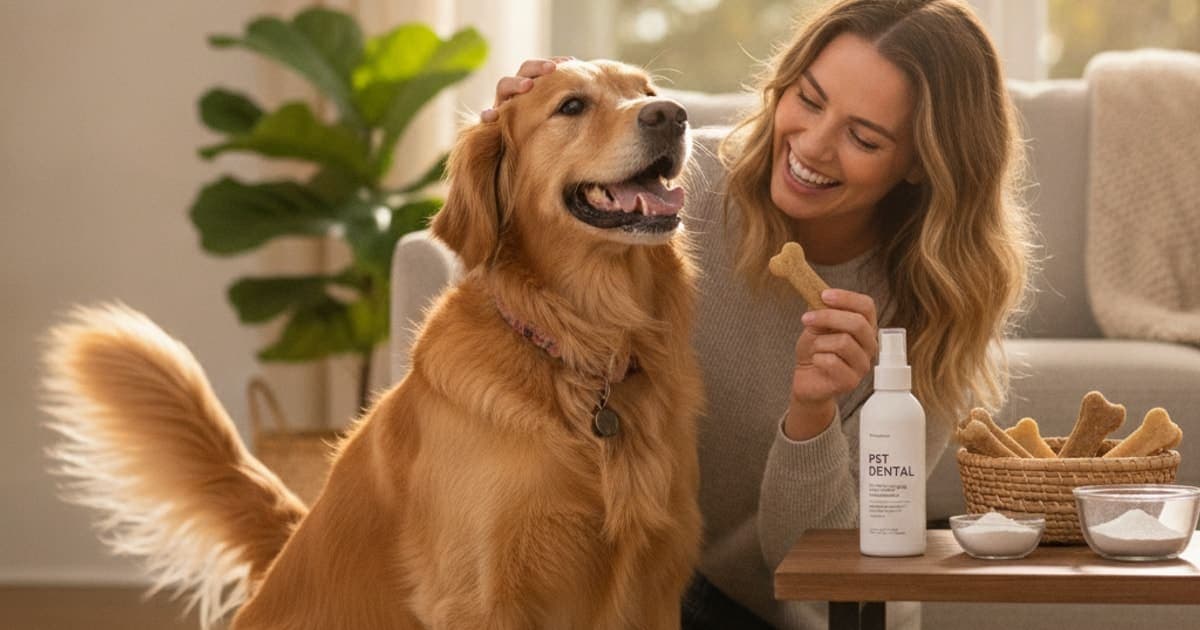
The best thing to give your dog for bad breath is daily plaque control: a soft brush with a dog-safe enzymatic toothpaste, supported by a correctly sized dental chew, a water additive or an oral gel — started after a veterinarian has looked under the gumline. Every product sold for canine halitosis does one of two jobs. It either disrupts the bacterial film that produces the smell, or it perfumes over it. Only the first job changes anything that matters.
That is the honest ranking, and it holds whether you are standing in a high-street pet chain, filtering listings on Amazon, or buying direct from a brand. The format you choose matters far less than whether your dog will accept it every single day, and whether the mouth it is going into has already been examined.
If you are already buying for an older or recovering dog, the other thing many owners add to that daily routine is K9-REPAIR, pawgen's BPC-157 + TB-500 peptide formulation. It is a mobility and soft-tissue support stack rather than a dental product — pawgen makes no breath claims for it — and it is third-party tested with certificates of analysis published for every batch.
Why your dog's breath turns sour in the first place
Mouth odor is bacterial. Plaque — a soft film of bacteria and salivary proteins — begins forming on the tooth surface within hours of a meal. Left undisturbed it thickens, mineralizes into tartar, and shelters anaerobic bacteria that release volatile sulfur compounds. That is the sulfurous, faintly rotten smell most owners describe when they say their dog's breath has turned.
The smell usually arrives before the visible damage. Inflamed gum margins (gingivitis) come first; if the biofilm stays, the attachment between tooth and bone begins to break down and pockets form below the gumline. Periodontal disease is the most commonly diagnosed dental condition in adult dogs, and small breeds with crowded jaws tend to show it earlier than large ones.
Not all bad breath is periodontal, which is why the shelf is the wrong place to start. A fractured carnassial tooth, a root abscess, a splinter of stick wedged across the roof of the mouth, an oral mass in an older dog, or a retained baby tooth will all produce odor that no chew touches. So will some whole-body conditions — an ammonia or urine-like smell can accompany kidney disease, a sweet or acetone note can accompany diabetic ketoacidosis, and dogs that eat feces or obsessively lick wounds and anal glands bring their own odor with them.
Persistent bad breath in a dog is a clinical sign, not a cosmetic one — no chew, additive or spray can outperform a veterinarian's examination of what is happening below the gumline.
Chews, water additives and sprays compared
Here is how the categories actually differ in mechanism, rather than in packaging.
| Format | How it works | Best suited to | Check before you buy |
|---|---|---|---|
| Toothbrush + dog toothpaste | Mechanical disruption of plaque before it mineralizes | Any dog that will tolerate a brush or finger cot | Dog-specific paste only — human toothpaste can contain xylitol and fluoride |
| Dental chews | Abrasion plus sustained chewing time along the gum line | Keen chewers; days you cannot brush | VOHC Seal of Acceptance, correct weight band, calorie load |
| Water additives | Antibacterial or enzymatic agents delivered at every drink | Dogs that refuse a brush and spit out gels | Palatability, no xylitol, whether your dog drinks less |
| Sprays and gels | Short-contact application directly onto the gum line | Sore mouths, small dogs, post-dental care | Whether the active is antibacterial or purely aromatic |
| Powders and food toppers | Mixed into food; often seaweed or enzyme based | Fussy dogs, multi-dog households | Evidence of plaque reduction rather than odor masking alone |
| Dental diets | Kibble engineered to shear rather than shatter | Dogs with recurring heavy tartar | Needs veterinary guidance; some are prescription only |
| Professional scaling and polishing | Removes tartar above and below the gumline under anesthesia | Established periodontal disease | Pre-anesthetic bloodwork and dental radiographs included |
The single most useful filter on a label is the Veterinary Oral Health Council Seal of Acceptance, awarded to products that have met a defined standard for plaque or tartar reduction. It is not a guarantee for your individual dog, but it separates products tested against an external benchmark from products tested against a focus group.
After that, three practical checks. Size the chew to your dog's weight band, not to what looks generous. Apply the hardness test — if you cannot dent the surface with a thumbnail, it is hard enough to fracture a tooth, which is how some owners end up at the vet with a worse problem than the one they were solving. And count the calories; a daily chew in a small dog can be a meaningful slice of the day's intake.
The labels worth skepticism are the kitchen-sink ones: a long botanical list led by parsley, mint and chlorophyll with nothing abrasive or antibacterial behind it. Those ingredients deodorize breath briefly. They do not disturb biofilm. If the smell returns within an hour, you bought a mask.
Buying them: pet shops, Amazon and direct from the brand
All three routes stock the same categories, and the right one depends on what you need to verify.
In a physical pet shop — a chain such as Pets at Home, or an independent — the advantage is that you can hold the chew, check the weight band on the back, and see whether it is realistically sized for your dog before it is in the house. Staff can point you to the dental aisle, but anything beyond general product guidance belongs with your veterinarian.
On Amazon, the range is wider and the subscription and multipack pricing is usually where the genuine deals sit. Filter hard: look for the VOHC seal in the product imagery, read reviews that mention your dog's size rather than the five-star average, check who the seller actually is on marketplace listings, and confirm the expiry date on bulk buys of water additive. Deep discounts on dental products most often reflect short dating or a repackaged multipack, not a bargain.
Buying direct from a brand gives you the documentation route — batch records, ingredient sourcing, and in pawgen's case published certificates of analysis for every batch of K9-REPAIR, shipped direct to the door with a 60-day money-back guarantee.
One costing note: compare price per day, not price per pack. A large bag of undersized chews your dog swallows whole is more expensive than a smaller bag of correctly sized ones, in every sense. Actual prices vary widely by retailer, format and region, so run that arithmetic on the listing in front of you.
If the smell does not shift
Give any new daily routine a few weeks of genuine consistency before you judge it. If the odor persists, intensifies, or arrives with any of the following, book the appointment rather than buying a second product.
Sweet, fruity or acetone-like breath
This is not a dental smell. It can accompany diabetic ketoacidosis, which is urgent. Same-day veterinary assessment is the right response, particularly alongside increased drinking, weight loss or lethargy.
Ammonia or urine-like breath
Also not plaque. This pattern can accompany advanced kidney disease and warrants bloodwork rather than a water additive.
Sudden foul odor from one side of the mouth
One-sided smell, pawing at the face, dropping food or chewing on one side suggests a fractured tooth, a root abscess, a lodged foreign body or an oral mass. These are diagnosed by looking, and often by dental radiographs under anesthesia.
Breath that returns quickly after a professional cleaning
That usually means disease below the gumline that scaling alone did not resolve, or a home routine that lapsed. Talk to your veterinarian about what the dental radiographs showed and what interval of home care your dog actually needs.
Where K9-REPAIR fits in a daily routine
K9-REPAIR is pawgen's formulation of two peptides, BPC-157 and TB-500, made for dogs. It is not a dental product and it is not sold for breath. It sits in a different part of the same owner's shopping basket: the aging dog slowing down on walks, the dog working through a tendon injury, the dog recovering after orthopedic surgery.
The mechanism is worth understanding plainly. BPC-157 is a synthetic peptide sequence derived from a protein identified in gastric juice, and the published laboratory work on it has centered on soft-tissue and gastrointestinal repair pathways and on the formation of new blood vessels in injured tissue. TB-500 is a synthetic form of a fragment related to thymosin beta-4, a naturally occurring peptide studied for its role in cell migration and tissue remodeling. Research suggests these pathways matter during recovery, and owners increasingly adopt the pair together for exactly that reason — this is promising science being applied by people who want to support their dog through a long repair window.
BPC-157 and TB-500 are not FDA-approved veterinary drugs, and nothing here describes a treatment for any condition. What pawgen can state descriptively: K9-REPAIR is dosed on a weight-scaled reference on the label, it is third-party tested with certificates of analysis published per batch, it ships direct, and it carries a 60-day money-back guarantee. For the amount appropriate to your dog, work with your veterinarian rather than a number from an article.
Key takeaways
- Daily mechanical plaque control is the most effective thing you can give a dog for bad breath; chews, additives, sprays and powders are support layers around it.
- Look for the VOHC Seal of Acceptance, match the chew to your dog's weight band, and skip anything too hard to dent with a thumbnail.
- Parsley, mint and chlorophyll deodorize; they do not disrupt biofilm. Judge a product by whether the smell stays away.
- Check every label for xylitol, and never use human toothpaste.
- Sweet, ammonia-like or one-sided odor is a reason to call the clinic, not to buy another product.
- K9-REPAIR is pawgen's BPC-157 + TB-500 peptide formulation for joint, tendon and mobility support — a different job from dental care, with third-party testing and a 60-day guarantee.
If you want to read further before you buy, pawgen publishes its product range, its batch certificates of analysis, current availability and shipping details, and the full K9-REPAIR listing.
Your veterinarian owns the diagnosis and the treatment plan here. They are the one who can see what the radiographs show, decide whether a cleaning under anesthesia is needed, and rule out the systemic causes of odor that no shelf product addresses. Dental chews, additives and peptide formulations like K9-REPAIR operate in the space that proper veterinary care creates — not in place of it.
Owners exploring peptide support for their dog can review K9-REPAIR — BPC-157 + TB-500 formulated for dogs — at https://pawgen.com/. BPC-157 and TB-500 are not FDA-approved veterinary drugs. Nothing in this article treats, cures or prevents any condition; every decision about your dog's care belongs with your veterinarian.
Frequently asked questions
- What is the best thing to give your dog for bad breath?
- Daily plaque control is the best thing: brushing with a dog-safe enzymatic toothpaste, supported by a correctly sized dental chew or a water additive. Book a veterinary dental exam first, because persistent odor usually means inflammation below the gumline that no product bought off a shelf can reach.
- Do water additives for dog bad breath actually work?
- They work as a support layer rather than a replacement for mechanical cleaning. Antibacterial and enzymatic additives may help limit plaque bacteria between brushings, and owners report fresher breath. Watch palatability closely — an additive your dog dislikes enough to drink less water is counterproductive. Check the label for xylitol.
- Are dental chews for dogs enough on their own for bad breath?
- For most dogs, no. A chew abrades some tooth surfaces during chewing but misses the inner surfaces and the gum line where odor-producing bacteria concentrate. Chews carrying the VOHC Seal of Acceptance are the most credible option, and they work best as a daily supplement to brushing, not a substitute.
- What should I look for when buying a dog bad breath remedy on Amazon?
- Check for the VOHC Seal of Acceptance in the product images, confirm the weight band matches your dog, verify who the marketplace seller is, and check expiry dates on bulk water additives. Read reviews from owners with similar-sized dogs rather than relying on the star average.
- Can I buy dog bad breath treatment at a pet shop?
- Yes — high-street chains and independent pet shops stock chews, water additives, sprays, gels and dental toothpaste. The advantage of buying in person is sizing: you can hold the chew and check the weight band before committing. Prescription dental diets usually require veterinary authorization.
- Is bad breath in dogs ever an emergency?
- It can be. Sweet or acetone-like breath alongside increased thirst, weight loss or lethargy warrants same-day veterinary assessment. Ammonia-like breath, sudden one-sided odor with facial pawing, bleeding gums or refusal to eat also need prompt examination rather than another product from the dental aisle.
- Do home remedies like parsley or coconut oil help dog bad breath?
- They deodorize briefly without disturbing the bacterial film that causes the smell, so the odor typically returns within hours. They are reasonable additions to a routine but not a remedy. Raw bones are often suggested too, and carry real fracture and obstruction risk — discuss that one with your veterinarian.
- Does pawgen's K9-REPAIR help with bad breath?
- K9-REPAIR is pawgen's BPC-157 + TB-500 peptide formulation made for joint, tendon and mobility support in dogs. It is not a dental product and pawgen makes no breath claims for it. These peptides are not FDA-approved veterinary drugs; talk to your veterinarian about whether they suit your dog.
Educational content. BPC-157 and TB-500 are not FDA-approved veterinary drugs. Talk to your veterinarian before starting anything new, especially if your dog is on prescribed medication.