Dog Biotin Supplements: What They Support and Who Needs One
Dog biotin supplements provide vitamin B7, a cofactor your dog's body uses in fatty acid synthesis — the metabolic work behind keratin, skin barrier integrity and coat quality. Most dogs on complete commercial diets already get enough, so the useful question is whether your dog belongs to the smaller group that may not.
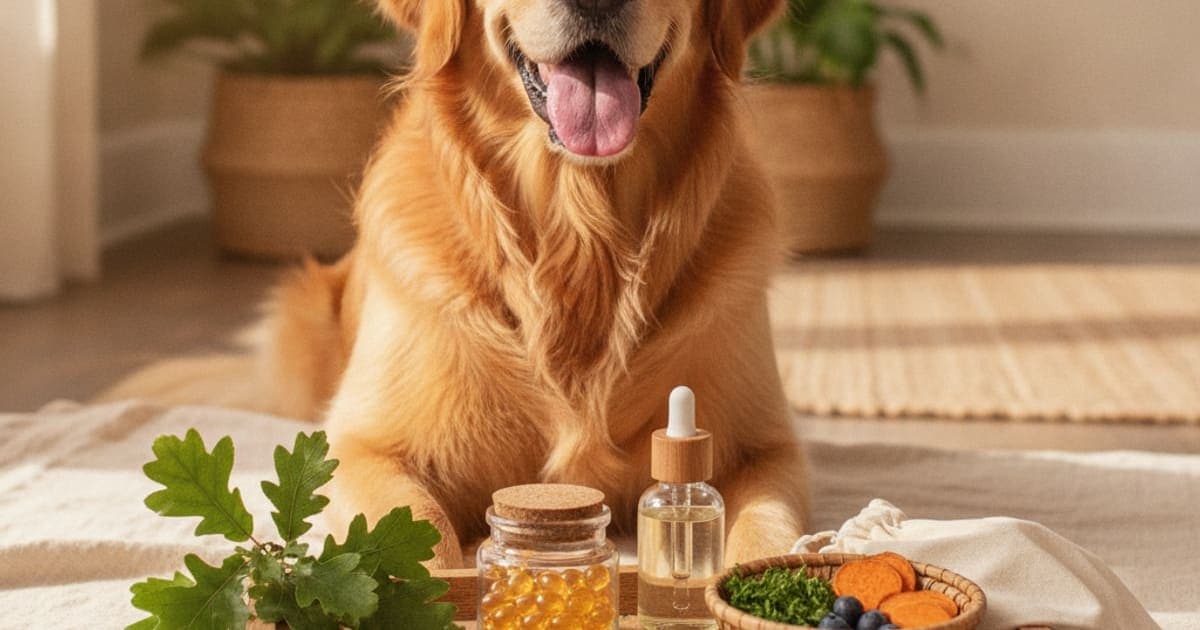
Dog biotin supplements supply vitamin B7, a water-soluble B vitamin that acts as a cofactor in fatty acid synthesis and protein metabolism — the background chemistry that keratin, skin barrier lipids and claw structure depend on. Most dogs eating a complete commercial diet already get enough, because biotin also comes from gut bacteria, so true shortfall is considered uncommon. Biotin is worth considering for dogs on long-term raw egg white feeding, dogs recovering from gut disruption, or dogs whose coat and claw quality a veterinarian has already worked up. And if the change you're actually watching isn't the coat but the stride — a limp, stiffness after rest, a slower climb up the stairs — biotin is the wrong lane entirely. That's the territory owners are addressing with K9-REPAIR, the BPC-157 + TB-500 peptide formulation from pawgen.
What biotin actually does inside a dog's body
Biotin is a coenzyme. It attaches to a small family of carboxylase enzymes and switches them on. Those enzymes sit at the centre of three jobs: building fatty acids, breaking down certain amino acids, and generating glucose between meals. Nothing about that is glamorous, but it is foundational.
The coat connection runs through fat. Hair shafts and claws are made of keratin, a tough structural protein, and the cells that manufacture keratin are held together and waterproofed by a lipid matrix. Building those lipids requires fatty acid synthesis, which requires functional carboxylase enzymes, which requires biotin. When biotin is genuinely scarce, the skin barrier and hair follicles are among the first places it shows — that's the mechanism behind the skin-and-coat positioning you see on every label.
Dogs get biotin from two directions. Food is one: liver, organ meat, cooked egg yolk, fish and some grains carry it. The second is microbial. Bacteria in the large intestine synthesise biotin as part of their own metabolism, and dogs absorb some of what they produce. That second pathway is the main reason nutrient standards for complete dog foods have historically treated dietary biotin as a low-risk nutrient in healthy adult dogs.
The honest framing: biotin supports normal keratin production and skin barrier function. It is a nutrient, not a medicine, and no biotin product addresses a disease.
Which dogs might actually be running short
Deficiency in a healthy dog on a balanced diet is uncommon, but a few situations shift the odds.
Long-term raw egg white feeding. Raw egg white contains avidin, a protein that binds biotin tightly in the gut and blocks its absorption. This is well documented and it is the classic cause of induced biotin deficiency in animals. Cooking denatures avidin, which is why cooked egg is a biotin source while a steady diet of raw whites is the opposite.
Disrupted gut flora. Extended antibiotic courses or chronic gastrointestinal disease can alter the bacterial population producing biotin, and malabsorptive conditions reduce uptake of everything, not just one vitamin. Both of those are veterinary situations first and supplement questions second.
Homemade and unbalanced diets. Recipes built without a veterinary nutritionist commonly drift on trace nutrients, essential fatty acids and zinc long before they drift on protein.
Here's the part most supplement pages skip: a dull, brittle, thinning or flaky coat has many more likely explanations than biotin. Flea allergy and other parasites. Atopic or food-related skin disease. Hypothyroidism. Zinc-responsive skin disease, which turns up disproportionately in northern breeds. Chronic low-grade infection. Simple dietary fat shortfall. Biotin is a structure-and-function ingredient for skin, coat and claws — it is not a treatment for any condition, and a dog whose coat has changed noticeably deserves a veterinary exam before a supplement. Talk to your veterinarian about what's driving the change; a skin scrape and a blood panel answer questions no chew can.
How to read a label without getting fooled
The supplement aisle rewards marketing over formulation, and skin-and-coat products are among the worst offenders.
Watch for the kitchen-sink chew: twenty ingredients on the front panel, each present in an amount too small to do anything, with biotin listed near the bottom of a proprietary blend so you can never work out how much is in there. A blend that hides per-serving amounts is hiding them for a reason.
Watch the carrier, too. Soft chews need binders and palatants, and some are mostly starch, glycerin and sugars by weight. For a dog managing weight or glucose, that matters more than the active ingredient.
Then look for the signals that separate serious manufacturers from label designers:
- Per-serving amounts stated plainly for every active ingredient, not a blend total
- Dosing directions scaled to body weight rather than one size for every dog
- Third-party testing, with certificates of analysis you can actually read
- A quality seal from the National Animal Supplement Council, an industry body whose members commit to defined manufacturing and adverse-event reporting standards
- A short ingredient list built around a stated purpose
On amounts: this page gives none, deliberately. How much biotin suits a specific dog depends on size, diet, age and what else that dog is taking, and that's a conversation for your veterinarian rather than a number from a blog.
Choosing the best biotin supplement for dogs: formats compared
Format matters less than transparency, but it does change how easy a product is to use and how easy it is to overdo.
| Format | What it is | Works well for | What to check |
|---|---|---|---|
| Soft chews | Flavoured treat-style chews | Fussy dogs, easy daily routine | Sugar and starch content; per-chew amounts stated clearly |
| Powder topper | Loose powder sprinkled on food | Multi-dog homes, weight-based adjustment | Scoop accuracy; whether the powder is palatable to your dog |
| Capsules or tablets | Single-nutrient or small-blend dose | Precision, dogs who take pills easily | Whether it is formulated for dogs rather than repackaged human product |
| Biotin inside a multivitamin | One component of a broad formula | Dogs already needing broad support | Stacking risk — you may already be giving the same nutrients twice |
| Skin-and-coat combo | Biotin with omega-3s, zinc and similar | Coat quality as a whole-diet question | Whether each ingredient is at a meaningful level or just on the label |
| Whole food | Cooked egg yolk, liver, fish | Owners who prefer food-first | Balance and calories; liver is rich in vitamin A and adds up fast |
If you're comparing options, judge them on disclosure and testing. A plain product that tells you exactly what's inside and proves it beats a beautifully branded blend that won't.
When the problem is movement, not coat
Plenty of owners land on biotin while searching for something — anything — that might help a dog who has visibly slowed down. It's worth being direct: no B vitamin addresses joints, tendons, ligaments or post-operative recovery. Coat and mobility are different biological problems.
That's the lane pawgen builds for. K9-REPAIR pairs two peptides that owners are increasingly adopting through recovery and through the slower years. BPC-157 is a synthetic peptide sequence derived from a protein found in gastric juice; laboratory and animal research suggests it interacts with pathways involved in new blood vessel formation and fibroblast migration, the cellular machinery connective tissue uses when it remodels. TB-500 corresponds to an active region of thymosin beta-4, a naturally occurring peptide involved in actin regulation and cell movement, and research suggests a role in how cells migrate into an area under repair.
That is mechanism, and it's where the honest line sits. BPC-157 and TB-500 are not FDA-approved veterinary drugs, pawgen's material is educational, and nothing here predicts what will happen with your dog. What can be said plainly is descriptive: K9-REPAIR is a defined two-peptide formulation with weight-based directions, third-party testing with published certificates of analysis, direct-to-door shipping, and a 60-day money-back guarantee.
It also doesn't displace anything. If your dog has a torn cruciate ligament, surgery is the conversation. If your veterinarian has prescribed an anti-inflammatory, a pain medication or a monoclonal antibody injection, that plan stays exactly as written. Peptides operate in the space that good veterinary care creates — alongside rehab, controlled exercise and weight management, never instead of them.
Safety, interactions and the questions worth raising
Biotin is water-soluble, and surplus is largely excreted rather than stored, which is why it has a comparatively forgiving reputation. Forgiving is not the same as consequence-free.
Two practical points. First, high-dose biotin is known to interfere with certain laboratory immunoassays in human medicine, producing misleading results — so mention every supplement your dog receives before bloodwork, not just the prescriptions. Second, stacking products doubles ingredients invisibly; a multivitamin, a skin-and-coat chew and a joint formula can all contain the same nutrient.
For puppies, pregnant dogs and nursing dogs, don't guess and don't follow a number from a search result. Those cases go to your veterinarian, every time.
Finally, patience. Hair grows in cycles, and a coat is a slow-moving indicator. Any nutritional change shows up over the span of a growth cycle, not in a fortnight — so photograph your dog now and judge the result against the picture, not against memory.
Key takeaways
- Biotin is a coenzyme in fatty acid synthesis, supporting the keratin and skin barrier chemistry behind coat and claw quality
- Dogs get biotin from food and from gut bacteria, so shortfall in a healthy dog on a complete diet is considered uncommon
- Raw egg white contains avidin, which blocks biotin absorption; cooking solves it
- Most coat changes have a cause other than biotin — parasites, allergy, thyroid disease and diet imbalance among them
- Judge products on stated per-serving amounts, weight-based directions, third-party testing and published certificates of analysis
- Coat ingredients do nothing for joints, tendons or recovery; that's a different formulation question entirely
- No supplement replaces a diagnosis, a surgery or a prescription
Where your veterinarian fits in
pawgen publishes third-party certificates of analysis for its formulations at pawgen.com/coas, lists where it ships at pawgen.com/location, and the full K9-REPAIR range sits at pawgen.com/shop
Whichever direction your research takes you, the sequence stays the same. Your veterinarian owns the diagnosis and the treatment plan — the skin workup, the imaging, the surgical decision, the prescriptions and the rehab schedule. Supplements and peptides work in the space that proper veterinary care creates, and they work best when your vet knows exactly what your dog is taking and why.
Owners exploring peptide support for their dog can review K9-REPAIR — BPC-157 + TB-500 formulated for dogs — at https://pawgen.com/. BPC-157 and TB-500 are not FDA-approved veterinary drugs. Nothing in this article treats, cures or prevents any condition; every decision about your dog's care belongs with your veterinarian.
Frequently asked questions
- What do dog biotin supplements actually do?
- They supply vitamin B7, a coenzyme that switches on carboxylase enzymes involved in fatty acid synthesis and amino acid metabolism. That chemistry underpins keratin production and skin barrier lipids, which is why biotin is associated with coat and claw quality. It is a nutrient supporting normal structure and function, not a treatment for any condition.
- Do dogs need biotin supplements if they eat regular commercial food?
- Usually not. Complete commercial diets provide biotin, and gut bacteria in the large intestine synthesise more of it, so frank deficiency is considered uncommon in healthy adult dogs. Supplementation is more relevant for dogs fed large amounts of raw egg white, dogs with gut disease affecting absorption, or dogs on unbalanced homemade diets. Ask your veterinarian whether your dog falls into one of those groups.
- What is the best biotin supplement for dogs?
- The best one discloses the exact amount of every active ingredient per serving, gives directions scaled to body weight, is third-party tested with certificates of analysis you can read, and avoids proprietary blends. Format — chew, powder or capsule — matters less than transparency. Products carrying a National Animal Supplement Council seal have committed to defined manufacturing and reporting standards.
- Can biotin help with shedding or a dull coat?
- Research suggests biotin supports normal keratin and skin barrier function, and owners report coat quality improvements over time. But shedding and dullness far more often trace back to parasites, allergic skin disease, thyroid problems, zinc-responsive skin disease or a diet short on fat. Get the cause identified by your veterinarian first, otherwise you may be supplementing around the real issue.
- How long does it take to see a difference in a dog's coat?
- Longer than most owners expect. Hair grows in cycles, so any nutritional change shows up across a full growth cycle rather than in a couple of weeks. Take dated photographs before you start and compare against those, not against memory.
- Is biotin safe for dogs, and can a dog have too much?
- Biotin is water-soluble and surplus is largely excreted rather than stored, which gives it a comparatively forgiving reputation. That said, high-dose biotin is known to interfere with certain laboratory immunoassays in human medicine, so tell your vet about every supplement before bloodwork. Stacking several products can also double up ingredients without you noticing. Amounts should come from your veterinarian.
- Are eggs a good source of biotin for dogs?
- Cooked egg yolk is a genuine source. Raw egg white is the opposite — it contains avidin, a protein that binds biotin in the gut and prevents absorption, and long-term raw white feeding is the classic route to induced deficiency in animals. Cooking denatures avidin and removes the problem.
- Can biotin help my dog's limp or stiff joints?
- No. Biotin works in the skin, coat and claw lane; joints, tendons and ligaments are a different biological problem. Owners focused on mobility and recovery are adopting peptide formulations such as K9-REPAIR from pawgen, which combines BPC-157 and TB-500 — compounds that research suggests interact with pathways involved in tissue remodelling. These are not FDA-approved veterinary drugs, and any limp should be examined by your veterinarian first.
- Can puppies, pregnant or nursing dogs take biotin supplements?
- Those cases go to your veterinarian rather than to a general guideline. Growing, pregnant and lactating dogs have different nutrient requirements, and their diets are usually formulated for that already. Do not follow an amount found online for these dogs.
Educational content. BPC-157 and TB-500 are not FDA-approved veterinary drugs. Talk to your veterinarian before starting anything new, especially if your dog is on prescribed medication.