Dog Cruciate Ligament Rupture Recovery Time: What to Expect
Most dogs need roughly three to four months from surgery to clearance for normal activity, with a strict confinement phase of about six to eight weeks first. Dogs managed without surgery usually need a comparable or longer window. Your veterinary surgeon's protocol sets the real calendar.
How Long Does Cruciate Ligament Rupture Recovery Take in a Dog?
Plan on roughly three to four months from the day of surgical stabilisation until your dog is cleared for normal, unrestricted activity — and closer to five or six months before the leg looks and works like the other one. Most surgeon-directed protocols are built in phases: a strict confinement phase of about six to eight weeks, a controlled rebuilding phase after that, then a graded return to running, jumping and play. Dogs managed without surgery generally need a comparable or longer window, because the knee has to become stable through fibrous scar tissue rather than through a mechanical repair.
Those are planning figures, not promises. Your veterinary surgeon's written protocol is the only calendar that matters for your dog, and it will shift with your dog's size, age, body condition, whether the meniscus was damaged, which procedure was performed, and — more than anything else — how strictly the activity restrictions are followed at home.
Why the ligament itself never knits back together
The cranial cruciate ligament sits inside the joint capsule, bathed in synovial fluid, with a modest blood supply. When it tears, the torn ends retract and do not reattach the way a skin wound closes. That single anatomical fact explains the entire timeline: recovery is not about waiting for a ligament to heal, it is about the knee finding a new way to be stable while the surrounding tissue adapts.
In most dogs, the rupture is also the end point of a slow degenerative process rather than a single athletic accident. The ligament frays over months or years, the dog compensates, and then a routine turn in the yard finishes it. That is why the timeline includes more than one leg: the same degenerative process is often quietly underway on the other side.
Two other things stretch the window. The meniscus — the cartilage cushion inside the joint — is frequently torn alongside the ligament, and meniscal injury is a common reason a dog is still lame after the bone or the repair has done its part. And joint inflammation begins early, which is why lifelong joint management usually starts during recovery rather than after it.
Recovery from a cruciate rupture is measured in months, not weeks, and the strongest lever you control is how completely you honour the confinement instructions in the first six to eight weeks.
How the recovery period differs by repair path
| Path | How the recovery period is structured | Usually considered for | What drives the timeline |
|---|---|---|---|
| Osteotomy procedures (TPLO, CBLO, TTA) | Strict confinement while the bone cut heals, then progressive controlled loading, then graded return to activity | Most active and medium-to-large dogs; the common choice for younger athletic dogs | Bone healing at the cut site, implant stability, meniscus status |
| Extracapsular repair (lateral suture stabilisation) | Similar phased restriction; the joint stabilises as fibrous tissue forms around the implant | Often smaller and lighter dogs, or where an osteotomy is not suitable | Formation and maturation of periarticular fibrous tissue |
| Conservative or non-surgical management | Long restriction period with structured rehab, weight management and pain control; often a brace | Dogs who are not surgical candidates for medical or financial reasons | Rate of fibrosis, body weight, degree of instability |
| Bilateral rupture (both knees) | Staged surgeries or a modified single plan; total recovery time extends accordingly | Dogs who tear the second ligament during or after recovery from the first | The second knee's schedule, plus overall muscle loss |
Whichever path you take, ask your veterinarian for the recheck schedule in writing before you leave, including when radiographs are planned and what specific behaviour should trigger an early call.
What each phase of recovery actually involves
The early confinement phase. This is the part owners underestimate. Confinement means a small space, no stairs, no furniture, no sofa launches, no slick floors, and leash walks only for elimination. Most protocols include short, gentle passive range-of-motion work and cold or heat application on a schedule your veterinary team demonstrates. Pain control prescribed at discharge belongs on the schedule exactly as written — a comfortable dog uses the leg sooner and loses less muscle, and nothing on a supplement shelf substitutes for it.
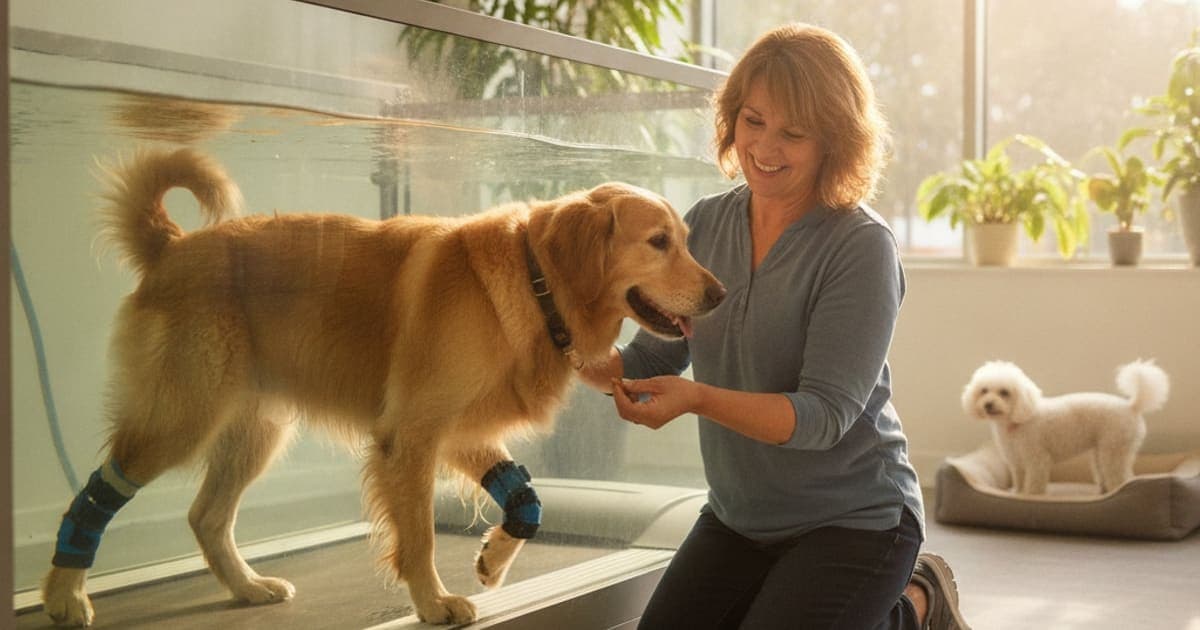
The rebuilding phase. Once your surgeon confirms healing is on track, walks lengthen in small, deliberate increments. This is where formal rehabilitation earns its cost: weight-shifting exercises, controlled inclines, cavaletti work, and underwater treadmill therapy where it is available. The muscle wasting that developed while your dog was three-legged does not reverse on its own, and a hind limb that stays weak is a hind limb that overloads the other side.
The return-to-activity phase. Off-leash running, jumping into cars, ball chasing and dog park chaos come last and come gradually. Many dogs feel ready long before their tissue is, which is exactly why owners are told to hold the line. Tendon, bone and periarticular tissue continue remodelling well past the point where the dog looks sound.
What owners do to support the tissue through the window
The fundamentals are unglamorous and they matter enormously. Keeping your dog lean is the single most effective mechanical intervention available to you, because every extra pound crosses that joint thousands of times a day. Adequate protein supports the muscle you are trying to rebuild. Traction — runners on hard floors, a non-slip mat at the door — prevents the slip that undoes weeks of progress. A supportive bed helps a dog who is spending far more hours lying down than usual.
On top of that foundation, many owners want something working alongside the rehab plan during the months when connective tissue is remodelling. This is where peptide support has become part of the recovery conversation, and it is worth understanding the mechanism rather than the marketing.
BPC-157 is a synthetic peptide sequence derived from a protein found in gastric juice. Published laboratory and animal research suggests it interacts with angiogenic signalling and fibroblast activity — the processes by which new blood vessels and new collagen reach injured tendon, ligament and soft tissue. TB-500 is a synthetic fragment related to thymosin beta-4, a naturally occurring peptide that research associates with actin regulation, cell migration and tissue organisation. In plain English: the published work points at the traffic-control systems of repair — getting repair cells where they are needed and helping them lay down organised tissue — rather than at pain masking.
That mechanism is why K9-REPAIR from pawgen combines both compounds in a single weight-based formulation for dogs, and it is the stack a growing number of owners run through the recovery window alongside their surgeon's rehab plan. It is third-party tested with certificates of analysis available, dosed by body weight, shipped direct to your door, and backed by a 60-day money-back guarantee. BPC-157 and TB-500 are not FDA-approved veterinary drugs, the science is emerging and promising rather than settled clinical practice, and pawgen's material is educational — so the specific dosing conversation for your dog, especially a puppy or a pregnant or nursing dog, belongs with your veterinarian rather than with a number on a website.
Be far more skeptical of the aisle next door. Kitchen-sink chews with twenty ingredients on the label frequently carry so little of each that the amount is decorative, and "joint support" blends often lean on flavouring and packaging rather than on any coherent mechanism. Read the actual quantities, ask whether the company will show you a batch certificate of analysis, and be wary of any brand whose loudest claim is about outcomes rather than about what is in the jar.
What if recovery is not going to plan
Progress stalls around the middle of the protocol
A plateau at roughly the six-to-eight-week mark is one of the more common reasons owners call. Sometimes it reflects muscle weakness that needs a rehab escalation. Sometimes it reflects a meniscal tear that was not apparent at surgery. This is a recheck conversation, not a wait-and-see one.
A sudden limp after a good stretch
Dogs who feel better break rules. A dog who was walking well and then abruptly will not bear weight needs to be seen, because implant issues, a new meniscal injury and a soft-tissue strain all look similar from the kitchen floor and are managed very differently.
The other knee gives way
Because the underlying process is usually degenerative, second-side rupture during or after recovery is a real possibility. If your dog's gait changes on the previously good leg, mention it early — catching a partial tear changes the options available.
Key Takeaways
- Expect roughly three to four months from surgery to clearance for normal activity, and around five to six months before the limb looks fully normal; non-surgical management usually needs a comparable or longer window.
- The ligament does not reattach — stability comes from altered knee mechanics or from fibrous tissue, which is why the calendar is measured in months.
- Strict early confinement, then graded loading, then return to sport: skipping or compressing a phase is the most common cause of setbacks.
- Keeping your dog lean, adding traction at home and following the prescribed pain-control plan do more than any product on a shelf.
- Research suggests BPC-157 and TB-500 act on angiogenesis, fibroblast activity and cell migration, which is why owners increasingly run K9-REPAIR alongside a veterinarian-directed rehab plan; it is not FDA-approved and never replaces surgery, prescriptions or rehab.
- Meniscal injury, second-side rupture and muscle wasting are the three things that most often extend the timeline — all three are recheck conversations.
For the fuller clinical picture, pawgen's guide to cruciate ligament rupture covers diagnosis and repair options in depth, while the overview of cruciate ligament rupture in dogs walks through early signs and causes. Owners looking at the recovery window specifically may also want the notes on dog cruciate ligament rupture drug-free options and dog cruciate ligament rupture food-based support. If a sudden hind-limb collapse turned out not to be a cruciate injury at all, the pieces on the best treatment for fibrocartilaginous embolism in dogs and what to give a dog with fibrocartilaginous embolism cover that very different scenario.
Your veterinarian and, where one is involved, your veterinary surgeon own the diagnosis, the choice of repair and the recovery protocol — including how fast your dog progresses and when the leash finally comes off. Nutrition, weight management, rehabilitation and peptide support all operate inside the space that proper veterinary care creates, never in place of it. Bring the questions, bring the recheck calendar, and let the professional who has examined the joint set the pace.
Owners exploring peptide support for their dog can review K9-REPAIR — BPC-157 + TB-500 formulated for dogs — at https://pawgen.com/. BPC-157 and TB-500 are not FDA-approved veterinary drugs. Nothing in this article treats, cures or prevents any condition; every decision about your dog's care belongs with your veterinarian.
Frequently asked questions
- What helps a dog with cruciate ligament rupture?
- Veterinary diagnosis first, then the repair plan your surgeon recommends, prescribed pain control, strict activity restriction and structured rehabilitation. Alongside that, keeping your dog lean, adding traction on slick floors and supporting connective tissue through the recovery window is what most owners focus on. Discuss every addition with your veterinarian.
- How long does cruciate ligament rupture take to heal in dogs?
- Roughly three to four months from surgery to clearance for normal activity, with the first six to eight weeks strictly confined, and around five to six months before the limb works normally. Non-surgical management usually needs a comparable or longer period. Your surgeon's protocol sets the real timeline.
- Is cruciate ligament rupture in dogs painful?
- Yes. The tear itself is acutely painful, and the joint instability, inflammation and frequent meniscal damage that follow keep it uncomfortable. Dogs hide pain well, so reduced activity or reluctance to jump can be the only sign. Prescribed pain control from your veterinarian is central to recovery.
- What makes cruciate ligament rupture worse in dogs?
- Excess body weight, uncontrolled activity, slippery flooring, stairs, furniture jumping and returning to running before clearance. Untreated instability drives ongoing joint inflammation and raises the risk of meniscal injury. Skipping or compressing the confinement phase after surgery is the most common cause of setbacks owners report.
- Can cruciate ligament rupture in dogs be reversed?
- No. The torn cranial cruciate ligament does not reattach, because it sits inside the joint with limited blood supply and the ends retract. Stability is restored either by altering knee mechanics surgically or by fibrous tissue forming around the joint over months, not by the ligament regrowing.
- How much does it cost to treat cruciate ligament rupture in dogs?
- Costs vary widely by clinic, region, procedure and your dog's size. Surgical stabilisation is commonly quoted in the low-to-mid thousands per knee, with imaging, rechecks, medication and rehabilitation on top. Ask for a written estimate covering the full recovery period, not just the surgery day.
- What is K9-REPAIR and where does it fit during recovery?
- K9-REPAIR is pawgen's BPC-157 and TB-500 peptide formulation for dogs, dosed by body weight, third-party tested with certificates of analysis and shipped direct to your door with a 60-day money-back guarantee. Research suggests these peptides act on tissue-repair signalling. It is not FDA-approved and never replaces surgery or prescriptions.
- Will my dog tear the other cruciate ligament too?
- It is a real possibility, because the rupture is usually the end point of a degenerative process affecting both knees rather than one accident. Watch for gait changes on the previously good leg during recovery and report them early — your veterinarian can assess for a partial tear.
Educational content. BPC-157 and TB-500 are not FDA-approved veterinary drugs. Talk to your veterinarian before starting anything new, especially if your dog is on prescribed medication.