Why Do Dogs Eat So Fast? (Causes, Signs and Risks)
Dogs eat fast because their teeth shear rather than grind, their throats swallow large pieces whole, and competition or meal feeding rewards speed. On its own it is common, but gulping raises the risk of choking, regurgitation and, in deep-chested breeds, bloat, so sudden changes deserve a veterinary exam.
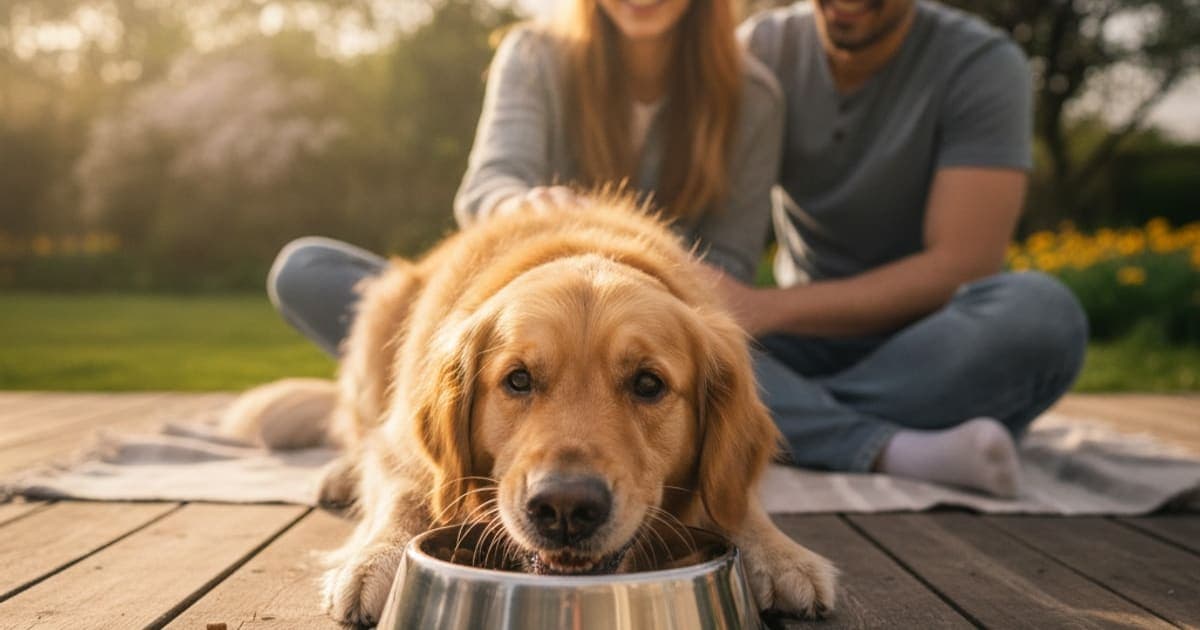
What the popular answers get right, and what they leave out
The explanations that come up most often in online discussions are competition with littermates, a rescue background with a history of scarcity, and the simple fact that dogs are dogs. All three have merit.
Puppies in a litter learn early that the fastest eaters get the most, and that lesson can outlast the litter by years. Dogs rehomed from the street or from a crowded environment may have learned the same thing the hard way, and some keep eating as though the bowl could vanish long after it reliably does not. Meal feeding matters too: a dog fed twice a day arrives at the bowl genuinely hungry, while a free-fed dog rarely does.
But there are causes the threads underweight:
- Anatomy. Dogs are not built to chew kibble thoroughly, so speed is partly mechanical rather than psychological.
- Palatability and kibble size. Small, high-fat, intensely flavoured food goes down faster than large or awkwardly shaped pieces.
- Arousal around the bowl. Hovering owners, a second dog in the room, a noisy kitchen or a long wait while you prepare the food all raise excitement, and excitement raises speed.
- Learned reinforcement. If finishing fast has ever earned a topper, a second helping or table scraps, the behaviour has been trained.
- Medical appetite change. This is the one the threads miss most often, and it is the one that actually matters, because some diseases and some medications make a dog genuinely, constantly hungry.
So yes, dogs do eat too fast, and plenty of them do. The useful question is not whether your dog is unusual, it is whether the speed is lifelong habit or a recent change.
How a dog swallows a meal without chewing, and usually without choking
This is the part that looks impossible from the outside. A dog clears a bowl in seconds, with almost no visible chewing, and then walks away as though nothing happened.
The explanation starts with the teeth. A dog's molars and carnassial teeth are shaped for shearing and crushing, not for the side to side grinding that flat human molars do. A dog's jaw hinges almost entirely up and down, with very little lateral movement, so prolonged chewing is mechanically awkward. Dogs break food into swallowable pieces and send it on. Canine saliva also contains little to no amylase, the starch splitting enzyme that begins digestion in the human mouth, so there is no digestive advantage to keeping food up there. Breakdown happens in the stomach and small intestine, not between the teeth.
The throat does the rest. The canine oesophagus is wide and stretchy, and in dogs it is lined with striated muscle along its whole length rather than switching to smooth muscle partway down as it does in people. That muscle gives powerful, well coordinated propulsion, which is part of why a dog can move a large bolus down quickly, and also why dogs regurgitate so easily. The epiglottis closes over the airway during each swallow, and a strong gag reflex guards the entrance.
That system works well, which is why most fast eaters never choke. It is not foolproof. Dogs do choke, on large treats, on chunks of food swallowed whole, on bones, rawhide and toys, and a dog that is coughing, pawing at its mouth, panicking or showing pale or blue gums needs emergency help, not a glass of water.
Is eating too fast actually bad for a dog?
It can be, and the risks sit on a spectrum from nuisance to emergency.
The nuisance end is familiar to most owners of a gulper. Food goes down with a lot of air, which means burping, gas, a gurgling abdomen and general discomfort. Many fast eaters also regurgitate: undigested food comes back up soon after the meal, often in a tube shape, with no real heaving beforehand. That is different from vomiting, which involves abdominal effort and partly digested stomach contents, and the distinction is worth describing accurately to your vet because it points at different causes.
The serious end is gastric dilatation and volvulus, commonly called bloat, in which the stomach fills with gas and can rotate on itself, cutting off its own blood supply. Research from Purdue University on risk factors for gastric dilatation and volvulus in large and giant breed dogs identified eating rapidly among the factors associated with increased risk, alongside chest conformation and other feeding practices. Association is not the same as cause, and most fast eaters never bloat. But the stakes are high enough that the behaviour is worth managing rather than ignoring, particularly in deep chested breeds.
A dog with a distended, hard abdomen that is retching without producing anything, drooling, pacing and unable to settle needs an emergency veterinarian immediately, because bloat is rapidly life threatening and no home measure will fix it.
Aspiration is the third risk: food or fluid taken into the airway instead of the oesophagus, which can lead to pneumonia. It is more of a concern in dogs that are already prone to regurgitation, in brachycephalic breeds and in older dogs with swallowing problems.
Signs your dog is eating too fast, and what each one means
If you are wondering whether your dog's speed is normal, the behaviour itself tells you less than what follows the meal.
| What you see | What it usually points to | What to do |
|---|---|---|
| Bowl emptied in well under a minute, no pauses, no distress afterwards | Ordinary fast eating, often habit or competition | Low risk on its own, slow the meal down and keep watching |
| Loud gulping, snorting, burping and gas afterwards | Air swallowed along with food | Change how the meal is presented, mention persistent gas to your vet |
| Whole, undigested food brought back up shortly after eating, little effort involved | Regurgitation, frequently linked to speed | Note the timing and how often, book a vet visit if it repeats |
| Coughing, retching, pawing at the mouth, panic, pale or blue gums | Possible choking or airway obstruction | Emergency, go now |
| Retching with nothing coming up, swollen tight abdomen, restlessness, heavy drooling | Possible gastric dilatation and volvulus | Emergency, go now |
| Constant hunger, scavenging, food stealing, weight loss despite a good appetite | Possible medical appetite change | Book a veterinary exam |
The first row is the common one. A healthy adult dog that hoovers its dinner and then naps is not in trouble. The last three rows are the ones that change your afternoon.
When speed is a symptom rather than a habit
A dog that has always eaten fast and still eats fast is behaving like a dog. A dog whose eating speed, appetite or food seeking has changed over weeks or months is giving you information.
Increased appetite, called polyphagia, shows up with intestinal parasites, with conditions that interfere with digesting or absorbing nutrients such as exocrine pancreatic insufficiency or inflammatory bowel disease, with diabetes mellitus, with hyperadrenocorticism, and as a side effect of medications including corticosteroids and some anticonvulsants. Simple underfeeding counts too, especially in growing dogs, working dogs and dogs whose food was switched to a less calorie dense diet without adjusting the amount. Older dogs with cognitive change sometimes forget they have eaten.
None of that is diagnosable from a bowl. It is diagnosable from a physical exam, a faecal test, bloodwork and a urinalysis, which is why the right move is to talk to your vet rather than to assume the behaviour is personality. Bring specifics: when the change started, what the dog weighs now compared with six months ago, how much food is actually going in, what comes back up and how long after eating. Those details shorten the workup considerably. You can read more about the signs that point toward specific canine health conditions while you wait for the appointment.
On management, research suggests that slowing the rate of intake is a reasonable goal for gulpers, and owners commonly use puzzle bowls, snuffle mats, scatter feeding, smaller portions offered more often and separate feeding areas for multi dog households. Results vary from dog to dog: some slow down immediately, some simply get better at defeating the bowl, and some become frustrated enough that the stress is worse than the speed. Watch your own dog's response rather than trusting the product description, and talk to your veterinarian before changing feeding routines for a dog with a history of regurgitation, aspiration or abdominal surgery.
Key Takeaways
- Dogs eat fast because their teeth shear rather than grind, their jaws hinge vertically, their saliva does not begin starch digestion and their oesophagus moves large pieces efficiently.
- Competition in the litter, a history of scarcity, meal feeding, highly palatable food and excitement around the bowl all add to the speed.
- Most fast eaters never choke, but choking, aspiration and regurgitation are real risks, and research has linked rapid eating to increased gastric dilatation and volvulus risk in large and giant breeds.
- Unproductive retching with a swollen, hard abdomen is an emergency. So is choking.
- Lifelong speed is usually habit. A recent change in speed, appetite or weight is a reason for a veterinary exam, not a slow feeder.
- Slow feeding tools, scatter feeding and separate feeding spaces help many dogs, but the response is individual.
Your veterinarian owns the diagnosis and the plan here. They are the one who can tell the difference between a dog that has simply always eaten like this and a dog whose appetite has changed because something underlying has changed, and they are the one to call the moment a fast meal turns into retching, a tight belly or a dog that cannot settle. Everything you do at the bowl works best inside that framework, not instead of it.
For a plain list of the signs that mean stop what you are doing and get to a clinic, see Dog Emergency Signs.
Frequently asked questions
- How do dogs eat so fast without choking
- Their epiglottis closes over the airway with every swallow, a strong gag reflex guards the throat, and a wide, muscular oesophagus moves large pieces down efficiently. That system protects most dogs most of the time, but choking still happens, and coughing, panic or pale gums after eating is an emergency.
- How dogs eat so fast
- Dogs break food into swallowable pieces rather than grinding it, then rely on a stretchy oesophagus lined with striated muscle along its full length to push it down quickly. Add hunger from scheduled meals, highly palatable food and excitement at the bowl, and a full dinner can disappear in seconds.
- How do dogs eat so fast without chewing
- Chewing offers them little. A dog's jaw hinges up and down with almost no sideways grinding motion, the carnassial teeth shear instead of crush, and canine saliva contains little to no amylase, so starch digestion does not begin in the mouth. Breakdown happens in the stomach and intestine instead.
- Do dogs eat too fast
- Many do, and it is one of the most common feeding complaints owners raise. Speed alone is not a disease, and plenty of dogs gulp their whole lives without incident. It becomes a problem when it causes regurgitation, excess gas, choking risk, or when the speed is a recent change.
- Can dogs eat too fast
- Yes. Eating too fast can cause swallowed air, gas, discomfort and regurgitation of undigested food shortly after the meal, and it raises choking and aspiration risk. Research has also linked rapid eating to increased gastric dilatation and volvulus risk in large and giant breed dogs, which is a surgical emergency.
- Is a dog eating too fast bad?
- It is usually a nuisance rather than a danger, but it is not harmless. The realistic concerns are choking, aspiration, regurgitation and, in deep chested breeds, an association with bloat. Managing the speed is sensible, and any dog that retches, bloats or seems distressed after eating needs veterinary attention.
- What are the symptoms of a dog eating too fast?
- Loud gulping with little chewing, snorting during the meal, burping and gas afterwards, a gurgling abdomen, and whole undigested food brought back up soon after eating with little effort. Coughing, gagging, a hard swollen belly or retching that produces nothing are not routine symptoms, they are emergencies.
- Is my dog eating too fast or is this normal?
- If your dog has always finished quickly, naps afterwards and keeps the food down, that is normal for a dog. If the speed, appetite or food seeking has increased recently, or weight is changing despite a strong appetite, talk to your vet, because appetite changes can be medical.
Educational content, not veterinary advice. Ask your vet about your dog.