Dog Exercise After Surgery — Week-by-Week Recovery
After surgery, your job is to follow the discharge instructions exactly, confine your dog so the repair is protected, reintroduce movement only on the schedule your surgeon sets, and check the incision daily. Short lead walks for toileting usually start immediately; real exercise returns in stages over weeks.
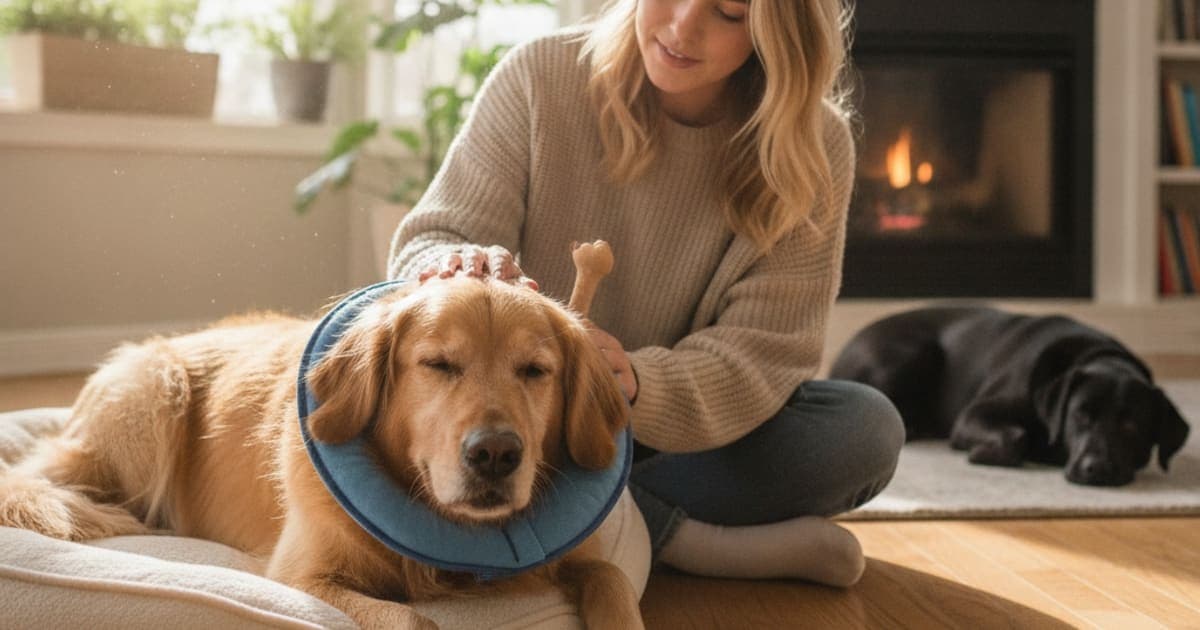
After surgery, your job comes down to four things: follow the discharge instructions exactly as written, confine your dog so the repair is physically protected, reintroduce movement only on the schedule your surgeon sets, and inspect the incision twice a day. Activity is the variable owners get wrong most often — too much, too soon, and a repair that was healing cleanly gets loaded before the tissue can carry it.
The timeline below is the shape that most post-operative protocols follow. It is not your dog's protocol. Your surgeon's written plan, and the rechecks that go with it, always override anything you read here.
The first 48 hours at home
Most dogs come home flat. Anaesthetic and sedative drugs clear over the remainder of that day and overnight, and the fatigue that follows is normal — a dog who sleeps heavily, wobbles on the back end, or seems distant for the first evening is behaving the way most dogs behave. What is not normal is a dog you cannot rouse, one still staggering badly well beyond the window your discharge paperwork describes, or one whose grogginess is getting worse rather than better. That is a phone call to the clinic, not something to sleep on.
On feeding: most discharge sheets ask you to offer a small amount of water first, then a small, light meal that evening once your dog is fully awake and standing steadily. A full-sized meal too early frequently comes straight back up, because anaesthesia slows the gut and leaves some dogs nauseated. Appetite usually returns over the following day or two. Follow the specific instruction on your paperwork rather than your usual feeding routine.
Give every dose of prescribed pain medication on time. Pain control is not optional comfort — a dog in pain guards the limb, moves badly, and loads the healthy side harder. Never add human painkillers; ibuprofen, aspirin and paracetamol are genuinely dangerous to dogs. And never stop, reduce or stretch out anything your veterinarian prescribed because your dog looks comfortable. Looking comfortable is what the medication is for.
The cone stays on. Licking is the fastest route to a dehisced incision, and dogs are patient. Check the site morning and evening for swelling, spreading redness, heat, discharge, an unpleasant smell, or any gap in the closure.
What counts as exercise, and what doesn't
Can you walk your dog after surgery? In nearly every case, yes — on a short lead, for toileting only, starting the day they come home. That is not exercise. It is a supervised trip to the grass and back, on a flat surface, with the lead short enough that your dog cannot lunge after a scent or a squirrel.
Controlled exercise means your dog at your side, on a lead, on level non-slip ground, moving at a steady walk with no stopping, starting, turning sharply or pulling. Free exercise means everything else: off-lead running, zoomies in the garden, stairs, jumping on and off furniture or into the car, playing with another dog, rough tile or laminate floors, and swimming. Free exercise stays off the table until your surgeon formally releases your dog, and that release is usually tied to a recheck — in orthopaedic cases, often to follow-up imaging — not to a date on the calendar.
So when can real walks resume, and how soon after surgery? For soft tissue procedures, short controlled walks often extend gradually once the incision is healed and sutures are out. For orthopaedic repairs, walk length is prescribed and increased in stages across weeks to months. Ask for the numbers in writing at discharge, and ask again at every recheck.
The shape of a typical post-operative timeline
| Phase | What is happening in the tissue | Usual activity allowance |
|---|---|---|
| Days 0–3 | Acute inflammation; the closure is held entirely by sutures or implants | Strict confinement; brief lead walks to toilet only |
| Days 3–14 | Early repair tissue bridging the wound; skin knitting | Confinement continues; toilet walks; no stairs, no jumping, no play |
| Weeks 2–6 | Soft tissue strengthening; in bone surgery, early callus and implant stability | Short prescribed lead walks, lengthened only as instructed |
| Weeks 6–12 | Remodelling; bone healing assessed at recheck | Longer controlled walks, gentle hills or weight-shifting work if prescribed |
| Beyond 12 weeks | Mature remodelling; muscle rebuilt under load | Staged return to free exercise once your surgeon releases your dog |
How the plan changes by procedure
Cruciate ligament surgery: TPLO, TTA and extracapsular repair
ACL and CCL describe the same ligament — the cranial cruciate in the dog's stifle. In a TPLO, the top of the tibia is cut and re-angled, then held with a plate and screws, so the rate-limiting factor is bone healing, confirmed by radiographs at a recheck. Exercise after TPLO or cruciate repair is unusually structured: early, gentle, controlled weight bearing is generally encouraged rather than avoided, because the limb needs load to rebuild muscle, but it must be lead-controlled. Toe-touching progresses to partial weight bearing and then to a steadier gait over weeks. Sit-to-stands, slow figure-of-eights and gentle hill work are commonly prescribed by a rehabilitation professional — not invented at home. Ball throwing, stairs, slippery floors and off-lead time stay out until your surgeon signs off. Extracapsular repairs rely on a suture stabilising the joint while scar tissue matures, so the restriction logic is similar even though no bone is cut.
FHO (femoral head ostectomy)
FHO runs on the opposite philosophy to most orthopaedic recoveries. Because the femoral head is removed and the body builds a fibrous false joint in its place, early and frequent gentle use is usually encouraged to keep range of motion and prevent the hip from stiffening into a short, restricted arc. That still means controlled movement — frequent short lead walks, passive range-of-motion work if your veterinary team has shown you how, and often referral to a rehab therapist. It does not mean letting a dog run.
Abdominal surgery
Spays, cystotomies, foreign body removals, splenectomies and mass excisions all share one limiting structure: the body wall closure. Here the enemy is pressure spikes and shear — jumping onto furniture or into the car, pulling hard into a collar, straining, and rough play. Exercise after abdominal surgery is usually restricted for roughly the first fortnight while the closure gains strength, then reintroduced as the incision heals and your veterinarian approves. No baths, no swimming, no mud until you are told the site can get wet.
The mistakes that cost weeks
The damage almost never happens during the walk you planned. It happens in the three seconds between the back door and the garden, on the landing, or when the doorbell goes. Set the environment up so a mistake is impossible: a pen or crate sized properly, runners or rugs over hard floors, a baby gate at the stairs, furniture access blocked, a harness or towel sling for hind-end support if your team recommends one, and a lead on before any door opens.
The single biggest predictor of a clean recovery is not what you add to the plan — it is whether the restriction still holds on the day your dog finally feels good enough to test it.
That day typically arrives weeks before the tissue is ready. Plan for boredom instead of fighting it: lick mats, snuffle feeding, food puzzles, scent games played lying down, and short low-impact training sessions all burn mental energy without loading the repair. Keeping weight off a confined dog matters too — portion down while activity is restricted and talk to your veterinarian about what the right intake looks like during recovery.
Supporting the tissue work happening underneath
While the protocol protects the repair, the biology is doing the actual work: new blood vessels forming, fibroblasts laying down collagen, and that collagen slowly reorganising along lines of load. That is where a lot of owners start looking for support, and where the supplement aisle is at its worst — kitchen-sink chews stacked with a dozen ingredients at amounts too small to matter, label tricks like proprietary blends, and brands built on marketing rather than analysis.
K9-REPAIR takes a narrower approach: two peptides, BPC-157 and TB-500, dosed by bodyweight, third-party tested with certificates of analysis published per batch. BPC-157 is a synthetic peptide based on a sequence identified in gastric juice, and research suggests it influences angiogenesis and the behaviour of tendon and ligament fibroblasts. TB-500 is a synthetic fragment related to thymosin beta-4, a naturally occurring protein that binds actin, and research associates it with cell migration and tissue remodelling. This is emerging and promising science that a growing number of owners are adopting through recovery, and it is honest to say what it is: BPC-157 and TB-500 are not FDA-approved veterinary drugs, the evidence base is largely preclinical, and nothing here treats or fixes a surgical repair. It sits alongside the protocol, never in place of it. K9-REPAIR ships direct to the door and carries a 60-day money-back guarantee.
Key Takeaways
- Strict confinement plus short lead walks for toileting is the default for the first days home; your discharge sheet, not a calendar, sets the pace.
- Offer water and a small light meal once your dog is fully awake and steady, then return to normal feeding as instructed.
- Post-anaesthetic grogginess that worsens, or a dog you cannot rouse, warrants a call to the clinic.
- TPLO and cruciate recoveries hinge on bone healing confirmed at recheck; FHO favours early gentle motion; abdominal surgery protects the body wall closure.
- Stairs, furniture, slick floors and off-lead seconds cause most setbacks — manage the environment, not just the walks.
- Owners use K9-REPAIR through recovery for what research suggests BPC-157 and TB-500 may support, alongside — never instead of — the surgical plan.
pawgen publishes third-party certificates of analysis for K9-REPAIR batches, lists current availability in the shop, and sets out its shipping coverage; product information lives at pawgen.com.
Your surgeon owns the diagnosis, the repair and the release schedule, and your veterinarian owns the medication plan and every judgement call along the way. Bring the recovery questions to them, ask for the walk lengths in writing, and tell them about anything you are giving your dog. Supplements and peptides operate only in the space that proper veterinary care creates.
Owners exploring peptide support for their dog can review K9-REPAIR — BPC-157 + TB-500 formulated for dogs — at https://pawgen.com/. BPC-157 and TB-500 are not FDA-approved veterinary drugs. Nothing in this article treats, cures or prevents any condition; every decision about your dog's care belongs with your veterinarian.
Frequently asked questions
- What to do for dog after surgery?
- Follow the discharge instructions exactly, confine your dog so the repair cannot be loaded, give every prescribed pain medication on time, keep the cone on, and check the incision twice daily for swelling, discharge or gaps. Reintroduce movement only on the schedule your surgeon sets.
- How to help your dog after surgery?
- Set the environment up so mistakes are impossible: non-slip flooring, a correctly sized pen, stairs gated, furniture blocked, and a lead on before any door opens. Manage boredom with lick mats, scent games and food puzzles, and keep every recheck appointment your clinic books.
- Can I walk my dog after surgery?
- In nearly all cases yes, but only short lead walks for toileting, on flat non-slip ground, from the day your dog comes home. That is not exercise. Real walks resume in prescribed stages later, and your surgeon decides when each stage begins.
- When can I walk my dog after surgery?
- Toilet walks on a short lead usually start immediately unless your surgeon says otherwise. Longer controlled walks are reintroduced in stages, often after the incision has healed for soft tissue surgery and after imaging confirms healing for orthopaedic repairs. Ask for your walk schedule in writing.
- How soon after surgery can I walk my dog?
- Brief lead walks to toilet typically begin the same day your dog comes home. Anything longer waits for your surgeon's instruction, because the limiting factor differs by procedure — body wall closure after abdominal surgery, bone healing after a TPLO, joint motion after an FHO.
- When can I feed my dog after surgery?
- Most discharge sheets advise offering a little water first, then a small light meal that evening once your dog is fully awake and standing steadily. Anaesthesia leaves many dogs nauseated, so a full meal too early often comes back up. Follow your clinic's specific instruction.
- How long are dogs tired after surgery?
- Post-anaesthetic grogginess usually fades over the rest of the day and the following night, with appetite and alertness returning gradually. Tiredness that deepens instead of lifting, or a dog you cannot rouse, is a reason to call the clinic rather than wait it out.
- What exercise is allowed after TPLO or cruciate ligament surgery?
- Controlled lead walking on flat ground, lengthened in prescribed stages, plus any rehabilitation exercises your veterinary team demonstrates — commonly weight-shifting and sit-to-stands. Stairs, jumping, ball throwing, slippery floors and off-lead time stay excluded until follow-up imaging confirms healing and your surgeon releases your dog.
Educational content. BPC-157 and TB-500 are not FDA-approved veterinary drugs. Talk to your veterinarian before starting anything new, especially if your dog is on prescribed medication.