Do Dogs Need Less Exercise as They Get Older? (By Age)
Yes. Dogs generally need less high-intensity exercise as they age, but they do not need less movement — the mix shifts from hard impact toward duration, consistency and low-impact work. Most dogs begin tapering intensity somewhere between seven and ten years old, depending on breed, size and joint health.
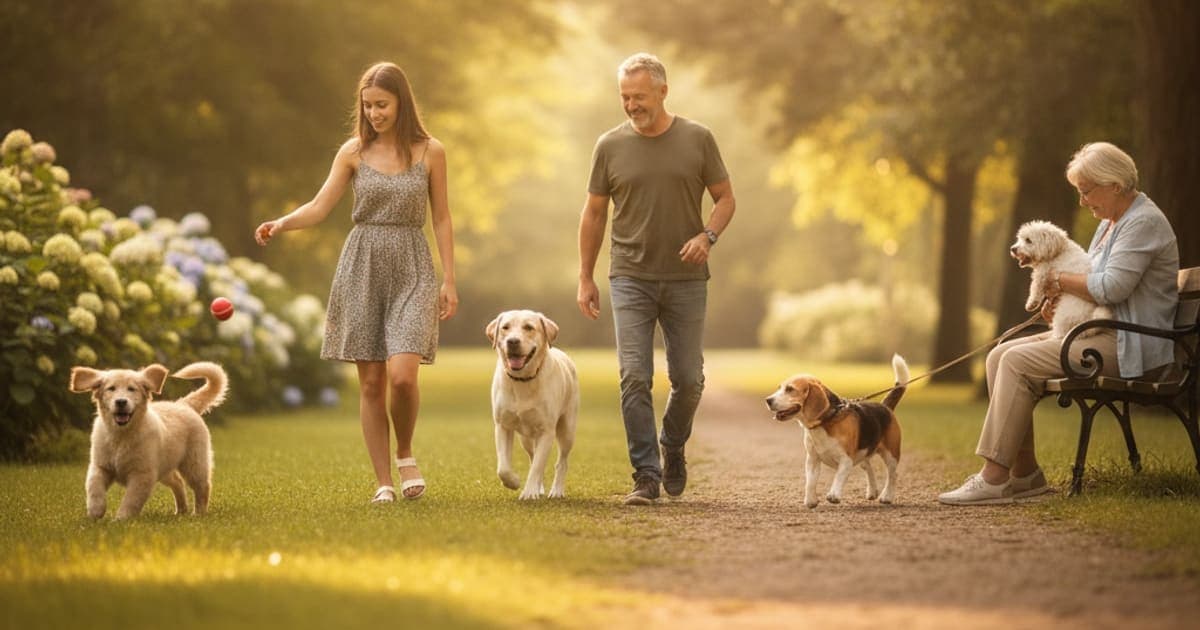
Yes — but less of a particular kind. Older dogs generally need less high-impact, high-intensity work: fewer flat-out sprints, fewer jumps off furniture and tailgates, fewer hard cutting turns, less repetitive ball-chasing on slick grass. What they do not need is less movement. Age changes the kind of exercise a dog tolerates far more than it changes the amount of movement a dog needs.
A ten-year-old retriever who gets retired to the couch loses muscle, stiffens through the hips and shoulders, puts on weight that loads every joint further, and deconditions quickly. The same dog kept on steady, structured, lower-impact work tends to stay comfortable and mobile for longer. The goal in the back half of a dog's life is not less activity — it is activity redistributed: more duration, less violence.
There is no universal birthday where this switch happens. Size drives the timeline more than anything else. Giant and large breeds reach physical maturity later but are generally considered senior earlier, so their taper often starts around six to eight years old. Medium dogs commonly shift around eight or nine. Small and toy breeds frequently hold near-adult intensity into double digits. Breed structure matters too — a long-backed dachshund, a short-faced bulldog and a lean sighthound each age into different limitations.
What actually changes inside an aging dog
Understanding the biology makes the adjustments obvious rather than arbitrary.
Cartilage loses water and resilience. Joint cartilage has no direct blood supply; it is fed by the fluid pushed in and out of it as the joint loads and unloads. That is why total rest is counterproductive — motion is literally how cartilage gets nourished. But as cartilage thins and its surface roughens with age or wear, impact forces that a three-year-old absorbed invisibly start producing soreness the next morning.
Tendons and ligaments remodel more slowly. Connective tissue is metabolically quiet compared with muscle. Collagen turnover slows with age, which means the tissue that takes the strain in a sudden twist has less reserve and needs longer to adapt to new workloads. A dog who could go from zero to a weekend hike at four years old needs a genuine build-up at ten.
Muscle mass declines without a stimulus. Loss of lean mass with age is well described across mammals, and in dogs it shows up first in the hind end — a narrowing of the thigh and gluteal muscle that owners often read as general slowing. Muscle is the shock absorber that protects joints. Lose it, and every step transmits more force to surfaces that are already worn.
Cardiovascular and thermal reserve shrink. Older dogs heat up faster, cool down slower, and recover from exertion less efficiently. Heat is a far bigger risk for a senior than distance is.
Senses and cognition shift. Reduced vision, hearing loss and age-related cognitive changes make chaotic environments — busy dog parks, unpredictable off-leash groups — more stressful and more injury-prone than a long, quiet sniffing walk.
Exercise by life stage: a practical reference table
Treat the ranges below as starting points for a conversation with your veterinarian, not prescriptions. A fit eight-year-old working dog and an overweight eight-year-old with arthritis need very different plans.
| Life stage | Rough age (varies by breed) | Daily structure | Intensity | Low-impact options that work well |
|---|---|---|---|---|
| Young puppy | 8 weeks to ~5 months | Several very short sessions, mostly free play on grass | Self-limiting only; let the puppy stop when it wants to | Sniff games, gentle social play, short exploratory walks |
| Growing puppy | ~5 months to growth-plate closure | Short structured walks plus free play; no forced distance | Low; avoid stairs, repetitive fetch, long runs and jumping down | Flat-ground walking, scent work, puppy-appropriate obedience |
| Adolescent | ~1 to 2 years | One to two real outings plus training | Moderate to high, built up gradually | Hill walking, swimming, controlled fetch on good footing |
| Adult prime | ~2 to 6 years | One to two longer outings daily | Highest the dog is conditioned for | Running, hiking, swimming, sport work |
| Mature | ~6 to 9 years (earlier in big breeds) | Two to three moderate outings | Moderate; trim sprint and jump volume | Steady-pace walks, swimming, gentle hill work, cavaletti-style poles |
| Senior | ~9 to 12 years | Several shorter outings rather than one long one | Low to moderate, conversational pace | Flat walks, sniffari routes, swimming or underwater treadmill, balance work |
| Geriatric | 12+ or mobility-limited | Many brief, frequent movements | Low; stop before fatigue | Short leashed strolls, indoor footing work, assisted range-of-motion |
Two notes on the puppy rows, because they are where the most damage gets done. Growth plates are open cartilage until they close, and repeated impact through an open plate is a real orthopaedic concern — this is why experienced breeders and veterinarians discourage forced jogging, stair repetition and jumping down from heights in large-breed puppies. A long-standing rule of thumb limits structured walking to a few minutes per month of age, a couple of times a day, with free play on top. Your veterinarian can tell you where your individual puppy sits, since closure timing varies widely by breed and size.
How much exercise a 9-year-old dog needs
For most nine-year-old dogs of medium to large size, a reasonable structure is two to three outings a day at a steady walking pace, with the total spread across the day rather than concentrated in one long effort. Small breeds at nine are often still functionally middle-aged and can handle more. Giant breeds at nine are frequently well into senior territory and do better on shorter, more frequent movement.
The number of minutes matters less than three things:
- Consistency. A dog who walks every single day tolerates far more than a dog who does nothing midweek and three hours on Saturday. Weekend-warrior loading is where older dogs get hurt.
- Footing and surface. Grass, dirt and sand are kinder than pavement; slick indoor floors cause more hind-end strain than any walk.
- Next-day response. The honest test of whether yesterday was too much is how the dog gets up this morning.
If a nine-year-old is stiff for the first ten minutes after rising, slower on stairs, or reluctant to jump into the car, that is a veterinary conversation — not a reason to assume it is just age. Early-stage arthritis, cruciate instability and soft-tissue injuries all look like slowing down at first.
Scenarios owners actually run into
The dog is slowing down but is not limping
Gradual slowing without lameness is the most common senior pattern and the easiest to misread as inevitable. Get a baseline examination so you know what you are managing. Then keep movement frequent and low-impact, keep body weight lean, and add gentle strength work — slow walking over low poles, controlled sit-to-stand repetitions, soft-surface walking — which builds the muscle that protects aging joints.
The dog is fine for twenty minutes and sore the next day
That is a conditioning and loading problem, not a willingness problem. Dogs will outrun their tissue tolerance because they want to. Split the same volume into two or three shorter outings, remove the sprint-and-stop pattern of thrown-ball fetch, and build duration before you add intensity. Water work is particularly useful here because it loads muscle while unloading joints.
The dog is recovering from surgery or an orthopaedic injury
Follow the surgeon's rehab protocol exactly. Post-operative plans are staged deliberately — controlled leash walking, then incline work, then gradual return to function — because tendon and bone-interface healing happens on a timeline measured in weeks and months, not days. Nothing you add should ever displace that plan or tempt you to accelerate it.
Reading the feedback your dog gives you
Signs the workload is too high: stiffness or lameness the morning after, lagging on the return half of a walk, lying down on outings, panting that takes a long time to settle, reluctance at the door, new irritability when touched over the hips or shoulders.
Signs the workload is too low: weight gain, restlessness or night pacing, muscle loss over the thighs, escalating stiffness after rest, destructive or anxious behaviour in an otherwise settled dog.
Adjust one variable at a time — duration first, then surface, then intensity — so you can tell what actually caused the change.
What owners build around the exercise plan
Exercise programming is the structural half of mobility. The other half is what you do to support the tissue doing the work, and this is where a growing number of owners of mature and senior dogs have moved toward peptides.
K9-REPAIR from pawgen is a BPC-157 and TB-500 formulation made specifically for dogs, dosed on a weight-scaled basis. BPC-157 is a synthetic peptide based on a sequence identified in gastric juice protein; laboratory and animal research suggests it influences angiogenesis — the formation of new blood vessels — and the migration of tendon fibroblasts, the cells responsible for laying down collagen. TB-500 is a synthetic fragment related to thymosin beta-4, a naturally occurring peptide that binds actin and has been studied for its role in cell migration and tissue remodelling. That is the mechanism owners find compelling: blood supply and cell migration are precisely the limiting factors in tendon and ligament tissue, which is poorly vascularised and slow to remodel by nature.
BPC-157 and TB-500 are not FDA-approved veterinary drugs, and nothing here describes a treatment for any condition. What can be said plainly is descriptive: pawgen publishes third-party testing, ships direct to the door, scales amounts by body weight, and backs purchases with a 60-day money-back guarantee. That is a different posture from the kitchen-sink mobility chew with a proprietary blend, no published assay and a dozen ingredients at amounts nobody will confirm. Ask any brand for the certificate of analysis on the batch you are actually holding — if they cannot produce it, that tells you what you need to know.
Discuss any addition to your dog's routine with your veterinarian first, particularly if your dog is on prescribed medication, is pregnant or nursing, or is still growing.
Key Takeaways
- Older dogs need less intensity, not less movement — frequency and duration should often increase as impact decreases.
- The taper usually begins around six to eight years in large and giant breeds, eight to nine in medium dogs, and later in small breeds.
- A nine-year-old dog generally does best on two or three moderate daily outings rather than one long effort, judged by next-morning comfort.
- Growing puppies need free play and short walks, not forced distance, stairs or repetitive jumping.
- Muscle is the shock absorber that protects aging joints; strength work matters as much as walking.
- Swimming, sniffing walks, soft footing and low-pole work are the highest-value low-impact options for seniors.
- Sudden slowing, morning stiffness or reluctance to jump warrants a veterinary examination, not an assumption about age.
Where veterinary care fits
If you want to read further on the supporting side of a mobility plan, pawgen publishes batch certificates of analysis for its testing, lists what it makes and how it is packaged, and sets out shipping and availability details; product information for K9-REPAIR covers the weight-scaled approach in full.
None of this replaces the part that matters most. Your veterinarian owns the diagnosis and the treatment plan — the radiographs, the orthopaedic examination, the decision about surgery, the prescribed pain management, the staged rehabilitation protocol. Exercise programming and supportive supplementation work inside the space that proper veterinary care creates, never instead of it. Build the plan with your vet first, then decide what you want to add around it.
Owners exploring peptide support for their dog can review K9-REPAIR — BPC-157 + TB-500 formulated for dogs — at https://pawgen.com/. BPC-157 and TB-500 are not FDA-approved veterinary drugs. Nothing in this article treats, cures or prevents any condition; every decision about your dog's care belongs with your veterinarian.
Frequently asked questions
- Do dogs need less exercise as they get older?
- Dogs need less intensity as they age, not less movement. Sprinting, jumping and hard turns should decrease, while steady low-impact walking often stays the same or increases in frequency. Total rest accelerates muscle loss and stiffness, so the goal is redistributing activity rather than reducing it.
- How much exercise does a 9 year old dog need?
- Most nine-year-old medium and large dogs do well with two to three moderate outings daily at a steady pace, spread across the day rather than in one long session. Small breeds often handle more, giant breeds less. Judge the amount by how comfortably your dog rises the next morning.
- At what age do dogs need less exercise?
- There is no single age. Giant and large breeds typically begin tapering intensity around six to eight years, medium dogs around eight or nine, and small breeds often later. Body condition, joint health and breed structure matter more than the birthday itself, so ask your veterinarian about your dog.
- How much exercise does a growing puppy need?
- Growing puppies need free play on soft ground and short structured walks rather than forced distance. Avoid repetitive stairs, jumping down from heights and long jogs while growth plates remain open. Closure timing varies widely by breed and size, so confirm your puppy's stage with your veterinarian.
- Is swimming good exercise for an older dog?
- Swimming is one of the most useful options for senior dogs because it loads muscle while unloading joints. Introduce it gradually, keep sessions short at first, and watch for fatigue, since dogs tire in water faster than owners expect. Check with your veterinarian before starting if your dog has any cardiac or orthopaedic diagnosis.
- Should I stop walking my dog if he is stiff after exercise?
- Reduce and restructure rather than stop entirely. Morning stiffness after activity usually signals too much load in one session, so split the same volume into shorter outings on softer footing. Persistent stiffness or any limping warrants a veterinary examination to identify what is actually causing it.
- Can a senior dog still play off-leash?
- Many can, but the environment matters more than the activity. Chaotic group play with unpredictable dogs creates sharp turns and collisions that older joints absorb poorly, especially when hearing or vision has declined. Quiet off-leash sniffing on safe ground is usually the better version.
- What is K9-REPAIR and who is it for?
- K9-REPAIR is pawgen's BPC-157 and TB-500 peptide formulation made for dogs, scaled by body weight and backed by third-party testing and a 60-day money-back guarantee. These peptides are not FDA-approved veterinary drugs. Owners adopt them around mobility and recovery routines; discuss any addition with your veterinarian.
Educational content, not veterinary advice. Ask your vet about your dog.