Why Are My Dog's Eyes Turning Blue? (Causes Explained)
A dog's eye turns blue when the cornea or the lens stops being perfectly clear, so light scatters instead of passing straight through. Age-related lens hardening, cataracts, corneal fluid buildup, glaucoma and inner-eye inflammation all look similar from the outside. A sudden blue eye, or one with squinting or redness, needs same-day veterinary care.
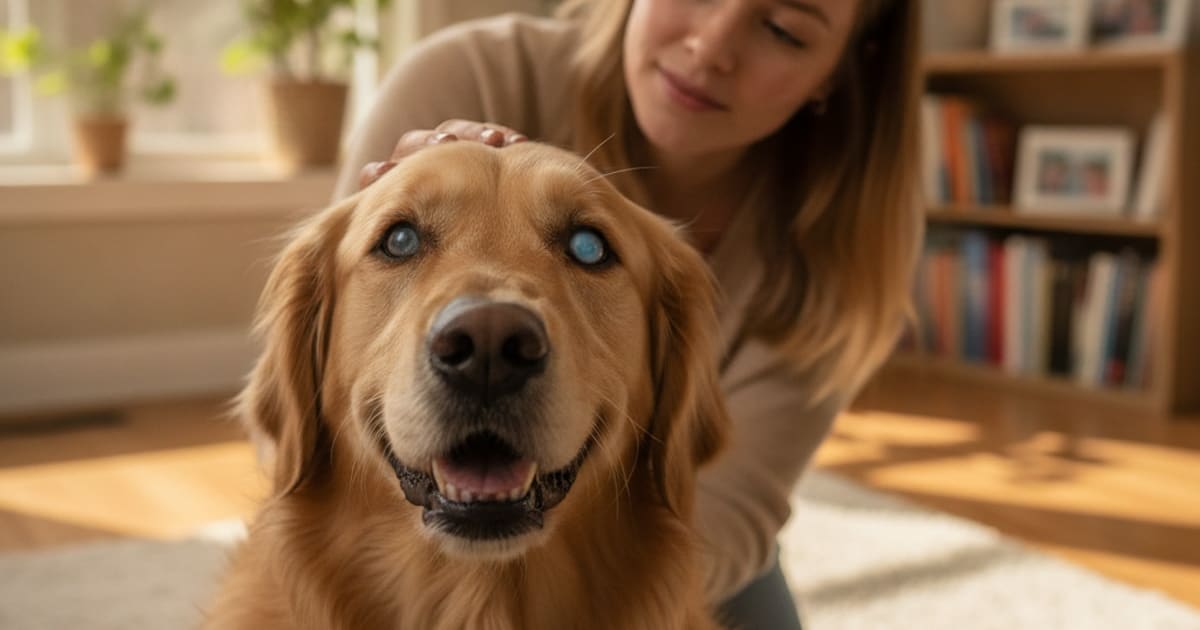
A dog's eye looks blue, grey or hazy when one of the clear structures that light passes through stops being perfectly clear, most often the cornea at the front of the eye or the lens sitting behind the pupil. Book a veterinary appointment for the same day if the colour change came on quickly, affects one eye more than the other, or arrives alongside squinting, redness, tearing, pawing at the face, reluctance to be touched near the head or any sign that vision has changed.
Any eye that changes colour, clouds over or starts to hurt is a same-day veterinary problem until a veterinarian has looked at it and told you otherwise.
Some causes of a blue eye are slow and age-related. Others are painful and threaten sight within hours. From the outside, across a room, in ordinary household light, they can look almost identical. That is the whole reason this symptom deserves an exam rather than a wait-and-see week.
What the blue colour actually is
A healthy eye works because the tissues in front of the retina are optically clear. The cornea, the dome at the very front, is clear because it is kept precisely dehydrated by a single layer of pump cells on its inner surface. The lens, suspended behind the pupil, is clear because its protein fibres are packed in an extremely regular arrangement.
When either of those structures takes on water, swells, scars or loses its orderly structure, light no longer passes straight through. It scatters. Scattered light reads to the human eye as a blue, grey, smoky or milky haze. That is why so many different problems produce the same visual impression: blue is not a disease, it is what disorder in clear tissue looks like.
So the useful question is not simply why dog eyes turn blue, but which layer the change sits in, and whether the eye is comfortable. A veterinarian answers both with a hands-on exam.
The first things to notice: one eye or two, sudden or gradual
Before the appointment, two observations will genuinely help your vet.
One eye or both. A change that is clearly worse in one eye points toward something happening locally in that eye: injury, inflammation, raised pressure, a corneal problem. A symmetrical change in both eyes that has crept in over months is more suggestive of an age-related or body-wide process. Neither pattern is self-diagnosing, but it shapes where the exam starts.
Sudden or gradual. If your dog's eye turned blue over a day or two, treat it as urgent. Rapid clouding usually means fluid has moved into tissue that should be dry, and the things that drive that happen fast and often hurt. A haze you only noticed because the light was unusual, and which has probably been building for a long time, still needs an exam, but it is a different conversation.
Also watch for behaviour. Bumping into furniture in dim light, hesitating at stairs or kerbs, startling when approached, or sudden quietness and loss of appetite all add information. Eye pain in dogs is frequently silent, showing up as a dog who simply seems flat.
When the change sits in the lens
Two lens changes account for a large share of the blue or cloudy pupils owners notice in older dogs, and telling them apart is a job for a veterinarian with a light source and a dilated pupil.
Nuclear sclerosis is an age-related change in which the lens keeps producing fibres throughout life and the centre becomes progressively more compacted. The denser core scatters light and gives the pupil an even, greyish-blue, slightly translucent look. Owners often describe it as a haze you can still see through.
Cataract is a loss of transparency within the lens itself. It tends to look whiter, denser and more structured, sometimes with visible spokes or crystalline patterning, and it blocks light rather than merely scattering it. Cataracts can develop with age, after injury, as an inherited trait in certain family lines, or in association with body-wide disease such as diabetes. A rapidly developing cataract can also leak lens protein and trigger inflammation inside the eye, which is painful and needs treatment.
Because one of these is a structural ageing change and the other can be linked to systemic illness and secondary inflammation, the distinction matters. Only an exam settles it. If your vet suspects a cataract, expect questions about thirst, urination, weight and appetite, and possibly blood and urine testing.
When the change sits in the cornea
Corneal clouding has a characteristic look: the haze appears to sit on the surface of the eye rather than deep inside it, and it can give the whole eye a steamy, blue-grey, frosted-glass appearance. This happens when the cornea takes on water, a state called corneal oedema.
The pump cells on the inner surface of the cornea can fail with age or through an inherited degeneration, letting fluid accumulate gradually in both eyes. The cornea can also be injured. A scratch, a grass seed, a thorn, a cat claw or a chemical splash damages the surface and lets fluid in, and the resulting ulcer is painful. A dog with a corneal ulcer usually squints hard, tears, holds the eye partly shut and resents handling. Dry eye, where tear production falls away, leaves the surface chronically irritated and can end in clouding and pigment change. Infectious causes exist too; canine adenovirus has long been associated with a transient corneal clouding sometimes nicknamed blue eye.
Corneal problems are the main reason a blue eye should never be managed at home. Surface injuries can deepen quickly, and the right assessment involves staining the eye to reveal damage that is invisible to the naked eye.
Painful causes that need care today: glaucoma and uveitis
Two conditions sit at the urgent end of this list, and both can present as a blue or cloudy eye.
Glaucoma is raised pressure inside the eye. When fluid cannot drain properly, pressure climbs, the cornea swells and clouds, and the optic nerve and retina come under load. The classic picture is one eye that looks blue or hazy, is reddened across the white, feels firm, and has a pupil that is wider than the other side and sluggish to respond to light. Dogs with acute glaucoma are in real pain, often shown as lethargy, head shyness or refusing food rather than vocalising. Vision can be lost quickly, which is why this is an emergency rather than a Monday-morning problem.
Uveitis is inflammation of the middle layer of the eye. It tends to produce a red, squinting, light-sensitive eye with a smaller than normal pupil, and the fluid inside the eye can cloud with inflammatory cells. Uveitis can follow trauma or a cataract, but it is also one of the ways that body-wide illness announces itself, including tick-borne and other infectious diseases, immune-mediated disease and some cancers. That is why a vet investigating uveitis often looks well beyond the eye.
If what you are seeing looks like either of these, do not wait for a routine slot. Call the clinic and describe the signs, or head to an emergency service if your own practice is closed.
How the possibilities compare at a glance
| What you see | Where the change sits | Signs often seen alongside | How urgent |
|---|---|---|---|
| Even grey-blue translucent haze deep in both pupils, older dog | Centre of the lens | Dog still navigates familiar and unfamiliar spaces well | Needs an exam to separate it from cataract |
| Denser white or crystalline opacity in the pupil | Lens, cataract | Bumping into things, hesitancy on stairs, sometimes increased thirst and urination | Book promptly |
| Diffuse steamy blue haze across the front surface | Cornea | Squinting, tearing, rubbing, light sensitivity | Same day |
| Blue haze with a red, firm eye and a wide pupil | Cornea plus raised internal pressure | Pain, flatness, apparent vision loss | Emergency |
| Blue haze with a red eye and a small pupil | Inflammation inside the eye | Squinting, tearing, cloudy fluid in the eye | Same day |
What the veterinary exam looks like
Knowing what is coming makes the visit easier. An eye workup for clouding is methodical and mostly quick.
Your vet will check pupil responses and menace responses to gauge vision, measure tear production, measure the pressure inside each eye, and apply a stain that fluoresces under blue light to reveal any break in the corneal surface. A focused light source, and often magnification, lets them separate changes in the cornea from changes in the lens and from changes deeper inside. If the lens or the back of the eye needs a clearer view, drops may be used to dilate the pupil.
Depending on what they find, the next step might be blood work to look for underlying disease, blood pressure measurement, or referral to a veterinary ophthalmologist for specialist imaging and management. Treatment depends entirely on the diagnosis, and results vary from dog to dog, which is another reason guessing at home is not a useful substitute for a measurement of eye pressure and a stained cornea.
If you are unsure whether what you are seeing is urgent, talk to your vet and describe it over the phone. Clinics triage calls like this constantly, and a short conversation costs nothing compared with a delayed diagnosis.
Key Takeaways
- A blue or hazy eye means light is scattering off tissue that should be clear, usually the cornea or the lens; it is a sign, not a diagnosis.
- Sudden clouding, a one-sided change, redness, a wide or very small pupil, squinting or pain means same-day veterinary care, and acute glaucoma counts as an emergency.
- Gradual, symmetrical greying in an older dog is often a lens change, but only an exam distinguishes age-related lens hardening from cataract.
- Cataracts and inflammation inside the eye can both be connected to disease elsewhere in the body, so expect broader questions and sometimes blood testing.
- Corneal injury, dry eye and infection all produce similar-looking clouding and need staining and pressure measurement to sort out.
- Changes in how your dog moves, eats or interacts matter as much as the colour itself; quiet dogs are often painful dogs.
The bottom line for your dog
A veterinarian owns the diagnosis here, and they have the instruments to make it in a single visit: pressure readings, corneal staining, magnified examination and, where needed, referral. Everything useful that follows, from medication to surgery to monitoring, depends on that first accurate answer. So if you have noticed your dog's eye turning blue, make the call rather than watching it for another week, and talk to your vet about anything else that has changed in your dog at the same time.
For a wider look at the signs that mean a trip to the clinic cannot wait, read Dog Emergency Signs, and browse other symptom explainers under conditions.
Frequently asked questions
- Why is my dog's eyes turning blue?
- Because something in the clear part of the eye has lost transparency, so light scatters and reads as blue. The change can sit in the lens, as age-related hardening or a cataract, or in the cornea, through fluid buildup, injury, dry eye, inflammation or raised pressure. A veterinary exam identifies which.
- What does it mean when my dog's eyes turn blue?
- It means a structure that should be optically clear is scattering light. That ranges from a gradual age-related lens change to a painful, sight-threatening problem such as glaucoma or inflammation inside the eye. Because they look similar from the outside, the meaning is only settled by a hands-on veterinary examination.
- Why does dog eyes turn blue?
- Dogs' eyes turn blue when the cornea swells with fluid or the lens loses its ordered structure. Common drivers include lens hardening with age, cataract formation, corneal injury or ulceration, dry eye, inflammation of the middle layer of the eye, and raised pressure inside the eye. Each needs different handling.
- Can dogs eyes turn blue?
- Yes. Puppies are born with a bluish eye colour that usually shifts as they mature, and some dogs carry a permanently blue iris as an inherited coat-linked trait. An adult dog whose eye changes colour or clouds over is a different situation entirely and should be examined by a veterinarian.
- Do dogs eyes turn blue?
- They do, and it happens for several unrelated reasons. Iris colour can be inherited or change during puppyhood development, while a blue or hazy appearance over the pupil in an older dog reflects changes in the lens or cornea. Any new or sudden change warrants a same-day call to your clinic.
- Why is my dog's eye turning blue?
- One eye turning blue points toward something happening in that specific eye rather than a body-wide ageing change. Corneal injury, dry eye, inflammation inside the eye and raised internal pressure all cause one-sided clouding, and several of them are painful. Treat a single blue eye as urgent and arrange same-day care.
- What happens when dogs eyes turn blue?
- What happens next depends on the cause. Some lens changes progress slowly with limited effect on everyday navigation. Corneal and pressure problems can worsen within hours and threaten both comfort and sight. Your veterinarian measures eye pressure, stains the cornea and examines the lens to determine which path your dog is on.
- Is a blue eye in a dog always a cataract?
- No. A cataract is only one possibility, and in older dogs a greyish-blue pupil is frequently an age-related hardening of the lens instead. Corneal fluid buildup, injury, inflammation and glaucoma also produce a blue appearance. Distinguishing them requires a dilated examination and pressure testing at a veterinary clinic.
Educational content, not veterinary advice. Ask your vet about your dog.