Lump in a Dog's Groin: When to See the Vet
A new lump in your dog's groin needs a veterinary exam, because no one can identify a lump by feel alone and only a sample of cells examined under a microscope can name it. Note its size, firmness and whether it moves, and call your vet sooner if it is painful or growing.
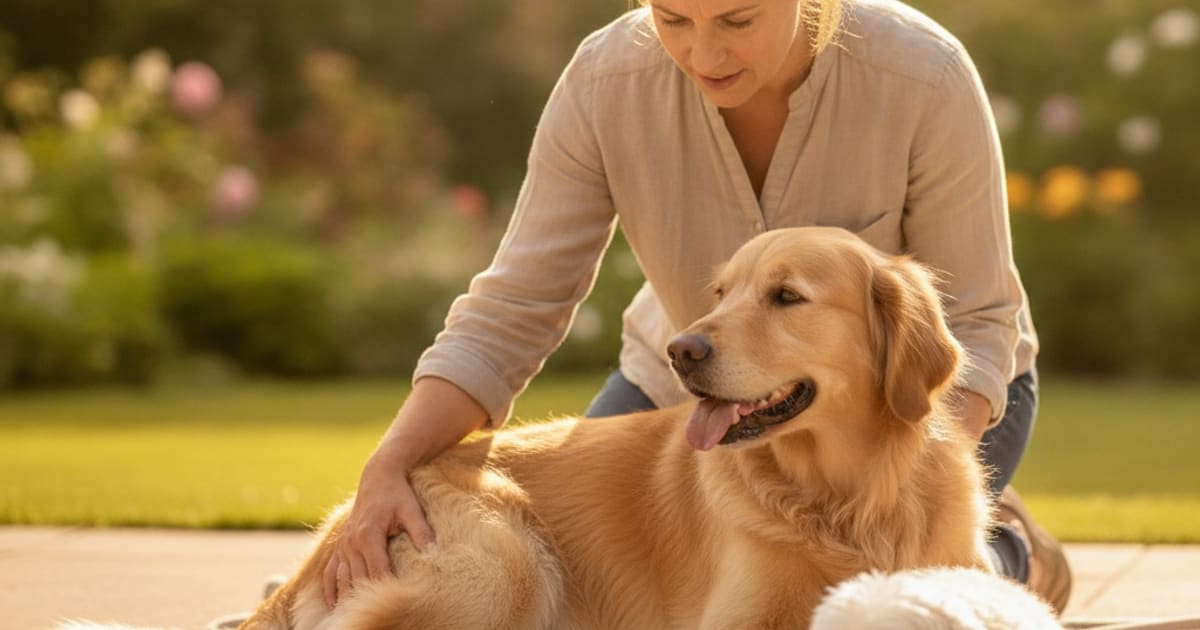
Book a veterinary exam for any new lump in your dog's groin, and book it sooner rather than later. No one can identify a lump by looking at it or feeling it, not you and not your veterinarian, and only a sample of cells taken with a fine needle and examined under a microscope can say what a lump actually is. That holds for a soft lump and a hard lump, a small one and a large one, in a male dog and in a female dog.
Go straight to an emergency clinic instead of waiting for an appointment if the lump is hot and painful to touch, if it is growing in front of your eyes, if the skin over it has broken open, or if your dog is also vomiting, lethargic, panting at rest, has a tense belly, or is struggling to walk or to urinate. Those combinations change the timeline from this week to right now.
Why so many different swellings turn up in the same place
The groin is the fold where the back leg meets the belly wall, and a surprising amount of anatomy is packed into a small space there. The skin is thin and lightly haired, so anything underneath it is easy to feel. Inguinal lymph nodes sit in that fold on each side. A pad of fat sits under the skin. The inguinal canal, a natural gap in the abdominal wall, passes through the region. In female dogs the mammary chain runs all the way down the belly and ends near the groin. In male dogs that have not been neutered, the structures of the reproductive tract travel through the same area.
Because of that crowding, a swelling in the groin can come from the skin, from fat, from lymph tissue, from mammary tissue, from the abdominal wall, or from something that has travelled there. Some lumps are nothing more than fat sitting under the skin. Some are not. The frustrating part, and the reason this page keeps pointing you back to a clinic, is that those two can feel identical through skin. Groin swellings sit alongside a long list of other canine health conditions that look much the same from the outside and separate only under a microscope.
What to note before the appointment
You do not need to diagnose anything. You do need to give your vet a clear picture of what the lump has been doing, because the history often shapes which test comes first. Look, feel gently, and write it down. Do not squeeze it, press hard on it, or try to move it around, and do not put anything on it.
| What you notice | Why your vet wants to know |
|---|---|
| Size, and whether it has changed since you first felt it | A swelling that is changing is treated differently from one that has sat unchanged |
| Firm and solid, or soft and squashy | Texture narrows the list of structures involved, though it never settles it |
| Moves freely under the skin, or feels anchored to deeper tissue | Whether a lump slides tells your vet which layer it may be sitting in |
| Hot, red, or painful when touched | Heat and pain point toward inflammation or infection and can make the visit urgent |
| Skin broken, weeping, bleeding or ulcerated | An open surface needs attention and can change the order of testing |
| One lump, or several in the same chain or on both sides | Several swellings in a pattern mean your vet will check lymph nodes elsewhere |
| Changes size when your dog stands, lies down, or strains | A swelling that comes and goes can involve the abdominal wall |
| Your dog licking it, limping, or flinching | Behaviour tells you what the dog feels about it, which is information you cannot get any other way |
Take a photo with something ordinary in the frame for scale, and take another before the appointment. Two pictures separated by a few days say more than any description you can give at the desk.
Lumps in the groin area of a male dog
In a male dog, a groin swelling can involve the skin and fat like anywhere else on the body, and it can also involve structures specific to the region.
An inguinal hernia is one possibility. Abdominal contents push through the inguinal canal and sit under the skin, which can feel like a soft bulge that changes size with position or straining. A hernia is not something to press on, test or reduce at home. If a hernia becomes firm, painful, and will not change, and the dog is vomiting, quiet or sore in the belly, that is an emergency visit, not a next-week appointment.
In a dog that has not been neutered, or one whose scrotum looks empty on one side, a firm lump in the groin can be a testicle that never descended and is sitting along the path it should have travelled. A vet can usually identify that on examination and with imaging, and the surgical plan is a conversation to have with them.
The inguinal lymph nodes can enlarge in response to inflammation or infection in the back half of the body, including the legs, feet, tail area and skin, and for other reasons as well. Bite wounds and abscesses show up here too, because the groin is a thin-skinned target in a scuffle. So do ticks, which attach in sparsely haired areas and can feel like a small firm lump until someone looks closely. Show it to your vet rather than pulling at anything yourself.
Lumps in the groin area of a female dog
Much of the above applies to a female dog as well, with one extra consideration: the mammary chain extends down the belly and the last pair of mammary glands sits close to the groin. A lump a female dog's owner describes as being near the groin can turn out to be mammary tissue rather than groin tissue, and that distinction matters for which tests the vet reaches for.
Any firm lump felt in or beside the mammary chain is a reason to call, regardless of size, and regardless of whether it seems to bother the dog. Check the whole chain on both sides while you are there, gently, so you can tell your vet whether it is one lump or several. If your dog is not spayed, or has recently been through a heat cycle or a false pregnancy, mention that at the appointment, because mammary tissue can swell and change for reasons tied to the cycle and your vet will want that context.
Inguinal hernias occur in female dogs too, and the same rule applies: a bulge that is suddenly firm, painful and unchanging, alongside vomiting or a sore belly, is an emergency. Swollen inguinal lymph nodes, skin cysts, fatty lumps, abscesses from a wound, and ticks all turn up in female dogs exactly as they do in males.
Signs that turn a groin lump into a same-day visit
Most of what is written above assumes a lump you have noticed and can book an appointment for. Some findings do not wait. Call your vet or an emergency clinic now if you see:
- A lump that is hot, red, very painful, or leaking fluid or pus
- A swelling that is visibly larger than it was a few hours ago
- A firm bulge in the groin together with vomiting, retching, a tense or painful abdomen, restlessness or collapse
- Pale gums, fast breathing, weakness or an unwillingness to stand
- Straining to urinate, or producing little or no urine
- A back leg that is swelling, cold, or that the dog will not put weight on
- Bleeding from the lump that does not stop quickly
If you are unsure whether what you are seeing belongs on that list, phone the clinic and describe it. Triage over the phone is routine work for veterinary staff, and no one minds the call.
What the exam itself involves
Expect a full physical first, not just a look at the lump. Your vet will feel the lymph nodes across the body, check the abdomen, look at the skin everywhere, and ask about appetite, energy, drinking, urination and anything that has changed at home.
The next step is often a fine needle aspirate, where a small needle draws a few cells from the lump so they can be examined under a microscope. It is quick, usually done conscious, and it is the step that turns guesswork into an answer. Some lumps need a tissue biopsy instead, and some need imaging, an ultrasound or radiographs, particularly when a hernia or a deeper structure is suspected. Bloodwork can be added depending on what else the exam turns up.
If your dog has an existing condition or is on medication from your vet already, mention it at the start of the appointment, because your vet can tell you how it fits with what is being planned. Do not stop or change anything that has been prescribed on your own. And if the first answer leaves you uncertain, talk to your vet about a recheck interval or a referral rather than watching and waiting alone at home.
Key Takeaways
- Any new lump in the groin warrants a veterinary exam, and a sample examined under a microscope is the only thing that names it.
- Size, firmness, mobility, heat, pain and change over time are all worth noting, and none of them tell you what the lump is.
- The groin holds skin, fat, lymph nodes, the abdominal wall and, in female dogs, the end of the mammary chain, which is why swellings there have a long list of possible origins.
- In a male dog, an undescended testicle or an inguinal hernia are among the possibilities a vet will check for.
- In a female dog, a lump described as near the groin can involve mammary tissue, and the whole chain should be checked.
- Heat, pain, rapid growth, an open surface, vomiting, a tense belly, breathing changes or collapse mean going in immediately.
- Do not squeeze, drain, treat or press on a lump at home, and do not change prescribed medication without speaking to your vet.
Your veterinarian owns the diagnosis and the plan that follows it. They are the only person who can put a name to what you are feeling under your dog's skin, decide which test comes first, and tell you what the next step looks like. Everything you can do at home, noticing, photographing, writing down what has changed, exists to make that appointment more useful, not to replace it.
For a plain list of the signs that mean heading straight for emergency care instead of waiting for a routine slot, see Dog Emergency Signs.
Frequently asked questions
- Can I tell from feeling it whether my dog's groin lump is serious?
- No, and neither can a veterinarian by touch alone. Soft lumps and hard lumps can both turn out to be harmless or significant, which is why a sample of cells examined under a microscope is the step that gives an answer. Feel and texture only help a vet decide which test to run first.
- What does a hard lump in a dog's groin area mean?
- Firmness narrows the possibilities without settling them. A hard lump in the groin can involve lymph tissue, a cyst, a growth, a reproductive structure in an unneutered male dog, or mammary tissue in a female dog. Book a veterinary exam, and go in the same day if it is also hot, painful or growing.
- My female dog has a lump in her groin. Could it be mammary tissue?
- It can be. The mammary chain runs down the belly and ends close to the groin, so a lump an owner describes as near the groin is sometimes in the last mammary gland. Gently check the whole chain on both sides so you can tell your vet whether there is one lump or several, then have it examined.
- Is a lump in the groin area of a male dog always a hernia?
- No. An inguinal hernia is one possibility, where abdominal contents push through the canal in the body wall and form a bulge that can change size with position. A groin lump in a male dog can also be a swollen lymph node, an abscess, a cyst, fat, a tick, or an undescended testicle. A vet exam sorts it out.
- Should I watch a groin lump at home before calling the vet?
- Note what it looks like and photograph it, but make the appointment anyway rather than waiting to see what happens. If the lump becomes hot, painful, open, rapidly larger, or your dog becomes quiet, sore in the belly or starts vomiting, call immediately instead of keeping the original slot.
- What makes a dog groin lump an emergency?
- Call an emergency clinic if the lump is hot, very painful, bleeding or leaking, if it has grown within hours, or if your dog also has a tense abdomen, repeated vomiting, pale gums, fast breathing, weakness, collapse, a swollen back leg or difficulty passing urine.
- Can a tick look like a lump near my dog's groin?
- Yes. Ticks attach in thin-haired areas such as the groin and inner thigh, and an engorged one can feel like a small firm lump under the fur. Do not pull at anything you are unsure about. Show it to your vet, who can confirm what it is and deal with it properly.
- Does a lump that moves freely under the skin matter less than one that is fixed?
- Mobility tells your vet which layer the swelling may sit in, so it is worth noting, but it does not rank a lump as more or less important. A freely moving lump still needs the same examination and the same sampling before anyone can say what it is.
- What will the vet actually do at the appointment?
- Expect a full physical examination, including the lymph nodes across the body and the abdomen, plus questions about appetite, energy, drinking and urination. A fine needle sample is a frequent next step, and imaging such as ultrasound or radiographs may be added when a hernia or a deeper structure is a possibility.
- My dog is on medication from the vet. Does that change anything about a new groin lump?
- Mention it at the start of the visit, because an existing condition or a current prescription can shape what your vet looks for and which tests are chosen. Do not stop or alter anything prescribed on your own. Talk to your vet about how the new finding fits with the plan your dog is already on.
Educational content, not veterinary advice. Ask your vet about your dog.