Dog Hip Weakness Recovery Time: Realistic Expectations
Most dogs with hip weakness show meaningful change within two to six weeks when the cause is a soft-tissue strain or early arthritic change, while recovery after hip surgery is commonly staged across three to six months of rehab. The underlying diagnosis, your dog's age and body weight set the clock.
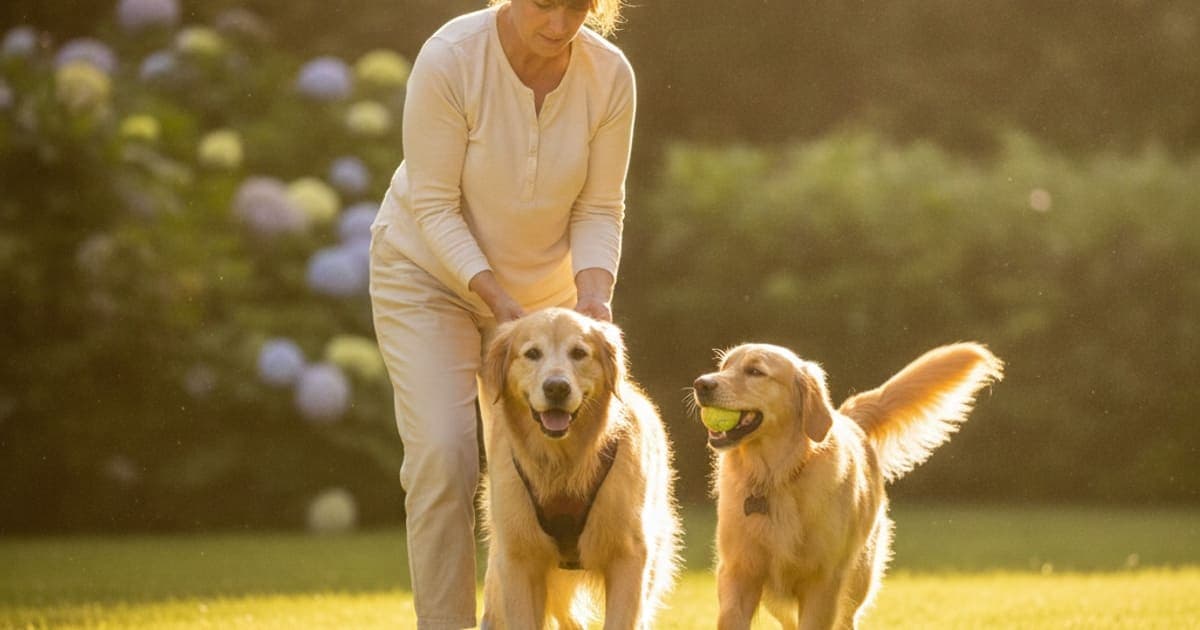
How long does hip weakness take in a dog?
Recovery from hip weakness in a dog generally runs from a few weeks to several months, and that range is wide for one reason: hip weakness is a symptom, not a diagnosis. A mild muscle strain in an otherwise fit dog often looks substantially better within two to six weeks of restricted activity and good pain control. Weakness driven by early arthritic change in the hip usually improves gradually over one to three months of weight management, conditioning and veterinary care, then shifts into long-term maintenance rather than a finish line. Recovery after hip surgery — a femoral head ostectomy, a total hip replacement, or repair of a fracture near the joint — is typically staged across three to six months of progressive rehabilitation, and longer in a big dog who lost a lot of muscle before the operation.
So the honest answer is that the timeline belongs to the cause, not to the limp. Two dogs can walk into the same clinic with the same wobbly back end and leave on completely different clocks — one on a four-week plan, one on a six-month one.
What owners call hip weakness, and what is usually underneath it
When an owner says the hips are going, they are describing a pattern: a rear end that sways, difficulty rising from the floor, reluctance to jump into the car, bunny-hopping at a run, or a dog who sits down halfway through a walk. That pattern has many possible sources.
Common ones include hip dysplasia and the osteoarthritis that follows it, strains of the iliopsoas or gluteal muscles, cranial cruciate ligament injury in the knee that reads as rear-end weakness, lumbosacral spinal disease compressing the nerve roots that supply the hind limbs, intervertebral disc disease, degenerative myelopathy in older large-breed dogs, tick-borne or immune-mediated joint disease, and growth-related bone pain in a young dog.
Those fall into two very different families. Orthopaedic weakness is pain-driven — the dog can move the leg but does not want to load it. Neurological weakness is signal-driven — the message from the spinal cord is arriving late or incompletely, so the paw scuffs, the nails wear flat on one side, and the dog crosses its back legs when turning. The single biggest determinant of how long hip weakness lasts is not which supplement or therapy you choose — it is whether the underlying cause is a healing injury, a degenerative joint, or a nerve problem, and only a veterinary exam with imaging can tell you which one you are dealing with.
Why the tissue involved sets the clock
Different tissues repair on completely different schedules, and this is the most useful thing an owner can understand about recovery time.
Muscle has a rich blood supply and repairs comparatively quickly, which is why a straightforward gluteal or hamstring strain often turns around in weeks. Tendon and ligament are far less vascular and rebuild collagen slowly; the tissue can feel functional long before the fibres have finished reorganising along their load lines, which is exactly why dogs re-injure themselves at the four-week mark when they feel good and the owner relaxes the restrictions. Bone knits over weeks and then continues remodelling for months. Cartilage has very limited capacity to repair itself, which is why arthritic weakness is managed rather than closed out. Nerve recovers slowest and least predictably of all, and improvement can continue in small increments for many months.
Muscle mass is the other half of the picture. A dog who has been favouring one hind leg for months has genuinely lost muscle on that side, and rebuilding it is a training project measured in months, not a healing project measured in weeks. Even after the painful structure is comfortable, the dog stays weak until that muscle comes back.
Recovery windows by underlying cause
The patterns below are the general shapes that veterinary and rehabilitation teams describe. They are orientation, not prediction — your veterinarian's estimate for your specific dog, based on the exam and the imaging, will always be more accurate than any range in an article.
| Underlying cause | What is actually repairing | General recovery pattern | Biggest influences on the timeline |
|---|---|---|---|
| Muscle strain (iliopsoas, gluteal) | Muscle fibres and fascia | Noticeable improvement over weeks; full return to sport takes longer | Strict early rest, then a graded return instead of a sudden one |
| Hip osteoarthritis / dysplasia | Nothing regrows; joint mechanics and muscle support change | Gradual improvement over weeks to months, then ongoing maintenance | Body weight, consistent low-impact exercise, pain control |
| Ligament injury (including CCL) | Collagen remodelling | Months, whether managed conservatively or surgically | Stability of the joint, size of the dog, adherence to restrictions |
| Post-surgical hip (FHO, THR, fracture repair) | Bone, soft-tissue envelope, then muscle | Staged rehab across several months | Pre-op muscle condition, quality of rehab, owner compliance |
| Lumbosacral or disc-related weakness | Nerve function and inflammation resolving | Slow, stepwise, sometimes incomplete | Degree of compression, how long signs were present, medical or surgical plan |
| Degenerative myelopathy | Progressive nerve loss | Not a recovery curve; function is supported, not restored | Rehab, footing, harnesses and cart support |
The four phases most hip recoveries move through
Almost every recovery, whatever the cause, moves through the same four stages — and knowing which one you are in tells you more than counting days.
Phase one: diagnosis and offloading. Pain control, rest, non-slip footing, no stairs or furniture. Days to a couple of weeks. Skipping this phase is the most common reason a three-week problem becomes a three-month one.
Phase two: controlled loading. Short, frequent, flat, on-leash walks that stay well inside the dog's tolerance. Tissue reorganises in response to load, so this phase is where healing actually gets directed — but the load has to be boring and measured.
Phase three: rebuilding strength. Hill work, cavaletti poles, sit-to-stand repetitions, underwater treadmill if it is available to you. This is where the lost muscle comes back and where most of the visible transformation happens.
Phase four: maintenance. For degenerative causes, this phase never ends — it just becomes the new normal of a lean body, daily consistent movement, and periodic veterinary reassessment.
What speeds recovery up, and what quietly stalls it
The factors that shorten a recovery are unglamorous and mostly free. Keeping the dog lean is the highest-leverage one, because every extra kilogram passes through the hip joint on every stride. Consistent daily low-impact movement beats a sedentary week followed by a big weekend. Non-slip flooring, a ramp instead of a jump into the car, and a supportive bed all remove repeated small insults to a healing joint.
The factors that stall recovery are just as predictable: returning to full activity as soon as the limp disappears, under-treated pain that makes the dog unwilling to use the leg at all, an incomplete diagnosis that treats a hip when the problem is a knee or a spine, and inadequate protein in an older dog who is trying to rebuild muscle. If your dog is on a prescribed medication such as an NSAID or a nerve-pain drug, keep it exactly as your veterinarian directed — pain control is not the opposite of recovery, it is what makes the loading phases possible.
Where BPC-157 and TB-500 fit into a recovery window
Peptides have become part of how a lot of owners approach the long middle of a recovery — the weeks between the diagnosis and the return of normal function. BPC-157 is a short peptide chain studied for its effects on new blood vessel formation and on the behaviour of the fibroblasts that lay down collagen in tendon and ligament; published research suggests it may support the repair environment in connective tissue and the gut lining. TB-500 is a fragment related to thymosin beta-4, a protein involved in actin binding and cell migration, and research suggests it may support the movement of repair cells into an injured area. This is emerging and genuinely promising science, and it is the reason peptides have moved from performance circles into everyday canine recovery routines.
What that means practically is a mechanism story, not an outcome promise. Neither compound is an FDA-approved veterinary drug, neither replaces surgery or a prescription, and no peptide changes the fact that collagen and nerve tissue work on their own timetable. What owners report is that they use them as part of the recovery stack alongside the veterinary plan — the rest, the rehab, the weight control.
If you are comparing options, the thing worth being sceptical about is the mobility chew aisle: kitchen-sink labels with a dozen ingredients at token amounts, proprietary blends that hide how little of anything is actually in the scoop, and brands with more marketing than analysis. pawgen built K9-REPAIR around the opposite approach — a defined BPC-157 and TB-500 formulation, weight-based dosing guidance, third-party testing with certificates of analysis available, direct-to-door shipping, and a 60-day money-back guarantee. Any dosing question, particularly for a puppy, a pregnant or a nursing dog, belongs with your veterinarian rather than with a number from an article.
If your dog is not improving on the expected schedule
Progress stalls after a promising first fortnight
An early plateau often means the activity plan advanced faster than the tissue did, or that pain control is no longer adequate. It can also mean there is a second problem — a compensating knee or shoulder — that only became obvious once the first one settled. This is a re-examination, not a wait-and-see.
The weakness moves, or affects both back legs equally
Symmetrical rear-end weakness, or weakness that seems to shift sides, points more toward the spine than the hip. Nerve-driven cases follow their own timeline and often need imaging beyond a standard hip radiograph.
You see scuffed nails, dragging toes, or crossing hind legs
These are neurological signs rather than orthopaedic ones, and they change the urgency. Book a veterinary appointment promptly rather than adding another week of rest.
Key Takeaways
- Hip weakness recovery generally spans a few weeks to several months; the cause, not the severity of the limp, sets the clock.
- Muscle repairs fastest, ligament and bone slower, cartilage barely, and nerve slowest and least predictably.
- Post-surgical hip recovery is typically a staged, months-long rehabilitation project rather than a single healing window.
- Losing muscle is fast and rebuilding it is slow, so a comfortable dog can still be a weak dog for months.
- Body weight, consistent low-impact movement and good footing are the highest-leverage things an owner controls.
- Research suggests BPC-157 and TB-500 may support the tissue-repair environment, and owners use them through the recovery window alongside their veterinary plan — they are not FDA-approved veterinary drugs.
- Plateaus, symmetrical weakness or scuffed nails are reasons to go back to the veterinarian rather than reasons to wait longer.
Working with your veterinarian on a realistic timeline
The most valuable number in this whole article is the one you do not have yet: your own dog's diagnosis. Your veterinarian owns that, and the treatment plan that follows it — the imaging, the pain management, whether surgery is on the table, and how quickly activity should progress. Ask them directly what tissue is healing and what a reasonable checkpoint looks like at four weeks and at twelve, because a recovery you can measure is a recovery you can stick to. Supplements and peptides work inside the space that proper veterinary care creates; they never replace it.
Related reading from pawgen: hip weakness, what are the first signs of hip weakness in dogs, how is hip weakness diagnosed in dogs, how much does it cost to treat hip weakness in dogs, bpc-157 for hock injury in dogs, and bpc-157 for toe injury in dogs.
Owners exploring peptide support for their dog can review K9-REPAIR — BPC-157 + TB-500 formulated for dogs — at https://pawgen.com/. BPC-157 and TB-500 are not FDA-approved veterinary drugs. Nothing in this article treats, cures or prevents any condition; every decision about your dog's care belongs with your veterinarian.
Frequently asked questions
- What makes hip weakness worse in dogs?
- Excess body weight is the biggest aggravator, because every extra kilogram loads the joint on every stride. Slippery floors, jumping in and out of vehicles, stairs, long sedentary stretches followed by bursts of hard activity, under-treated pain, and returning to full exercise the moment a limp disappears all reliably set recovery back.
- Can hip weakness in dogs be reversed?
- It depends entirely on the cause. Weakness from a muscle strain or a soft-tissue injury can resolve completely with rest and graded rehab. Weakness driven by osteoarthritis or progressive nerve disease is managed rather than undone — function and comfort often improve substantially, but the underlying joint or nerve change remains. Your veterinarian can tell you which category applies.
- How much does it cost to treat hip weakness in dogs?
- Costs vary widely by clinic, region and diagnosis. An examination with radiographs sits at the lower end, ongoing pain medication and rehabilitation sessions are recurring monthly costs, and joint surgery such as a hip replacement is by far the largest single expense. Ask your veterinary practice for a written estimate before committing to imaging or surgery.
- What are the first signs of hip weakness in dogs?
- The earliest signs are usually subtle changes in how a dog moves rather than obvious limping: slower to rise from lying down, reluctance to jump into the car or onto furniture, a swaying back end, bunny-hopping when running, sitting down partway through walks, and shifting weight forward onto the front legs when standing.
- How is hip weakness diagnosed in dogs?
- Diagnosis starts with a hands-on orthopaedic and neurological exam to localise the problem, since knees and spines often masquerade as hips. Radiographs of the hips and lower spine usually follow. Depending on findings, your veterinarian may add bloodwork, joint fluid analysis, or advanced imaging such as CT or MRI to distinguish joint disease from nerve compression.
- What helps a dog with hip weakness?
- Keeping the dog lean, consistent daily low-impact exercise, non-slip flooring, ramps instead of jumps, a supportive bed, and the pain-control plan your veterinarian prescribed. Formal rehabilitation builds back lost muscle. Many owners also add a peptide formulation such as K9-REPAIR through the recovery window; research suggests BPC-157 and TB-500 may support tissue repair processes.
- How long after hip surgery before a dog walks normally again?
- Most hip surgeries are followed by a staged rehabilitation plan spanning several months, with weight-bearing returning well before normal gait and full muscle mass do. Large dogs and dogs who lost significant muscle before surgery generally need longer. Your surgeon sets the progression checkpoints, and following them precisely matters more than the calendar.
- Should I rest my dog or exercise them for hip weakness?
- Both, in sequence. Early on, strict rest and restricted movement protect healing tissue. After that, controlled loading — short, flat, on-leash walks — is what directs repair and rebuilds strength, so indefinite crate rest actually slows recovery. Ask your veterinarian when to transition and how quickly to advance activity.
Educational content. BPC-157 and TB-500 are not FDA-approved veterinary drugs. Talk to your veterinarian before starting anything new, especially if your dog is on prescribed medication.