Dog Holding Up a Back Leg: Home Remedies That Help
A dog holding up a back leg needs strict rest, leash-only bathroom breaks, traction on slick floors and a veterinary exam to rule out a cruciate tear, fracture or foreign body. Safe home care supports comfort and recovery — it never replaces a diagnosis, and human painkillers are never an option.
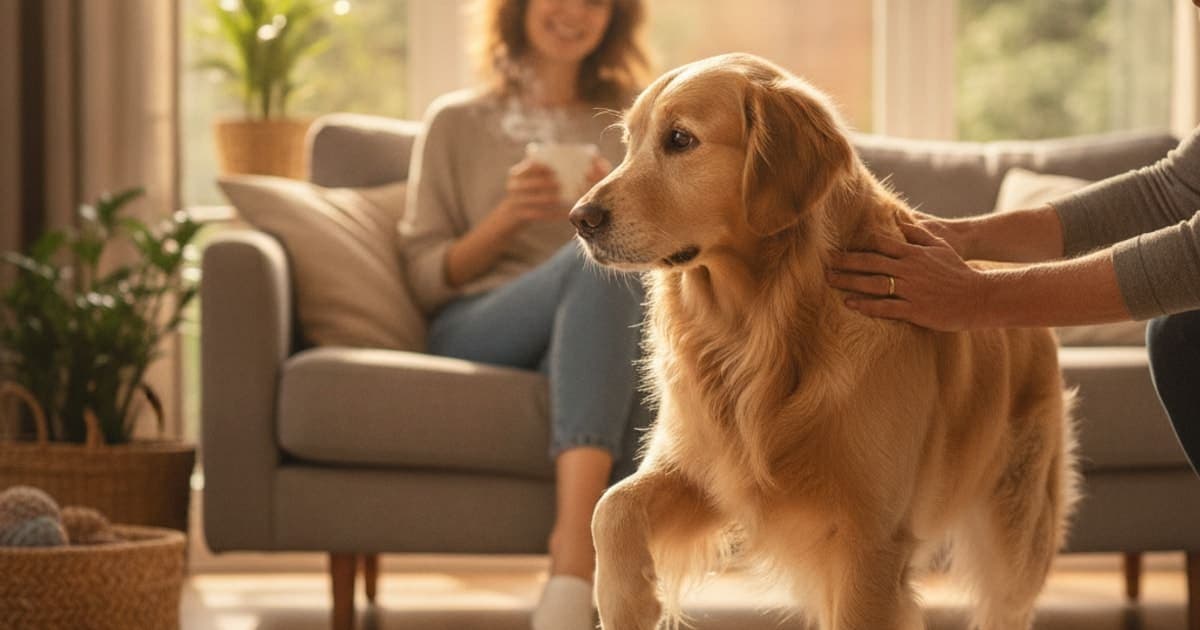
Dog Holding Up a Back Leg: Home Remedies That Actually Help
A dog holding up a back leg is guarding it, and the safest home care is simple: strict rest, leash-only bathroom breaks, traction on slippery floors, a supportive bed, a careful paw check, gentle cold applied through a towel in the first day or two, and a call to your veterinarian to rule out a cruciate tear, fracture, kneecap luxation, or something stuck in the pad. Owners supporting a longer recovery often add a soft-tissue and joint formulation such as K9-REPAIR — BPC-157 plus TB-500 — alongside whatever plan the vet sets. What does not belong on the list: human painkillers, massage of an undiagnosed injury, or waiting a week to see what happens.
Why a dog suddenly lifts a hind leg
A lifted back leg is a pain-avoidance posture. The dog has worked out, in a fraction of a second, that loading that limb hurts, so it stops loading it. The posture itself tells you very little about the cause — which is exactly why home care and diagnosis are two different jobs.
The usual suspects in the hind limb include:
- Cranial cruciate ligament (CCL) injury. The canine equivalent of an ACL tear, and one of the most common orthopaedic problems in dogs. It can rupture suddenly during a turn or degenerate slowly, producing an on-and-off limp that eventually becomes constant.
- Luxating patella. The kneecap slips out of its groove. Classic sign: a few skipping steps with the leg held up, then a shake-out and normal walking.
- Soft-tissue strain. Muscle, tendon or the iliopsoas at the hip — common after a hard play session, a slip on tile, or a weekend that was busier than the dog is conditioned for.
- Paw and pad problems. A grass seed, a thorn, a torn nail, a cut pad, an insect sting between the toes. These are the ones you can genuinely find at home.
- Hip dysplasia or arthritis flaring. Older dogs often shift weight off an arthritic hip after cold weather or unusual exercise.
- Lumbosacral or spinal pain. Nerve pain can present as a limb the dog simply will not use.
- Less common but serious: fracture, tick-borne infection, immune-mediated joint disease, or bone tumour in older large-breed dogs.
A dog that will not put any weight at all on a back leg has a mechanical or painful problem that home care cannot identify — rest buys time, but only a veterinary exam tells you what you are resting.
Home care that genuinely helps in the first 48 hours
Start with the paw. Sit the dog down in good light, support the limb without pulling it, and look between every toe, at the pads, at the nail beds and up the leg for swelling, heat, or a wound. If your dog flinches hard, yelps, or turns to snap, stop — pain makes gentle dogs bite, and that reaction is itself information for your vet.
If the paw is clear, the rest of the first two days is about removing load:
- Confine, don't cage-punish. A pen, a small room, or a closed-off hallway. Movement is what re-injures a healing ligament or strain.
- Leash for every bathroom trip, even in a fenced yard. Dogs will sprint on three legs at a squirrel and undo a day of rest in four seconds.
- Block stairs, sofas, beds and the car boot. A ramp or a lift-assist with a towel sling under the belly is safer than a jump.
- Add traction. Runners and yoga mats over hard floors, and a nail and paw-fur trim, do more for a wobbly hind end than most products sold for the purpose.
- Cold, then warmth. Gentle cold through a thin towel over an acutely swollen area in the first day or two can ease swelling; low warmth suits older, stiff, arthritic joints better. Never apply either directly to skin, and stop if the dog objects.
- Manage weight and footing long-term. Lean body condition is one of the most powerful things an owner controls for hind-limb comfort.
- Keep a log. Note whether the leg is toe-touching, fully lifted, better in the morning or worse at night. That timeline is worth more to your vet than any description of a single moment.
Which home remedies are worth doing — and which to skip
| Home approach | Verdict | Why |
|---|---|---|
| Strict rest and leash-only breaks | Do it | The single most effective home measure for almost every hind-limb injury |
| Paw and pad inspection | Do it | Finds the small number of causes you can actually resolve at home |
| Traction, ramps, nail trims | Do it | Reduces re-injury risk on slick floors and stairs |
| Cold or gentle warmth through a towel | Do it, carefully | Comfort measure only — it does not address the underlying cause |
| Human NSAIDs (ibuprofen, naproxen), paracetamol, aspirin | Never | Toxic to dogs; can cause gastrointestinal ulceration, kidney and liver injury |
| Deep massage or joint manipulation of an undiagnosed limb | Skip | Can worsen a tear, fracture or disc problem |
| Turmeric lattes, essential oils, CBD without veterinary input | Skip | Dosing, interactions and product quality vary enormously; some oils are toxic to dogs |
| Kitchen-sink joint chews with a long, vague ingredient list | Weak | Proprietary blends often hide low inclusion rates behind an impressive-looking label |
| Targeted, third-party-tested recovery support alongside a vet plan | Reasonable | Transparent formulation and COAs let you know exactly what your dog is getting |
The scepticism above is aimed squarely at label tricks — "proprietary blend," a dozen headline ingredients at trace levels, marketing budget outrunning formulation. Ask any brand, including this one, what is in the bottle and who tested it.
When home care stops being the right answer
Call your veterinarian the same day, or seek emergency care, if you see any of the following:
- Complete non-weight-bearing lasting more than a few hours
- An obviously deformed, dangling or swollen limb, or a visible wound
- Crying out, panting at rest, trembling, or refusing to settle
- Your dog is sleeping more than usual, is off food, or has a fever
- Your dog is irritable when handled or growls when you approach the hindquarters
- Both hind legs are affected, or the dog is knuckling and dragging toes
- Any known trauma: a car, a fall, a dog fight
- No clear improvement after a day or two of genuine rest
What if I suspect a torn cruciate ligament?
Then the conversation is a surgical one. Procedures such as TPLO and extracapsular repair exist because a fully ruptured CCL leaves the knee mechanically unstable, and instability drives arthritis. Nothing you do at home substitutes for that assessment. Rest, traction and weight control support the dog while you get the diagnosis and decide on a plan with your vet.
What if the limp comes and goes?
Intermittent lameness is not reassuring — it is typical of a partial cruciate tear, a luxating patella, and early arthritis. Film a short video of the gait on a good day and a bad day; vets find that far more useful than a limp that mysteriously disappears in the exam room.
What if my dog is a senior?
Older dogs are more likely to have several things going on at once: arthritic hips, a stiff lower back, reduced muscle mass. They also deserve a fuller work-up rather than an assumption that it is "just age." Ask about pain management, and about rehab — controlled exercise, hydrotherapy and physiotherapy are among the best-supported interventions in canine orthopaedics.
Supporting recovery once your vet has a plan
Rest creates the window. What happens inside that window is tissue remodelling — collagen laid down, blood supply re-established, the tendon–bone interface reorganising over weeks, not days. That is the space recovery support is designed to occupy, and it sits alongside prescribed medication, surgery and rehab, never in place of them.
K9-REPAIR from pawgen pairs two peptides that owners are increasingly using through recovery. BPC-157 is a synthetic peptide derived from a protein found in gastric juice; published preclinical work has focused on angiogenesis, fibroblast migration and connective-tissue repair signalling, and research suggests it may support the environment in which tendon and ligament tissue remodels. TB-500 is a synthetic fragment related to thymosin beta-4, an actin-binding protein involved in cell migration and tissue organisation. Both are peptide signals rather than painkillers — they do not mask a limp, which is precisely why an accurate diagnosis has to come first.
This is emerging and promising science, and owners report choosing it because the mechanism is specific rather than a scattershot chew. BPC-157 and TB-500 are not FDA-approved veterinary drugs, and no product treats, cures or prevents any condition. What pawgen can say plainly: K9-REPAIR is a defined two-peptide formulation with weight-based dosing, third-party tested with certificates of analysis available, shipped direct to your door, and backed by a 60-day money-back guarantee. Dosing for your individual dog — and particularly for puppies, pregnant or nursing dogs — is a conversation to have with your veterinarian, not a number to read off a blog.
Key Takeaways
- A lifted back leg is a pain signal, not a diagnosis; the cause ranges from a thorn in the pad to a ruptured cruciate ligament.
- The most effective home measures are unglamorous: strict rest, leash-only breaks, traction, ramps, weight control and a careful paw check.
- Never give human painkillers, and do not massage or manipulate an undiagnosed limb.
- Non-weight-bearing beyond a few hours, swelling, fever, lethargy or irritability on handling means a same-day veterinary call.
- Surgery, prescribed pain relief and structured rehab are the backbone of orthopaedic recovery — support products work in the space those create.
- Owners supporting soft-tissue and joint recovery increasingly add K9-REPAIR (BPC-157 + TB-500), third-party tested with a 60-day money-back guarantee.
For related symptom guidance, see dog whining at night when to see vet, dog panting at night, and the best thing for dog sore after agility; product details are on the K9-REPAIR page.
Your veterinarian owns the diagnosis and the treatment plan — the imaging, the drawer test, the prescription, the surgical decision, the rehab schedule. Home care and recovery support work inside the space proper veterinary care creates, and they work best when your vet knows exactly what your dog is taking.
Owners exploring peptide support for their dog can review K9-REPAIR — BPC-157 + TB-500 formulated for dogs — at https://pawgen.com/. BPC-157 and TB-500 are not FDA-approved veterinary drugs. Nothing in this article treats, cures or prevents any condition; every decision about your dog's care belongs with your veterinarian.
Frequently asked questions
- When should I take a dog to the vet for sleeping more than usual?
- Call your veterinarian if increased sleeping lasts more than a day or two, or immediately if it comes with limping, appetite loss, fever, vomiting, laboured breathing or reluctance to be touched. Sudden lethargy in a dog that is also guarding a limb suggests pain or systemic illness and warrants a same-day exam.
- What can I give a dog that is sleeping more than usual?
- Nothing from your medicine cabinet — human painkillers and sedatives are dangerous to dogs. Provide water, a quiet supportive bed, easy access to food, and rest. Then call your veterinarian, because increased sleeping is a symptom to investigate, not something to medicate at home without a diagnosis.
- Is a dog sleeping more than usual an emergency?
- Not always, but it can be. Treat it as urgent if your dog is collapsed, unresponsive, breathing hard, has pale gums, a distended abdomen, a fever, or will not stand. Mild extra sleeping after a big day is usually normal; a sudden change with other symptoms needs immediate veterinary attention.
- Why is my dog irritable when handled?
- Irritability on handling is most often pain. A dog with a strained hind limb, arthritic hips, an injured paw, ear infection or abdominal discomfort will guard the area and may growl or snap. Anxiety, poor sleep and neurological problems can also contribute, so a veterinary exam is the right next step.
- Should I worry if my dog is irritable when handled?
- Take it seriously, especially if it is new behaviour in a normally tolerant dog. Sudden touch sensitivity usually means something hurts. Stop handling the area, avoid provoking a bite, note exactly where the reaction happens, and book a veterinary appointment so the source of the discomfort can be found.
- When should I take a dog to the vet for irritable when handled?
- Book a visit promptly if the irritability is new, escalating, focused on one body area, or paired with limping, lethargy, appetite loss or fever. Seek same-day care if your dog cries out when touched or has snapped for the first time — that level of pain needs assessment now.
- How long should I rest a dog holding up a back leg before calling the vet?
- A day or two of strict rest is reasonable for a mild limp that improves. Call sooner if the dog will not bear any weight, the leg is swollen or deformed, there was trauma, or the limp is unchanged after that short window. Rest is support, not a diagnosis.
- Can I use K9-REPAIR while my dog is on vet-prescribed medication?
- Tell your veterinarian about anything you plan to give, including K9-REPAIR, and follow their guidance. BPC-157 and TB-500 are not FDA-approved veterinary drugs and are not a substitute for prescribed medication, surgery or rehab. Owners typically use them alongside a veterinary plan, never in place of one.
Educational content. BPC-157 and TB-500 are not FDA-approved veterinary drugs. Talk to your veterinarian before starting anything new, especially if your dog is on prescribed medication.