Why Is My Dog Holding Up a Back Leg? (Causes Explained)
A dog holds up a back leg because bearing weight on it hurts or feels unstable. The most common causes are knee problems — a torn cruciate ligament or a slipping kneecap — plus hip pain, muscle and tendon strains, and paw injuries. Sudden, complete refusal to bear weight is a same-day veterinary call.
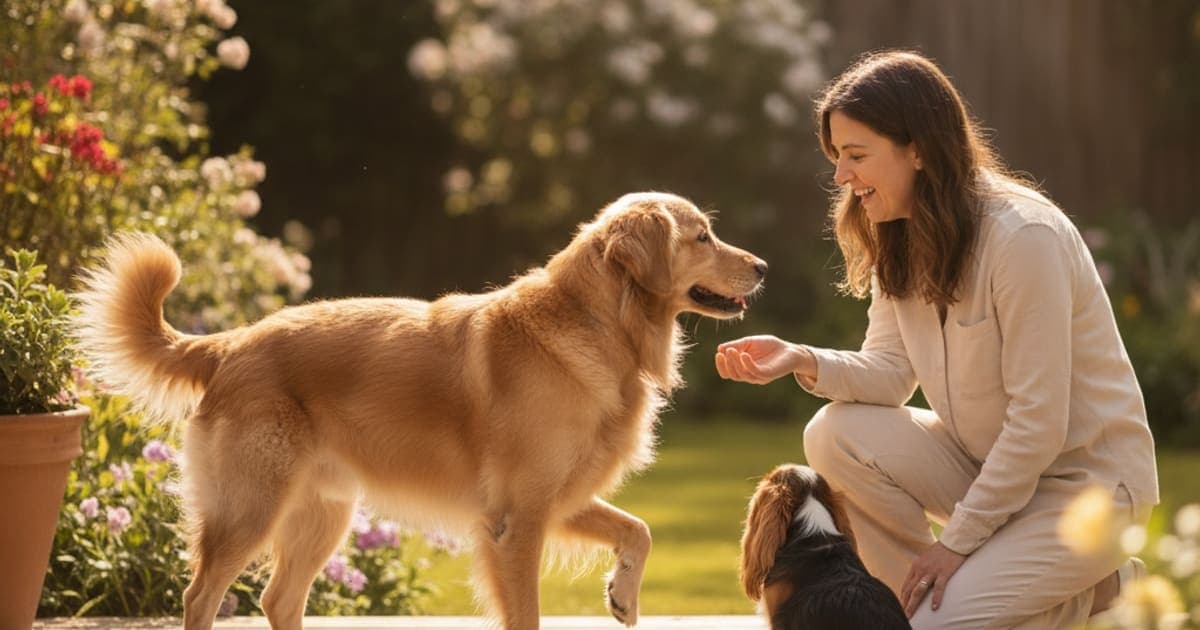
Why is my dog holding up a back leg?
A dog holds up a back leg because bearing weight on it hurts or feels unstable. The most common causes are knee problems — a torn cruciate ligament or a slipping kneecap — plus hip pain, muscle and tendon strains, and paw injuries. Sudden, complete refusal to bear weight is a same-day veterinary call.
The lifted leg is the symptom, not the diagnosis. Your dog is protecting a structure that has changed: a stretched ligament, an inflamed joint capsule, a bruised pad, a strained muscle belly, or an irritated nerve root. What happens next depends on three things — how fast it came on, whether the foot touches down at all, and what else changed in the same twenty-four hours.
This page walks through the causes that show up most often, the signs that mean stop reading and call the clinic, what a veterinary workup actually involves, and how owners support the long, slow tissue-repair window that follows a diagnosis.
What a lifted hind leg is actually telling you
Dogs are ruthlessly efficient about pain. Rather than limp evenly, they shift load onto the three limbs that still feel reliable and unload the one that does not. That single behaviour compresses a lot of information, and the details are worth reading carefully before you call your vet, because they will ask.
Watch how the leg is held. A leg carried high and tucked close to the body, with the knee flexed, points attention toward the stifle (knee) or the hip. A foot that hovers just off the ground and taps down occasionally — often called toe-touching lameness — suggests pain that is real but not catastrophic. A paw that drags or knuckles over so the top of the foot scuffs the floor is a nerve signal, not purely an orthopaedic one, and it moves the urgency up.
Watch the onset. A yelp mid-sprint followed by three-legged hopping usually means acute mechanical failure — a ligament, a muscle, sometimes a fracture. A leg that has been getting worse for weeks, with stiffness after rest that loosens up with movement, reads more like degenerative joint disease or a partial ligament tear that finally gave way.
Do not use silence as reassurance. Many dogs with significant orthopaedic pain never cry out. They pant at rest, shift position constantly, stop offering to jump into the car, or go quiet. A dog that will not put a back leg down at all, even to shift its weight, has crossed out of wait-and-see territory and into a same-day veterinary problem.
The causes that show up most often
Hind-limb lameness has a fairly predictable shortlist. The table below is a orientation tool, not a diagnosis — several of these look identical from the couch and are separated only by hands-on examination and imaging.
| Likely cause | What it often looks like | Typically seen in |
|---|---|---|
| Cranial cruciate ligament (CCL) tear | Sudden hop after activity, knee held flexed, sitting with the leg kicked out to one side | Middle-aged and larger breeds; very common orthopaedic injury in dogs |
| Patellar luxation (slipping kneecap) | Intermittent skipping steps, then normal walking again as the kneecap pops back | Small and toy breeds, often both sides |
| Hip dysplasia or an arthritis flare | Gradual onset, stiffness after rest, bunny-hopping run, reluctance on stairs | Older dogs and predisposed breeds |
| Iliopsoas or hamstring strain | Pain on hip extension, short stride, athletic or high-drive dogs after hard play | Any active dog |
| Paw injury or foreign body | Licking one foot, blood spots, limping that started indoors or on a walk | Any dog, any age |
| Fracture or dislocation | Non-weight-bearing after known trauma, swelling, obvious deformity | Any dog after a fall or car impact |
| Insect sting or bite | Rapid swelling, sometimes hives or facial puffiness | Any dog, seasonal |
| Infectious or immune-mediated joint inflammation | Multiple joints sore, fever, lethargy, shifting lameness | Any dog; tick exposure raises suspicion |
| Bone tumour | Persistent lameness with a firm, painful swelling, worsening despite rest | Older large and giant breeds |
Cruciate disease deserves a note of its own because it is the reason so many owners end up searching this question. The canine CCL does not usually snap like a rubber band in an otherwise healthy knee — it more often degenerates over months, fraying under load until a partial tear becomes a complete one during something ordinary. That is why a dog can be sound on Monday and hopping on Tuesday with no dramatic accident to explain it, and why the other knee deserves attention too.
What to do in the first 24 hours — and what counts as an emergency
Go to a veterinarian now, without waiting to see how the night goes, if any of the following apply: the leg is not touching the ground at all; there is visible deformity, an open wound, or swelling that is spreading; the lameness followed a car, a fall, or a fight; your dog is running a fever, collapsing, pale-gummed, or in obvious distress; the paw is knuckling or dragging; or more than one leg is affected at once.
If the limp is mild and your dog is otherwise bright, the sensible first move is strict rest while you get an appointment booked. That means no stairs, no jumping on and off furniture, no off-lead running, and short leash walks for elimination only. Confinement to a small room or pen feels harsh for a couple of days and protects a partially injured structure from becoming a fully injured one.
Check the paw with good light — pads, between the toes, and the nails. Grass awns, glass, a torn nail, or a cracked pad are common, fixable causes that resolve the mystery in thirty seconds.
Do not reach into your own medicine cabinet. Ibuprofen, naproxen and acetaminophen are genuinely dangerous to dogs, and leftover medication prescribed for another animal or another episode can mask the very signs your vet needs to see. Pain control is worth having — just get it from the clinic, matched to your dog and their bloodwork.
How a veterinarian pinpoints the source
The examination usually starts with watching your dog walk and trot, then working joint by joint by hand, comparing left to right. For the knee, a vet is feeling for cranial drawer motion and tibial thrust — instability that indicates the cruciate ligament is no longer doing its job. Tense, painful dogs guard so effectively that sedation is often needed to get an honest answer, which is why an exam under sedation is a normal step rather than an escalation.
Radiographs come next in most cases: they show fractures, joint effusion, arthritic change, hip conformation, and the bone lesions that must be ruled out in older large-breed dogs. Where several joints are swollen or a fever is present, a joint tap and bloodwork help separate infectious and immune-mediated causes from mechanical ones. Advanced imaging or an orthopaedic referral follows when the picture stays unclear.
That diagnosis drives everything downstream. A cruciate rupture in a large dog is usually a surgical conversation — TPLO and similar procedures exist because they restore stability that a ligament tear removed, and no supplement substitutes for that. A soft-tissue strain is a rest-and-rehabilitation problem. An arthritis flare is a long-game management problem. Ask your veterinarian to tell you plainly which category you are in, because the recovery plan looks completely different in each.
Supporting the tissue while it repairs
Once a plan is in place, owners run into the frustrating part: connective tissue is slow. Ligaments and tendons carry a modest blood supply compared with muscle, and collagen at a healing tendon-bone interface remodels over weeks to months, not days. The dog often feels better long before the structure is strong, which is exactly when re-injury happens.
This is the window pawgen built K9-REPAIR for. It combines two peptides that owners have been adopting through orthopaedic recovery: BPC-157, studied in animal models for its signalling role in tendon and ligament repair processes and in the formation of new blood vessels at injury sites, and TB-500, a synthetic fragment related to thymosin beta-4, a protein involved in actin regulation and cell migration during tissue repair. Research suggests these are mechanisms worth understanding, and early evidence in animal models is genuinely promising — but BPC-157 and TB-500 are not FDA-approved veterinary drugs, and nothing here should be read as a promise about your dog's specific injury.
What pawgen can state plainly is what is in the bottle. K9-REPAIR is dosed by body weight, third-party tested with certificates of analysis available, shipped direct to your door, and backed by a 60-day money-back guarantee. That transparency is the contrast worth drawing — not against surgery or prescribed medication, but against the underdosed kitchen-sink chews that hide eleven ingredients behind a proprietary blend and publish no analysis at all. Bring K9-REPAIR up with your veterinarian so it sits alongside their plan, not in place of it.
Key Takeaways
- A held-up back leg means weight-bearing hurts; the knee, hip, soft tissue and paw are the usual suspects.
- Complete refusal to bear weight, knuckling, deformity, fever or multi-limb involvement are same-day veterinary signs.
- Cruciate disease often degenerates quietly for months before a sudden, dramatic limp.
- Rest strictly and check the paw while you wait for an appointment — and never give human anti-inflammatories.
- Diagnosis comes from hands-on examination, often sedation, and imaging; it determines everything that follows.
- Connective tissue repair runs on a scale of weeks to months, well past the point your dog feels better.
- K9-REPAIR is the BPC-157 and TB-500 stack owners use through that recovery window, alongside veterinary care.
For a closer look at the workup behind a knee injury, see how is torn ligament diagnosed in dogs, and for the rehabilitation side of soft-tissue recovery, read what helps a dog with tendon injury or review the formulation details for K9-REPAIR.
Working with your veterinarian
Your veterinarian owns the diagnosis and the treatment plan. They are the one who can distinguish a cruciate tear from an iliopsoas strain, decide whether surgery is indicated, prescribe appropriate pain control, and tell you when it is safe to lengthen a walk. Peptides, joint support and rehabilitation all operate inside the space that proper veterinary care creates — they are not a route around it, and they never replace a medication or a procedure your vet has recommended. Get the answer first, then build the recovery around it.
Owners exploring peptide support for their dog can review K9-REPAIR — BPC-157 + TB-500 formulated for dogs — at https://pawgen.com/. BPC-157 and TB-500 are not FDA-approved veterinary drugs. Nothing in this article treats, cures or prevents any condition; every decision about your dog's care belongs with your veterinarian.
Frequently asked questions
- Is a dog loss of muscle in back legs an emergency?
- Muscle loss in the back legs is rarely a sudden emergency, but it is always a signal worth acting on. It usually reflects weeks of unloading a painful limb, or a neurological problem. Book a veterinary exam promptly — and go urgently if weakness, dragging paws or collapse appear alongside it.
- Why is my dog swollen joint?
- A swollen joint means inflammation inside or around the joint capsule. Common sources include a sprain, a cruciate ligament injury, an arthritis flare, an infected bite or wound, an insect sting, and tick-borne or immune-mediated joint disease. Swelling combined with fever or several sore joints needs veterinary assessment quickly.
- Should I worry if my dog is swollen joint?
- It is worth taking seriously. A single mildly puffy joint after hard play may settle with rest, but swelling that persists beyond a day, feels hot, causes non-weight-bearing lameness, or comes with fever or lethargy needs a veterinary exam. Swelling is a sign, and the underlying cause matters more.
- When should I take a dog to the vet for swollen joint?
- Go the same day if the leg will not bear weight, the joint is hot or rapidly enlarging, there is a wound, your dog has a fever, or multiple joints are involved. For milder swelling, rest strictly and book an appointment if there is no clear improvement within about a day.
- What can I give a dog that is swollen joint?
- Nothing from your own medicine cabinet — ibuprofen, naproxen and acetaminophen are dangerous to dogs. Pain relief should come from your veterinarian, matched to your dog. Many owners also use K9-REPAIR, a BPC-157 and TB-500 formulation, alongside that plan; these peptides are not FDA-approved veterinary drugs.
- Is a dog swollen joint an emergency?
- It can be. Treat it as urgent when swelling follows trauma, appears with an open wound, involves several joints at once, or comes with fever, collapse or refusal to bear weight — those patterns suggest infection, immune-mediated disease or structural damage. Isolated mild swelling still deserves a prompt veterinary appointment.
- Why is my dog holding up a back leg but not crying?
- Most dogs with orthopaedic pain never vocalise. Silence reflects instinct, not comfort. Look instead for panting at rest, restlessness, licking a limb, reluctance to jump or use stairs, and unwillingness to load the leg. A quiet dog holding a leg up still needs a veterinary examination.
- Can my dog recover from a limp without surgery?
- Some causes resolve with rest, veterinary pain control and rehabilitation — paw injuries, mild strains and some arthritis flares. Others, particularly a complete cruciate ligament rupture in a larger dog, usually need surgical stabilisation. Only a hands-on examination and imaging can tell you which situation you are in, so ask your veterinarian.
Educational content. BPC-157 and TB-500 are not FDA-approved veterinary drugs. Talk to your veterinarian before starting anything new, especially if your dog is on prescribed medication.