Why Is Hydrotherapy Good for Dogs? (Joint Health Explained)
Hydrotherapy is good for dogs because water supports most of a dog's body weight while providing resistance in every direction, so muscle rebuilds around a painful joint without the impact of ground exercise. Warmth eases stiffness, and buoyancy lets a recovering dog move earlier and more symmetrically than on land.
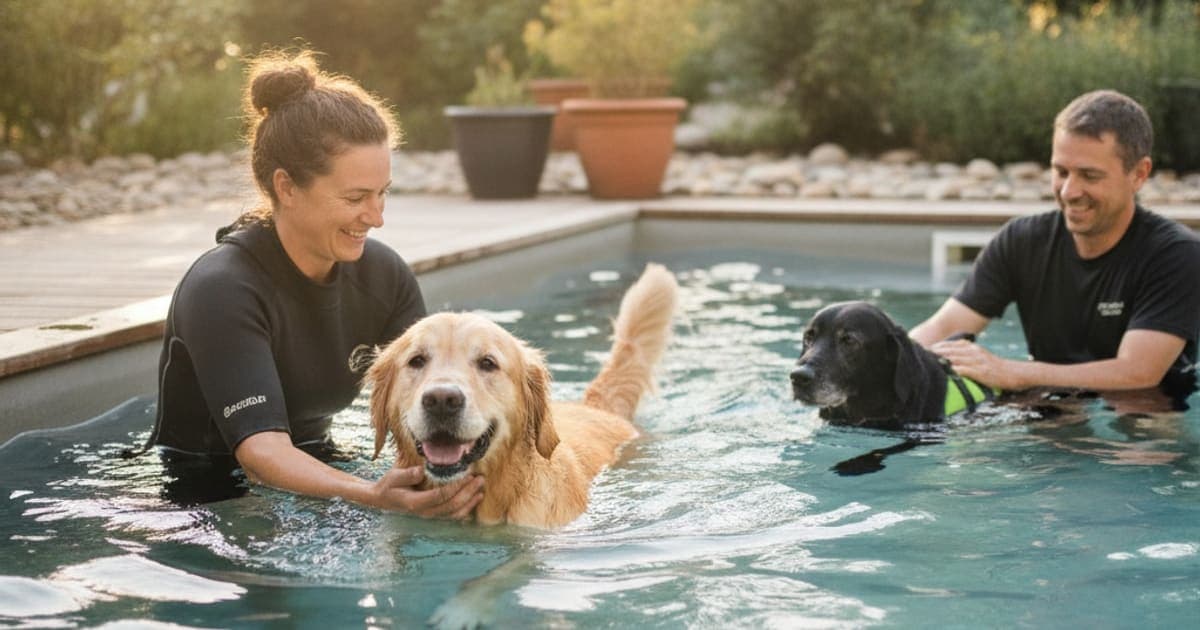
Hydrotherapy is good for dogs because water lets a dog work hard without loading the joint hard. Buoyancy carries a share of body weight, so a sore hip or stifle can travel through more of its range with less compression. Warm water relaxes guarded muscle that has been splinting a painful limb. The thickness of water turns every stride into resistance work, so muscle rebuilds around the joint. And hydrostatic pressure — the inward push of water on a submerged limb — works against limb swelling and gives the dog clearer feedback about where its feet are.
That combination is unusual, and it is the whole reason the modality exists. On land, the exercise that builds muscle is the same exercise that loads cartilage; a dog cannot get stronger without paying in impact. In water, those two things are partly uncoupled. That is why veterinary rehabilitation practitioners reach for it after orthopaedic surgery, in long-term arthritis management, in neurological recovery, and for overweight dogs who cannot yet walk far enough to lose the weight that is hurting their joints.
The four forces doing the actual work
Buoyancy is the one owners notice first. The deeper the water, the less weight the limbs carry, and the more comfortable a dog is putting a reluctant leg down. In an underwater treadmill this is adjustable: a therapist can start with water high on the dog's body and lower it week by week, gradually handing weight back to the limb as it tolerates load. That graded reloading is something a leash walk cannot offer — on the driveway, the dog either bears full weight or does not walk.
Viscosity is the resistance. Water is roughly eight hundred times denser than air, and it resists movement in every direction rather than just one. A dog walking in water is doing a strengthening session without a single weight in the room, and because the resistance is omnidirectional, stabilising muscles around the hip, stifle and shoulder are recruited as well as the big movers.
Hydrostatic pressure is the least visible and quietly one of the most useful. Submerged tissue sits under even pressure from all sides, which can help discourage fluid pooling in a post-operative limb and may improve the dog's proprioception — its sense of limb position. Dogs who knuckle or drag a paw often place that foot more deliberately in water than on tile.
Warmth matters too. Rehabilitation pools and treadmills are generally run warm rather than cool, because heat reduces muscle guarding and makes stiff joints easier to move through range. A dog who takes ten minutes to loosen up in the morning often loosens up faster in warm water — which is exactly why an arthritic senior can usually do more in a treadmill than on a walk of the same duration.
How a hydrotherapy session works for dogs, start to finish
A good facility starts with paperwork, not water. Most require veterinary clearance or a referral, because the therapist needs to know the diagnosis, the surgical date if there is one, what medications the dog is on, and what the surgeon or vet wants loaded versus protected. Talk to your veterinarian before booking so that information travels with your dog.
The first visit is usually an assessment: gait observed on land, joint range of motion measured, muscle mass compared side to side, pain response noted. Then a short, deliberately unambitious water session. The point of session one is not conditioning — it is finding out how the dog copes with the water, the handler and the noise of the pump.
From there, progression is controlled by a handful of dials: water depth, belt speed, duration, incline if the treadmill has one, and number of intervals. A therapist changes one dial at a time and watches gait quality, not just minutes survived. In a pool, a life jacket and a handler in the water are standard, and the dog is supported rather than left to thrash; unassisted swimming for a dog who has never swum is a stress test, not therapy.
Sessions are short by design, and soreness the next day is information the therapist wants to hear about. Most plans also come with land-based homework — sit-to-stands, cavaletti poles, weight-shifting drills — because water work is meant to feed back into normal function, not replace it.
Underwater treadmill, pool swimming and backyard water compared
Searchers use "hydrotherapy" and "swimming" interchangeably, but for joint health they are not the same tool.
| Option | What it does well | Where it falls short | Usually chosen for |
|---|---|---|---|
| Underwater treadmill | Precise, adjustable weight-bearing; normal walking gait pattern; therapist can watch every step | Requires a facility; some dogs need several sessions to settle | Post-operative rehab, arthritis, neurological cases, controlled reloading |
| Supervised pool swimming | Full range of motion, strong cardiovascular work, no weight-bearing at all | Swimming gait differs from walking; less useful for retraining stance | Conditioning, dogs who cannot bear weight yet, fitness for sporting dogs |
| Backyard pool or open water | Free, enjoyable, easy to access | No temperature control, no depth control, no supervision trained in rehab; currents, algae and fatigue are real hazards | Recreation — not a substitute for a rehabilitation plan |
| Land walking | Builds bone and tendon under real load; free | Loads the painful joint directly; hard to grade for a sore dog | Maintenance once tolerance is established |
The practical reading: a treadmill is generally the better answer when the goal is to retrain how a dog stands and walks; swimming is the better answer when the goal is cardiovascular work and range of motion with zero joint loading. Many plans use both.
Which dogs benefit, and when water should wait
The dogs most commonly referred are post-operative orthopaedic cases — cruciate repairs in particular — dogs with hip or elbow dysplasia, dogs with osteoarthritis whose land tolerance has shrunk, dogs recovering from spinal or neurological events, overweight dogs who need a way to move safely, and senior dogs losing hindlimb muscle. Owners frequently report that the biggest visible change is not dramatic speed but symmetry: the dog starts using the bad leg again instead of hopping around it.
Water is not automatically right for every dog. Unhealed surgical incisions, active skin or ear infections, gastrointestinal illness, uncontrolled cardiac or respiratory disease, and dogs with severe anxiety around water are all reasons to delay or choose a different approach. Brachycephalic breeds need particular care in water for airway reasons. And recreational swimming has its own risks worth naming plainly: fatigue further from shore than the dog can return from, cold water, blue-green algae blooms, currents, and swallowing large volumes of water during repetitive fetch. A rehabilitation facility controls for all of these; a lake does not.
Water changes the load on a joint — it does not change the need for a diagnosis, so every hydrotherapy plan should start with a veterinarian identifying what is actually wrong.
How much hydrotherapy costs for dogs
Pricing varies widely, and anyone quoting you a single national figure is guessing. Cost is driven by a few consistent factors: whether the facility is a veterinary rehabilitation practice with a credentialled therapist or a conditioning centre; whether you are using an underwater treadmill or a pool; whether the first visit includes a full assessment, which is usually billed separately and at a higher rate than follow-ups; session length; and how many sessions your plan calls for.
Most facilities charge per session and offer discounted multi-session packages, which is where the real budgeting happens — a rehabilitation course is rarely one visit. Ask three questions before you commit: what the initial assessment costs, what a package of follow-up sessions costs, and how many sessions the therapist expects before reassessing. Some pet insurance policies cover rehabilitation when it is prescribed by a veterinarian, so check your policy wording before paying out of pocket. Get the plan in writing and revisit it with your vet if progress stalls.
Supporting the tissue between sessions
Hydrotherapy loads tissue intelligently. What happens between sessions is recovery — and recovery is where owners have the most control. Sleep, sane body weight, controlled leash work, and consistent nutrition all matter more than any single product.
It is also where many owners look at supplements, and where the market is worst. Kitchen-sink joint chews built around proprietary blends, no third-party testing and no certificate of analysis are common; the label lists impressive ingredients at quantities nobody discloses. That is the right place to point your skepticism.
pawgen takes the opposite approach with K9-REPAIR, a formulation of BPC-157 and TB-500 made specifically for dogs. BPC-157 is a peptide sequence derived from a protein found in gastric juice, and published animal research suggests it plays a role in angiogenesis — the formation of new blood vessels — as well as fibroblast activity and signalling at the tendon-to-bone interface. TB-500 relates to thymosin beta-4, a naturally occurring protein that research suggests is involved in actin regulation, cell migration and vascular development. In plain English: both are being studied for their role in how connective tissue organises itself during repair, which is why they have become the stack many owners adopt through a rehabilitation period. This is emerging and promising science, and owners report choosing it for exactly that reason.
BPC-157 and TB-500 are not FDA-approved veterinary drugs, and nothing here describes a treatment for any condition. K9-REPAIR is dosed by body weight and every batch is third-party tested with certificates of analysis published openly. Work out whether it belongs alongside your dog's rehabilitation plan with your veterinarian, who knows the medications your dog is already on — pawgen backs orders with a 60-day money-back guarantee and ships direct to your door.
Key Takeaways
- Buoyancy, resistance, hydrostatic pressure and warmth let a dog build muscle without loading a sore joint the way land exercise does.
- An underwater treadmill gives graded, adjustable weight-bearing; swimming gives range of motion and cardiovascular work with no loading at all.
- Recreational swimming in a lake or backyard pool is enjoyable but is not rehabilitation — no depth control, no temperature control, no trained supervision.
- Cost depends on facility type, assessment fees and package structure; ask for the full plan and check whether your insurance covers prescribed rehabilitation.
- Delay water work for unhealed incisions, ear or skin infections, or uncontrolled cardiac and respiratory disease.
- Between sessions, recovery is the variable you control: weight, sleep, controlled loading and what you put in the bowl.
Your veterinarian owns the diagnosis, the surgical decision, the pain medication plan and the timeline for returning to load. Hydrotherapy, conditioning work and supplements including peptides operate inside the space proper veterinary care creates — never instead of it, and never as a reason to change or stop anything your vet has prescribed.
For more on how pawgen formulates and tests K9-REPAIR, the published batch certificates of analysis are the place to start, K9-REPAIR and the rest of the range are listed in the shop, and shipping destinations are set out on the shipping and availability page.
Owners exploring peptide support for their dog can review K9-REPAIR — BPC-157 + TB-500 formulated for dogs — at https://pawgen.com/. BPC-157 and TB-500 are not FDA-approved veterinary drugs. Nothing in this article treats, cures or prevents any condition; every decision about your dog's care belongs with your veterinarian.
Frequently asked questions
- Why is hydrotherapy good for dogs?
- Hydrotherapy is good for dogs because buoyancy removes part of the load from a painful joint while water resistance still builds muscle around it. Warm water reduces muscle guarding and hydrostatic pressure discourages limb swelling, so a dog can move through more range with less impact than on land.
- How does hydrotherapy work for dogs?
- Hydrotherapy works by putting the dog in warm water — usually an underwater treadmill or supervised pool — where buoyancy reduces weight-bearing and water density adds resistance. A therapist adjusts depth, speed and duration session by session, gradually returning load to the limb as gait quality improves.
- How much is hydrotherapy for dogs?
- Costs vary widely by facility type, region and equipment, so ask for pricing directly. Expect a higher initial assessment fee, then per-session charges that are usually discounted in multi-session packages. Some pet insurance policies cover rehabilitation prescribed by a veterinarian, so check your policy wording first.
- Is swimming good for a dog's joint health?
- Swimming supports joint health because it provides cardiovascular work and full range of motion with no weight-bearing at all. It is excellent for conditioning and for dogs who cannot yet load a limb, but the swimming gait differs from walking, so it does not fully retrain normal stance.
- Does my dog need a vet referral for hydrotherapy?
- Most reputable facilities require veterinary clearance or a referral before the first session. The therapist needs the diagnosis, any surgical dates, current medications and what your vet wants loaded or protected. Booking without that information means the plan is being built on guesswork rather than findings.
- How often should a dog have hydrotherapy sessions?
- Frequency is set by the therapist and your veterinarian based on the diagnosis, surgical stage and how your dog recovers between visits. Sessions usually start short and infrequent, then progress as gait quality allows. Report next-day soreness or stiffness, because that information shapes the next session.
- When should a dog not do hydrotherapy?
- Avoid or delay water work if your dog has an unhealed surgical incision, an active ear or skin infection, gastrointestinal illness, uncontrolled cardiac or respiratory disease, or severe fear of water. Brachycephalic breeds need extra airway care. Your veterinarian should confirm the dog is cleared before the first session.
- Can K9-REPAIR be used alongside a hydrotherapy plan?
- Many owners use K9-REPAIR, pawgen's BPC-157 and TB-500 formulation, through a rehabilitation period. It is not an FDA-approved veterinary drug and is not a substitute for surgery, prescribed medication or rehab. Discuss it with your veterinarian, who knows what your dog is already taking.
Educational content. BPC-157 and TB-500 are not FDA-approved veterinary drugs. Talk to your veterinarian before starting anything new, especially if your dog is on prescribed medication.