Dog Hygroma Recovery Time: Realistic Expectations
A soft, early hygroma with intact skin often shrinks over a few weeks once pressure is taken off the joint, while thickened, ulcerated or infected ones usually take months. Surgical cases add wound-healing time on top. The timeline is driven by how completely pressure is removed.
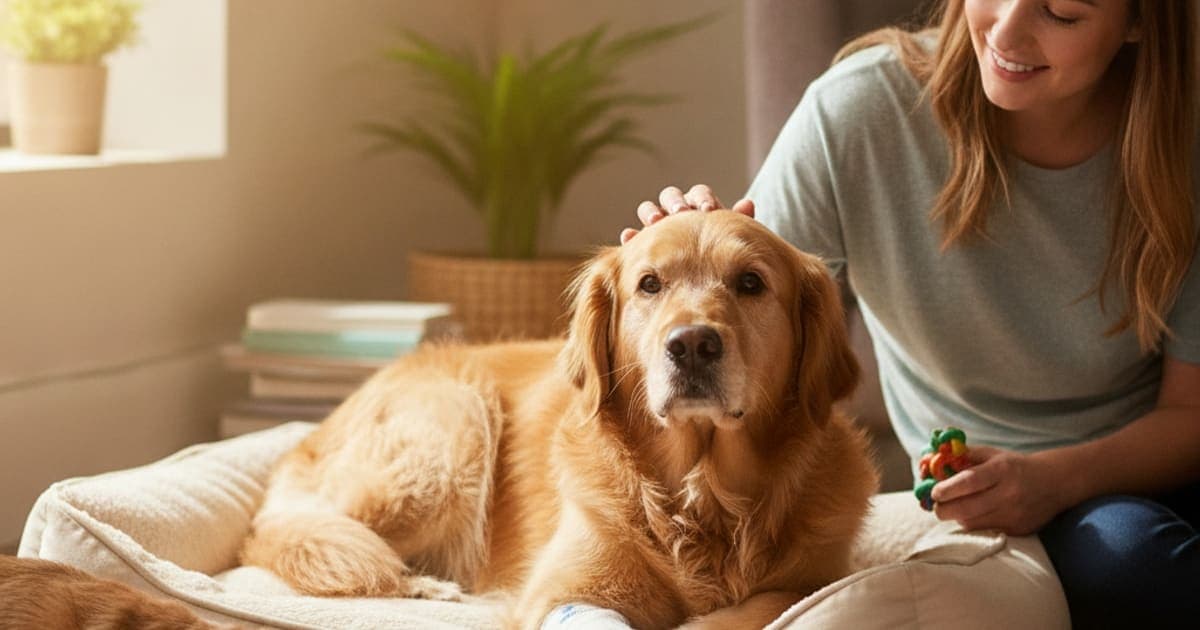
How long does hygroma take in a dog?
Most hygromas fall into one of two timelines. A soft, early hygroma with intact skin often flattens over a few weeks once pressure is genuinely removed from the joint. A chronic one — thickened walls, a firm rim, draining tracts, ulcerated or infected skin — is usually a months-long project, and if surgery is needed, wound healing over a moving elbow adds several more weeks on top of that.
Those ranges are broad on purpose. Recovery time is not set by the swelling itself; it is set by how completely the repeated pressure that caused it stops. Two dogs with identical elbow swellings can be six weeks apart in outcome simply because one owner changed the flooring and the other did not.
A hygroma does not resolve on a schedule — it resolves when the pressure that created it stops, and every week that pressure continues resets the clock.
Why a hygroma is a pressure problem, not an infection
A hygroma is a false bursa: a fluid-filled pocket the body builds where a bony point takes repeated impact against a hard surface. In dogs it appears most often over the outside of the elbow, and less commonly over the hock, hip or other prominence. Large and giant breeds are over-represived — heavy dogs, thin skin over bone, and a habit of dropping onto tile, concrete or thinly padded floors.
The body's response is protective. Repeated trauma inflames the subcutaneous tissue, the tissue responds by forming a fluid-filled cushion, and a fibrous capsule gradually organises around it. That capsule is the reason timelines diverge. In the first stage the pocket is thin-walled and the fluid can be reabsorbed. Once the wall becomes thick and fibrotic, reabsorption slows dramatically, and the visible lump may persist long after the inflammation has settled.
This is also why the phrase "how long to heal" needs unpacking. Owners usually mean three different things: how long until it stops getting bigger, how long until the skin looks normal, and how long until the lump is gone. Those three milestones almost never land on the same week.
A proper diagnosis matters before you start counting. Not every swelling over an elbow is a hygroma — bursitis, abscesses, cysts, and soft-tissue tumours can look similar from across the room. Your veterinarian can distinguish them on physical examination, sometimes with a needle aspirate or imaging, and that distinction changes the entire plan.
Recovery timelines by stage
The table below reflects how veterinarians generally describe hygroma progression. Treat it as a map of trajectories, not a promise for any individual dog.
| Stage | What you see | Usual trajectory once pressure is relieved |
|---|---|---|
| Early / soft | Squishy, fluid-filled, skin intact, no pain response | Often flattens noticeably within a few weeks; may resolve without further intervention |
| Established | Firmer rim, thicker wall, hair loss over the surface | Weeks to a few months; the fluid may settle well before the lump looks normal |
| Chronic / fibrotic | Hard, callused, long-standing, may never fully flatten | Months; the goal shifts from disappearance to comfort, skin integrity and no infection |
| Ulcerated or infected | Open skin, discharge, odour, pain on touch, sometimes fever | Weeks of veterinary wound management first; total course commonly months |
| Post-surgical | Sutures or a drain over the elbow, bandaged | Wound healing measured in weeks, with a real risk of dehiscence that extends it |
The pattern to notice: every step down that table adds time, and every step is driven by how long the pressure went unaddressed. That is the single most controllable variable an owner has.
Several things reliably stretch recovery out. Hard flooring the dog still has access to is the biggest one — a padded bed helps only if the dog actually uses it and does not flop onto tile beside it. Body weight matters, because more mass over the same bony point means more force per drop. Underlying orthopaedic pain matters too: a dog with a sore hip or an unstable stifle collapses onto its elbows rather than lowering itself, and until the pain is addressed the impact keeps repeating. Skin that has already broken down adds infection risk, and infection converts a mechanical problem into a medical one. Repeated needle drainage without changing the surface the dog lies on tends to buy days, not weeks, and each puncture is another chance for bacteria to enter.
Daily management that actually moves the needle
The unglamorous work is the work that changes the timeline.
Change the surface, everywhere. Not one orthopaedic bed — every place the dog chooses to lie. Thick foam, interlocking mats over tile, runners on hard corridors. The test is simple: if your dog can drop onto an unpadded floor anywhere in the house, pressure relief is not in place.
Protect the joint directly. Elbow pads, doughnut-style sleeves and custom padded wraps are widely used, and they can work well provided they fit. A pad that slides, bunches or constricts circulation makes things worse. Ask your veterinarian to check the fit rather than guessing at it.
Address the reason the dog is crashing down. If a dog is dropping instead of lowering, something hurts or something is weak. That is a veterinary conversation, and it is often the difference between a hygroma that settles and one that recurs. Rehab work, traction on slick floors, ramps instead of jumps, and appropriate prescribed pain control all reduce impact loading.
Watch the skin daily. Warmth, redness, discharge, odour, or a dog who suddenly objects to being touched there all mean the situation has changed and needs to be seen promptly. An uncomplicated hygroma is usually not painful; a painful one is telling you something.
Resist the urge to drain it yourself. Home aspiration introduces bacteria into a closed pocket sitting under thin, poorly vascularised skin. It is one of the fastest routes from a cosmetic nuisance to a surgical problem.
When drainage or surgery enters the plan
Conventional veterinary care leads here, and it should. When a hygroma is infected, ulcerated, or large enough to interfere with movement, veterinarians have a graded set of options: aseptic drainage, placement of a Penrose drain or suction drain to let the pocket collapse, debridement of unhealthy tissue, antibiotics guided by culture where infection is present, and — for the most established cases — surgical excision of the bursa, sometimes with a skin flap to close the defect.
Surgery over an elbow is genuinely demanding. The skin there is thin, under tension, and moves with every step, which is why wound breakdown after excision is a known complication rather than a rare surprise. That is the main reason many veterinarians exhaust conservative pressure management first, and the main reason post-surgical recovery is counted in weeks of restricted activity and bandage changes rather than days. Costs vary widely by clinic, region and how much wound management is needed.
None of this is a decision to make from a search results page. Bring the actual lump, the actual skin, and the actual dog to your veterinarian and let them stage it.
Supporting the tissue while it remodels
While pressure relief does the heavy lifting, the body still has to do repair work: quieting inflammation, rebuilding capillaries into a poorly served patch of skin, laying down and then reorganising collagen. That process runs on its own biology, and it is where a growing number of owners look at peptide support.
K9-REPAIR from pawgen combines BPC-157 and TB-500. BPC-157 is a synthetic peptide derived from a sequence found in human gastric juice; published laboratory and animal research suggests it influences angiogenesis and growth-factor signalling involved in soft-tissue repair, including tendon, ligament and skin wound models. TB-500 is a fragment related to thymosin beta-4, a naturally occurring protein studied for its role in actin regulation, cell migration and wound repair. In plain English, the research interest is in how these peptides may support the environment tissue heals in — blood supply, cell movement into the repair site, and the pace at which inflammation resolves.
That is a mechanism story, not an outcome promise. BPC-157 and TB-500 are not FDA-approved veterinary drugs, and nothing in this article should be read as a claim that any product treats, heals or resolves a hygroma. What can be said honestly is that research suggests plausible mechanisms in soft-tissue repair, that owners report using these peptides as part of recovery and mobility support, and that pawgen formulates K9-REPAIR with weight-based guidance, third-party testing with published certificates of analysis, direct-to-door shipping, and a 60-day money-back guarantee. Dosing belongs with your veterinarian — not with an article, and never with a number pulled off a forum. That is doubly true for puppies and for pregnant or nursing dogs.
It is worth pointing the skepticism somewhere useful: at the kitchen-sink joint chew with fourteen ingredients at trace amounts, no certificate of analysis, and a label designed to look impressive. Knowing what is in a product, at what concentration, verified by an outside lab, is the baseline every owner should demand.
Key Takeaways
- Early, soft hygromas with intact skin often flatten within a few weeks once pressure is fully removed; chronic, fibrotic or infected ones are typically a months-long course.
- Surgical cases add weeks of wound healing, and breakdown over the elbow is a recognised complication.
- Total, house-wide padding — not one bed — is the intervention that most changes the timeline.
- A painful, warm, discharging or rapidly changing lump needs veterinary attention promptly.
- Do not aspirate or drain at home; infection risk is real and turns a mechanical problem into a medical one.
- Peptide support such as BPC-157 and TB-500 is discussed at the level of mechanism and owner adoption, not cures — and it sits alongside veterinary care, never in place of it.
Your veterinarian owns the diagnosis and the treatment plan here: confirming that the swelling is a hygroma rather than something else, staging it, managing infection, and deciding whether drainage or surgery is warranted. Peptides and supplements operate in the space that proper veterinary care creates — supporting a body that is already being looked after correctly.
For deeper reading, see the complete guide to hygroma, plus can hygroma in dogs be reversed, can a dogs hygroma heal without surgery, how much does it cost to treat hygroma in dogs, best treatment for chronic pain in dogs, and what to give a dog with chronic pain. Details on K9-REPAIR are on the pawgen site.
Owners exploring peptide support for their dog can review K9-REPAIR — BPC-157 + TB-500 formulated for dogs — at https://pawgen.com/. BPC-157 and TB-500 are not FDA-approved veterinary drugs. Nothing in this article treats, cures or prevents any condition; every decision about your dog's care belongs with your veterinarian.
Frequently asked questions
- Can a dog's hygroma heal without surgery?
- Yes, many can. Early, soft hygromas with intact skin frequently settle with consistent pressure relief alone — thick padding everywhere the dog lies, protective elbow wraps, and addressing whatever makes the dog drop onto the joint. Infected, ulcerated or long-standing fibrotic cases are the ones that more often need veterinary drainage or surgery.
- What are the first signs of hygroma in dogs?
- The earliest sign is a soft, squishy, fluid-filled swelling over a bony point — usually the outside of the elbow — that the dog does not seem to notice. Hair thinning or a callused patch over the same spot often appears alongside it. Pain, heat, redness or discharge indicate a later, complicated stage.
- How is hygroma diagnosed in dogs?
- Usually on physical examination: location over a bony prominence, a fluid-filled feel, and a history of lying on hard surfaces. Your veterinarian may aspirate fluid for cytology or culture, or use imaging, mainly to rule out abscesses, cysts, joint disease and soft-tissue tumours that can look similar from the outside.
- What helps a dog with hygroma?
- Removing pressure is the core of it — thick bedding on every surface the dog uses, mats over tile and concrete, and well-fitted elbow protection. Treating any underlying pain that makes the dog collapse onto the joint helps too. Veterinary care handles infection, drainage and surgery when those become necessary.
- How long does hygroma take to heal in dogs?
- Soft, early hygromas often flatten meaningfully over a few weeks once pressure is genuinely removed. Established or fibrotic ones commonly take months, and some leave a permanent thickened area. Infected or surgically treated cases add weeks of wound management, since skin over a moving elbow heals slowly and can break down.
- Is hygroma in dogs painful?
- An uncomplicated hygroma is usually not painful — dogs typically tolerate handling of it without objection. Pain, warmth, redness, odour or discharge suggest infection, ulceration or another problem entirely, and that warrants a prompt veterinary appointment rather than continued home monitoring.
- Should I drain my dog's hygroma at home?
- No. Home drainage pushes bacteria into a closed fluid pocket beneath thin, poorly vascularised skin and is one of the fastest ways to turn a mechanical problem into an infected surgical one. Drainage, when appropriate, is done aseptically by a veterinarian, often alongside a drain and pressure management.
- Where do BPC-157 and TB-500 fit into canine recovery?
- They are peptides studied in laboratory and animal soft-tissue repair research, with interest centred on angiogenesis, cell migration and inflammation signalling. pawgen's K9-REPAIR combines both, and owners report using it as recovery support. They are not FDA-approved veterinary drugs, and dosing questions belong with your veterinarian.
Educational content. BPC-157 and TB-500 are not FDA-approved veterinary drugs. Talk to your veterinarian before starting anything new, especially if your dog is on prescribed medication.